8
WINE SKUS TRACKED DAILY

Daily SKU Tracking Across Kroger, Total Wine & Whole Foods for Smarter Winery Pricing, Availability, and Retail Performance Intelligence.
This case study presents a real-world enterprise scenario in which a Minnesota-based winery used structured retail data extraction to monitor eight wine SKUs across Kroger, Total Wine, and Whole Foods on a daily basis. The objective was to create a reliable intelligence layer covering retail pricing, product availability, promotions, pack sizes, and assortment changes across major retail channels.
It is designed for:
The winery specifically needed Daily SKU Tracking Across Kroger, Total Wine & Whole Foods to understand how its products appeared across different retail environments and how pricing and availability changed from one day to another.
The project also supported teams seeking to Track wine SKUS across Kroger, Total Wine & Whole Foods through an automated monitoring framework capable of collecting comparable information without depending on repetitive manual retailer checks.
A Minnesota winery managing eight wine SKUs across major retail channels required a scalable approach for monitoring daily retail performance. Its products were listed across Kroger, Total Wine, and Whole Foods, but information about pricing, availability, promotions, and product presentation was fragmented between retailer websites and digital shopping environments.
The winery implemented a structured retail intelligence framework designed to collect and normalize product-level information across the three retailers. The system monitored SKU names, bottle sizes, listed prices, promotional prices, availability signals, retailer locations, product URLs, and collection timestamps.
The initiative introduced Daily wine price monitoring for wineries as a continuous intelligence capability, enabling the business to observe price movements instead of relying on occasional manual checks. It also implemented wine SKU availability Data Scraping across retailers to identify whether individual products were listed, available, temporarily unavailable, or missing from specific retailer environments.
Data was collected daily and transformed into standardized records, allowing analysts to compare the same SKU across multiple retail channels. Historical snapshots were retained so teams could identify price movements, assortment changes, and recurring availability patterns.
The system also supported retailer-level comparisons, promotion monitoring, and exception identification. Instead of manually visiting separate retailer pages, the winery received structured datasets suitable for dashboards, spreadsheets, reporting systems, and downstream analytics.
The Minnesota winery faced increasing difficulty maintaining accurate visibility across eight wine SKUs distributed through multiple retail channels. Each retailer presented product information differently, creating inconsistencies in naming, pricing, availability indicators, pack descriptions, and promotional presentation.
One of the most important challenges was building a reliable Kroger, Total Wine & Whole Foods price comparison process. Manual comparisons required employees to repeatedly open different retailer pages, locate matching products, record prices, and reconcile differences between bottle sizes or promotional offers.
The winery also lacked a consistent system for Daily retail data Extraction for wine brands, making it difficult to maintain historical records of changing retail conditions. Without structured daily snapshots, analysts could see the current price but had limited ability to determine when a change occurred or whether it represented a temporary promotion.
Another challenge involved retailer-specific monitoring. The team required Total Wine Scraper capabilities to capture product-level information consistently while also coordinating comparable data from Kroger and Whole Foods.
By adopting an automated retail intelligence pipeline, the winery replaced repetitive manual retailer checks with a structured process capable of monitoring eight SKUs across Kroger, Total Wine, and Whole Foods every day.
| Dimension | Manual Retail Tracking | Winery Data Scraping System |
|---|---|---|
| Data collection | Employees manually visit retailer websites | Automated daily retailer-level collection |
| SKU monitoring | Individual product checks | Eight SKUs monitored systematically |
| Price tracking | Spreadsheet updates | Daily historical price snapshots |
| Availability | Manually recorded retailer status | Normalized availability fields |
| Promotion tracking | Inconsistent capture | Regular and promotional prices captured |
| SKU matching | Manual product identification | Standardized SKU matching logic |
| Historical visibility | Limited records | Continuous historical dataset |
| Exception detection | Dependent on human review | Automated change identification |
| Reporting | Periodic spreadsheet preparation | Structured dashboards and datasets |
| Operational reach | Limited monitoring frequency | Daily multi-retailer coverage |
The structured pipeline gave the winery a standardized view of its products regardless of how each retailer presented information. Data fields were normalized to support side-by-side analysis and reduce inconsistencies.
The brand in focus is a Minnesota-based winery with a growing retail distribution footprint and a portfolio containing eight monitored wine SKUs. Its products were available through major retail channels, creating opportunities for broader customer reach but also increasing the complexity of tracking retail execution.
As distribution expanded, the winery needed better visibility into how its products were represented across digital retail environments. Pricing could differ between retailers, promotions could temporarily change consumer-facing prices, and availability could vary by location or fulfillment environment.
The winery's management team wanted to move beyond occasional competitive checks and establish a repeatable daily monitoring process. The goal was not simply to collect prices but to understand the complete retail context surrounding each SKU.
This included tracking product titles, bottle sizes, listed prices, promotional pricing, availability, retailer presence, product URLs, and collection dates. The resulting dataset provided a consistent foundation for pricing analysis and retailer performance discussions.
The brand also wanted to preserve historical observations. By storing daily records, analysts could distinguish short-term promotional changes from longer-term pricing movements and identify products experiencing recurring availability issues.
The transformation allowed the winery to move from reactive retail monitoring toward proactive decision support, giving commercial teams greater visibility into the digital shelf and retailer-level execution.
We delivered an end-to-end retail intelligence solution designed around the winery's eight priority SKUs and three major retail channels. The system collected product-level information, standardized retailer fields, validated records, and generated historical snapshots for daily analysis.
The first layer focused on SKU identification. Each wine product was assigned a standardized internal identifier that connected retailer-specific product names and URLs to the winery's master SKU catalog.
The second layer captured price information, including regular price, promotional price where available, bottle size, and displayed unit information. This allowed analysts to compare equivalent products more accurately.
The solution incorporated a Kroger Grocery Delivery Data Scraper capability within the broader retail monitoring architecture to capture product information and availability signals from relevant digital grocery environments.
The architecture also supported Food Delivery App Menu Datasets as a complementary structured-data capability for organizations that need product, menu, pricing, and availability intelligence across food commerce ecosystems.
For broader digital retail intelligence, the system incorporated Food and restaurant data scraping capabilities that could be extended to adjacent food, beverage, restaurant, and grocery datasets.
The data pipeline then performed cleaning and validation. Duplicate records were removed, inconsistent fields were standardized, and timestamps were applied to every observation. Retailer-specific availability descriptions were converted into normalized categories.
A change-detection layer compared the latest records with previous snapshots. When prices changed, products disappeared, availability shifted, or promotional conditions appeared, the system flagged the relevant SKU for review.
The final layer delivered structured outputs suitable for dashboards, CSV files, JSON datasets, spreadsheet reporting, and analytical workflows.
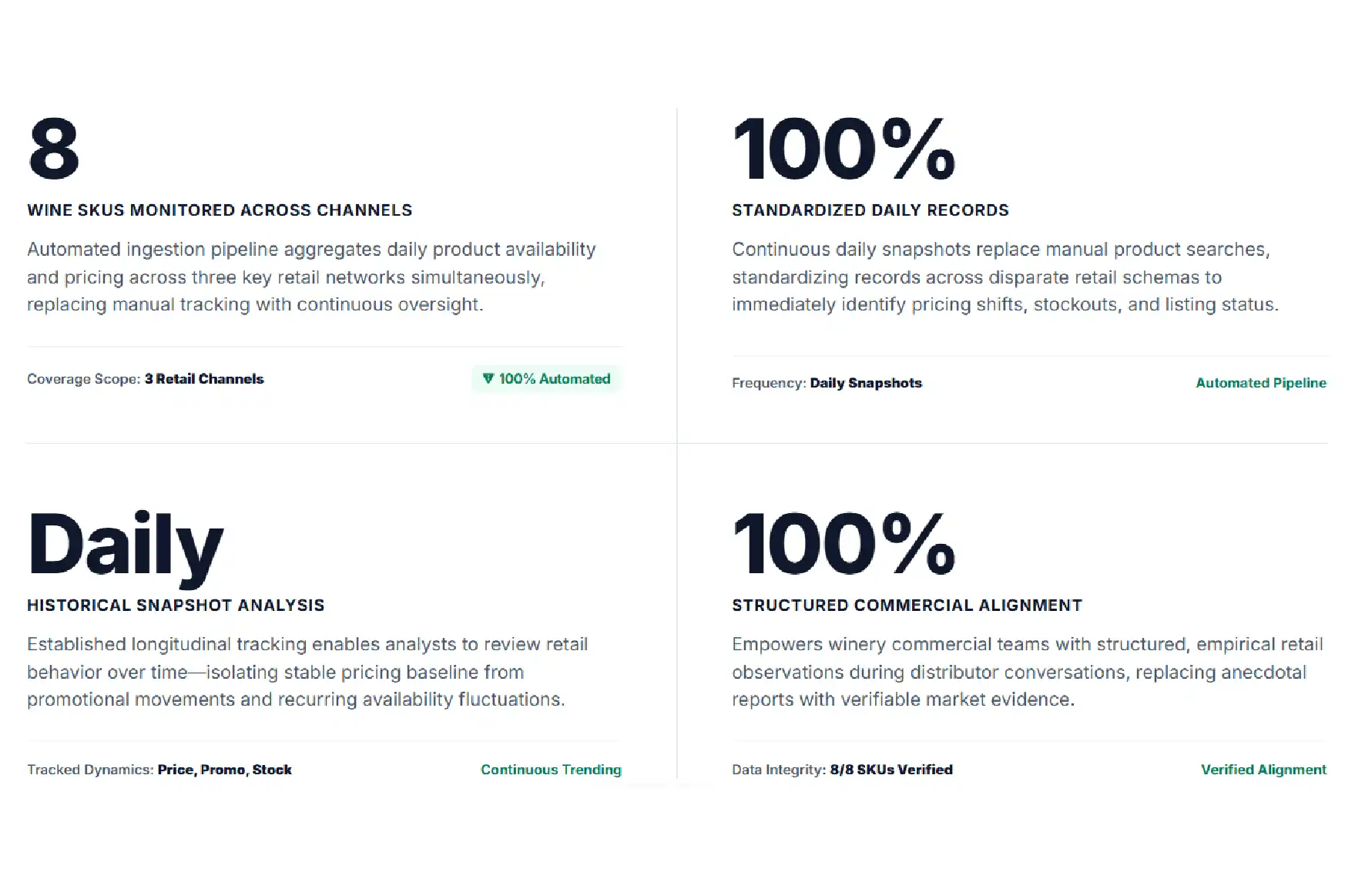
The implementation provided the winery with a consistent daily view of all eight monitored SKUs across the three selected retail channels.
Previously, the team had to manually locate products and record information. The automated system created a standardized record for each SKU, making it easier to understand whether products remained listed, changed price, or experienced availability fluctuations.
Daily snapshots also established a historical record. This allowed analysts to review retail behavior over time rather than depending on isolated observations.
The winery could identify which SKUs maintained stable pricing, which products experienced promotional movements, and which products showed recurring availability changes.
This improved visibility also supported distributor conversations because commercial teams could reference structured retail observations instead of relying solely on anecdotal reports.
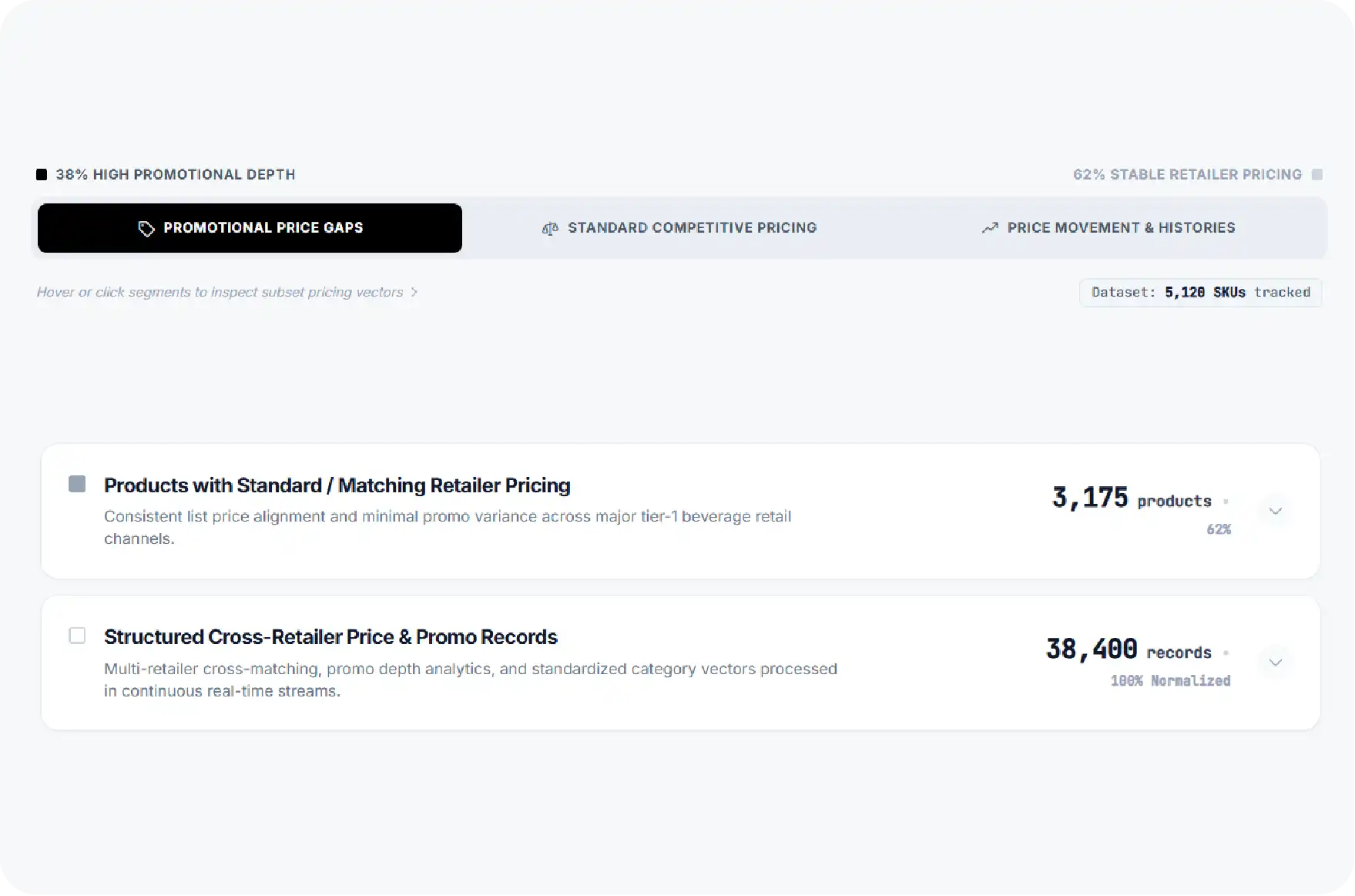
The second major finding involved daily price movement detection. The system compared current prices against historical records and identified changes at SKU and retailer level.
For example, when a product moved from a standard listed price to a promotional price, the system captured both observations and preserved the corresponding date.
This made it possible to separate temporary promotional activity from sustained pricing changes. Analysts could review whether a price difference occurred across one retailer or multiple channels.
The system also reduced the risk of missing small but commercially important price movements. Instead of relying on periodic manual audits, the winery received a continuous stream of comparable records.
Price histories could subsequently support revenue planning, promotional evaluation, distributor discussions, and retailer-level benchmarking.
Availability became another important intelligence dimension. Wine products can experience retailer-specific availability differences caused by inventory, fulfillment coverage, regional assortment decisions, or temporary listing conditions.
The system normalized different retailer signals into structured availability categories. This allowed the winery to distinguish between active listings, unavailable products, limited availability, and missing product records.
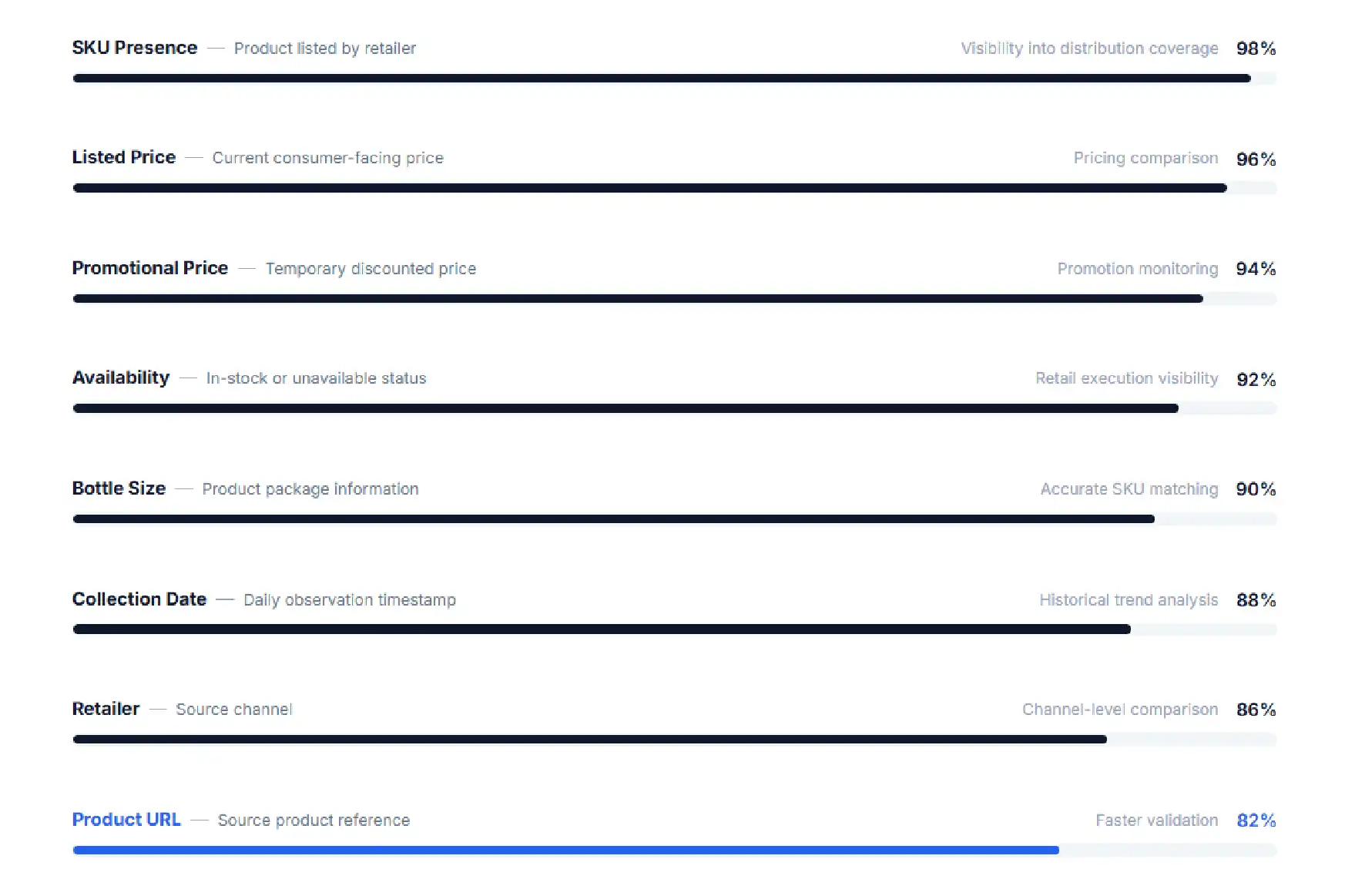
| Metric | Insight Captured | Business Impact |
|---|---|---|
| SKU Presence | Product listed by retailer | Visibility into distribution coverage |
| Listed Price | Current consumer-facing price | Pricing comparison |
| Promotional Price | Temporary discounted price | Promotion monitoring |
| Availability | In-stock or unavailable status | Retail execution visibility |
| Bottle Size | Product package information | Accurate SKU matching |
| Collection Date | Daily observation timestamp | Historical trend analysis |
| Retailer | Source channel | Channel-level comparison |
| Product URL | Source product reference | Faster validation |
This structured approach enabled commercial teams to identify availability gaps faster and determine whether a missing product required further investigation.
A major advantage of the project was the creation of a historical retail dataset. Every daily observation became part of a growing record that could be analyzed by SKU, retailer, date, price, and availability.
This historical layer allowed the winery to identify recurring patterns. A product experiencing temporary unavailability once represented a different situation from a product repeatedly disappearing from a retailer environment.
Similarly, a one-day promotion could be distinguished from a sustained price reduction by reviewing consecutive daily observations.
The historical dataset also created opportunities for forecasting and trend analysis. Analysts could examine price stability, promotional frequency, availability consistency, and retailer-specific behavior.
Instead of treating retail monitoring as a series of disconnected checks, the winery established a continuously expanding intelligence resource.
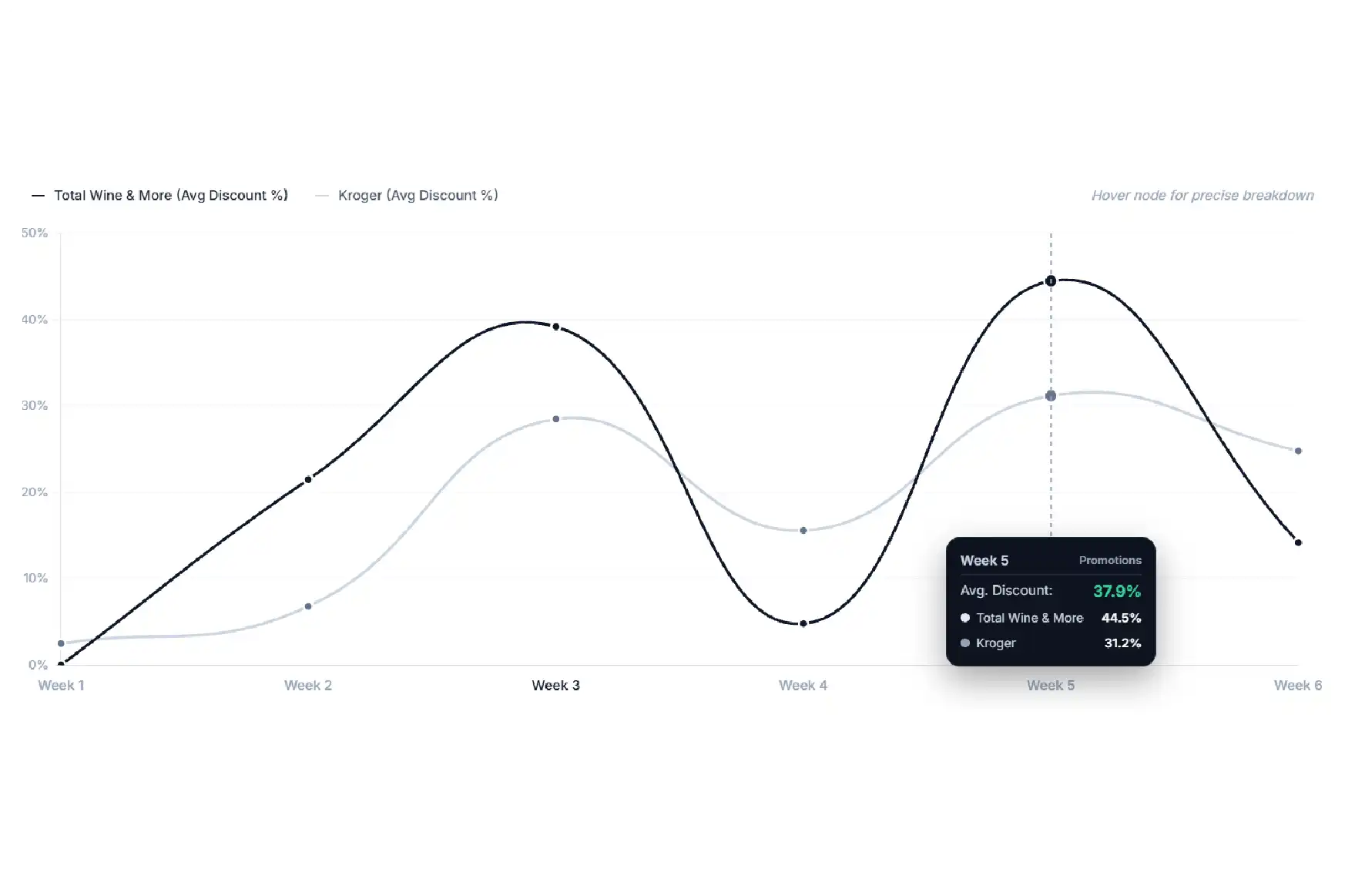
The dataset snapshot below illustrates how the winery's eight monitored SKUs could be organized across Kroger, Total Wine, and Whole Foods. The structured format allows analysts to compare price, availability, promotion, and product information within one unified view.
| SKU | Retailer | Bottle Size | Regular Price | Promo Price | Availability | Collection |
|---|---|---|---|---|---|---|
| North Star Chardonnay | Kroger | 750ml | $18.99 | $16.99 | In Stock | Daily |
| North Star Chardonnay | Total Wine | 750ml | $17.49 | $15.99 | In Stock | Daily |
| North Star Chardonnay | Whole Foods | 750ml | $19.49 | — | In Stock | Daily |
| Lakeview Pinot Noir | Kroger | 750ml | $21.99 | $19.99 | In Stock | Daily |
| Lakeview Pinot Noir | Total Wine | 750ml | $20.49 | — | In Stock | Daily |
| Lakeview Pinot Noir | Whole Foods | 750ml | $22.99 | $20.99 | Limited | Daily |
| Prairie Reserve Rosé | Kroger | 750ml | $16.99 | $14.99 | In Stock | Daily |
| Prairie Reserve Rosé | Total Wine | 750ml | $15.49 | $13.99 | In Stock | Daily |
The dataset can be expanded with additional fields such as product URL, retailer location, promotion type, stock indicator, historical price, percentage price change, and SKU matching confidence.
After implementing structured daily retail intelligence, the winery gained stronger visibility into product pricing, availability, and retailer-level execution across its eight monitored SKUs.
Our approach provides wineries with a structured way to consolidate fragmented retail information into a single intelligence environment. Instead of monitoring individual retailer pages manually, businesses can maintain standardized product records across multiple channels.
The system supports continuous retail monitoring by capturing changing prices, promotional activity, availability, product listings, and other commercial signals. This enables teams to observe market conditions more consistently and identify important changes earlier.
Data quality is another important advantage. Automated validation, deduplication, SKU matching, and normalization reduce inconsistencies that can occur when employees manually collect information from different websites.
The architecture is also scalable. A winery can begin with a small group of priority products and later expand monitoring to additional SKUs, retailers, regions, and product categories.
"We needed a reliable way to understand what was happening with our wine products across multiple retail channels every day. The solution gave our team a much clearer view of pricing, availability, and promotional changes without requiring employees to manually check every retailer.
The structured dataset has made our reporting faster and improved the quality of our retailer discussions. We can now look at historical SKU-level information, identify changes quickly, and make better-informed decisions about pricing, distribution, and promotional activity.
The system has significantly reduced repetitive work while giving our commercial team stronger visibility into digital retail performance."
— Director of Sales & Retail Strategy
The final outcome was a scalable daily retail intelligence system that transformed fragmented retailer information into structured SKU-level insights for the Minnesota winery.
The winery gained centralized visibility into eight wine products across Kroger, Total Wine, and Whole Foods. Instead of depending on occasional manual checks, the organization established a repeatable daily process for collecting prices, availability, promotions, product information, and timestamps.
The solution created a historical record that enabled the business to understand how retail conditions changed over time. Price movements could be reviewed by retailer and SKU, while availability patterns could be examined to identify recurring distribution or inventory concerns.
The structured architecture also established a foundation for expansion. Additional wine SKUs, retailers, geographic markets, and data attributes can be incorporated into the same monitoring framework as the winery's retail footprint grows.
The project ultimately improved operational visibility, reduced manual monitoring requirements, strengthened retailer-level analysis, and created a reliable foundation for data-driven wine retail strategy.
Wineries can monitor SKU names, bottle sizes, prices, promotional prices, availability, product URLs, retailer presence, collection dates, and other product-level attributes. Additional fields can be added according to specific business requirements.
Yes. A structured retail scraping system can monitor multiple retailers within the same workflow. This allows wineries to create comparable datasets and evaluate pricing, availability, assortment, and promotional activity across different channels.
Collection frequency depends on business requirements and source availability. Daily monitoring is useful for wineries that need consistent visibility into price and availability changes, while higher-frequency monitoring can be considered for particularly dynamic retail environments.
Yes. Each collection can be stored with a timestamp, allowing businesses to build historical datasets. These records can be used to identify pricing trends, promotional patterns, recurring availability changes, and retailer-specific behavior over time.
Absolutely. The architecture can be scaled to support additional SKUs, retailers, markets, product categories, and data fields. This allows a winery to begin with priority products and expand its retail intelligence program as its distribution network grows.
Our retail data scraping and intelligence solutions help wineries monitor SKU pricing, availability, promotions, and product visibility across major retail channels. By transforming fragmented retailer information into structured historical datasets, businesses can improve pricing analysis, strengthen distribution oversight, and make faster data-driven retail decisions.
Start a projectFields marked * are required. Everything else just helps us scope faster — skip what you don't know yet.