
38.6K+
RESTAURANT & MENU RECORDS PROCESSED

Keeta Data to Track Restaurant Visibility & Menu Intelligence Across Saudi Food Delivery Markets, Pricing Trends, Menu Changes, and Competitive Insights
This case study presents a real-world enterprise-style scenario involving a Saudi restaurant and food-service brand that wanted to understand how its digital visibility was changing across Keeta. The organization needed structured intelligence covering restaurant listings, menus, prices, availability, ratings, promotions, delivery information, and competitive positioning. Instead of relying on occasional manual checks, the brand implemented a scalable data intelligence framework to continuously monitor restaurant performance across selected Saudi locations.
The case study is particularly relevant for businesses looking to build Keeta Data to Track Restaurant Visibility & Menu Intelligence and transform food-delivery platform information into structured datasets that can support pricing, operations, marketing, and competitive strategy.
It is designed for:
The brand's objective was straightforward: build a reliable intelligence layer that could show what customers were seeing on Keeta, how competing restaurants were positioned, and how menu changes affected digital visibility and commercial performance.
The Saudi brand operated in a highly competitive food-delivery environment where restaurant visibility could change according to location, cuisine, customer demand, availability, promotions, ratings, and menu configuration. Management needed a reliable method to understand how its restaurants appeared to customers and how competing restaurants were performing across the same digital marketplace.
The implementation of a structured data pipeline helped the organization Track restaurant visibility on Keeta across selected Saudi markets. Instead of checking individual restaurant pages manually, the system collected restaurant-level information and converted it into standardized records that could be compared over time.
The solution also established Keeta menu pricing and availability monitoring capabilities, enabling the brand to identify price movements, unavailable dishes, menu additions, removed items, promotional offers, and changes in restaurant operating status.
The intelligence framework captured information such as restaurant name, cuisine, location, rating, review count, delivery estimate, menu categories, item names, prices, discounts, availability, restaurant status, and promotional indicators.
Data was collected at regular intervals, processed through validation and normalization layers, and organized into analytical datasets. This allowed the business to compare its own restaurant visibility with competing establishments operating in similar locations and categories.
The client was a Saudi restaurant brand operating in a competitive food-delivery market. As the number of restaurants and menu options increased, maintaining an accurate view of its digital marketplace presence became increasingly difficult.
One of the biggest challenges was fragmented restaurant information. Restaurant listings, menu categories, prices, offers, ratings, and availability could change frequently. Manual teams struggled to capture these changes consistently across multiple locations.
The organization also needed reliable Restaurant performance tracking with Keeta data because traditional sales reporting did not provide sufficient visibility into how the restaurant appeared alongside competitors on the marketplace.
The team wanted to understand whether changes in menu pricing, restaurant availability, ratings, promotions, or delivery information could influence customer-facing visibility.
Another challenge was the absence of structured Keeta food delivery data scraping for Saudi brands. Data was available through the customer-facing ecosystem, but converting changing marketplace information into standardized records required an automated collection and processing framework.
The business also faced operational difficulties related to Mobile app scraping. Important customer-facing information was presented through mobile experiences, making manual monitoring particularly time-consuming when teams needed to check multiple restaurants, cities, menus, and categories.
The client replaced fragmented marketplace observation with an automated intelligence pipeline designed to collect restaurant and menu information consistently.
| Dimension | Manual Tracking | Structured Keeta Intelligence System |
|---|---|---|
| Restaurant discovery | Periodic manual searches | Automated restaurant-level collection |
| Menu collection | Manually copied menus | Structured menu and item datasets |
| Price monitoring | Occasional checks | Historical price comparison |
| Availability | Checked when required | Continuous availability monitoring |
| Competitor tracking | Limited restaurant sample | Scalable competitor coverage |
| Location comparison | Spreadsheet-based | Location-level analytical datasets |
| Promotions | Manually recorded | Structured promotional indicators |
| Historical analysis | Limited | Snapshot-based trend analysis |
| Reporting | Manual spreadsheets | Automated dashboards and reports |
| Data consistency | Dependent on analysts | Standardized fields and validation |
| Update frequency | Irregular | Scheduled collection cycles |
| Decision speed | Delayed | Faster marketplace intelligence |
This transformation enabled the brand to move from reactive observation to systematic marketplace intelligence.
Instead of asking analysts to repeatedly search restaurant listings, the organization established a repeatable process that could collect, process, compare, and report changes across its selected Saudi markets.
The brand in this case study represents a growing Saudi restaurant organization with multiple locations competing for customer attention across digital food-delivery marketplaces.
Its restaurant portfolio included multiple menu categories, popular individual dishes, combination meals, beverages, and promotional offerings. As digital ordering became increasingly important to customer acquisition, management recognized that restaurant performance could no longer be evaluated solely through internal sales reports.
The customer-facing marketplace environment had become an important source of competitive intelligence.
A restaurant could have strong internal performance while losing visibility against competitors offering lower prices, broader menus, stronger ratings, faster delivery estimates, or more attractive promotions.
The brand therefore wanted to understand the complete digital presentation of restaurants from the customer's perspective.
iWeb Data Intelligence Team developed an end-to-end data collection and analytics framework designed to transform marketplace information into structured business intelligence.
The first stage focused on restaurant discovery. Relevant restaurants were identified according to location, cuisine, restaurant category, brand, and other available marketplace attributes.
The second stage focused on menu-level collection. Restaurant menus were transformed into structured records containing categories, item names, prices, availability, promotional indicators, and related metadata.
The solution generated standardized Food-delivery datasets that could be used for historical comparison, competitor benchmarking, pricing analysis, and restaurant intelligence.
The system also incorporated Online Restaurant Data Extraction capabilities to capture restaurant-level information across selected Saudi markets and convert it into normalized records.
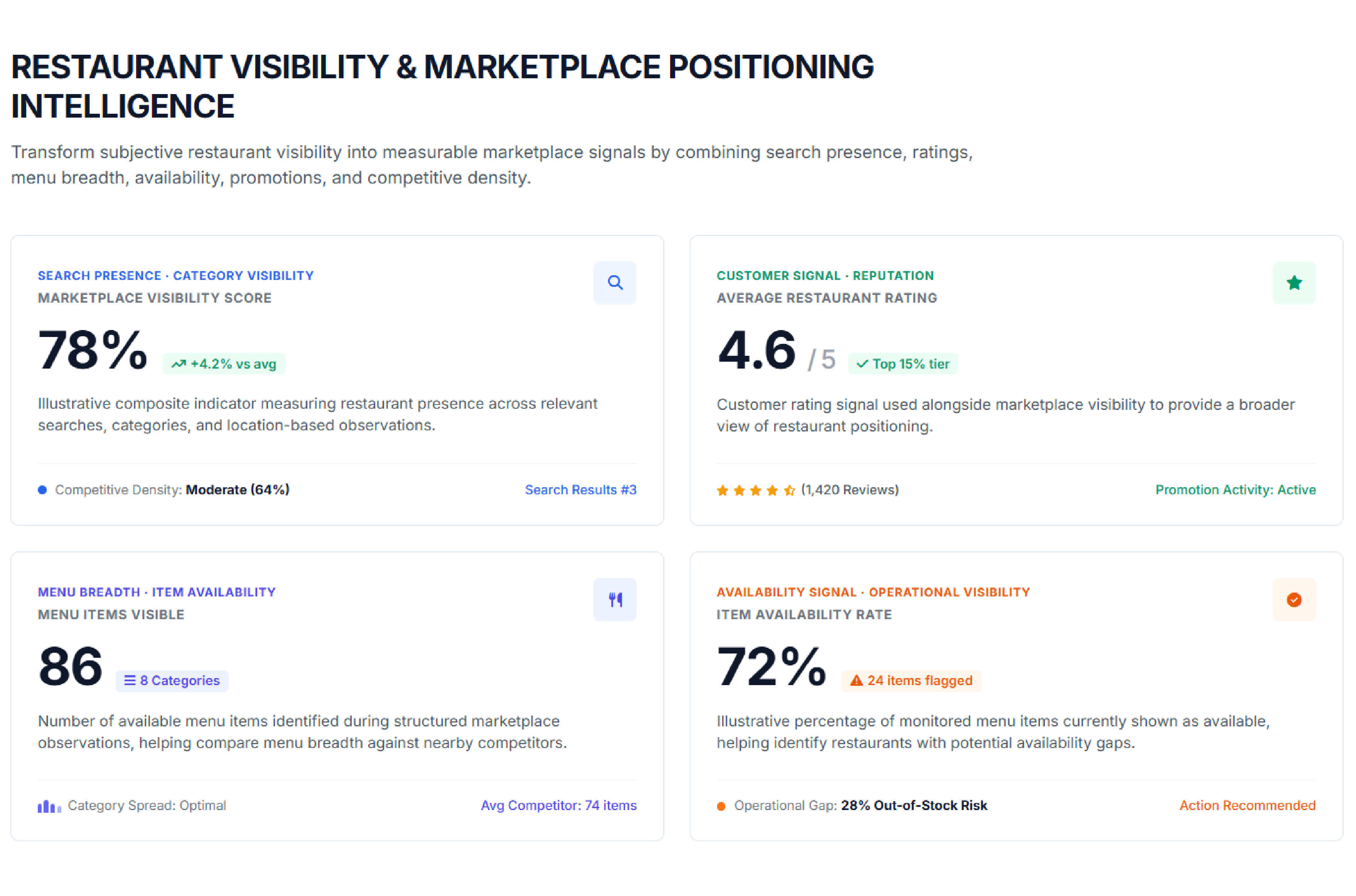
Before implementation, restaurant visibility was largely evaluated through subjective observation.
After structured data collection was introduced, the client could establish measurable indicators for marketplace presence.
The team could compare how frequently restaurants appeared in relevant searches, categories, and location-based observations. These signals were combined with restaurant ratings, menu breadth, availability, promotional activity, and competitive density to create a broader visibility perspective.
This helped the organization identify restaurants that required stronger digital positioning.
For example, one restaurant could maintain a strong rating but have fewer visible menu promotions than nearby competitors. Another could have a broad menu but several unavailable items.
The intelligence framework made these differences easier to identify.
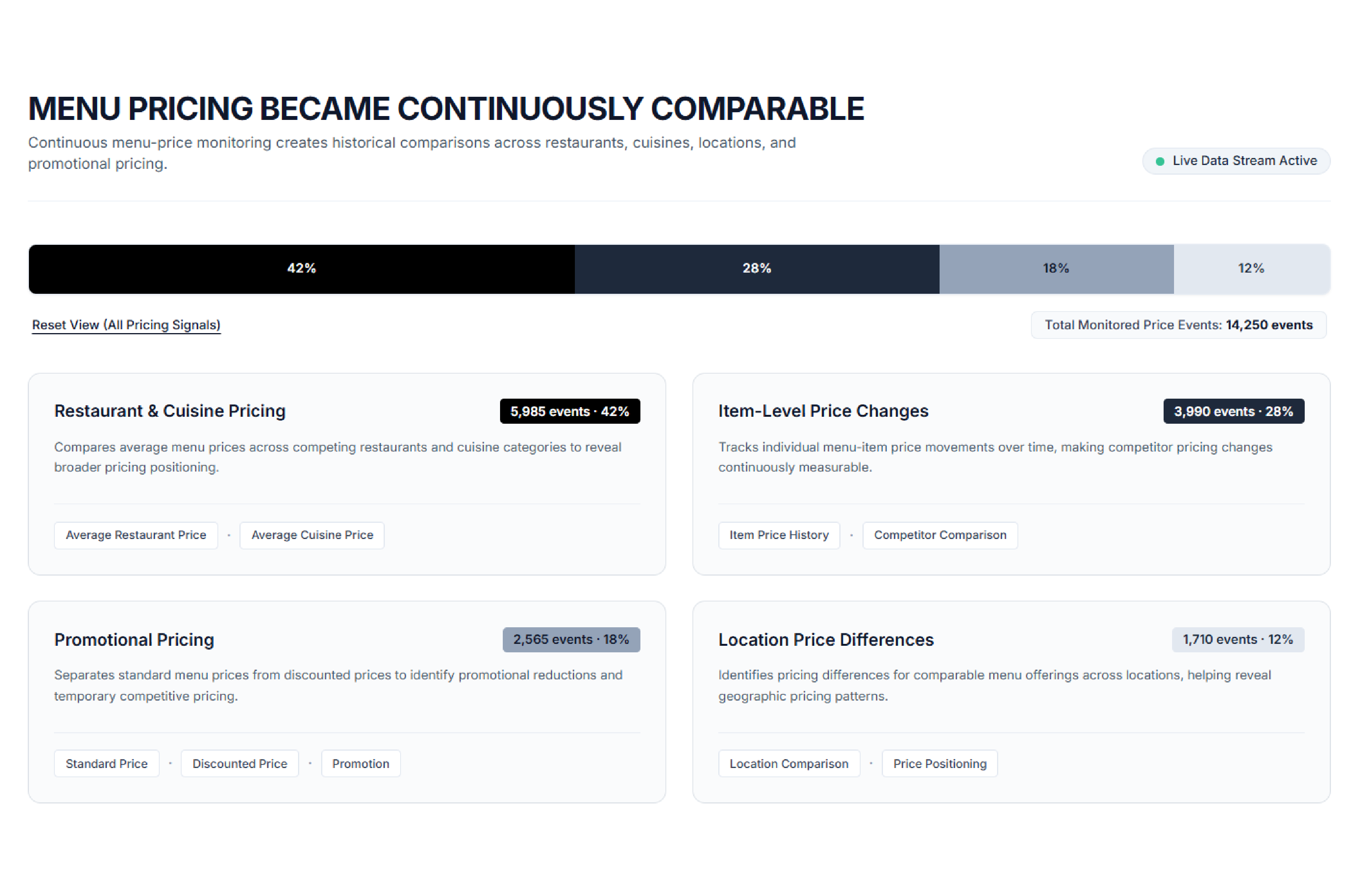
Menu pricing represented one of the most important intelligence areas.
The client previously depended on periodic manual price checks. This provided only a limited snapshot and made it difficult to understand how competitors changed their prices over time.
The structured pipeline created historical menu-price records.
This enabled the team to compare:
The resulting intelligence supported more informed menu planning.
Instead of responding to individual competitor observations, the restaurant team could analyze broader pricing patterns and identify where its offerings were positioned above or below comparable products.
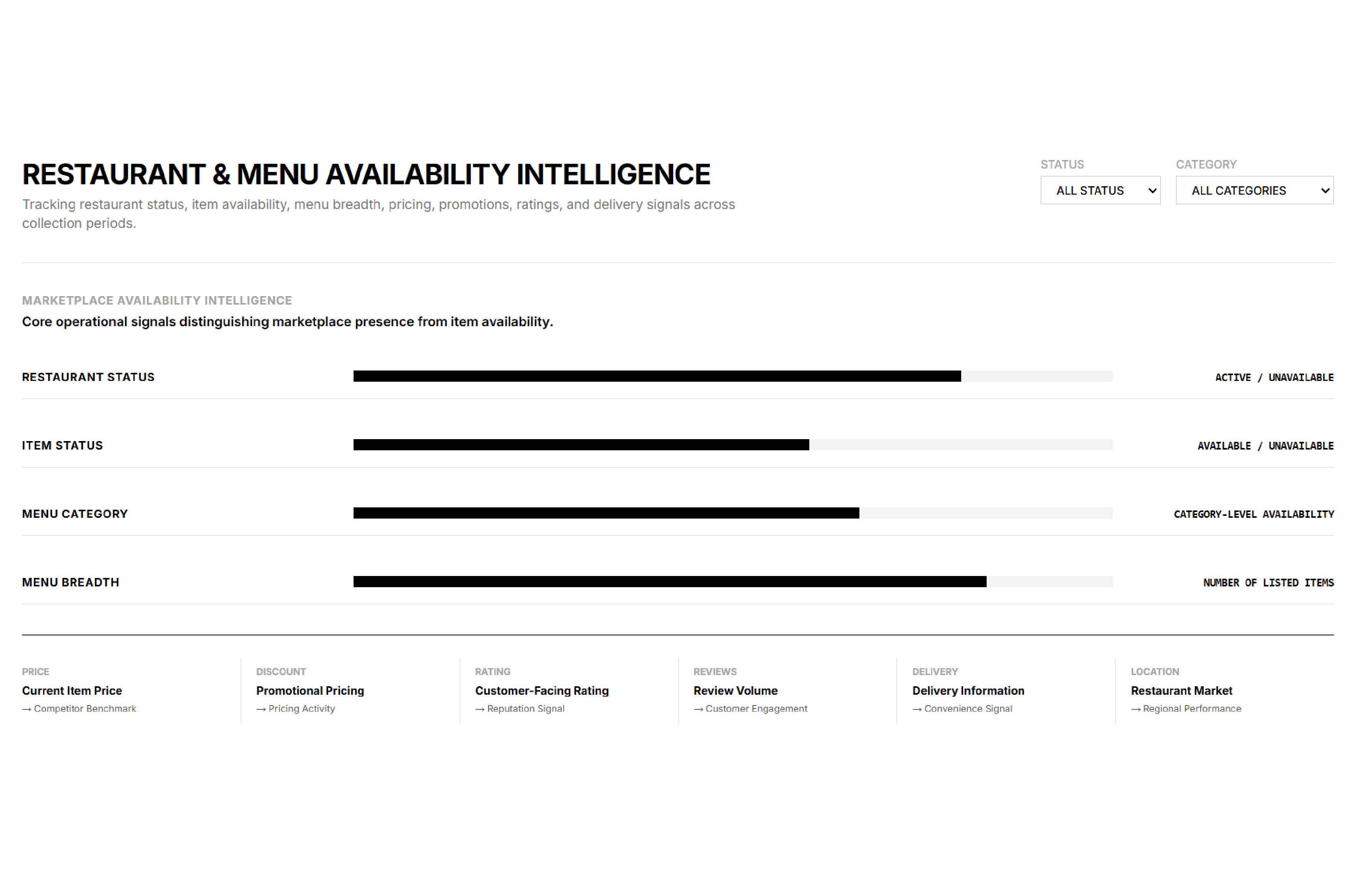
Restaurant availability and menu-item availability were another important area of analysis.
A restaurant may appear active while individual products are unavailable. From a customer perspective, repeated unavailability can reduce the attractiveness of a menu.
The structured dataset allowed the client to track item status across collection periods.
Analysts could identify:
| Intelligence Area | Captured Signal | Business Use |
|---|---|---|
| Restaurant status | Active or unavailable | Monitor marketplace presence |
| Item status | Available or unavailable | Identify menu gaps |
| Menu category | Category-level availability | Detect operational issues |
| Price | Current item price | Benchmark competitors |
| Discount | Promotional pricing | Measure pricing activity |
| Rating | Customer-facing rating | Track reputation |
| Reviews | Review volume | Compare customer engagement |
| Delivery information | Customer-facing delivery signal | Compare convenience |
| Menu breadth | Number of listed items | Benchmark assortment |
| Location | Restaurant market | Compare regional performance |
This helped management distinguish between pricing problems, assortment problems, and operational availability problems.
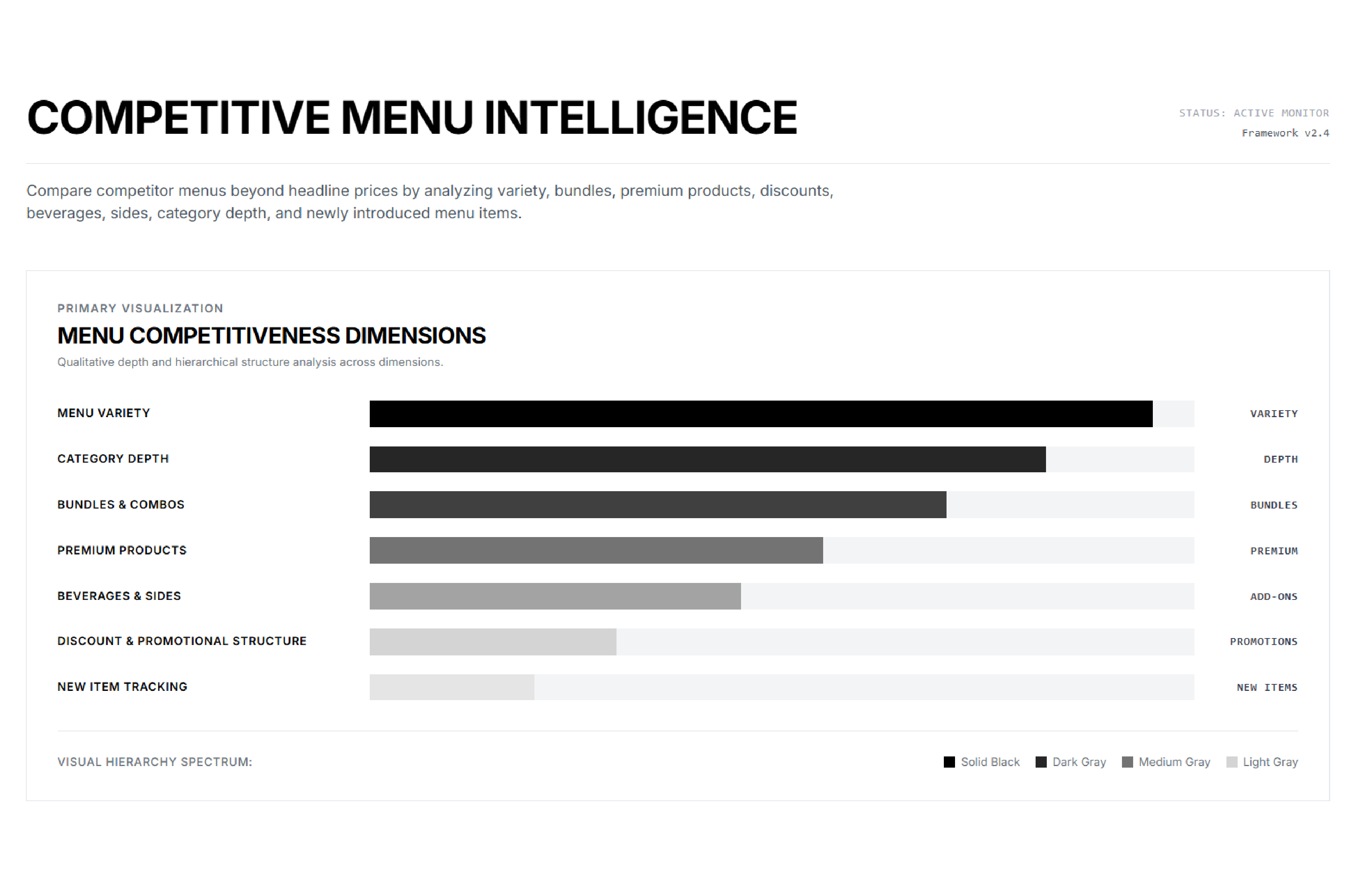
The client discovered that restaurant competition extended beyond headline prices.
Competitors could differentiate through menu variety, bundles, premium products, discounts, beverages, side dishes, and category depth.
The structured dataset enabled the brand to compare menus at a much deeper level.
For example, if three competing restaurants offered similar main dishes, analysts could compare their associated sides, beverages, bundles, portion-related descriptions, and promotional structures.
This supported a more comprehensive understanding of menu competitiveness.
The brand could also identify new menu items introduced by competitors and monitor whether those products remained available over subsequent collection periods.
Such intelligence helped the restaurant team respond more strategically rather than simply matching competitor prices.

Saudi Arabia contains highly diverse restaurant markets, and restaurant performance can vary significantly between locations.
The client therefore analyzed marketplace information at a location level.
The dataset could separate restaurant information by city, neighborhood, delivery area, or other available geographic attributes.
This enabled comparisons such as:
A menu strategy that performed well in one market did not necessarily need to be replicated identically in another.
Location-level intelligence therefore became an important component of the client's restaurant strategy.
The following illustrative dataset demonstrates how structured Keeta restaurant intelligence could be organized for analysis.
| Restaurant | Location | Cuisine | Menu Items | Avg. Price | Rating | Availability | Visibility Signal |
|---|---|---|---|---|---|---|---|
| Urban Grill | Riyadh | Burgers | 48 | SAR 31.50 | 4.5 | 94% | High |
| Spice Route | Jeddah | Indian | 62 | SAR 29.80 | 4.4 | 91% | High |
| Coastal Bites | Dammam | Seafood | 41 | SAR 38.60 | 4.3 | 88% | Medium |
| Daily Shawarma | Riyadh | Arabic | 36 | SAR 21.90 | 4.6 | 96% | High |
| Pasta House | Jeddah | Italian | 53 | SAR 34.20 | 4.2 | 89% | Medium |
| Green Bowl | Dammam | Healthy | 39 | SAR 27.40 | 4.5 | 93% | Medium |
The table illustrates how restaurant-level information can be combined with menu and operational signals to create a broader competitive intelligence framework.
Historical versions of the same dataset could then be compared to identify changes in prices, ratings, availability, and menu breadth.
The implementation of structured restaurant and menu intelligence created several measurable operational improvements for the client.
The success of the project depended on more than collecting restaurant information. The client required a complete framework capable of converting marketplace data into reliable intelligence.
iWeb Data Intelligence's approach focused on structured collection, normalization, validation, historical tracking, and analytical usability.
The solution consolidated restaurant and menu information into consistent datasets, allowing business teams to work from a unified intelligence layer.
Automated validation processes helped identify duplicates, incomplete records, inconsistent naming, and abnormal values.
Historical snapshots provided another major advantage. Rather than replacing old data with new information, the system preserved changes so analysts could examine pricing, availability, and menu evolution.
The architecture was also designed to scale as the client's monitoring requirements expanded.
Additional restaurants, cities, cuisines, menu categories, and competitors could be incorporated without requiring a completely new monitoring framework.
The system therefore supported both operational intelligence and longer-term strategic analysis.
"We needed a clearer understanding of how our restaurants were positioned across the digital food-delivery ecosystem. The solution provided us with structured visibility into menus, pricing, availability, and competitor activity that was previously difficult to monitor consistently. The historical datasets and dashboards have helped our teams identify market changes faster and make better decisions around menu strategy and competitive positioning. The biggest improvement has been moving from manual marketplace checks to a reliable intelligence process that our teams can use continuously."
— Head of Digital Strategy, Saudi Restaurant Brand
The project delivered a scalable restaurant intelligence framework that transformed marketplace information into structured, actionable business data.
The client gained stronger visibility into restaurant listings, menu structures, item pricing, availability, ratings, promotions, and competitive positioning across selected Saudi markets.
The implementation of Food Menu Data Extraction enabled the organization to create structured menu datasets containing item-level information that could be analyzed historically and comparatively.
The resulting intelligence framework supported restaurant benchmarking, pricing analysis, availability monitoring, competitive menu research, and location-level market analysis.
The system also retained historical snapshots, allowing teams to understand how restaurant menus and marketplace conditions changed over time rather than relying on isolated observations.
Implementation of Web Scraping API Services further supported continuous integration of collected information into the client's downstream analytics environment, dashboards, and reporting workflows.
The final system reduced manual monitoring requirements while increasing the speed at which restaurant intelligence could be generated.
Restaurant brands can structure information such as restaurant names, locations, cuisines, ratings, reviews, menu categories, item names, prices, discounts, availability, promotional indicators, and other customer-facing attributes available through the monitored marketplace experience.
Structured data can help businesses compare restaurant presence across locations, categories, competitors, menus, ratings, promotions, and availability. Historical snapshots can also reveal how visibility-related signals change over time.
Yes. A structured collection framework can retain snapshots from different collection periods, allowing analysts to compare item-level pricing and identify increases, reductions, promotional changes, and other menu-price movements.
Unavailable menu items can affect customer choice and restaurant attractiveness. Monitoring availability helps businesses identify recurring gaps and distinguish operational availability problems from broader menu strategy issues.
Yes. A structured restaurant intelligence framework can monitor selected competitors and compare attributes such as menus, prices, ratings, availability, promotions, and location-level presence.
Track restaurant visibility, menu pricing, and competitor movements with powerful Keeta data intelligence built for smarter food-service decisions.
Start a projectFields marked * are required. Everything else just helps us scope faster — skip what you don't know yet.