Introduction
Latin America’s children’s footwear market is evolving as families increasingly purchase school shoes, sneakers, sandals, sports footwear, and everyday footwear through digital marketplaces. Mercado Libre plays an important role in this transformation by connecting local retailers, established footwear brands, independent sellers, and consumers across markets such as Brazil, Mexico, Argentina, Chile, and Colombia. Differences in purchasing power, currency values, import costs, seasonal demand, and promotional strategies create distinct pricing opportunities in each country.
In 2026, Mercado Libre data scraping provides a practical approach to examining product assortment, advertised prices, seller competition, and consumer-facing product information across these markets. By collecting publicly accessible listing details, researchers can identify how children's footwear brands position their products, which categories receive prominent placement, and where price differences create opportunities for retailers and manufacturers.
A structured Mercado Libre data scraping process can also capture product variations, sizes, discounts, shipping charges where displayed, seller ratings, and availability signals. These details help organizations evaluate the competitive landscape rather than relying solely on broad market estimates.
The kids footwear price data LATAM research framework compares product prices in local currencies, differentiates everyday footwear from premium and sports categories, and examines the commercial factors influencing purchase decisions. Because Mercado Libre listings change frequently, reliable analysis requires timestamped collection, currency-specific reporting, consistent product classification, and careful separation of observed marketplace records from estimated market indicators.
This report presents a country-level framework for evaluating children's footwear brands, pricing, and leading sellers in 2026. The numerical tables below are illustrative research datasets designed to demonstrate comparative analysis; they are not verified live Mercado Libre listings, official marketplace sales figures, or audited seller rankings.
1. Regional Market Overview and Consumer Demand
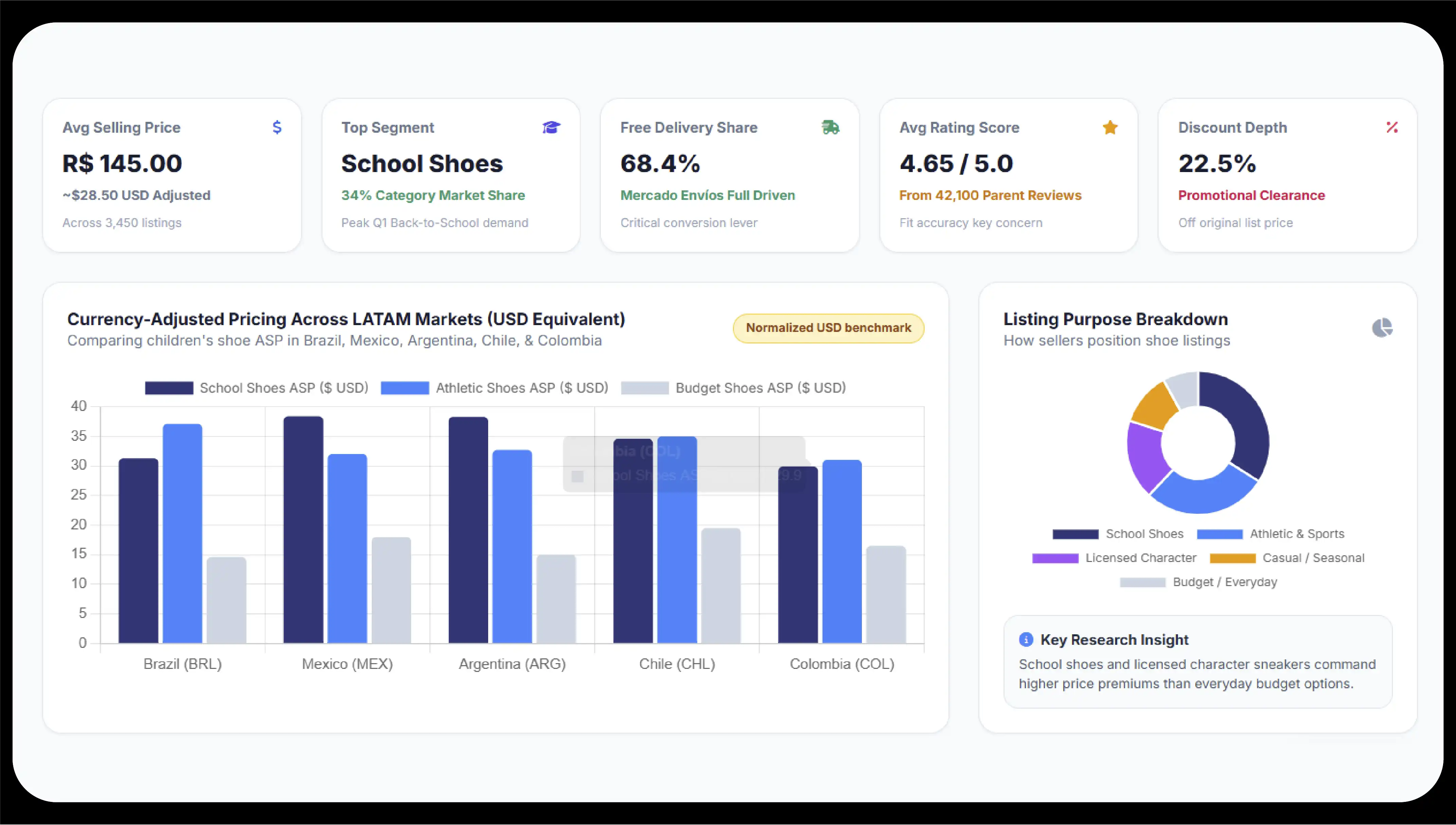
Children's footwear is a diverse e-commerce category because parents purchase products for different purposes, including school attendance, sports, casual outings, holidays, and seasonal weather conditions. Unlike adult footwear, children's shoes require frequent size replacement as children grow, creating recurring purchase opportunities for retailers.
Mercado Libre's marketplace model allows shoppers to compare products from different sellers, making product visibility, delivery expectations, reviews, and discounts important elements of competitive positioning. Marketplace listings can also reveal how sellers distinguish school shoes from fashion sneakers, licensed-character footwear, athletic designs, and lower-priced everyday options.
The main research opportunity is to compare countries using consistent categories while preserving local market differences. Brazil and Mexico offer large domestic consumer markets, while Argentina, Chile, and Colombia provide useful comparisons for currency-adjusted pricing, brand availability, and seller competition.
2. Country-Level Footwear Pricing and Competition
Each country requires its own pricing methodology. A Brazilian listing priced in reais cannot be compared directly with a Mexican listing priced in pesos or a Chilean listing priced in Chilean pesos. Researchers should first compare prices within each country and then convert them using a documented exchange-rate date when a regional comparison is required.
Mercado Libre product scraper workflows can organize listings by country, product type, brand, size, seller, discount, and availability. A consistent classification system makes it easier to distinguish genuine price differences from differences in product construction, size range, shipping, and brand positioning.
Table 1. Illustrative children's footwear price comparison by country, 2026
All prices and listing counts below are hypothetical analytical examples, not live marketplace observations or verified country averages. Prices are expressed in local currency.
| Brazil |
BRL |
129.90 |
119.90 |
59.90 |
179.90 |
12,400 |
| Mexico |
MXN |
649 |
579 |
299 |
899 |
10,800 |
| Argentina |
ARS |
48,900 |
42,500 |
22,900 |
67,900 |
7,600 |
| Chile |
CLP |
24,990 |
21,990 |
12,990 |
34,990 |
5,400 |
| Colombia |
COP |
109,900 |
94,900 |
49,900 |
149,900 |
6,700 |
The figures demonstrate how a country-level pricing dashboard could present comparable categories without incorrectly treating local currency values as equivalent purchasing costs. The illustrative listing counts represent hypothetical research samples rather than total marketplace inventory.
Several analytical insights can be drawn from this framework:
- Category premiums: Sports shoes may command higher prices because of cushioning, specialized soles, recognizable branding, and performance-oriented designs.
- School footwear demand: School shoes deserve separate analysis because uniform requirements and school calendars can influence purchase timing.
- Sandals and casual shoes: Lower-priced categories can attract budget-conscious shoppers, particularly when multiple sizes and colors are available.
- Country-level price dispersion: Median prices should be accompanied by lower quartiles, upper quartiles, and sample sizes to reveal whether a category is concentrated around a typical price or contains a wide premium-to-budget range.
- Promotion effects: Temporary discounts should be recorded separately from regular displayed prices to prevent short-term campaigns from distorting longer-term comparisons.
A robust LATAM ecommerce pricing report should therefore distinguish listed prices, discounted prices, delivery charges, and final displayed costs wherever those fields are available.
3. Brand Positioning Across Latin America
Children's footwear brands compete across several overlapping segments. International athletic brands often emphasize sports performance and recognizable design, while established local manufacturers may compete through school footwear, affordability, durability, and regional availability. Private-label and unbranded products introduce additional competition at the lower end of the price spectrum.
A kids shoes brand analysis Mercado Libre should classify brands by product type instead of ranking every brand in one combined list. For example, a brand with a strong school-shoe assortment may be competitive in a category where athletic brands have limited representation.
Researchers should investigate:
- Brand assortment: Count distinct products and models, rather than treating every size or color variation as a separate model.
- Price positioning: Compare each brand's median price with the country and category median.
- Size availability: : Identify the breadth of children's sizes offered and whether popular sizes appear unavailable.
- Promotional intensity: : Measure how frequently discounted listings appear and how large their displayed discounts are.
- Seller concentration: : Determine whether a brand is distributed among many independent merchants or concentrated among a smaller group of sellers.
Brand analysis should also distinguish officially branded products from listings with incomplete brand information. Where authenticity cannot be established from available evidence, the listing should not automatically be classified as an authorized product.
4. Top Sellers and Marketplace Competition by Country
Identifying top sellers requires more than counting how many products each merchant lists. A seller with hundreds of listings may have limited customer engagement, while a smaller retailer may specialize in a popular category and maintain strong customer ratings.
Mercado Libre top sellers data can support a structured evaluation of merchant visibility, assortment breadth, advertised pricing, ratings, review counts, and product availability. However, listing counts and ratings are indicators of marketplace presence, not proof of actual sales volume.
For meaningful comparisons, researchers should separate three dimensions of seller performance:
- Assortment leadership: Merchants offering a broad selection of brands, sizes, and footwear categories.
- Price competitiveness: Sellers consistently offering competitive prices for comparable products.
- Customer-facing performance: Merchants with strong visible ratings, substantial review histories, and clear delivery information.
A workflow designed to scrape Mercado Libre listings should preserve the seller identifier and listing identifier wherever publicly available. This helps distinguish multiple listings from unique products and prevents duplicate size or color variations from artificially inflating a merchant's assortment.
Table 2. Illustrative seller-level competitive intelligence by country, 2026
The seller labels and numerical values are hypothetical examples for demonstrating seller benchmarking. They do not identify actual Mercado Libre merchants or establish real seller rankings.
| Brazil |
Seller BR-01 |
420 |
185 |
BRL 119.90 |
12% |
4.8 |
2,450 |
| Brazil |
Seller BR-02 |
310 |
142 |
BRL 139.90 |
8% |
4.7 |
1,820 |
| Brazil |
Seller BR-03 |
265 |
118 |
BRL 99.90 |
15% |
4.6 |
1,340 |
| Mexico |
Seller MX-01 |
380 |
170 |
MXN 599 |
10% |
4.8 |
2,100 |
| Mexico |
Seller MX-02 |
290 |
132 |
MXN 699 |
14% |
4.7 |
1,760 |
| Mexico |
Seller MX-03 |
235 |
104 |
MXN 499 |
7% |
4.6 |
1,120 |
| Argentina |
Seller AR-01 |
275 |
120 |
ARS 45,900 |
11% |
4.7 |
1,580 |
| Argentina |
Seller AR-02 |
220 |
96 |
ARS 52,500 |
9% |
4.8 |
1,240 |
| Argentina |
Seller AR-03 |
180 |
78 |
ARS 39,900 |
13% |
4.6 |
940 |
| Chile |
Seller CL-01 |
240 |
105 |
CLP 23,990 |
10% |
4.8 |
1,430 |
| Chile |
Seller CL-02 |
195 |
86 |
CLP 27,990 |
12% |
4.7 |
1,080 |
| Chile |
Seller CL-03 |
160 |
71 |
CLP 19,990 |
8% |
4.6 |
760 |
| Colombia |
Seller CO-01 |
260 |
115 |
COP 99,900 |
14% |
4.8 |
1,620 |
| Colombia |
Seller CO-02 |
210 |
92 |
COP 119,900 |
9% |
4.7 |
1,170 |
| Colombia |
Seller CO-03 |
175 |
76 |
COP 89,900 |
11% |
4.6 |
830 |
Note: The ratings, review counts, discounts, and seller statistics are illustrative and should not be interpreted as verified marketplace metrics.
The sample demonstrates several useful benchmarking approaches. Sellers with larger assortments may serve multiple consumer segments, whereas smaller assortments can focus on specific price bands or footwear categories. Lower median prices may improve price competitiveness, but the comparison is meaningful only when products have similar materials, styles, sizes, and brand positioning.
Seller ratings should also be interpreted carefully. A rating of 4.8 with 2,100 visible reviews provides a different level of supporting evidence from a rating of 4.8 with only a small number of reviews. Even so, neither figure independently establishes current sales volume.
5. Product Categories and Consumer Purchasing Patterns
Children's footwear listings can be grouped into five principal categories to support more detailed market comparisons.
- Casual sneakers: : These serve everyday use and may include canvas shoes, lightweight trainers, slip-ons, and fashion-oriented designs. Key attributes include upper material, sole construction, closure type, and available colors.
- School shoes: These products prioritize practical design, durability, comfort, and compliance with school dress expectations. Their demand can be seasonal, making historical observations valuable for understanding back-to-school price movements.
- Sports footwear: : Running shoes, training shoes, and sport-specific designs can occupy higher price bands. Brand reputation, cushioning, grip, and material specifications help explain price differences.
- Sandals and summer footwear: : These products may experience seasonal variation and compete strongly on affordability, comfort, and ease of use.
- Character and fashion footwear: : Bright colors, themed designs, and licensed characters may appeal to children seeking specific styles. Researchers should verify licensing claims where possible rather than assuming every character-themed listing is officially licensed.
For each category, Latin America footwear market data should capture product title, brand, category, price, size range, seller, discount, shipping information, rating, review count, and observation timestamp. This structured approach allows analysts to compare similar products and track changes over time.
6. Research Methodology for Mercado Libre Data Collection
A dependable 2026 study requires a repeatable process rather than a single snapshot of search results.
Step 1: Define country coverage
Create separate research scopes for Brazil, Mexico, Argentina, Chile, and Colombia. Record the marketplace domain, collection date, local currency, and search terms used for each market.
Step 2: Standardize product categories
Normalize spelling differences, brand names, product types, sizes, and materials. Deduplicate listings and distinguish unique product models from variations.
Step 3: Capture prices and promotions
Store the regular displayed price, current promotional price, displayed discount, and shipping cost when available. Preserve the original currency and avoid assuming that a discount is calculated against a verified historical price.
Step 4: Evaluate seller visibility
Record observable seller details, ratings, review counts, listing counts, and availability indicators. Rank sellers using a documented methodology, and label estimates separately from observed data.
Step 5: Track historical changes
Repeat collections at consistent intervals to monitor price changes, product additions, stock signals, and promotional activity. Daily collection may suit highly dynamic categories, while weekly snapshots may be adequate for broader assortment studies.
Step 6: Validate data quality
Review duplicate records, currency formats, implausible prices, incomplete product attributes, and inconsistent category assignments. Follow marketplace terms, use authorized access methods, and respect privacy and technical restrictions.
7. Business Applications and Strategic Opportunities
The resulting dataset can support several commercial decisions.
- Retail pricing: : Identify comparable products priced below or above the category median.
- Brand expansion: : Discover countries where particular footwear categories have limited observed assortment.
- Inventory planning: : Monitor size availability and seasonal changes to help inform replenishment decisions.
- Competitive benchmarking: : Compare merchant assortment, pricing, discounts, and visible customer feedback.
- Promotional strategy: Examine the relationship between advertised discounts and changes in listing visibility or availability, without assuming causation.
- Regional planning: : Compare country-specific price distributions after accounting for currency, taxes, product differences, and delivery costs.
These applications make marketplace intelligence useful for manufacturers, distributors, retailers, and e-commerce teams. Nevertheless, listing data alone cannot reveal total category revenue, verified units sold, market share, or consumer demand across all sales channels. Those questions require additional evidence, such as transaction data, representative market research, or other reliable industry sources.
Conclusion
The 2026 children's footwear landscape on Mercado Libre offers a valuable framework for examining brand positioning, country-level pricing, seller competition, and product assortment across Latin America. Brazil, Mexico, Argentina, Chile, and Colombia should be analyzed separately before their results are combined into a regional comparison.
A reliable Latin America footwear market data strategy should prioritize comparable product classifications, transparent price calculations, deduplicated listings, and timestamped records. These practices help businesses distinguish genuine competitive differences from currency effects, product variations, and temporary promotions.
With consistent collection and validation, kids footwear price data LATAM can help retailers identify pricing opportunities, monitor assortment gaps, and benchmark sellers across individual countries. Integrating these findings into a broader LATAM ecommerce pricing report enables more informed decisions about product positioning, promotional planning, and regional expansion—while keeping illustrative estimates separate from verified marketplace evidence.
Experience top-notch web scraping service and mobile app scraping solutions with iWeb Data Scraping. Our skilled team excels in extracting various data sets, including retail store locations and beyond. Connect with us today to learn how our customized services can address your unique project needs, delivering the highest efficiency and dependability for all your data requirements.