What Are Digital Shelf Services - Category-Level Market Share Tracking and Why Do They Matter?
Introduction
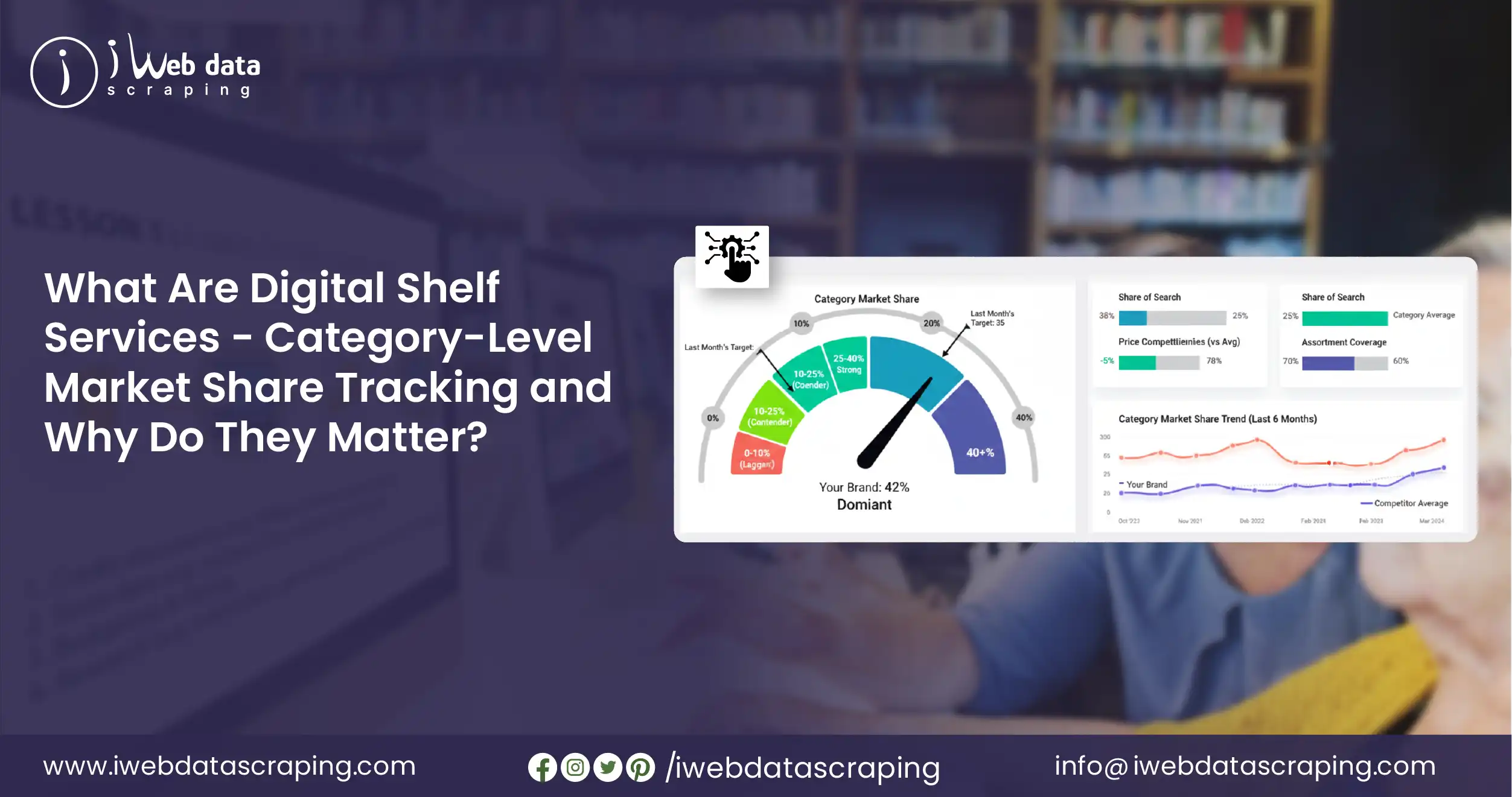
The ecommerce ecosystem has become a hyper-competitive battlefield where visibility, pricing, availability, and category dominance define brand success. In this rapidly evolving digital environment, Digital Shelf Services - Category-Level Market Share Tracking has emerged as a critical capability for brands and retailers aiming to outperform competitors. Businesses are no longer satisfied with overall sales insights—they demand granular intelligence across categories, subcategories, and product clusters.
Modern retail leaders increasingly rely on Digital Shelf Market Share Analytics to evaluate how their products perform within specific categories across multiple marketplaces. Whether a brand sells personal care, grocery, electronics, or pharmaceuticals, understanding where it stands within a category is fundamental to strategic planning.
To gain these insights, companies must Extract Category-Level Market Share Data from ecommerce platforms in real time. This data includes product rankings, share of search, review volume, price positioning, assortment coverage, and promotional penetration—metrics that directly influence category performance.
Why Category-Level Market Share Tracking Matters?
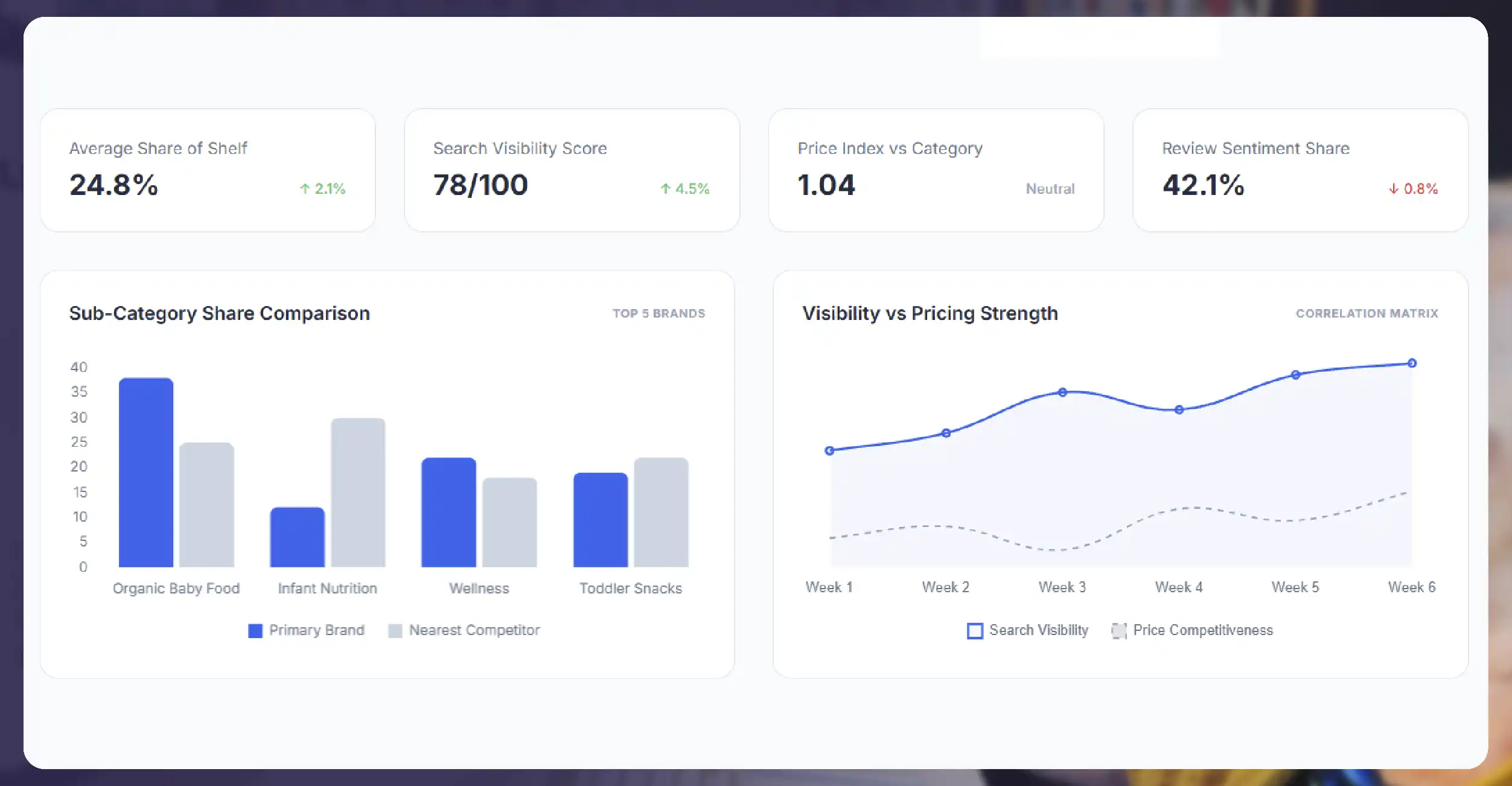
Tracking market share at the overall brand level provides limited perspective. Category-level analysis, however, reveals deeper competitive patterns. For instance:
- A brand may dominate the “Organic Baby Food” segment but struggle in the broader “Infant Nutrition” category.
- A private-label competitor may outperform national brands in a specific subcategory due to aggressive pricing.
- Seasonal trends may shift share across brands within niche segments.
When companies Track Market Share at Category Level on Ecommerce, they gain clarity on:
- Share of shelf within digital categories
- Share of search visibility
- Share of reviews and ratings
- Share of pricing competitiveness
- Promotional share across category campaigns
These insights help brands adjust assortment strategy, optimize pricing, and enhance digital visibility.
The Mechanics Behind Category-Level Tracking
To accurately Scrape Category-Level Market Share Data, advanced data collection frameworks are required. Ecommerce platforms continuously update product listings, pricing, stock availability, sponsored placements, and category rankings. Static data snapshots are insufficient.
A robust tracking system captures:
- Category page product listings
- Sponsored vs organic product placements
- Product rank changes over time
- Brand representation within category filters
- SKU distribution across sellers
- Review velocity trends
By collecting this data daily or hourly, brands can calculate precise share metrics within each category.
Moving Beyond Sales: The Rise of Digital Shelf Intelligence
Traditional retail measurement focused heavily on sell-through data from physical stores. In contrast, digital shelf tracking provides real-time competitive insights without waiting for POS data cycles.
With ecommerce, performance signals are visible instantly:
- Which brands dominate page one?
- Which products appear in sponsored placements?
- Which SKUs frequently go out of stock?
- Which competitors aggressively discount within categories?
This shift has fueled demand for Category-Level Competitive Intelligence for Retail. Instead of reacting to quarterly reports, brands can proactively optimize digital shelf presence.
Key Metrics in Category-Level Market Share Analytics
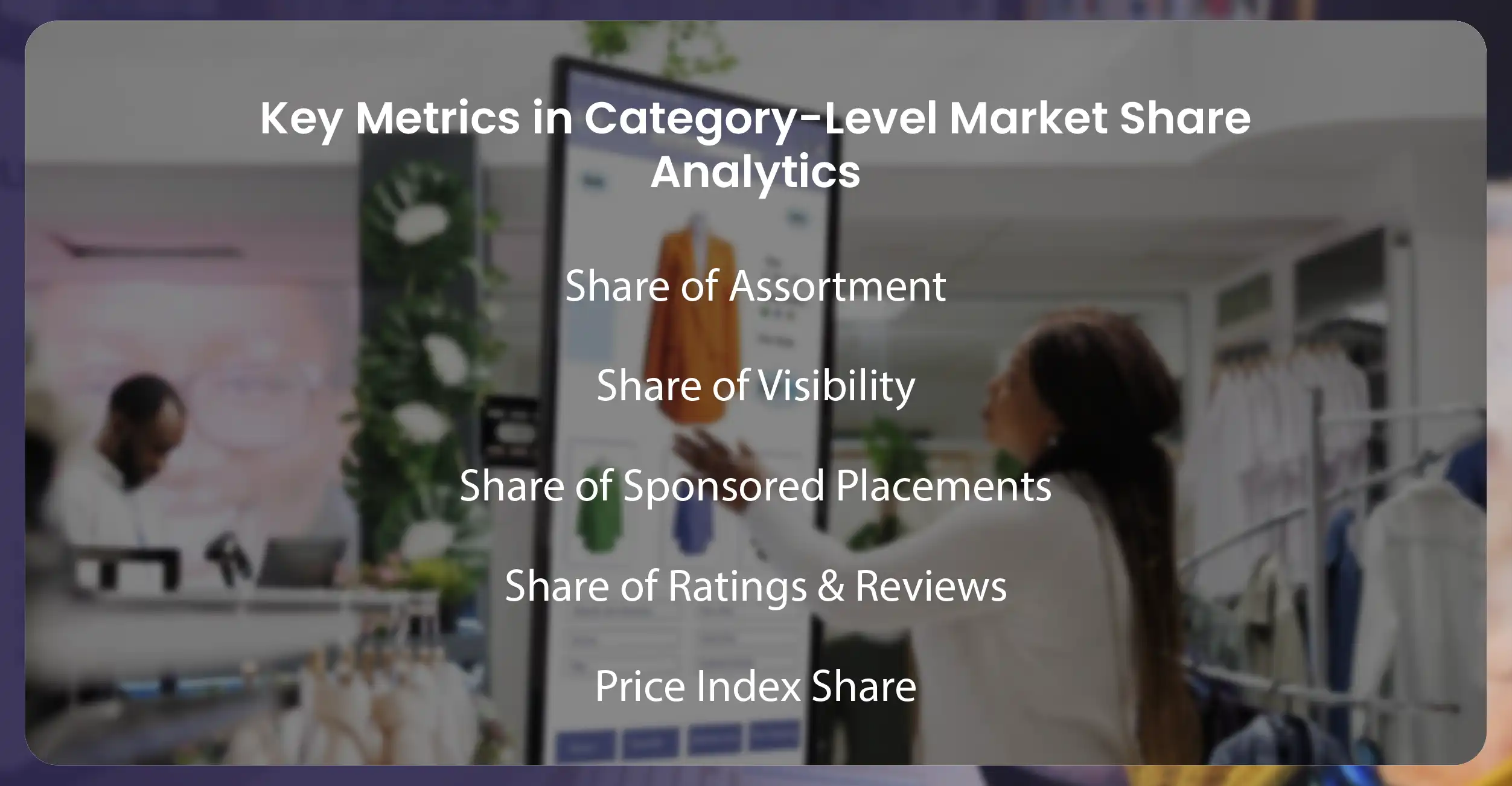
Category-level tracking is more than counting SKUs. Advanced analytics evaluate:
1. Share of Assortment
The percentage of SKUs a brand holds within a category compared to competitors.
2. Share of Visibility
Measures how often a brand appears in top search results and category rankings.
3. Share of Sponsored Placements
Tracks paid promotions and how aggressively competitors advertise within a category.
4. Share of Ratings & Reviews
Indicates consumer trust and engagement.
5. Price Index Share
Compares pricing competitiveness across similar SKUs.
By combining these data layers, brands build comprehensive Digital Shelf Analytics Solutions that go beyond simple reporting.
Benefits of Category-Level Market Share Tracking
Strategic Category Planning
Brands can identify high-growth categories and shift investments accordingly.
Assortment Optimization
Tracking reveals SKU gaps compared to competitors within specific segments.
Promotional Effectiveness
Brands understand whether discounts genuinely improve category share.
Competitive Monitoring
Real-time alerts highlight when competitors launch new SKUs or price aggressively.
Regional & Platform Insights
Category dominance may vary across Amazon, Flipkart, Walmart, or niche marketplaces. Tracking ensures platform-specific optimization.
How Ecommerce Platforms Shape Category Share?
Ecommerce algorithms heavily influence category visibility. Ranking factors often include:
- Sales velocity
- Customer reviews
- Conversion rate
- Keyword optimization
- Fulfillment speed
- Sponsored bidding strategy
Therefore, category-level tracking must incorporate both organic and sponsored insights. When brands consistently monitor these elements, they better understand why share shifts occur.
Real-World Application: Multi-Brand Category Monitoring
Consider a multinational FMCG company managing multiple brands within “Healthy Snacks.” Category-level tracking allows the company to:
- Compare internal brand cannibalization
- Identify white-space subcategories
- Monitor private-label expansion
- Benchmark price positioning
- Measure share impact during promotional events
Such granular intelligence helps allocate marketing budgets more efficiently and avoid internal competition pitfalls.
Challenges in Category-Level Data Collection
Despite its importance, category-level tracking presents technical challenges:
- Ecommerce websites frequently change layouts.
- Sponsored placements are dynamic.
- Pagination affects product coverage.
- Filters and sorting mechanisms alter rankings.
- Regional variations complicate normalization.
To overcome these issues, companies deploy scalable data extraction pipelines capable of handling dynamic content, API integrations, and automated scheduling.
Integrating Market Share Tracking with Business Intelligence
Data alone does not create value—insights do. Once brands collect category-level metrics, they integrate them with:
- Sales dashboards
- Inventory planning systems
- Marketing performance tools
- Price monitoring engines
- Forecasting models
When category share trends align with revenue data, brands can pinpoint root causes behind growth or decline.
For example:
- A decline in category visibility may explain reduced sales.
- Increased competitor discounting may shrink price competitiveness share.
- Stock-outs may reduce share of assortment.
By connecting digital shelf tracking with internal KPIs, organizations transform raw data into strategic advantage.
Unlock real-time category insights and outperform competitors—partner with us today for smarter digital shelf intelligence.
The Future of Category-Level Market Share Tracking
As ecommerce expands globally, category competition will intensify. Artificial intelligence and machine learning models are increasingly used to:
- Predict share fluctuations
- Detect competitive threats early
- Identify emerging subcategories
- Forecast promotional impact
- Automate pricing recommendations
Real-time intelligence is no longer optional—it is foundational for digital growth.
The future will also see deeper segmentation, such as:
- Brand vs private-label share
- Premium vs budget share within categories
- Regional category share differences
- Seasonal micro-category trends
Brands that adopt advanced digital shelf monitoring today will lead tomorrow’s ecommerce markets.
Why Businesses Need Professional Data Partners?
Building in-house scraping infrastructure requires technical expertise, compliance awareness, and scalable architecture. Many brands therefore partner with specialized data providers that offer:
- Automated category tracking
- Cross-platform monitoring
- Real-time dashboards
- Historical trend analysis
- Custom reporting frameworks
Professional Web Scraping API Services enable seamless data extraction across marketplaces with minimal manual intervention. These APIs support structured data delivery, ensuring faster integration with analytics systems.
In addition, advanced Web Scraping Services help brands capture dynamic category listings, sponsored placements, and ranking changes without disruption.
To complement share tracking, companies often integrate Price Intelligence Services to monitor competitor pricing behavior within categories, ensuring optimal price positioning and margin protection.
How iWeb Data Scraping Can Help You?
1. Deeper Category-Level Visibility
Our data scraping services uncover granular insights within specific categories and subcategories. Instead of relying on broad performance reports, you gain detailed intelligence on brand share, SKU presence, and competitive density inside each product segment.
2. Faster Strategic Decision-Making
We deliver structured, ready-to-use datasets that reduce manual research time. With faster access to competitive data, your teams can quickly adjust pricing, promotions, and assortment strategies to protect and grow category share.
3. Identification of Growth Opportunities
By analyzing gaps in competitor assortments and emerging subcategories, our services help you identify untapped opportunities. This enables smarter product launches and improved positioning within high-potential segments.
4. Enhanced Promotional Optimization
Our scraping solutions track discount patterns, sponsored placements, and campaign visibility within categories. This allows you to evaluate promotional effectiveness and optimize advertising budgets for stronger ROI.
5. Long-Term Competitive Intelligence
We build continuous monitoring systems that provide historical trend analysis. This helps you detect patterns in market share shifts, competitor expansion, and pricing movements, supporting sustainable ecommerce growth strategies.
Conclusion
Digital commerce has fundamentally reshaped how market share is measured and managed. Overall sales figures are no longer enough—brands must understand their standing within each category and subcategory across platforms.
By leveraging Digital Shelf Services - Category-Level Market Share Tracking, companies gain actionable insights into visibility, pricing, assortment, and competitive positioning. Category-level intelligence enables proactive strategy adjustments, better promotional planning, and stronger digital shelf dominance.
In a marketplace where every ranking position influences conversion, real-time category tracking is the competitive advantage that separates leaders from laggards. Businesses that invest in advanced digital shelf analytics today will command stronger category share, greater profitability, and sustained ecommerce growth in the years ahead.
Experience top-notch web scraping service and mobile app scraping solutions with iWeb Data Scraping. Our skilled team excels in extracting various data sets, including retail store locations and beyond. Connect with us today to learn how our customized services can address your unique project needs, delivering the highest efficiency and dependability for all your data requirements.