
38.2K+
TOTAL DISTRICT EVENT SIGNALS PROCESSED
District by Zomato data scraping enables real-time event intelligence, venue analytics, audience insights, and scalable experience ecosystem optimization solutions.
This case study is based on a real-world enterprise intelligence deployment where structured event discovery data from District by Zomato is transformed into actionable business intelligence across entertainment, dining, and live experience ecosystems.
It demonstrates how organizations use large-scale District by Zomato data scraping pipelines to decode fragmented event discovery behavior, audience intent signals, and venue-level engagement across multiple cities in real time.
It is designed for:
The primary challenge addressed here is the inability of traditional analytics systems to interpret fast-moving, unstructured, and highly dynamic event discovery behavior across District ecosystems.
A recent enterprise intelligence initiative explored how District by Zomato ecosystems can be transformed into structured experience intelligence systems for business decision-making.
Teams implemented large-scale pipelines to continuously analyze event listings, user engagement behavior, and venue-level performance across cities.
Analysts used systems to Extract event listings from District by Zomato to identify high-demand event categories, seasonal spikes, and user interaction patterns.
In parallel, structured pipelines were deployed to Scrape venue information from District by Zomato, enabling deep visibility into restaurant-linked events, live shows, and curated experiences.
Advanced analytics models processed millions of interaction points daily, identifying patterns such as early-stage demand spikes, category-based engagement differences, and cross-city behavioral variations.
Dashboards provided real-time intelligence on how users moved from discovery → interest → booking intent, enabling faster optimization of campaigns and event promotions.
The client operated in a highly dynamic experience marketplace but lacked visibility into real-time event discovery behavior across District ecosystems.
One major challenge was the absence of City-wise event tracking from District by Zomato, which created blind spots in understanding regional demand differences and hyperlocal trends.
Another limitation was the inability to systematically Extract restaurant listings from District by Zomato, which caused fragmented insights across dining-linked event ecosystems.
They also lacked a unified District by Zomato dataset, making it difficult to combine event metadata, engagement signals, and user behavior into a single analytical framework.
Additionally, rapid fluctuations in event popularity made it impossible to track momentum shifts manually, especially during peak entertainment seasons.
Operational teams struggled with inconsistent visibility into ticket demand patterns, venue popularity cycles, and cross-category engagement flows.
By adopting a structured system to Scrape District by Zomato scraping API, the organization replaced manual browsing and fragmented monitoring with a fully automated intelligence pipeline.
This system continuously captures event discovery signals, venue metadata, and engagement behavior across multiple cities in real time.
| Dimension | Manual Tracking | Automated Scraping System |
|---|---|---|
| Data collection | Manual listing checks | Continuous API-driven ingestion |
| Update frequency | Periodic snapshots | Real-time streaming updates |
| Data structure | Unstructured notes | Clean relational datasets |
| Trend detection | Post-event analysis | Pre-peak prediction models |
| Coverage | Limited cities | Nationwide event visibility |
| Accuracy | Human-dependent | Automated validation layers |
This transformation allowed the client to move from reactive reporting to predictive experience intelligence.
The brand in focus is a large-scale experience intelligence platform operating across entertainment, dining, nightlife, and live event discovery ecosystems powered by District by Zomato.
As user activity grew, the platform faced increasing complexity in tracking millions of dynamic event listings, venue updates, and real-time engagement signals.
The organization required a system that could unify fragmented signals from multiple cities into a single intelligence layer.
Operating in a fast-paced experience economy, the brand relies heavily on real-time understanding of audience preferences, booking intent signals, and engagement velocity across categories such as concerts, movies, food festivals, and curated experiences.
This shift enabled the company to evolve from manual monitoring to predictive analytics-driven decision-making.
We implemented a full-scale data intelligence architecture that converted raw District ecosystem activity into structured, analytics-ready datasets.
The system was designed to process high-frequency event updates, normalize venue-level metadata, and enrich datasets with behavioral and temporal attributes.
We integrated Custom Mobile App Data Scraping Services to capture real-time mobile-first event discovery behavior, including scroll depth, listing interaction signals, and engagement patterns.
We also deployed Digital Shelf Analytics Solutions to measure visibility strength, engagement intensity, and category-level performance across event listings.
The system included multi-layer processing:
This architecture enabled seamless transformation of raw experience data into structured business intelligence.
The system enabled continuous, end-to-end monitoring of how users interacted with event listings across District ecosystems in real time, capturing every micro-interaction from initial discovery to final engagement. Instead of relying on delayed or static reporting dashboards, the client gained always-on visibility into discovery-to-engagement journeys, including impressions, clicks, saves, shares, and booking transitions. This granular tracking helped map how users moved through the decision funnel for different event types and categories. It also revealed behavioral differences between high-intent and low-intent audiences across cities and time periods. As a result, businesses were able to understand how interest evolved minute-by-minute during peak event cycles, such as concerts, festivals, and nightlife experiences, allowing for faster optimization of visibility strategies, content placement, and promotional timing.
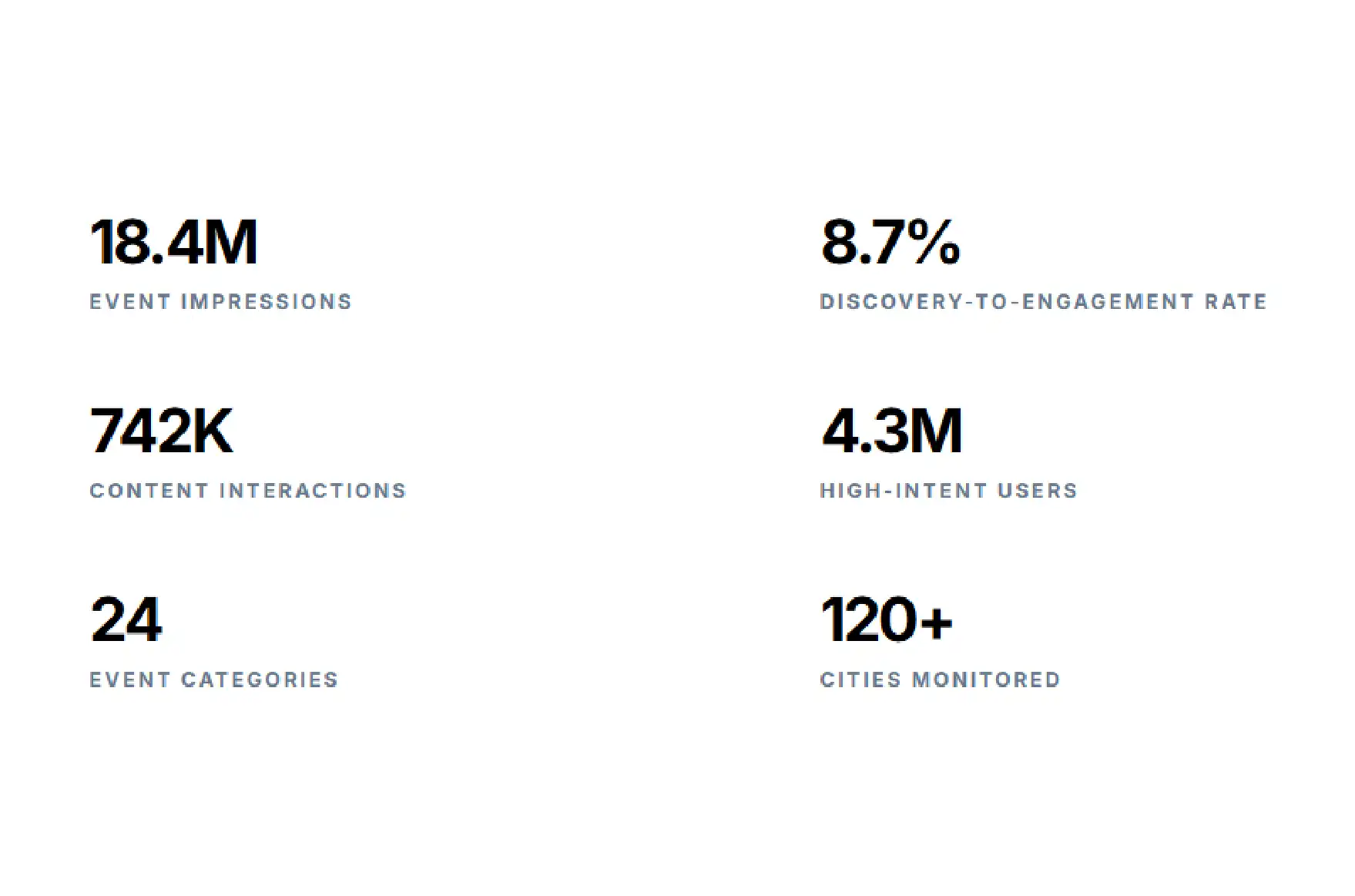
The pipeline enabled early detection of emerging experience demand surges by continuously analyzing interaction velocity, listing impressions, search frequency, and engagement acceleration patterns across District ecosystems. Instead of reacting after events became popular, the system identified subtle growth signals at the earliest stages of audience interest. This included tracking sudden increases in clicks, repeated listing views, and rising engagement density for specific event categories or venues. By combining these signals, the system accurately predicted which experiences were likely to trend in the near future. This capability allowed marketing and operations teams to execute proactive promotion strategies, allocate budgets more effectively, and improve event visibility timing. It also reduced missed opportunities by ensuring that high-potential events were amplified before reaching peak saturation or competitive overcrowding.
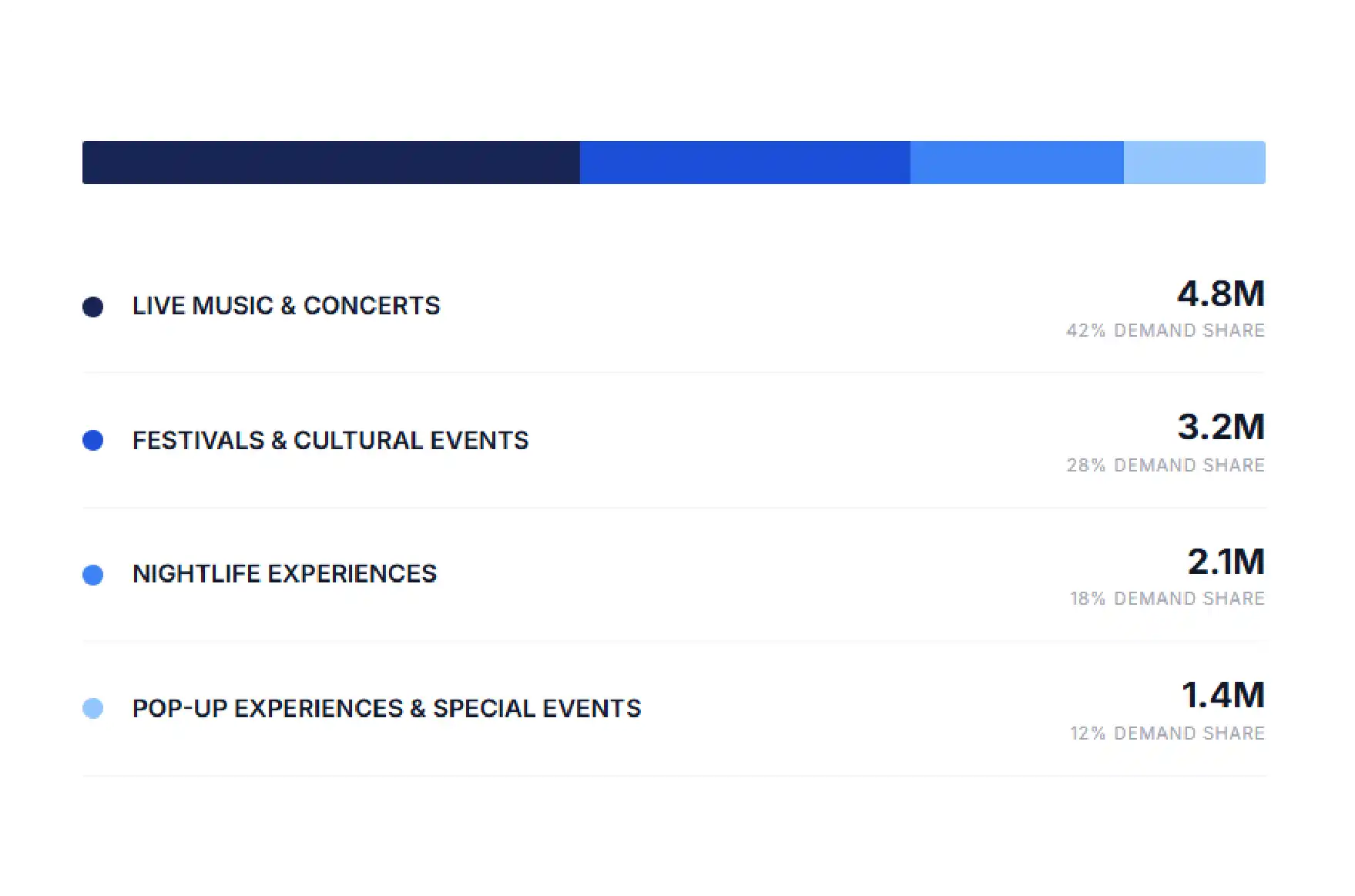
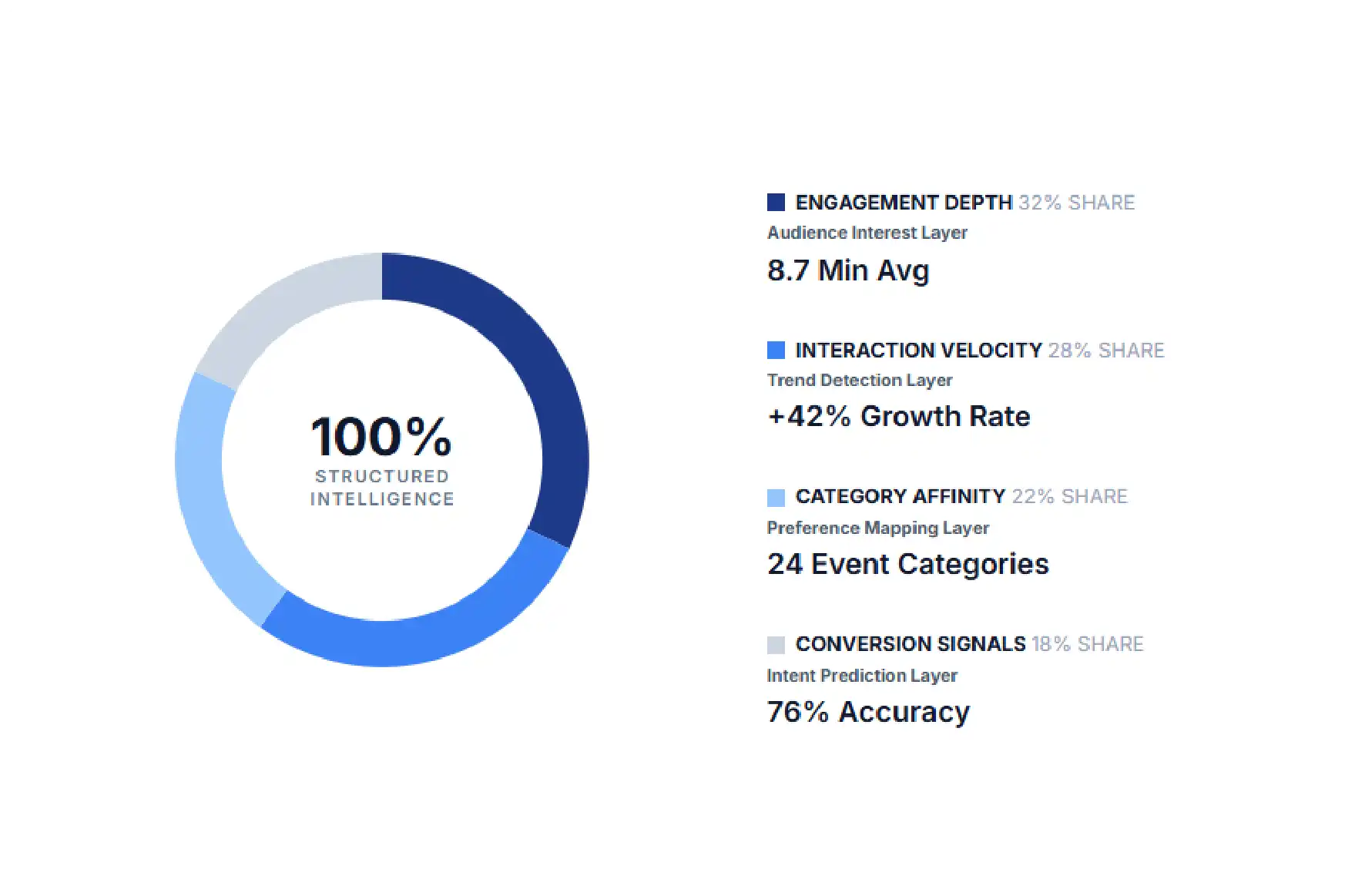
Unstructured event interaction data from District ecosystems was transformed into structured behavioral intelligence models that enabled deep user segmentation and predictive analytics. Instead of raw logs, the system generated meaningful behavioral indicators that reflected user intent, interest strength, and engagement consistency.
| Metric | Insight Captured | Business Impact |
|---|---|---|
| Engagement Depth | Time spent per listing and interaction frequency | Measurement of user interest strength and content relevance |
| Interaction Velocity | Speed at which engagement grows over time | Early prediction of trending events and experiences |
| Category Affinity | Preference patterns across event types like music, food, or nightlife | Improved recommendation system accuracy |
| Conversion Signals | Booking likelihood based on interaction behavior | Increased revenue optimization and targeting efficiency |
This structured intelligence enabled precise segmentation of audiences based on intent levels, enabling more personalized marketing campaigns and stronger alignment between user preferences and event offerings.
The system successfully scaled across multiple cities, processing thousands of event updates, venue changes, and engagement signals simultaneously without performance degradation. It provided unified visibility across both metropolitan hubs and regional markets, ensuring consistent intelligence coverage across the entire ecosystem. Even during high-traffic periods such as festivals, concerts, public holidays, and seasonal events, the pipeline maintained stable ingestion and analysis of real-time data. This allowed organizations to track cross-city demand variations, compare performance benchmarks, and identify regional behavioral differences in audience engagement. The scalability of the system ensured that no critical signals were lost during high-volume spikes, enabling continuous intelligence generation and supporting long-term strategic planning across diverse urban markets.
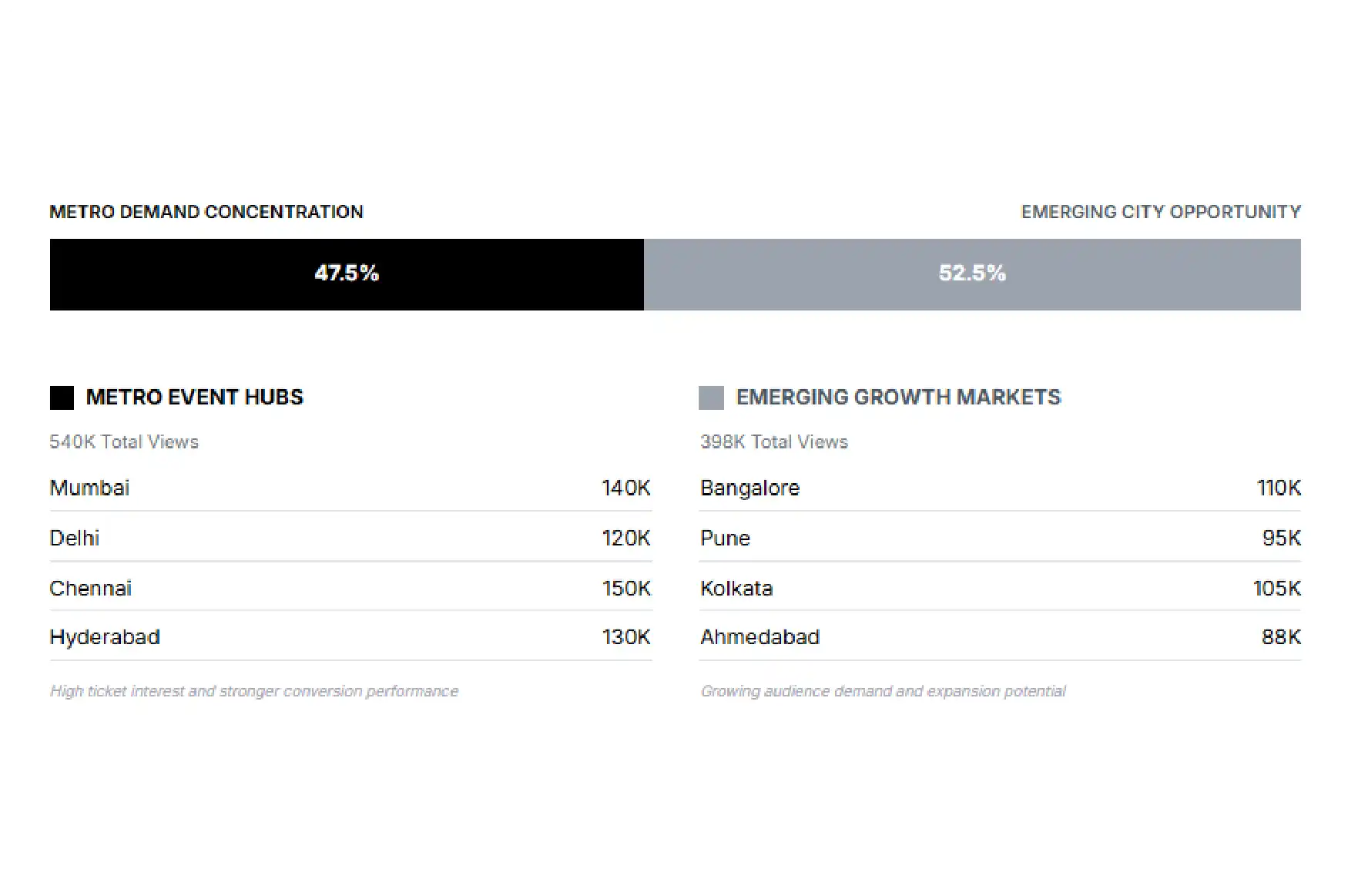
This table represents a structured District ecosystem dataset capturing city-wise event performance across engagement rate, sentiment, views, and conversion signals. It helps identify regional demand patterns, audience interest intensity, and category-level performance differences for data-driven decision-making.
| City | Event Type | Engagement Rate | Sentiment | Views | Top Category | Ticket Interest | Avg Session Time | Conversion Rate |
|---|---|---|---|---|---|---|---|---|
| Mumbai | Concert | 9.1% | Positive | 140K | Live Music | High | 4.8 min | 3.6% |
| Delhi | Food Festival | 7.8% | Positive | 120K | Culinary | Medium | 3.9 min | 2.8% |
| Bangalore | Night Event | 8.2% | Neutral | 110K | Nightlife | High | 4.2 min | 3.1% |
| Pune | Movie Screening | 6.5% | Positive | 95K | Cinema | Medium | 3.4 min | 2.2% |
| Hyderabad | Stand-up Comedy | 8.7% | Positive | 130K | Entertainment | High | 4.6 min | 3.9% |
| Chennai | Music Festival | 9.3% | Positive | 150K | Live Music | Very High | 5.1 min | 4.2% |
| Kolkata | Cultural Event | 7.2% | Neutral | 105K | Heritage | Medium | 3.6 min | 2.5% |
| Ahmedabad | Tech Meetup | 6.9% | Positive | 88K | Networking | Low | 3.1 min | 1.9% |
After implementing structured District intelligence systems, the organization achieved significant operational and analytical improvements across both strategic and execution layers of decision-making.
Our system enables unified intelligence across fragmented experience ecosystems by consolidating event, venue, and engagement data from multiple sources into a single structured analytics framework that supports consistent interpretation and reporting. It provides continuous, real-time monitoring of evolving user behavior patterns across entertainment, dining, nightlife, and discovery platforms, ensuring that businesses can understand shifting audience interests as they happen rather than after delays. The solution enhances data reliability through advanced automated cleaning, deduplication, validation, and normalization processes that remove inconsistencies and ensure only high-quality, analysis-ready datasets are used for decision-making. It is specifically designed for high scalability, allowing organizations to efficiently process rapidly increasing volumes of event listings, engagement signals, and user interactions without performance degradation or data loss. Ultimately, this system empowers enterprises with faster, more accurate, and data-driven decision-making capabilities, helping them optimize experiences, improve targeting strategies, and strengthen competitiveness across fast-moving experience-driven industries.
We have seen a major transformation in how we analyze event discovery and audience engagement across cities. The system provided real-time clarity into user behavior patterns that were previously invisible to us.
The structured intelligence framework significantly improved our ability to respond to demand fluctuations and optimize event visibility strategies.
We now operate with a unified view of events, venues, and engagement signals, which has greatly improved our strategic planning and execution speed.
— Head of Experience Strategy
The final outcome of the project was a fully automated, scalable intelligence system that converted District ecosystem signals into structured business insights.
The organization achieved faster decision-making cycles, improved predictive accuracy, and stronger engagement optimization across multiple cities.
Implementation of Web Scraping API Service enabled high-speed, reliable data extraction from District ecosystems with enterprise-grade stability.
Deployment of Web Scraping Services ensured scalable infrastructure capable of handling continuous growth in event and engagement data streams.
Overall, the solution delivered measurable ROI, improved intelligence maturity, and established a strong foundation for future expansion in experience analytics ecosystems.
Yes, we transform District ecosystem data into structured insights for faster decisions and better audience targeting. Connect with us today to scale your experience-driven analytics.
Start a projectIt is used to convert raw event discovery, listing activity, and venue-level data from District ecosystems into structured intelligence that supports analytics, forecasting, and informed business decision-making across platforms.
The system continuously captures live updates from event listings, venue changes, engagement signals, and user interactions across multiple cities, ensuring always-on visibility into evolving audience behavior and demand patterns.
Yes, it identifies early-stage engagement spikes, rising interest signals, and acceleration in interaction velocity, allowing businesses to detect potential trending events before they achieve mainstream visibility and peak popularity.
Yes, it is built for high scalability, enabling consistent performance across nationwide and multi-city event ecosystems while processing large volumes of real-time data without compromising speed, accuracy, or reliability.
Industries such as entertainment, hospitality, food discovery, travel, nightlife, and digital experience platforms benefit most, as they rely heavily on real-time event insights, audience behavior tracking, and engagement intelligence systems.
We start by signing a Non-Disclosure Agreement (NDA) to protect your ideas.
Our team will analyze your needs to understand what you want.
You'll get a clear and detailed project outline showing how we'll work together.
We'll take care of the project, allowing you to focus on growing your business.