How Can the DoorDash Menu Pricing Intelligence API Improve Competitive Pricing?
Introduction
The online food delivery ecosystem has become intensely competitive, with restaurants, cloud kitchens, and aggregators continuously adjusting prices, promotions, and menu structures. In such a fast-moving environment, relying on manual price checks or static reports is no longer enough. Businesses now require real-time, structured, and scalable data solutions to stay ahead. This is where the DoorDash menu pricing intelligence API becomes a powerful tool for extracting actionable insights from one of the world’s largest food delivery platforms.
At its core, pricing intelligence enables brands to track menu prices, discounts, add-ons, and availability across locations and timeframes. With increasing regional competition and dynamic surge pricing, DoorDash food delivery pricing Monitoring allows businesses to understand how pricing strategies shift based on demand, location, and consumer behavior. A well-structured DoorDash menu item price dataset helps decision-makers move beyond guesswork and adopt data-driven pricing, marketing, and expansion strategies.
Understanding DoorDash Menu Pricing Intelligence
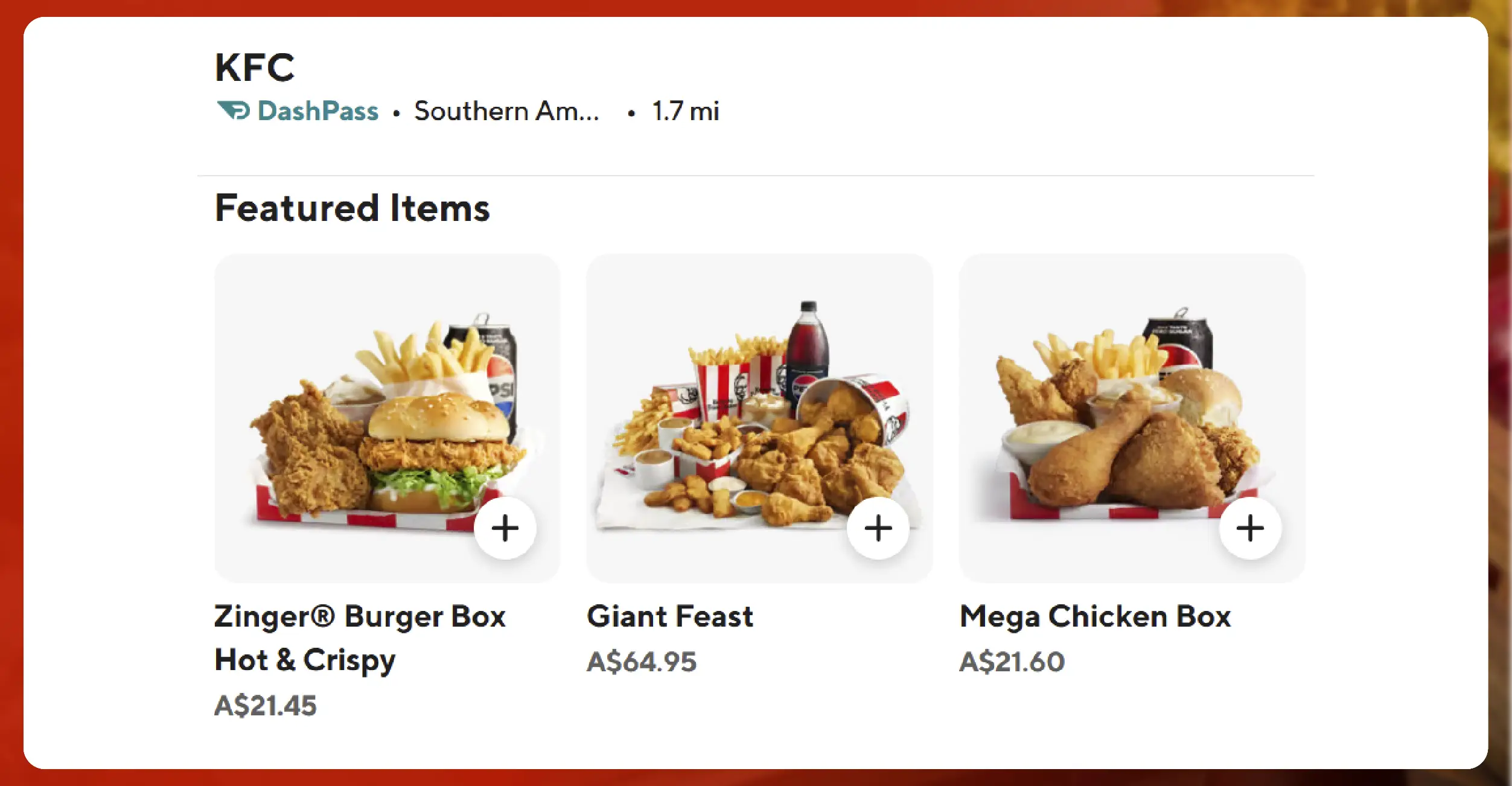
DoorDash menu pricing intelligence focuses on collecting and analyzing menu-level data from restaurants listed on the DoorDash platform. This includes base prices, combo deals, limited-time offers, delivery fees, service charges, and item availability. By monitoring these elements, businesses can identify pricing gaps, regional variations, and promotional patterns that influence customer conversion.
Unlike traditional market research, pricing intelligence APIs provide automated access to continuously updated data. This allows restaurants, aggregators, and analytics firms to observe pricing movements in near real time, ensuring that insights remain relevant and actionable.
Why Menu-Level Data Matters in Food Delivery?
Menu-level data is one of the most granular and valuable data layers in food delivery analytics. It reveals how customers interact with specific items, not just brands or categories. When businesses Extract Menu Item Data DoorDash, they gain visibility into portion pricing, premium add-ons, dietary variants, and bundled offers that often drive higher order values.
This level of detail supports smarter decisions around menu engineering, upselling strategies, and localized pricing. It also helps multi-brand operators compare performance across cuisines, formats, and cities.
- Reveals item-level pricing differences across locations, helping brands optimize regional and city-specific pricing strategies.
- Identifies high-performing and low-performing menu items to support data-driven menu engineering decisions.
- Tracks add-ons, customization charges, and combo pricing that significantly impact average order value.
- Helps understand customer preferences by analyzing price sensitivity across cuisines and meal categories.
- Supports competitive benchmarking by comparing similar menu items across multiple restaurants and brands.
Role of APIs in DoorDash Pricing Intelligence
APIs streamline the process of collecting large volumes of structured data without manual intervention. A robust DoorDash Food Delivery Scraping API enables businesses to capture menu pricing, restaurant metadata, and availability signals across thousands of listings. These APIs are designed to handle scale, frequency, and data normalization, making them suitable for enterprise analytics.
By integrating API outputs into dashboards or BI tools, companies can visualize pricing trends, identify anomalies, and trigger alerts when competitors change prices or launch promotions. Automates large-scale data collection without manual tracking, ensuring accuracy and time efficiency.
- Enables real-time or scheduled data updates to capture frequent menu and price changes.
- Delivers structured, normalized data ready for analytics, dashboards, and BI tools.
- Scales seamlessly across thousands of restaurants, locations, and menu items.
- Reduces operational overhead while maintaining consistent and reliable data pipelines.
Pricing Insights from DashMart and Convenience Stores
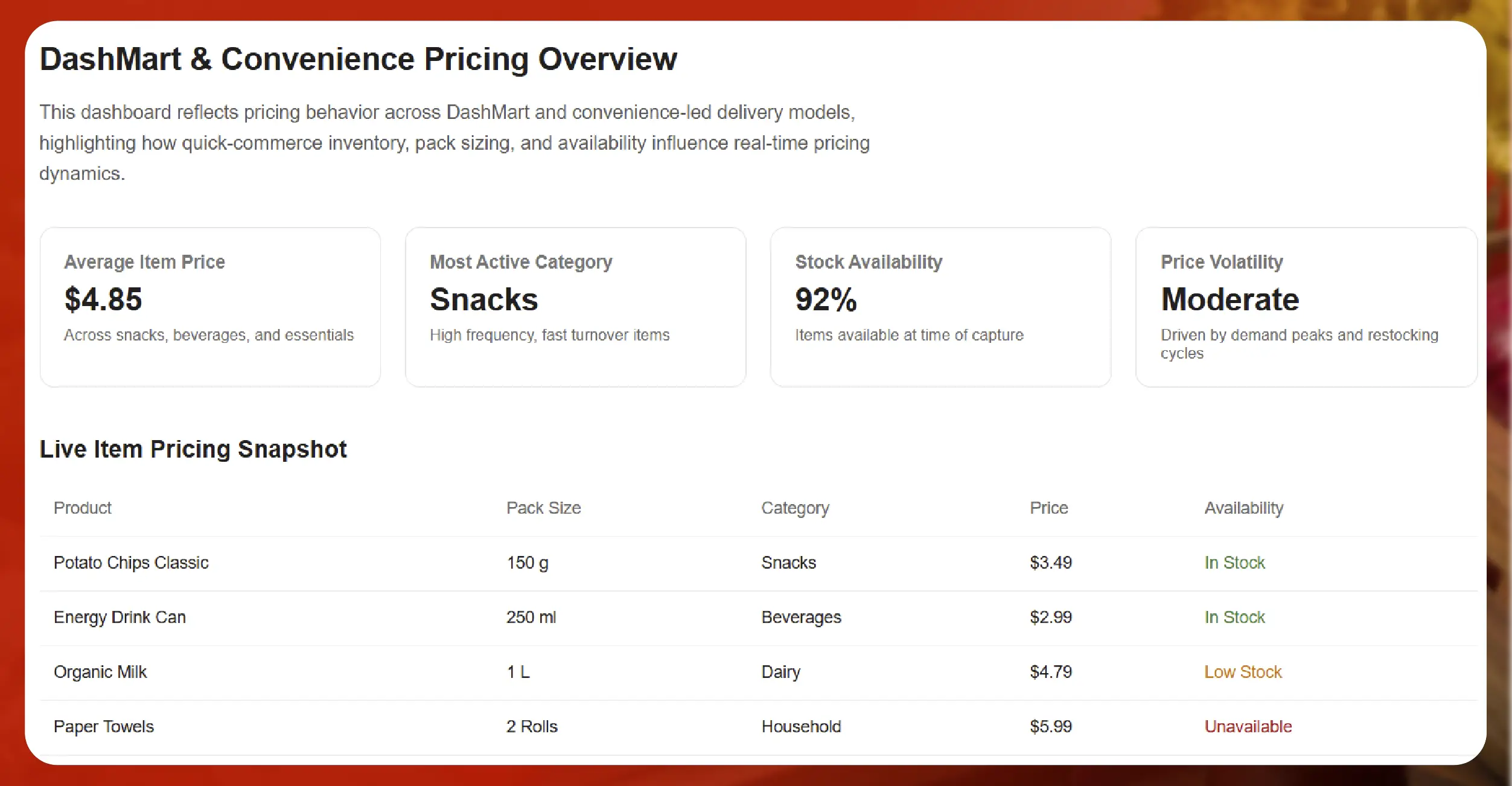
Beyond restaurants, DoorDash DashMart has emerged as a key channel for groceries, snacks, and everyday essentials. Monitoring DashMart pricing requires a specialized approach due to frequent inventory changes and time-sensitive demand. A Scraping API For DoorDash DashMart allows businesses to track item prices, pack sizes, stock availability, and category-level trends.
These insights are especially valuable for FMCG brands and quick-commerce operators aiming to benchmark pricing against convenience-led delivery models.
Extracting App-Level Data for Strategic Decisions
Menu pricing intelligence goes beyond prices alone. Businesses increasingly focus on understanding the broader ecosystem, including ratings, delivery times, and promotional placements. Through DoorDash Food Delivery App data Extraction, companies can analyze how pricing correlates with visibility, ranking, and customer engagement.
This data helps answer critical questions: Do discounts improve conversion? How does pricing impact ratings? Which price points perform best during peak hours? Such insights directly influence growth strategies.
Get real-time DoorDash pricing insights to stay competitive and make smarter decisions.
Building Reliable DoorDash Datasets
Raw data is only useful when it is accurate, structured, and consistent. A comprehensive Doordash Food Delivery App Dataset typically includes restaurant identifiers, menu hierarchies, pricing attributes, and temporal markers. Clean datasets allow analysts to perform time-series analysis, competitor benchmarking, and predictive modeling.
These datasets are often used by consulting firms, market research agencies, and food tech startups to generate long-term insights into delivery economics.
Enterprise-Grade Data Extraction Services
For businesses without in-house scraping infrastructure, managed services provide a scalable alternative. DoorDash Food Data Extraction Services handle the entire pipeline—from data collection and validation to formatting and delivery. This ensures compliance, accuracy, and continuity, especially when platform structures evolve.
Such services reduce operational overhead while ensuring that stakeholders receive consistent, high-quality data feeds tailored to their analytical needs.
Transforming Raw Data into Intelligence
Collecting data is only the first step. The real value emerges when data is transformed into insights. Food Delivery Data Intelligence Services apply analytics, visualization, and machine learning to uncover patterns that are not immediately visible in raw datasets. These services help businesses forecast demand, optimize pricing, and identify underserved markets.
By combining historical data with real-time feeds, companies can simulate pricing scenarios and measure their potential impact before implementation.
Use Cases Across the Food Delivery Ecosystem
DoorDash menu pricing intelligence supports a wide range of use cases. Restaurants use it to benchmark against competitors and optimize menu design. Aggregators leverage it to refine commission strategies and partnerships. Investors and analysts rely on it to assess market dynamics and brand performance.
Even logistics and supply chain teams benefit from understanding how pricing influences order volume and delivery density across regions.
- Restaurants analyze competitor pricing to adjust menus, promotions, and discounts strategically.
- Cloud kitchens optimize pricing models based on demand patterns and local competition.
- Aggregators monitor platform-wide pricing trends to refine partnerships and commission strategies.
- Market research firms generate insights on consumer behavior, pricing elasticity, and category growth.
- Investors and analysts evaluate brand performance, expansion opportunities, and market dynamics.
How iWeb Data Scraping Can Help You?
- Real-Time Competitive Monitoring: Track menu prices, discounts, and availability across DoorDash to stay ahead of competitor pricing changes.
- Accurate, Structured Data Delivery: Receive clean, validated, and analysis-ready datasets that integrate seamlessly with dashboards and BI tools.
- Scalable Coverage Across Locations: Monitor thousands of restaurants, menu items, and DashMart listings across multiple cities and regions effortlessly.
- Actionable Pricing & Demand Insights: Transform raw data into insights that support smarter pricing strategies, menu optimization, and revenue growth.
- Reduced Operational & Research Costs: Eliminate manual tracking and data errors while accelerating decision-making with automated, reliable data pipelines.
Conclusion
As food delivery markets mature, success increasingly depends on precision, speed, and data-driven decision-making. Access to structured Food Delivery App Menu Datasets empowers businesses to understand not just what customers order, but why they choose one option over another. When supported by scalable Doordash Food Delivery Scraping API Services, pricing intelligence becomes a continuous advantage rather than a one-time insight.
By leveraging a reliable DoorDash Food Data Scraper, companies can stay ahead of pricing shifts, respond quickly to competitor moves, and design menus that align with evolving consumer expectations. In a landscape defined by rapid change, DoorDash menu pricing intelligence is no longer optional—it is essential.
Experience top-notch web scraping service and mobile app scraping solutions with iWeb Data Scraping. Our skilled team excels in extracting various data sets, including retail store locations and beyond. Connect with us today to learn how our customized services can address your unique project needs, delivering the highest efficiency and dependability for all your data requirements.