
52.8K+
TOTAL FLIGHT AVAILABILITY RECORDS PROCESSED
Extract Flight Availability Using Google Flights Data for Real-Time Route Intelligence, Airline Monitoring, and Travel Analytics.
This case study is based on a real-world enterprise scenario where a travel intelligence and aviation analytics team leveraged large-scale flight data extraction through methods to Extract Flight availability using Google Flights data and transform fragmented airline information into structured business intelligence for route monitoring, demand forecasting, and competitive travel analytics. The organization also required the ability to Extract flight schedules from Google Flights to maintain accurate visibility into airline operations, route frequencies, and schedule changes across global travel markets.
It is designed for:
The client’s core challenge was simple: airline schedules, route availability, and inventory signals change continuously across global travel markets but remain fragmented across multiple data sources. Their objective was to convert scattered flight information into a unified intelligence layer that supports faster business decisions and improves visibility into airline operations and traveler demand.
A recent case study explored how modern travel intelligence teams leveraged large-scale aviation ecosystems for operational insights. Teams implemented advanced Google Flights extraction pipelines to capture airline availability and route performance across multiple markets effectively.
Analysts benefited from comprehensive flight intelligence datasets to measure route activity, airline coverage, and booking patterns globally. Data engineers processed millions of records while enabling Flight seat availability tracking and helping enterprises for strategic planning purposes. This initiative helped organizations build structured airline intelligence systems for competitive analysis and travel market monitoring.
Machine learning models analyzed extracted datasets to Compare airline availability across routes and identify route demand clusters and forecast airline capacity shifts accurately. Insights were visualized in dashboards enabling stakeholders to optimize travel products, market positioning, and route intelligence strategies rapidly. Businesses reported improved forecasting accuracy and stronger visibility into aviation market dynamics. Ultimately, the study confirmed the scalability of flight data extraction systems for large-scale travel intelligence applications. Overall, it demonstrated the transformation of fragmented airline information into structured, actionable business intelligence at scale successfully.
The client faced significant difficulties in monitoring rapidly changing airline availability, route coverage, and scheduling information across multiple travel markets. Traditional travel intelligence tools were unable to provide timely insights, resulting in delayed responses to market changes and missed strategic opportunities.
Another major challenge was the absence of structured Google Flights Route Data Extraction, which limited the ability to evaluate route performance and airline coverage accurately across different regions.
The client also struggled with fragmented airline information sources, making it difficult to maintain consistent monitoring of route availability and flight schedules globally.
Additionally, they lacked comprehensive Passenger booking trend analytics from Google Flights, restricting their ability to identify changing traveler demand patterns and emerging travel corridors.
Manual tracking methods proved inefficient, time-consuming, and prone to inaccuracies when dealing with thousands of route and schedule updates occurring daily.
The organization also required reliable Google Flights Booking Data Analytics to improve forecasting models, competitive benchmarking, and travel market intelligence initiatives.
To address these issues, they required scalable systems capable of continuously processing aviation datasets and transforming raw airline information into structured insights.
They ultimately needed a comprehensive travel data intelligence solution to unify data collection, improve accuracy, and enable faster strategic decision-making across travel operations.
By adopting a structured Google Flights extraction framework, the client replaced fragmented manual monitoring with an automated aviation intelligence pipeline that continuously captures route availability, airline schedules, inventory signals, and travel demand patterns across global markets, enabling faster insights, higher accuracy, and improved strategic responsiveness.
| Dimension | Manual Flight Tracking | Client Data Scraping System |
|---|---|---|
| Data collection | Individual route searches and manual reviews | Automated multi-route flight intelligence collection |
| Insight speed | Slow and dependent on manual monitoring | Continuous real-time route intelligence updates |
| Data structuring | Spreadsheet-based tracking | Structured aviation datasets with metadata |
| Route identification | Reactive discovery of changes | Early detection of route availability shifts |
| Capacity tracking | Manual airline comparison | Automated airline inventory monitoring |
| Operational reach | Limited route visibility | Scalable global route intelligence coverage |
The brand in focus is a rapidly growing travel intelligence and aviation analytics organization operating within a complex global airline ecosystem. It specializes in method to Scrape Google Flights Travel Data, route intelligence generation, airline schedule monitoring, and demand analytics to understand travel market behavior, route performance, and airline competitiveness across multiple regions.
As its monitoring scope expanded, the organization struggled with increasing route complexity, frequent schedule updates, and the challenge of interpreting large-scale aviation information in real time. To overcome this, it adopted a structured intelligence framework powered by automated systems that Extract Google Flights Travel Data API outputs and transform them into analytical datasets.
Operating in a fast-moving environment where airline schedules, route availability, and traveler demand change continuously, the brand depends on real-time visibility into aviation performance signals and route intelligence metrics. It also leverages Travel & Tourism App Datasets to enrich airline intelligence and improve market forecasting capabilities.
This shift enabled the organization to move from reactive manual monitoring to proactive, data-driven aviation intelligence generation, significantly improving its ability to identify opportunities, respond to travel demand fluctuations, and optimize strategic decisions across its analytics operations.
We delivered an end-to-end analytics solution that transformed raw Google Flights route information into structured business intelligence using automated extraction pipelines, advanced processing frameworks, and scalable cloud infrastructure.
The system cleaned duplicate records, standardized airline metadata, and enriched datasets with route-level indicators such as airline coverage, availability frequency, departure schedules, and route demand signals to improve analytical accuracy.
It also enabled cross-market route monitoring, airline benchmarking, and demand clustering to help the client identify high-performing travel corridors and market opportunities quickly.
The platform integrated Travel Intelligence Services to unify insights across multiple travel ecosystems and aviation datasets. Using advanced pipelines, we implemented route performance analytics solutions to map airline coverage, route activity, and travel demand patterns across markets. Analysts could compare route effectiveness, identify anomalies, and optimize strategic planning initiatives. The final layer applied continuous aviation data extraction services for real-time updates and scalable intelligence generation. Overall, the solution delivered actionable travel insights while significantly reducing manual effort.
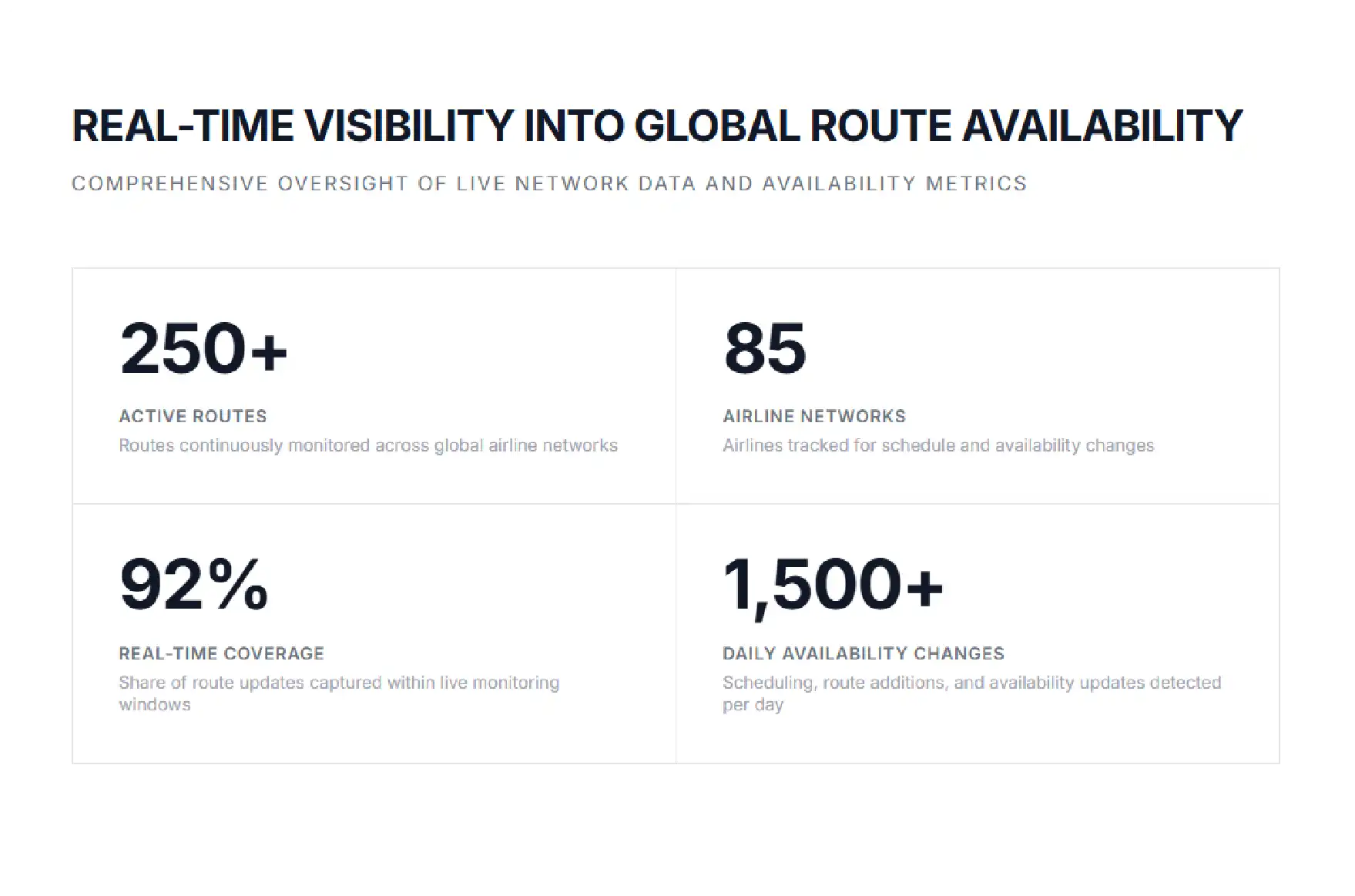
The implementation of continuous flight data extraction enabled the client to gain real-time visibility into route availability across multiple airline networks. Instead of relying on manual route searches, the system captured availability shifts, airline additions, and scheduling updates as they occurred. This allowed the organization to understand evolving travel patterns across regions and markets. As a result, strategic decisions became more responsive, reducing the lag between market changes and operational actions.
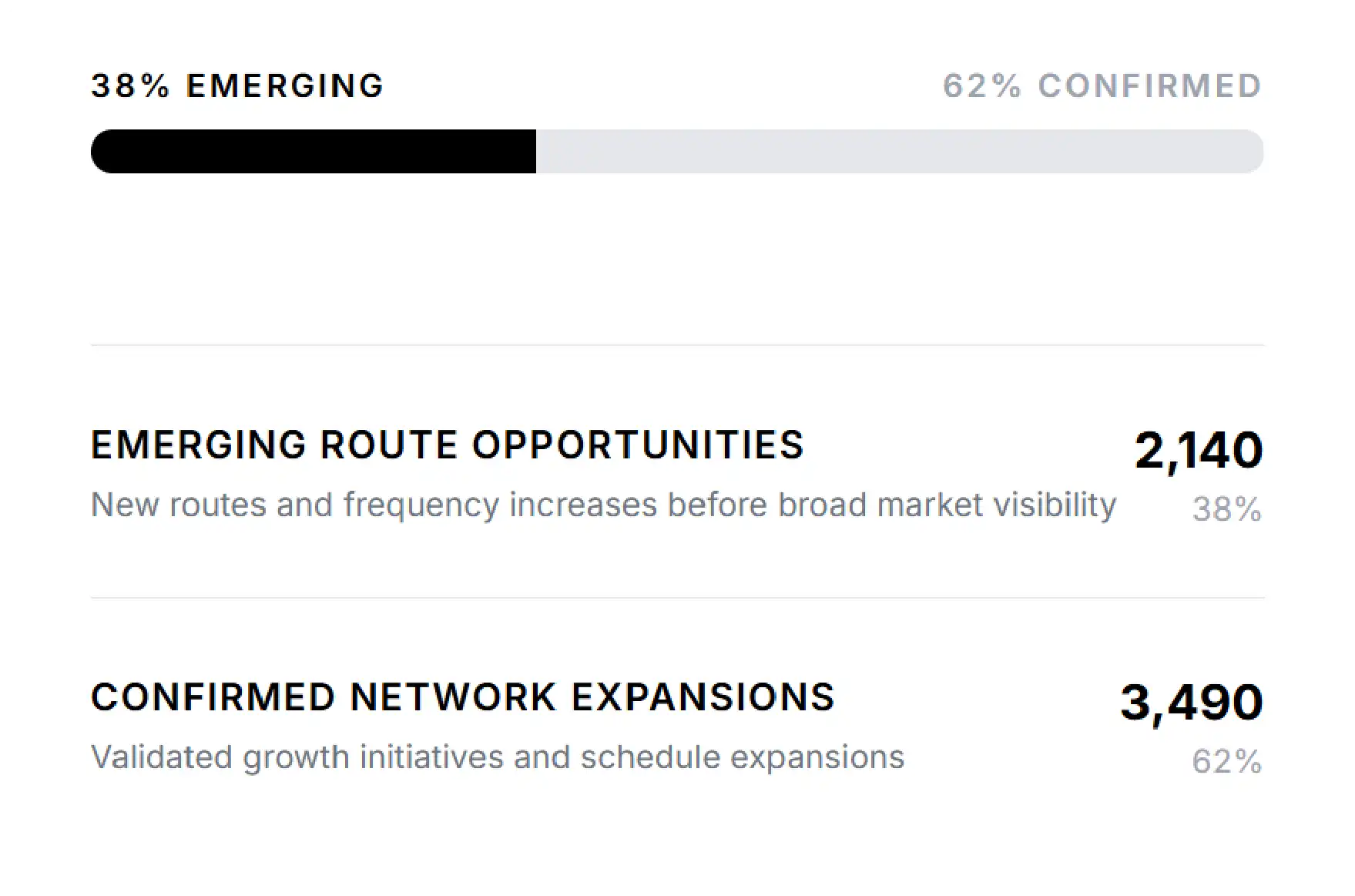
The extraction pipeline enabled early identification of route launches, airline expansion activities, and availability changes before they became widely visible in traditional reporting channels. By continuously analyzing route frequency, airline participation, and schedule updates, the system highlighted emerging travel opportunities in advance. This allowed teams to respond proactively with planning, partnerships, and competitive positioning strategies.
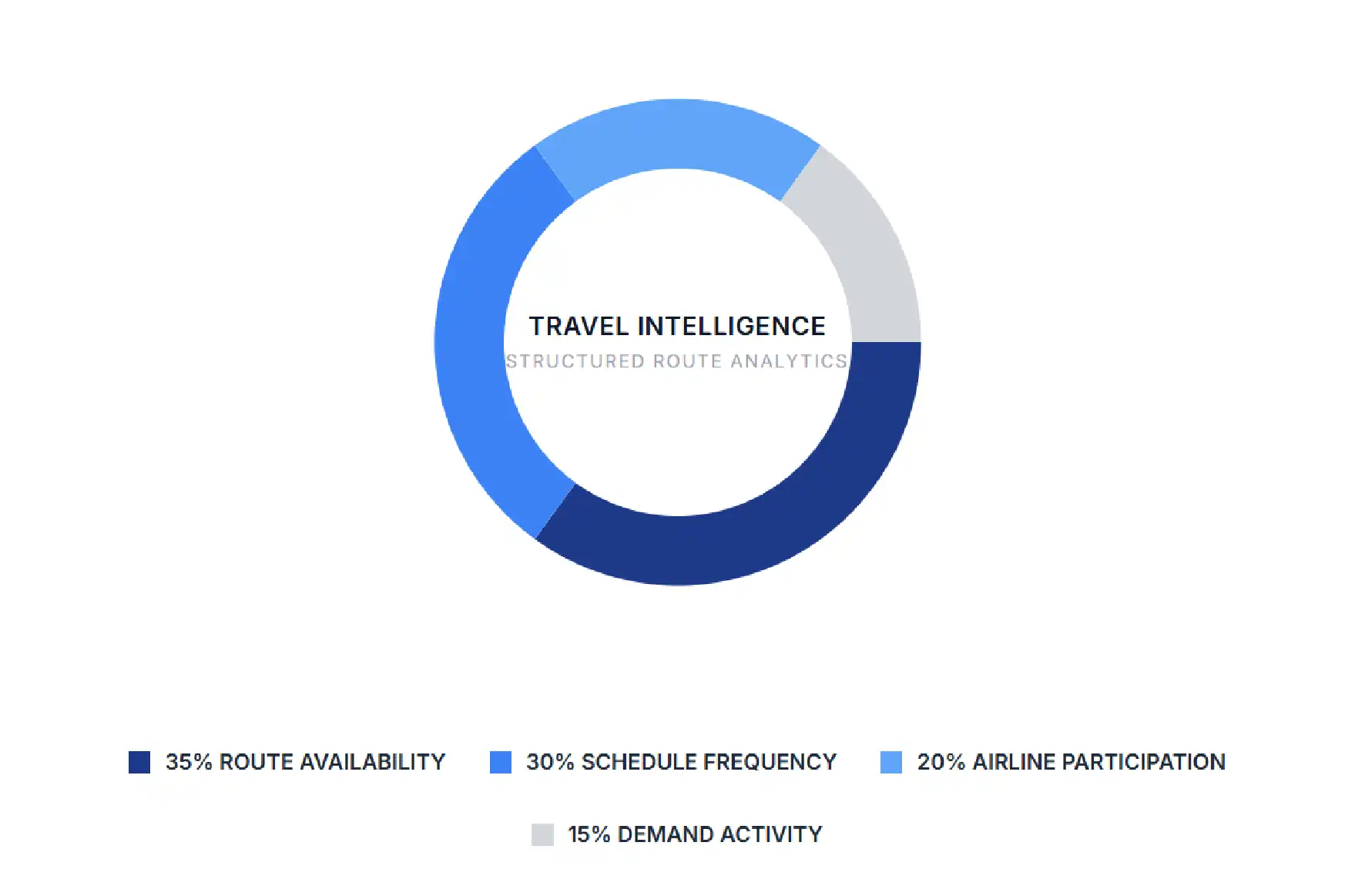
By converting fragmented airline information into structured datasets, the system enabled consistent route performance analysis and demand segmentation across travel markets. This helped identify how different regions, airlines, and travel corridors performed under varying market conditions. The structured output supported advanced forecasting models and improved decision-making accuracy.
| Metric | Insight Captured | Business Impact |
|---|---|---|
| Route Availability Score | Active airline coverage by route | Improved route visibility |
| Schedule Frequency | Flight activity levels | Better planning decisions |
| Airline Participation | Carrier presence by market | Competitive benchmarking |
| Demand Activity | Route popularity patterns | Enhanced forecasting accuracy |
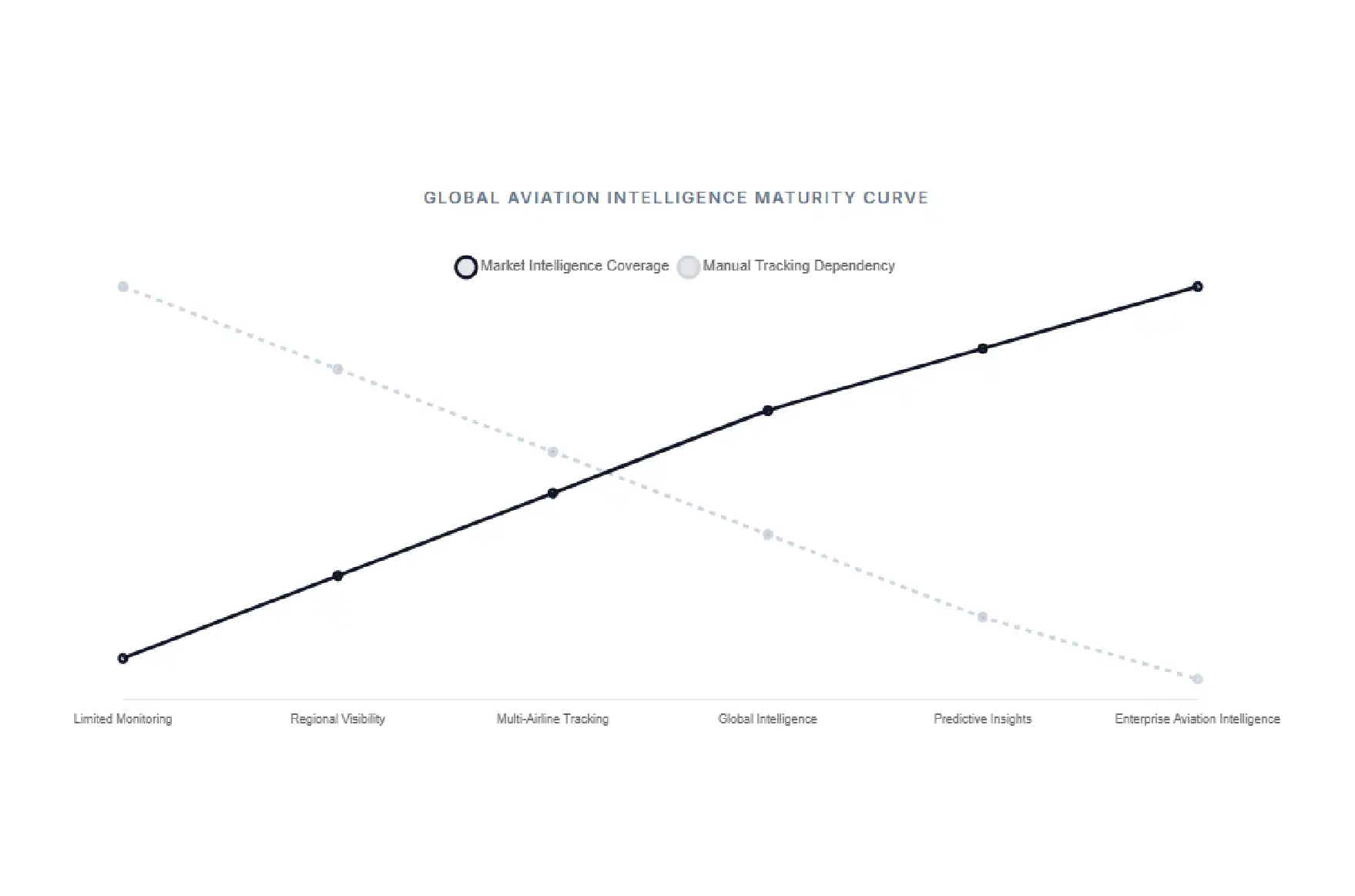
The automated system enabled large-scale monitoring across thousands of routes and airline combinations simultaneously. Unlike manual tracking, which was limited in scope, the pipeline ensured consistent extraction, normalization, and analysis of high-volume aviation datasets. This scalability allowed the organization to maintain continuous visibility across diverse travel markets and rapidly evolving airline ecosystems, improving strategic agility and competitive awareness.
The dataset snapshot shows airline route availability across different markets. It highlights how route frequency, airline participation, and availability vary by market, with major international routes showing stronger activity while emerging corridors demonstrate increasing growth potential.
| Route | Airline | Weekly Flights | Availability Score | Market Demand | Top Insight |
|---|---|---|---|---|---|
| New York–London | Multiple | 210 | High | Strong | Business Travel |
| Dubai–Mumbai | Multiple | 185 | High | Growing | International Demand |
| Singapore–Bangkok | Multiple | 160 | Medium | Stable | Regional Travel |
| Paris–Rome | Multiple | 125 | Medium | Seasonal | Leisure Travel |
| Los Angeles–Tokyo | Multiple | 198 | High | Strong | Long-Haul Demand |
| Sydney–Melbourne | Multiple | 245 | High | Stable | Domestic Travel |
| Frankfurt–Amsterdam | Multiple | 140 | Medium | Stable | European Connectivity |
| Toronto–Vancouver | Multiple | 172 | High | Growing | Domestic Business Travel |
| Hong Kong–Seoul | Multiple | 154 | Medium | Growing | Regional Commerce |
| Bangkok–Phuket | Multiple | 188 | High | Seasonal | Tourism Traffic |
| Delhi–Bengaluru | Multiple | 265 | High | Strong | Corporate Travel |
| Chennai–Dubai | Multiple | 132 | Medium | Growing | Expatriate Travel |
| San Francisco–Seattle | Multiple | 176 | High | Stable | Tech Corridor Demand |
| Madrid–Barcelona | Multiple | 220 | High | Strong | Domestic Connectivity |
| Istanbul–Doha | Multiple | 118 | Medium | Growing | Transit Hub Activity |
| Kuala Lumpur–Singapore | Multiple | 230 | High | Strong | Cross-Border Travel |
| Johannesburg–Cape Town | Multiple | 148 | Medium | Stable | Domestic Tourism |
| Mexico City–Cancun | Multiple | 190 | High | Seasonal | Leisure Travel |
| Rome–Athens | Multiple | 112 | Medium | Growing | Mediterranean Tourism |
| Abu Dhabi–Riyadh | Multiple | 136 | High | Strong | Business & Government Travel |
| Jakarta–Bali | Multiple | 214 | High | Seasonal | Tourism Demand |
| Chicago–Miami | Multiple | 167 | Medium | Growing | Mixed Travel Demand |
| London–Dublin | Multiple | 201 | High | Stable | Short-Haul Business Travel |
| Mumbai–Goa | Multiple | 195 | High | Seasonal | Vacation Travel |
| Seoul–Jeju | Multiple | 208 | High | Strong | Domestic Tourism |
| Beijing–Shanghai | Multiple | 280 | High | Strong | Corporate & Domestic Travel |
After implementing structured Google Flights intelligence through continuous route and schedule extraction, the client achieved significant improvements in route visibility, airline monitoring, and travel demand forecasting.
Our approach enables unified aviation data collection across multiple travel ecosystems by consolidating airline schedules, route availability, and market intelligence into a single structured framework. This removes fragmentation, reduces manual effort, and ensures reliable datasets for analytics, forecasting, and strategic planning.
The solution supports real-time travel market monitoring by continuously tracking airline activity, route changes, and demand shifts, allowing organizations to respond quickly to emerging opportunities and competitive movements.
In addition, the system enhances data quality through validation, normalization, and automated cleansing processes, ensuring highly accurate intelligence outputs suitable for advanced analytics and forecasting initiatives.
It is also designed for scalable insight generation, allowing seamless processing of growing aviation datasets while maintaining performance and reliability. Finally, it transforms raw travel information into structured intelligence that supports better route planning, competitive analysis, and evidence-based decision-making.
We are extremely satisfied with the aviation intelligence solution delivered by the team. The project helped us streamline large-scale flight data collection and convert fragmented airline information into clear, actionable insights. Their approach significantly improved our understanding of route dynamics, airline activity, and travel demand patterns.
The accuracy, speed, and reliability of the system exceeded our expectations and reduced our manual analysis efforts substantially. The dashboards and reporting tools enhanced our decision-making process and improved forecasting efficiency. We now operate with greater visibility, faster intelligence, and stronger competitive positioning across our travel analytics initiatives.
— Head of Travel Intelligence
The final outcome of the project was a fully automated and scalable aviation intelligence system that transformed raw airline signals into structured business insights. The client achieved significantly faster decision-making capabilities with real-time visibility into route performance, airline availability, and travel demand trends. Operational efficiency improved as manual route monitoring was eliminated and replaced with automated pipelines, reducing errors and saving valuable time.
Implementation of Web Scraping API Services enabled seamless and continuous extraction of airline schedules, route availability, and travel intelligence datasets with high accuracy and reliability. As a result, the organization gained stronger forecasting capabilities, improved travel market visibility, and enhanced competitive positioning within a rapidly evolving aviation landscape. The solution also improved data consistency across reporting systems and supported advanced route intelligence use cases.
Deployment of Travel Data Extraction Services further strengthened the organization’s ability to process growing travel datasets while maintaining analytical performance and scalability. Implementation of Web Scraping Services ensured long-term infrastructure support, enabling the platform to handle increasing volumes of airline intelligence data without performance degradation. Overall, the project delivered measurable ROI, improved operational intelligence, and established a strong foundation for future data-driven growth in the global travel industry.
Extract and analyze flight availability, schedules, and demand signals to improve forecasting, route monitoring, and competitive decisions.
Start a projectOur solutions are designed to collect, clean, and structure large volumes of aviation data from multiple sources. This helps businesses gain actionable insights, monitor airline activity, and make faster, more informed decisions based on accurate and real-time travel intelligence.
We use advanced validation techniques, normalization frameworks, and automated cleansing pipelines to ensure all collected airline data remains accurate, consistent, and suitable for analytics and forecasting applications.
Yes, our infrastructure is built for continuous processing. It captures and updates airline schedules, route availability, and travel market intelligence in real time, enabling organizations to respond quickly to changing conditions.
Absolutely. Our architecture is designed to scale efficiently with increasing travel data volumes while maintaining performance, speed, and analytical accuracy.
Our solutions are widely used by travel technology companies, online travel agencies, aviation analytics providers, tourism organizations, and enterprises that depend on travel intelligence, route analytics, and market forecasting for strategic decision-making.
We start by signing a Non-Disclosure Agreement (NDA) to protect your ideas.
Our team will analyze your needs to understand what you want.
You'll get a clear and detailed project outline showing how we'll work together.
We'll take care of the project, allowing you to focus on growing your business.