Newsletter / April 2026 Edition
INSIGHTS & TRENDS

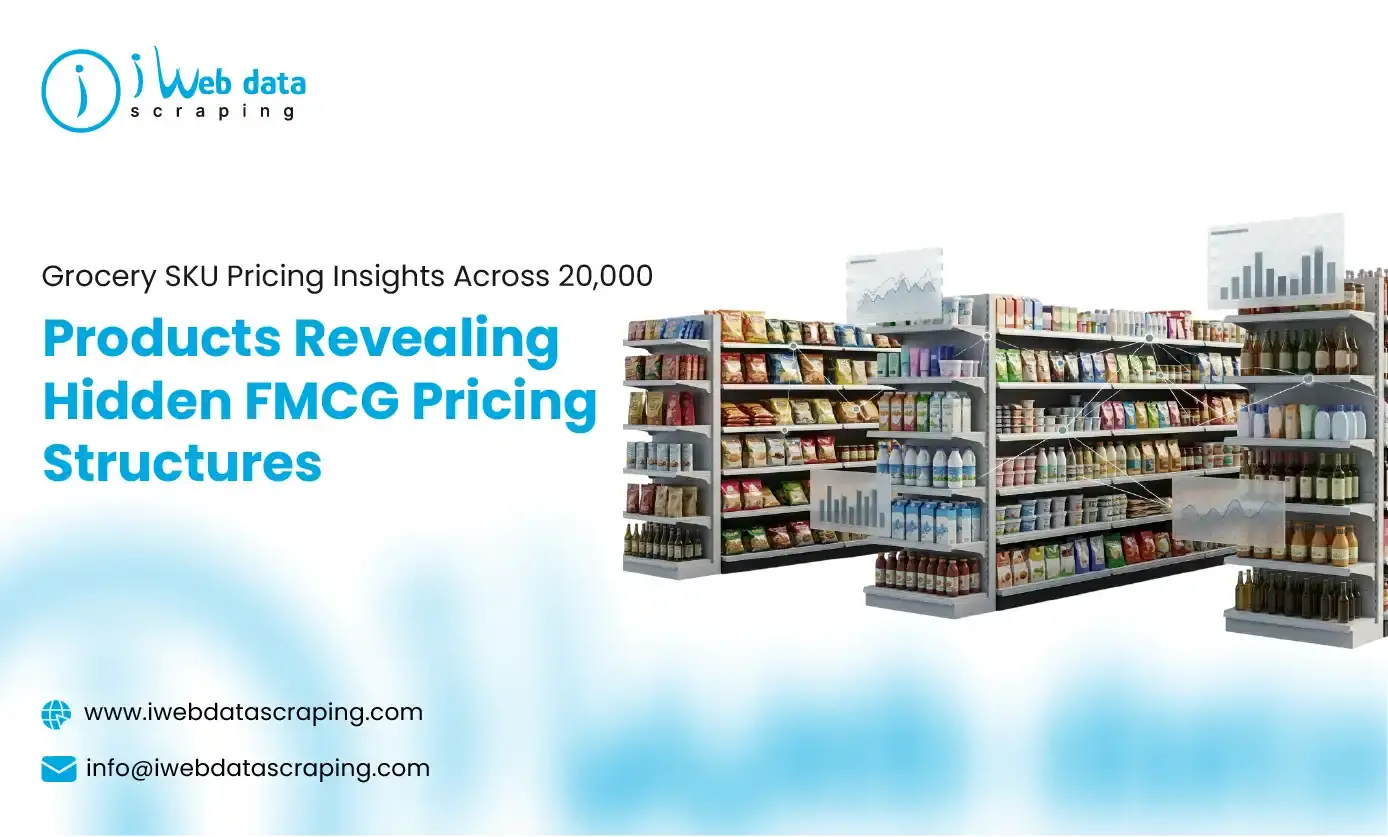
Grocery SKU Pricing Insights Across 20,000 Products Revealing Hidden FMCG Pricing Structures

📅 April, 2026 👤 iWeb Data Team ⏱ 8 Min Read
main

Uncovering News & Updates with iWeb Data Scraping

Grocery SKU Pricing Insights from 20,000 SKUs uncovering price behavior, regional variation, and FMCG market intelligence signals

Grocery pricing today behaves less like a fixed label and more like a constantly shifting signal system. When 20,000 grocery SKUs are tracked together, the market starts revealing patterns that are otherwise invisible—how demand bends prices, how supply gaps create volatility, and how regional behavior reshapes product value. Instead of isolated price points, what emerges is a connected ecosystem where every SKU contributes to a larger narrative of retail movement and consumer response. For this businesses Scrape FMCG pricing shifts across grocery SKUs.

SKU Movement as a Real-Time Pricing Language

Every SKU behaves like a small signal generator inside the grocery ecosystem. Some products move slowly with stable pricing cycles, while others fluctuate rapidly based on competition, promotions, or stock pressure. Over time, these movements form a structured “pricing language” that only becomes visible when analyzed at scale.

Essential items like grains and cooking staples show predictable stability, but FMCG-branded products respond sharply to promotional bursts and competitor pricing adjustments.

This is where Grocery SKU Pricing Insights becomes critical, helping decode how thousands of micro price changes collectively define market behavior rather than individual product shifts.

Geography as a Silent Price Engine

Location plays a far deeper role in pricing than most surface-level analysis suggests. Across cities, even identical SKUs behave differently depending on demand density, logistics cost, and competition intensity.

Metro cities show faster pricing cycles with frequent discount rotations, while smaller cities reflect more stable and delayed pricing adjustments. These differences are not random—they are structural reflections of consumption behavior and supply chain design.

To capture this variation, businesses rely to Scrape City-wise grocery price variation Data, uncovering how geography quietly reshapes affordability and retail strategy at a granular level.

Availability Gaps That Reshape Pricing

Stock availability is not just an operational metric—it directly influences pricing behavior. When demand outpaces supply, pricing pressure builds automatically, and when restocking occurs, prices often stabilize or recalibrate.

Out-of-stock events reveal deeper system inefficiencies, including forecasting gaps, sudden demand spikes, and promotional overload. These patterns highlight how closely pricing and inventory are interconnected in modern grocery ecosystems.

This makes Grocery Out-of-stock trends analysis essential for understanding how supply disruptions indirectly trigger pricing volatility and consumer purchasing shifts.

How iWeb Data Scraping Powers This Entire Intelligence Layer?

At the core of this entire ecosystem is the role of iWeb Data Scraping, which acts as the backbone for capturing, organizing, and interpreting massive-scale grocery data. Without it, tracking 20,000 SKUs across cities, categories, and timeframes would be impossible at meaningful speed or accuracy.

iWeb Data Scraping continuously extracts structured pricing signals from multiple grocery platforms, enabling real-time visibility into FMCG behavior, city-wise price variations, and stock fluctuations. It transforms raw, scattered listings into clean, analyzable datasets that reveal trends before they become visible to the market.

Most importantly, it allows businesses to move from reactive decisions to predictive intelligence—understanding not just what changed, but why it changed and where it will move next.

Conclusion

Tracking 20,000 grocery SKUs reveals that retail is no longer static—it is a constantly evolving system shaped by pricing pressure, geography, and availability. Each SKU contributes a small piece to a much larger behavioral map of the market.

In this landscape, iWeb Data Scraping plays a foundational role, turning fragmented retail data into continuous intelligence. It doesn’t just observe the market—it helps decode its rhythm, making sense of complexity at scale and transforming raw grocery data into strategic clarity.

Let’s Talk About Product

What's Next?

We start by signing a Non-Disclosure Agreement (NDA) to protect your ideas.

Our team will analyze your needs to understand what you want.

You'll get a clear and detailed project outline showing how we'll work together.

We'll take care of the project, allowing you to focus on growing your business.