What Role Does Scraping Remote Work Category Trends Play in Home Office Furniture Demand Intelligence 2026?
Introduction
The global shift toward hybrid and remote work has transformed how businesses understand workplace consumption patterns. In this evolving ecosystem, Home Office Furniture Demand Intelligence has become a critical pillar for manufacturers, retailers, and analysts aiming to decode buyer behavior across digital channels. It helps businesses understand what remote professionals are buying, when they are buying, and why those preferences change over time.
At the same time, Scraping Remote Work Category Trends is enabling companies to continuously monitor shifts in product demand across eCommerce platforms, marketplaces, and direct-to-consumer brands. This allows decision-makers to stay ahead of fast-moving consumer expectations in the remote work economy.
Modern analytics frameworks now heavily depend on method to scrape home office furniture data for demand intelligence to extract structured insights from large-scale product listings, reviews, and pricing datasets. This creates a foundation for predictive modeling and trend forecasting in the home office segment.
The Rise of Remote Work and Furniture Transformation

Remote work is no longer a temporary adjustment—it has become a permanent structural change in the global workforce. As employees set up home offices, demand for ergonomic chairs, adjustable desks, storage units, and hybrid workspace accessories has increased dramatically.
This shift has created a highly dynamic furniture market where demand fluctuates based on work-from-home policies, economic conditions, and lifestyle preferences. Companies that fail to track these changes risk losing competitive advantage in pricing, inventory planning, and product design.
To address this, data-driven intelligence systems are now essential for understanding how remote work environments shape purchasing decisions in real time.
Remote Work Furniture Analytics in 2026
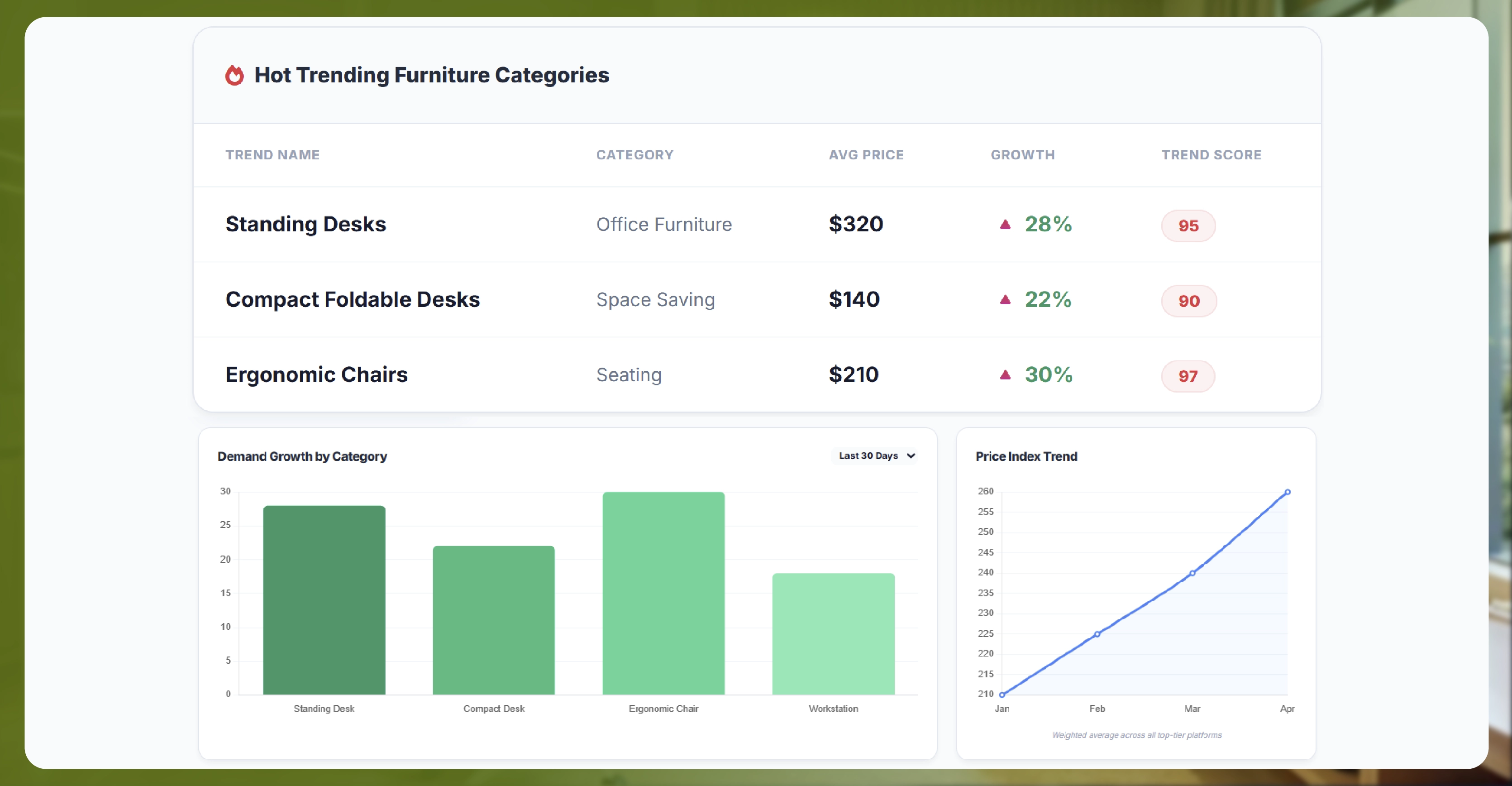
One of the most powerful advancements in this domain is Remote work furniture trend Data extraction 2026, which enables companies to analyze structured and unstructured data from multiple online sources. This includes marketplaces like Amazon, Walmart, and niche furniture retailers.
By extracting data at scale, businesses can identify emerging trends such as:
- Increased demand for standing desks
- Growing popularity of compact furniture for small apartments
- Rising interest in ergonomic and posture-support solutions
- Preference for multi-functional furniture setups
These insights allow manufacturers to align product innovation with real-world demand patterns, reducing inventory risks and improving customer satisfaction.
Real-Time Market Intelligence for Competitive Advantage
In a highly competitive digital marketplace, timing is everything. Companies increasingly rely on Real-time home office furniture price and demand tracking to monitor price fluctuations, discount strategies, and demand spikes across platforms.
Real-time tracking provides several advantages:
- Instant detection of competitor price changes
- Identification of seasonal demand surges
- Monitoring of flash sale impacts
- Dynamic pricing optimization
With this approach, businesses can adjust pricing strategies instantly rather than relying on outdated monthly or quarterly reports. This agility is crucial in eCommerce environments where consumer behavior can shift within hours.
Sales Trend Extraction in the Work-from-Home Economy
Understanding long-term purchasing behavior requires deeper historical analysis. Extract work from home furniture sales trends 2026 to help businesses evaluate how consumer preferences evolve over time.
This includes analyzing:
- Year-over-year sales growth of ergonomic chairs
- Desk configuration preferences across regions
- Demand for premium vs budget furniture categories
- Seasonal spikes in home office upgrades
Such insights allow brands to design targeted marketing campaigns and optimize supply chains based on predictive demand models.
Tracking Behavioral Shifts in Remote Work Furniture
The ability to continuously monitor category evolution is essential for staying relevant. Track remote work furniture trends using data scraping empowers companies to capture real-time behavioral shifts across thousands of product listings.
This process typically involves:
- Monitoring product listing updates
- Tracking review sentiment changes
- Observing keyword trends in product descriptions
- Analyzing competitor assortment strategies
By combining these signals, businesses can build a holistic view of how remote work furniture preferences are changing globally.
Role of Customer Feedback in Demand Intelligence
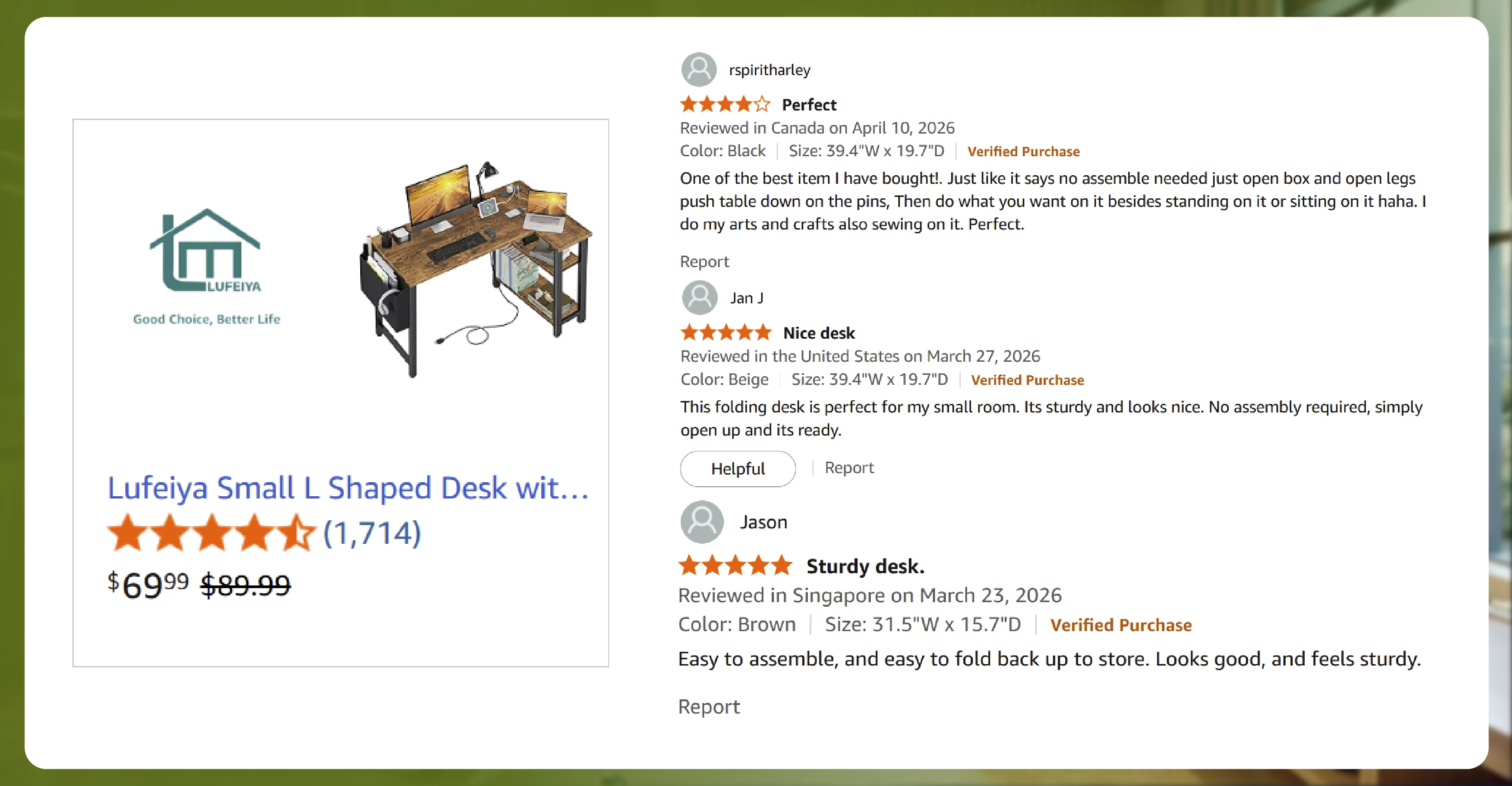
Customer reviews have become one of the most valuable data sources in eCommerce analytics. The Ecommerce Product Ratings and Review Dataset provides rich qualitative and quantitative insights into consumer satisfaction, product performance, and usability feedback.
Through review analysis, companies can:
- Identify product durability issues
- Understand ergonomic satisfaction levels
- Detect design preferences and dislikes
- Improve future product iterations
When combined with pricing and sales data, review datasets help create a 360-degree view of market demand.
Unlock smarter decisions with our data scraping services for real-time home office furniture demand intelligence.
Data Ecosystem Powering Furniture Intelligence
Behind every successful demand intelligence system lies a strong data infrastructure. Businesses increasingly rely on automated systems that integrate multiple data sources to generate actionable insights.
This is where structured data pipelines, APIs, and scraping frameworks play a vital role in transforming raw web data into meaningful business intelligence.
Companies that invest in scalable data systems gain a long-term competitive advantage by continuously adapting to market changes in real time.
Future of Home Office Furniture Intelligence
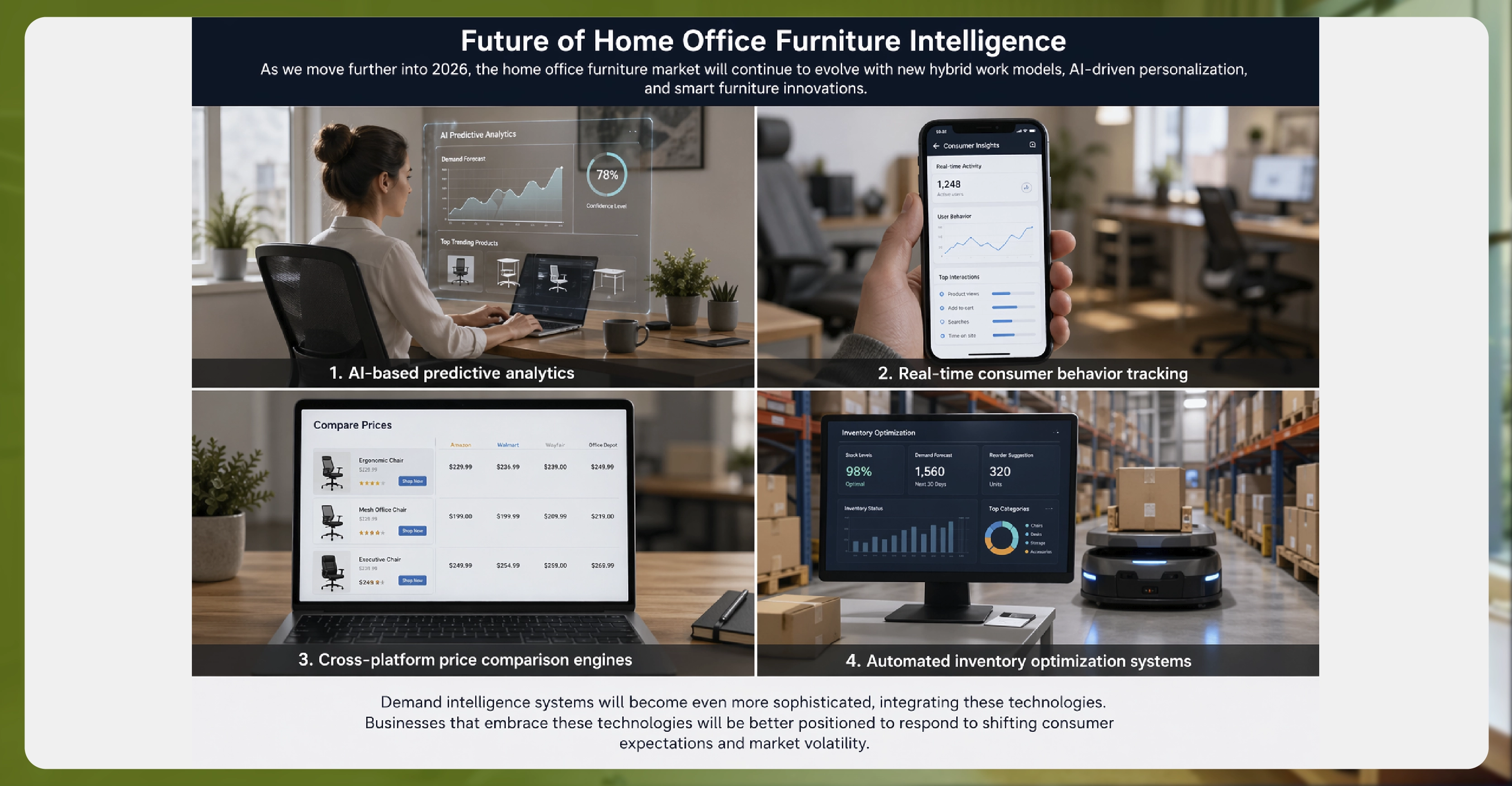
As we move further into 2026, the home office furniture market will continue to evolve with new hybrid work models, AI-driven personalization, and smart furniture innovations.
Demand intelligence systems will become even more sophisticated, integrating:
- AI-based predictive analytics
- Real-time consumer behavior tracking
- Cross-platform price comparison engines
- Automated inventory optimization systems
Businesses that embrace these technologies will be better positioned to respond to shifting consumer expectations and market volatility.
How iWeb Data Scraping Can Help You?
1. Real-Time Market Monitoring
Our data scraping services continuously track home office furniture prices, demand shifts, and competitor listings, enabling faster decisions and stronger market positioning across platforms.
2. Accurate Demand Forecasting
We extract structured datasets from multiple sources to help you predict remote work furniture demand patterns, reduce inventory risks, and optimize supply chain planning efficiently.
3. Competitive Price Intelligence
Our systems capture real-time pricing updates across eCommerce platforms, allowing you to benchmark products, adjust pricing strategies, and stay competitive in dynamic furniture markets.
4. Customer Sentiment Analysis
We gather Ecommerce Product Ratings and Review Dataset insights to help you understand customer satisfaction, product issues, and preferences for better product development strategies.
5. Scalable Data Integration Solutions
Through advanced eCommerce Data Scraping Services can unlock scalable insights across global marketplaces, improving decision-making efficiency and strategic planning.
Similarly, Web Scraping API Services provide structured access to large-scale data streams, allowing seamless integration with analytics platforms and dashboards.
Web Scraping Services ensure that businesses can continuously collect, process, and analyze data from multiple sources without manual effort, making demand intelligence faster and more reliable than ever before.
Conclusion: Data-Driven Future of Remote Work Furniture
The home office furniture industry is entering a data-first era where decisions are driven by real-time insights rather than assumptions. Advanced analytics and scraping technologies are enabling companies to understand customer behavior at unprecedented depth.
Organizations leveraging eCommerce Data Scraping Services can unlock scalable insights across global marketplaces, improving decision-making efficiency and strategic planning.
Similarly, Web Scraping API Services provide structured access to large-scale data streams, allowing seamless integration with analytics platforms and dashboards.
Finally, Web Scraping Services ensure that businesses can continuously collect, process, and analyze data from multiple sources without manual effort, making demand intelligence faster and more reliable than ever before.
Experience top-notch web scraping service and mobile app scraping solutions with iWeb Data Scraping. Our skilled team excels in extracting various data sets, including retail store locations and beyond. Connect with us today to learn how our customized services can address your unique project needs, delivering the highest efficiency and dependability for all your data requirements.