
41.9K+
TOTAL K-BEAUTY SKU SIGNALS PROCESSED
Kaspi.kz Beauty Category Dashboard delivers structured skincare marketplace intelligence for pricing, competition, demand analysis, and strategic K-Beauty launches.
This case study is based on a real-world enterprise intelligence deployment where structured marketplace data from Kaspi.kz is transformed into actionable intelligence for K-Beauty skincare ecosystem benchmarking before seller launch decisions.
It demonstrates how organizations use large-scale Kaspi.kz Beauty Category Dashboard systems to evaluate thousands of skincare SKUs, understand pricing behavior, and measure competitive density across categories.
It is designed for:
The primary challenge addressed is the lack of structured visibility into large-scale skincare SKU competition and rapidly changing pricing behavior across Kaspi.kz beauty categories.
A recent enterprise intelligence initiative analyzed how K-Beauty brands can evaluate Kaspi.kz marketplace readiness before launching products.
Teams deployed large-scale pipelines to monitor SKU-level competition, pricing dynamics, discount trends, and category saturation across 3,500+ skincare listings.
Analysts leveraged Kaspi.kz K-Beauty Brands demand trends to identify high-performing skincare categories such as cleansers, serums, and moisturizers based on engagement signals.
Additionally, Kaspi.kz Marketplace Insights for K-Beauty provided a unified view of pricing clusters, competitor density, and category-level performance patterns.
Advanced systems processed millions of SKU-level signals including ranking shifts, discount changes, and review activity.
Machine learning models identified high-demand segments, underpriced categories, and saturation zones suitable for new K-Beauty entrants.
This enabled data-driven marketplace entry strategy instead of assumption-based planning.
The client faced significant uncertainty in understanding Kaspi.kz beauty marketplace dynamics before launching K-Beauty skincare products, as there was no structured visibility into how thousands of competing skincare SKUs were performing across pricing, visibility, and demand layers in real time.
A key limitation was lack of Kaspi.kz Beauty Category Data Scraping, which restricted visibility into SKU-level competition, pricing variation, promotional frequency, and category saturation across multiple skincare segments, making it difficult to evaluate true market entry conditions.
Another challenge was inability to Extract cleanser product data for K-Beauty Brands, limiting benchmarking for the most competitive skincare entry category, where price sensitivity, brand density, and conversion-driven performance signals are critical for success.
They also lacked structured intelligence on discount cycles, pricing fluctuations, and promotional intensity across skincare SKUs, which prevented accurate understanding of seasonal pricing behavior and competitor-driven discount strategies that heavily influence marketplace ranking.
Fragmented marketplace data made it difficult to identify demand gaps, high-opportunity micro-segments, and underpenetrated skincare categories, resulting in incomplete visibility into where new K-Beauty products could achieve strong positioning.
Without structured SKU intelligence, marketplace entry decisions carried high risk, as the brand could not reliably predict competition intensity, pricing pressure, or category-level performance dynamics before investment and launch execution.
By adopting Cosmetic & Beauty Product Data Scraping Service, the organization replaced manual tracking with an automated intelligence pipeline.
The system continuously monitored 3,500+ skincare SKUs across Kaspi.kz in real time.
| Dimension | Manual Tracking | Automated Scraping System |
|---|---|---|
| SKU Coverage | Partial visibility | Full 3,500+ SKU coverage |
| Pricing Updates | Manual checks | Real-time ingestion |
| Discount Tracking | Inconsistent | Structured lifecycle tracking |
| Category Insights | Fragmented | Unified intelligence model |
| Competitive Benchmarking | Limited | Full ecosystem visibility |
This enabled predictive marketplace intelligence instead of reactive reporting.
The brand in focus is a rapidly scaling K-Beauty skincare company preparing to enter the Kaspi.kz marketplace with a diversified portfolio of products including cleansers, serums, toners, essences, and moisturizers, each targeting different consumer segments such as sensitive skin care, anti-aging, hydration, and brightening solutions.
The ecosystem they are entering is highly competitive and dynamic, with thousands of active SKUs competing simultaneously across similar categories, where product visibility is continuously influenced by pricing fluctuations, discount campaigns, review performance, and algorithm-driven ranking changes. Frequent promotional cycles, aggressive competitor pricing strategies, and shifting demand patterns make it extremely difficult to maintain stable positioning without structured intelligence support.
The brand required deep, structured intelligence to evaluate optimal entry categories by identifying which skincare segments offer the best balance of demand strength and competition intensity, while also understanding how pricing bands influence visibility and conversion potential across different product types.
In addition, they needed clarity on competition density at SKU level to avoid overcrowded segments and instead target underpenetrated niches where new K-Beauty products could gain faster traction and higher visibility. This also included benchmarking against top-performing brands already established on Kaspi.kz to understand pricing psychology, promotional behavior, and category dominance patterns.
Overall, the brand needed a data-driven foundation to reduce launch risk, optimize product positioning, and build a precise marketplace entry strategy supported by real-time competitive and demand intelligence rather than assumptions.
We built a full-scale marketplace intelligence architecture to convert raw Kaspi.kz data into structured K-Beauty insights.
The system integrated Pricing & Promotions Services to analyze discount cycles, price elasticity, and promotional strategies across skincare SKUs.
Each product was normalized into categories such as cleanser, serum, toner, moisturizer, and essence.
Core system layers included:
This enabled precise pre-launch decision-making.
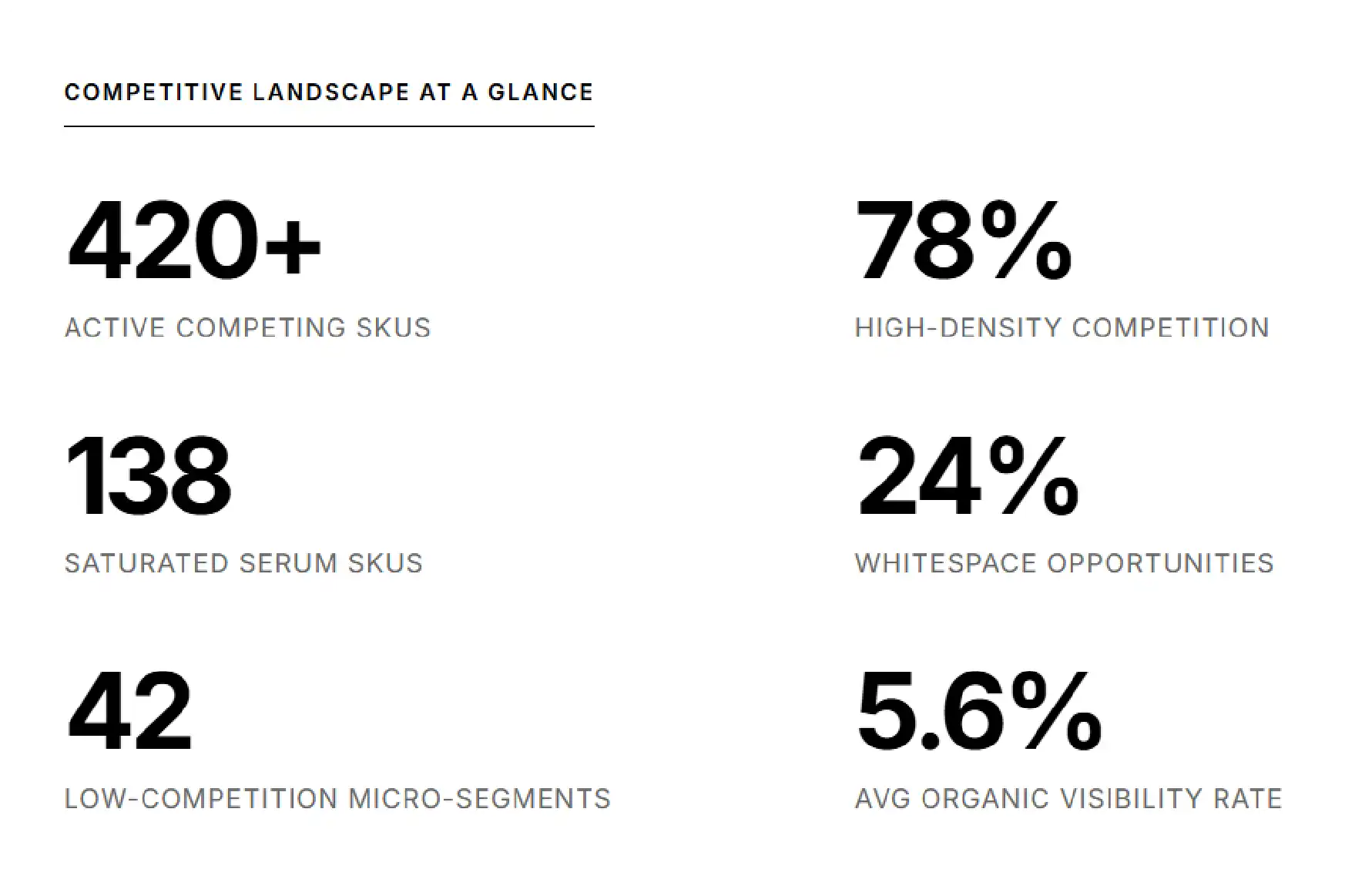
The system revealed extreme SKU saturation in core skincare categories such as cleansers and serums, where hundreds of brands compete simultaneously within tightly clustered and highly competitive pricing bands. This intense saturation creates significant visibility pressure, making it difficult for new K-Beauty entrants to achieve organic ranking without strategic positioning or pricing differentiation.
It also highlighted that competition is not evenly distributed, with certain sub-segments showing disproportionate dominance by established brands, while others remain fragmented and under-optimized.
Additionally, the analysis identified low-competition micro-segments within niche skincare categories such as specialized hydration cleansers and targeted serum variants, offering strong entry potential for new K-Beauty brands seeking faster visibility and reduced acquisition cost in Kaspi.kz marketplace.
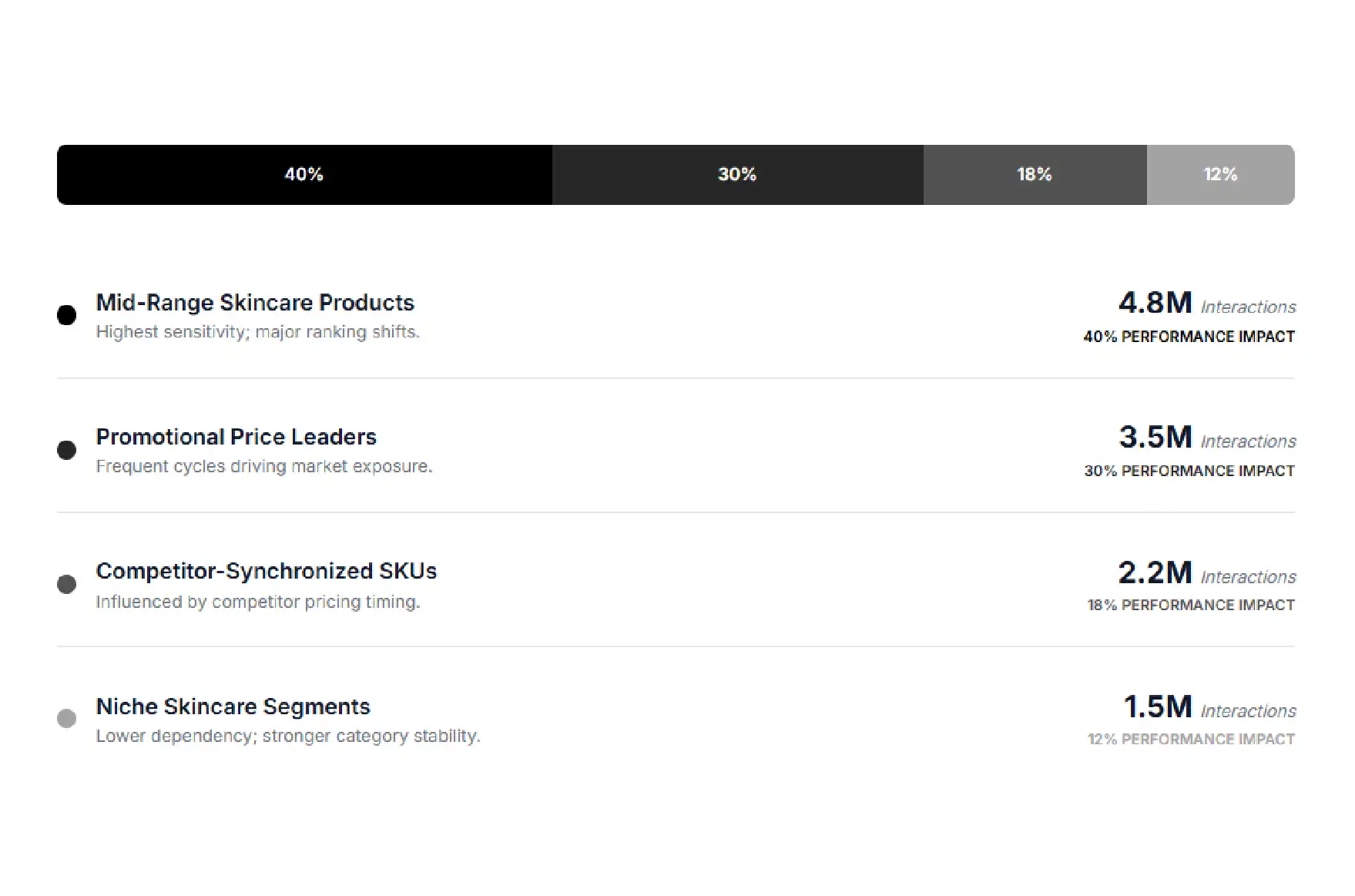
Analysis showed strong price elasticity in mid-range skincare products, where even small changes in discount percentage significantly influenced product ranking, visibility, and user engagement behavior. This indicates that consumers in this category are highly responsive to promotional triggers rather than purely brand-driven loyalty.
Frequent discount cycles across top-performing SKUs reflected aggressive competitive behavior, where brands continuously adjust pricing strategies to maintain visibility within marketplace ranking algorithms.
The system also identified that discount depth alone is not sufficient; timing, frequency, and competitor synchronization play a critical role in determining overall performance impact across skincare categories.
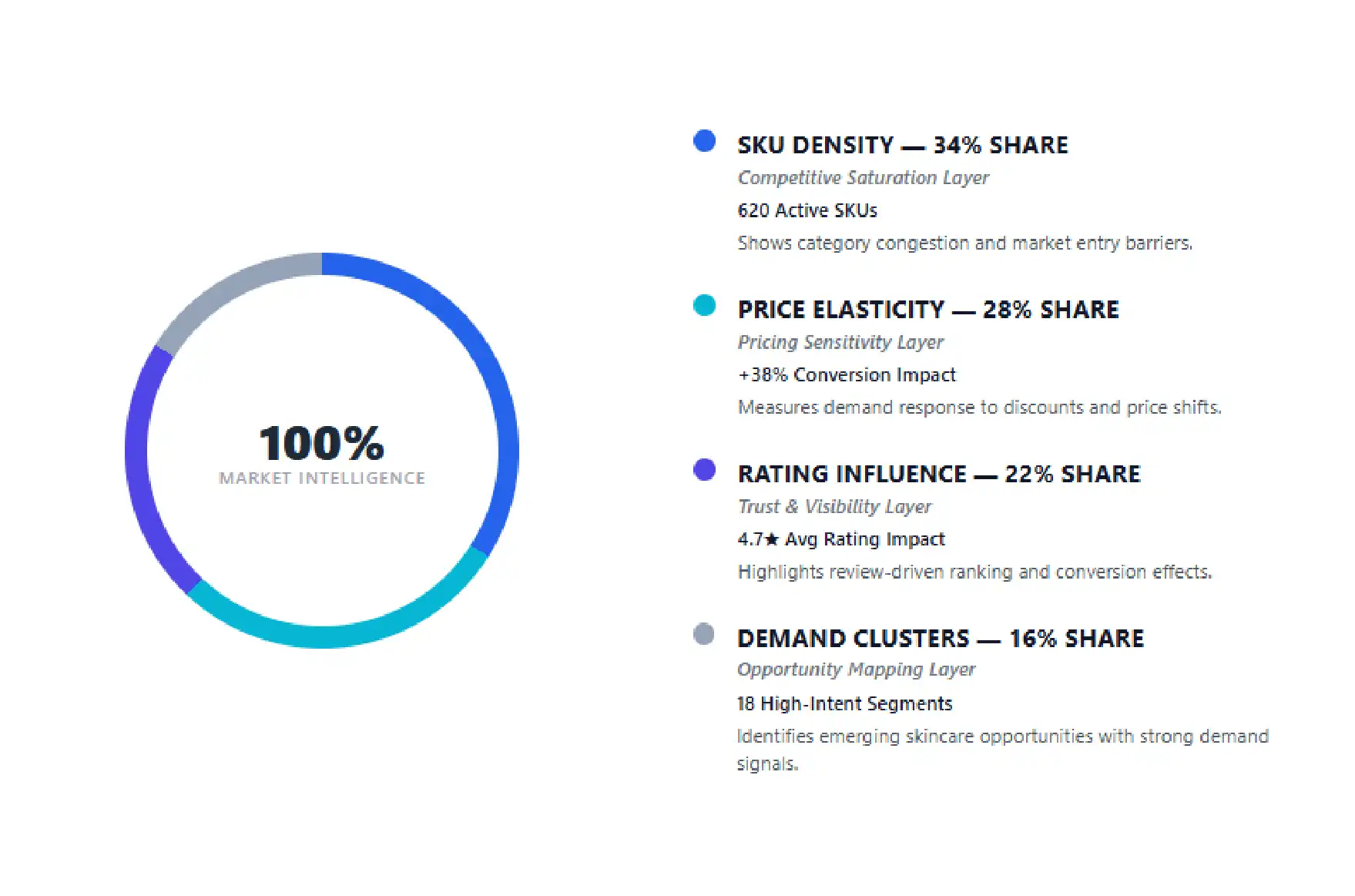
| Metric | Insight Captured | Business Impact |
|---|---|---|
| SKU Density | Level of competitive saturation across categories | Helps define entry barriers and market congestion zones |
| Price Elasticity | Sensitivity of demand to price and discount changes | Enables optimized pricing strategy for higher conversion |
| Rating Influence | Impact of reviews and ratings on ranking visibility | Improves conversion rate and trust-based positioning |
| Demand Clusters | Grouping of high-interest skincare segments based on engagement signals | Supports precise product prioritization and assortment planning |
These clustered insights enabled a deeper understanding of how different skincare categories behave in terms of consumer intent, allowing brands to align product launches with actual demand intensity rather than estimated projections.
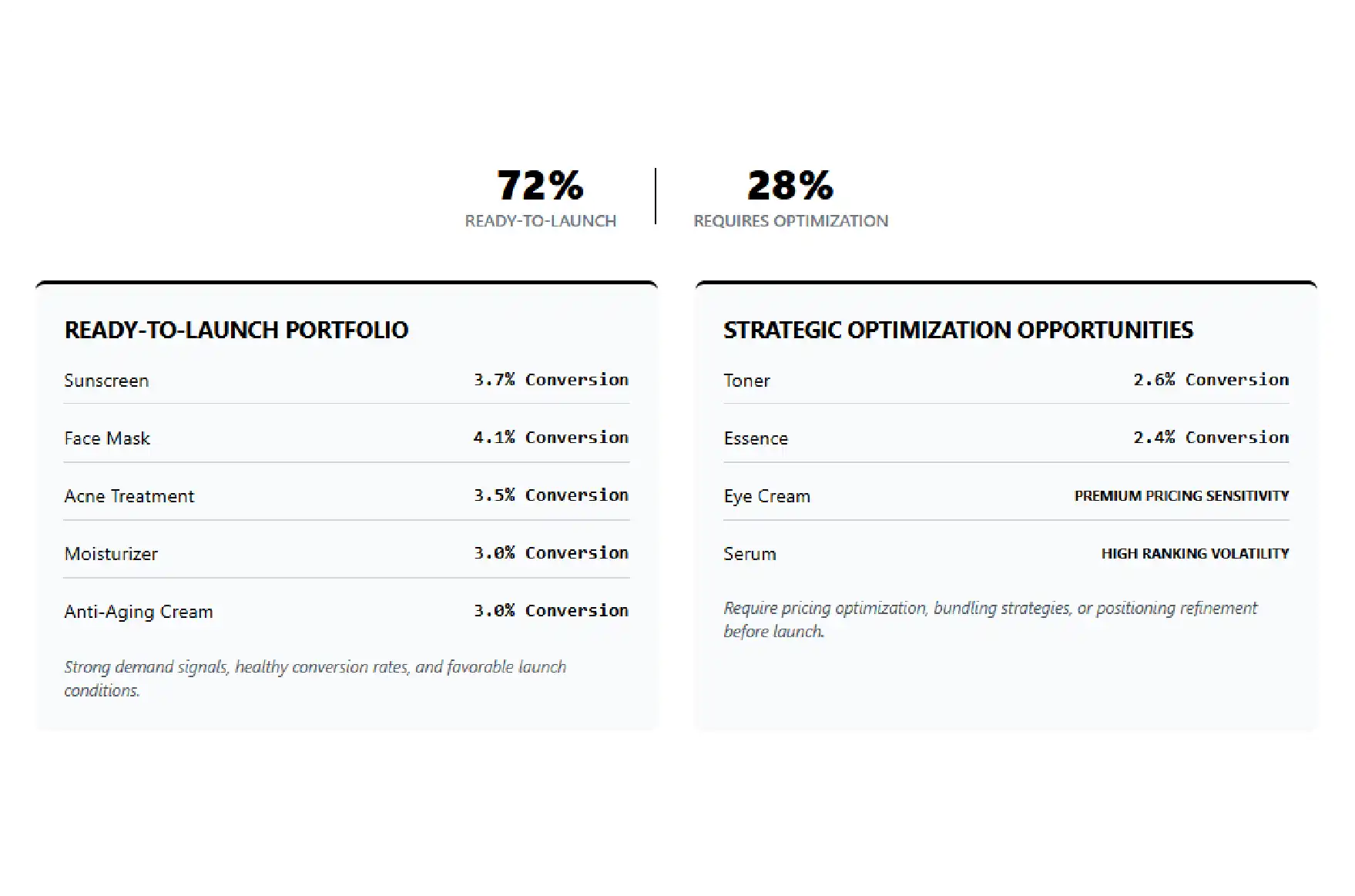
The system generated a structured launch readiness scoring framework by combining multiple intelligence layers including demand strength, competitive density, pricing volatility, and promotional intensity across skincare SKUs.
This scoring model allowed precise identification of SKUs and categories that are ready for immediate market entry versus those that require repositioning, bundling, or pricing adjustments before launch.
It also enabled simulation of market entry outcomes by evaluating how new K-Beauty products would perform under current competitive conditions, helping reduce launch risk and improve strategic decision accuracy.
This expanded Kaspi.kz beauty dataset provides deeper SKU-level intelligence across skincare categories, combining pricing, demand, competition, volatility, and conversion signals. It enables precise benchmarking, identifies saturation zones, and highlights high-opportunity segments for strategic K-Beauty marketplace entry decisions.
| Product Category | Brand Count | Avg Price | Discount Rate | Demand Score | Competition Level | SKU Density Index | Ranking Volatility | Conversion Rate |
|---|---|---|---|---|---|---|---|---|
| Cleanser | 820 | $12.5 | 18% | High | Very High | 0.92 | High | 3.4% |
| Serum | 760 | $18.2 | 22% | High | High | 0.88 | Very High | 3.1% |
| Toner | 640 | $10.8 | 15% | Medium | Medium | 0.71 | Medium | 2.6% |
| Moisturizer | 720 | $16.4 | 20% | High | High | 0.85 | High | 3.0% |
| Essence | 410 | $14.6 | 19% | Medium | Medium | 0.63 | Medium | 2.4% |
| Sunscreen | 530 | $13.9 | 25% | High | High | 0.81 | High | 3.7% |
| Face Mask | 690 | $9.8 | 28% | High | Very High | 0.94 | Very High | 4.1% |
| Eye Cream | 360 | $21.3 | 17% | Medium | Medium | 0.58 | Medium | 2.2% |
| Acne Treatment | 290 | $15.7 | 23% | High | Medium | 0.66 | High | 3.5% |
| Anti-Aging Cream | 480 | $24.1 | 21% | High | High | 0.79 | High | 3.0% |
Our system enables unified intelligence across fragmented beauty ecosystems by consolidating SKU, pricing, demand, and promotional data into a single structured analytics framework that removes data silos and provides a complete view of marketplace behavior across thousands of skincare products.
It continuously monitors competitive pricing behavior, discount cycles, ranking fluctuations, and promotional intensity across skincare categories, allowing brands to understand how competitors adjust strategies in real time and how these changes influence visibility and demand patterns.
It ensures high data accuracy through automated cleaning, deduplication, normalization, and validation processes that eliminate inconsistencies, remove outdated listings, and standardize SKU-level attributes for reliable cross-category comparison and forecasting.
It is built for large-scale SKU processing without performance loss, enabling stable ingestion and analysis of thousands of beauty products simultaneously while maintaining speed, scalability, and consistency across high-frequency marketplace updates.
It also enriches raw marketplace signals with structured intelligence layers such as demand scoring, competition indexing, and category clustering to support deeper strategic analysis.
Ultimately, it enables smarter, faster, and lower-risk K-Beauty marketplace entry decisions by transforming fragmented marketplace noise into clear, actionable insights for pricing, positioning, and product launch strategy.
The system gave us complete clarity on Kaspi.kz skincare competition before launch.
We now understand pricing, demand, and SKU positioning far more accurately.
This significantly reduced our market entry risk.
— Head of K-Beauty Strategy
The final outcome was a fully automated intelligence system converting Kaspi.kz marketplace data into structured K-Beauty insights.
The organization achieved faster decision-making and improved SKU benchmarking accuracy.
Implementation of Web Scraping API Services enabled real-time SKU-level extraction with enterprise-grade reliability.
Deployment of Web Scraping Services ensured scalable monitoring across thousands of skincare listings.
Overall, the solution delivered measurable ROI and a strong foundation for K-Beauty expansion strategy.
Leverage structured Kaspi.kz SKU intelligence to analyze pricing, competition, and demand patterns, enabling smarter, faster, and lower-risk K-Beauty product launches.
Start a projectIt converts raw skincare marketplace data into structured intelligence that helps K-Beauty brands analyze competition, pricing behavior, demand trends, and category saturation before making informed marketplace entry and launch decisions on Kaspi.kz.
It continuously captures real-time updates from thousands of skincare SKUs across Kaspi.kz, including pricing changes, discount variations, rating movements, ranking shifts, and category-level performance signals for structured competitive analysis.
Cleanser SKUs represent the most competitive and high-volume entry point in skincare, making them essential for understanding pricing pressure, competitor density, customer demand patterns, and overall market saturation before product launch.
Yes, it identifies early-stage demand shifts by analyzing engagement spikes, pricing fluctuations, review activity, and ranking movements, enabling brands to detect emerging high-demand skincare categories before they become saturated.
Yes, it is designed for enterprise-scale scalability, capable of processing thousands of skincare SKUs simultaneously while maintaining real-time performance, accuracy, and structured intelligence output across large and complex marketplaces.
We start by signing a Non-Disclosure Agreement (NDA) to protect your ideas.
Our team will analyze your needs to understand what you want.
You'll get a clear and detailed project outline showing how we'll work together.
We'll take care of the project, allowing you to focus on growing your business.