
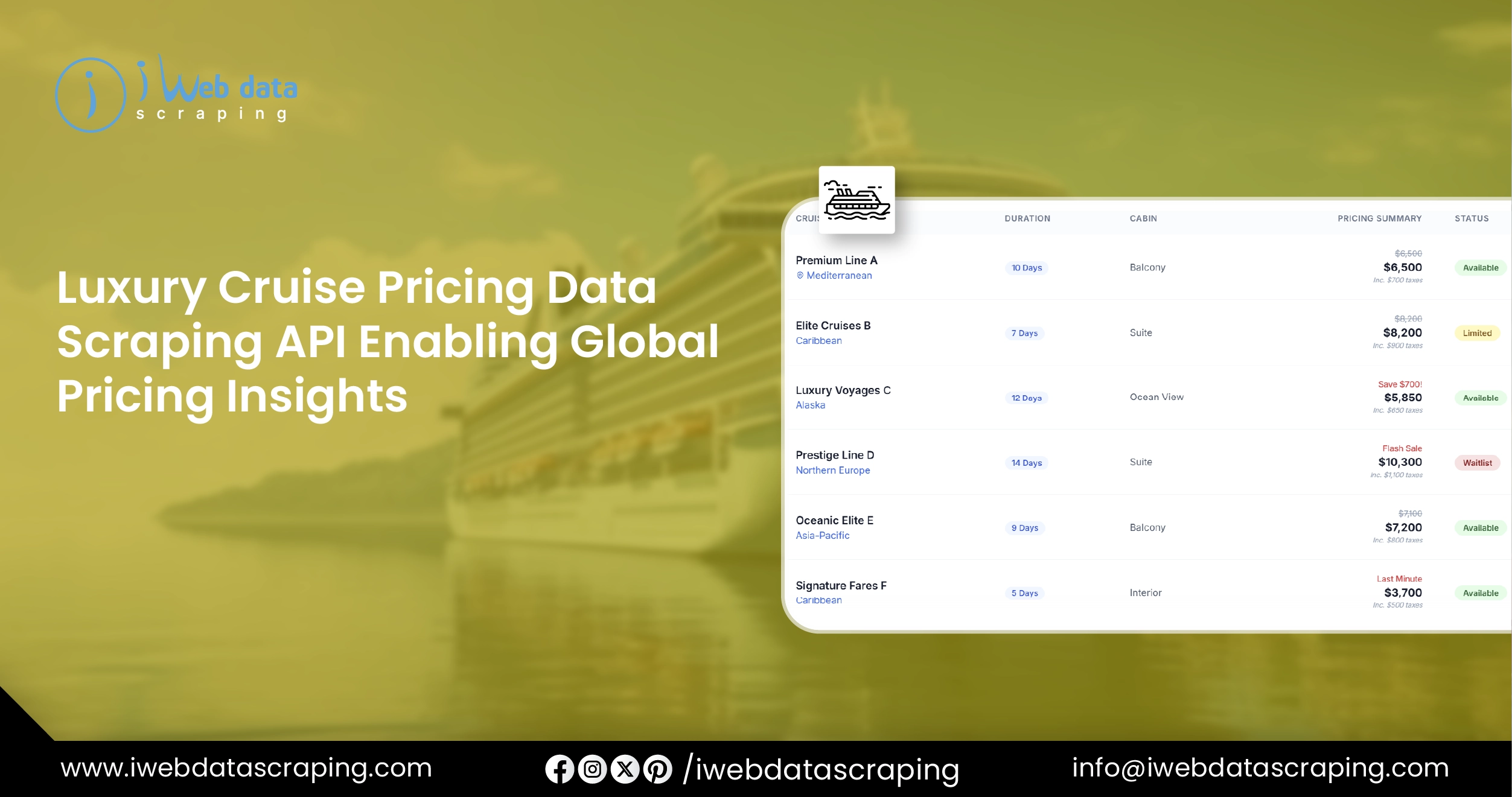
The global luxury cruise industry has witnessed exponential growth, driven by rising demand for premium travel experiences, personalized itineraries, and high-end onboard services. In this competitive landscape, pricing intelligence plays a critical role in decision-making for cruise operators, travel aggregators, and analytics firms. Leveraging a Luxury Cruise Pricing Data Scraping API, businesses can efficiently gather real-time pricing insights across multiple cruise lines and booking platforms.
Simultaneously, developing a Luxury Cruise Market Pricing Benchmark enables organizations to compare pricing strategies, identify seasonal fluctuations, and optimize revenue models. Advanced solutions that Scrape Luxury Cruise Pricing Trends Data empower stakeholders to analyze dynamic pricing patterns influenced by demand, route popularity, cabin categories, and promotional campaigns.
This research report explores the architecture, applications, benefits, and strategic importance of luxury cruise pricing data scraping APIs, supported by detailed datasets and comparative tables.
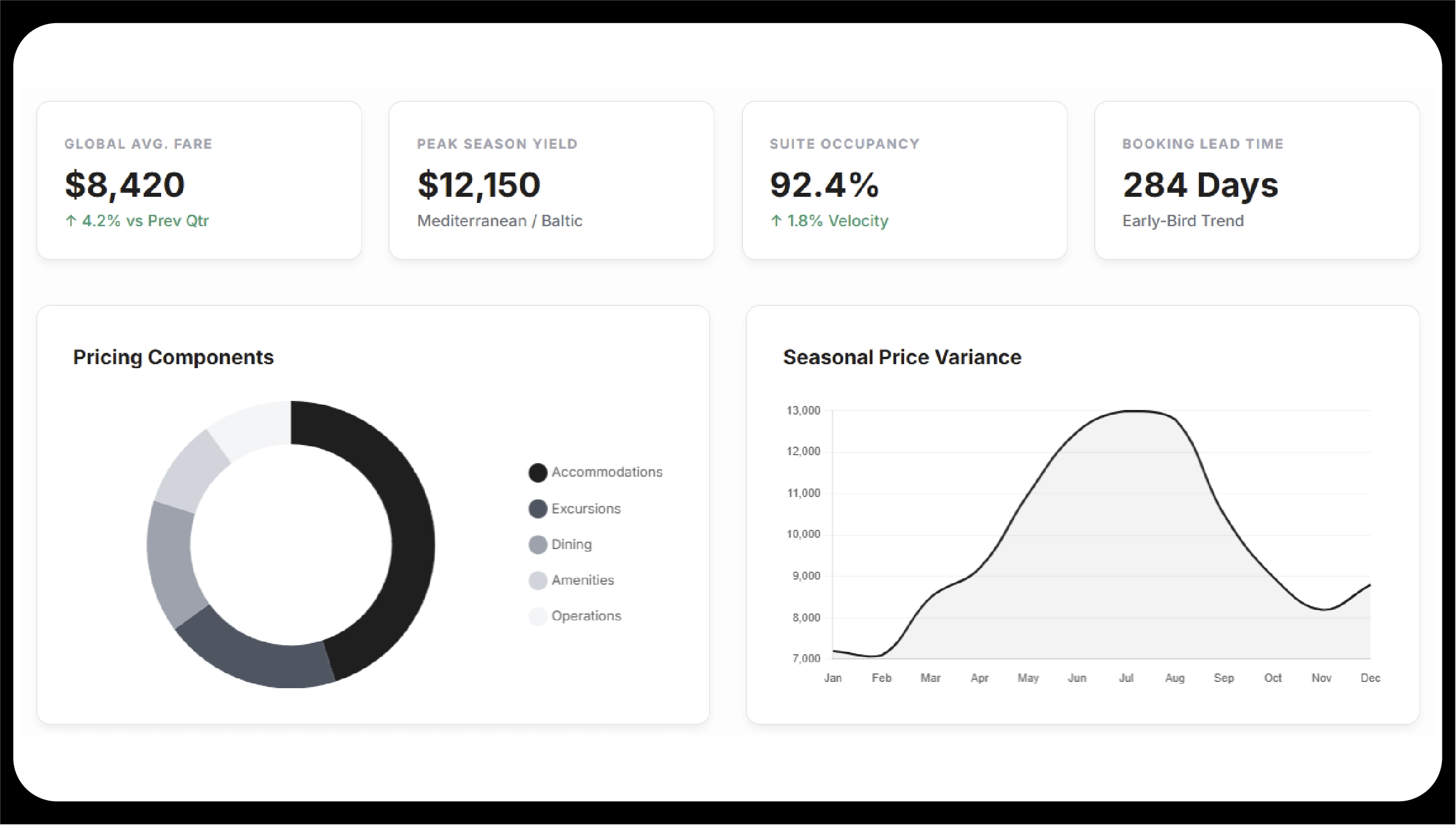
Luxury cruise pricing is influenced by a combination of structured and dynamic factors, including:
Unlike traditional travel pricing, cruise fares often bundle accommodations, dining, entertainment, and excursions. Therefore, extracting granular pricing data requires advanced scraping techniques capable of capturing multi-layered datasets.
A robust API designed to Extract Luxury Cruise Pricing Data enables automated data collection from cruise websites, OTA platforms, and travel marketplaces. These APIs provide structured outputs such as:
Modern systems integrate luxury cruise price monitoring API capabilities, allowing businesses to track pricing changes in near real-time and respond strategically.
Below are critical attributes typically extracted:
| Data Category | Description |
|---|---|
| Cruise Line Name | Operator or brand offering the cruise |
| Ship Name | Vessel used for the itinerary |
| Departure Port | Starting location of the cruise |
| Destination Region | Caribbean, Mediterranean, Arctic, etc. |
| Duration (Days) | Total cruise length |
| Cabin Type | Interior, Ocean View, Balcony, Suite |
| Base Price | Initial listed price |
| Discounted Price | Promotional or reduced fare |
| Taxes & Fees | Additional mandatory charges |
| Availability Status | Available, Waitlist, Sold Out |
| Booking Window | Advance booking timeline |
| Cruise Line | Region | Duration | Cabin Type | Base Price ($) | Discounted Price ($) | Taxes ($) | Final Price ($) | Availability |
|---|---|---|---|---|---|---|---|---|
| Premium Line A | Mediterranean | 10 Days | Balcony | 6,500 | 5,800 | 700 | 6,500 | Available |
| Elite Cruises B | Caribbean | 7 Days | Suite | 8,200 | 7,300 | 900 | 8,200 | Limited |
| Luxury Voyages C | Alaska | 12 Days | Ocean View | 5,900 | 5,200 | 650 | 5,850 | Available |
| Prestige Line D | Northern Europe | 14 Days | Suite | 10,500 | 9,200 | 1,100 | 10,300 | Waitlist |
| Oceanic Elite E | Asia-Pacific | 9 Days | Balcony | 7,100 | 6,400 | 800 | 7,200 | Available |
| Signature Fares F | Caribbean | 5 Days | Interior | 3,800 | 3,200 | 500 | 3,700 | Available |
| Royal Prestige G | Mediterranean | 11 Days | Suite | 9,800 | 8,900 | 1,000 | 9,900 | Limited |
| Luxe Sail H | Arctic | 15 Days | Suite | 12,500 | 11,200 | 1,300 | 12,500 | Waitlist |
Competitive Pricing Strategy
Businesses use cruise travel pricing data extraction to monitor competitor pricing and adjust their own offerings accordingly.
Demand Forecasting
Analyzing historical and real-time data helps predict peak booking periods and optimize pricing strategies.
Dynamic Pricing Optimization
With access to a cruise industry pricing intelligence dataset, cruise operators can implement AI-driven pricing adjustments.
Market Positioning
Luxury brands can assess whether their pricing aligns with perceived value and competitor benchmarks.
Modern APIs go beyond basic scraping and offer:
These capabilities enhance the effectiveness of Travel Data Scraping Services, enabling businesses to make data-driven decisions at scale.
| Season | Region | Avg Interior Price ($) | Avg Balcony Price ($) | Avg Suite Price ($) | Demand Index | Price Volatility |
|---|---|---|---|---|---|---|
| Winter | Caribbean | 3,500 | 5,800 | 7,900 | High | Medium |
| Spring | Mediterranean | 4,200 | 6,500 | 8,800 | Medium | Low |
| Summer | Alaska | 4,800 | 7,200 | 9,500 | Very High | High |
| Autumn | Europe | 3,900 | 6,100 | 8,200 | Medium | Medium |
| Winter | Asia-Pacific | 3,600 | 5,900 | 7,800 | High | Low |
| Summer | Arctic | 6,500 | 9,800 | 12,500 | Niche High | High |
Real-Time Insights
Access to live pricing enables proactive decision-making and quick adjustments to market changes.
Improved Revenue Management
Optimized pricing leads to higher occupancy rates and increased profitability.
Enhanced Customer Experience
Competitive pricing ensures better value for customers, improving satisfaction and loyalty.
Data-Driven Strategy
Combining Travel Data Intelligence with analytics tools enables deeper insights into consumer behavior.
Luxury cruise pricing APIs integrate seamlessly with:
They also support aggregation of Travel & Tourism App Datasets, providing a holistic view of travel pricing trends across multiple verticals.
Despite its advantages, there are several challenges:
Overcoming these challenges requires robust Web Scraping API Services and adaptive scraping frameworks.
The future of cruise pricing data scraping will be shaped by:
Businesses investing in advanced scraping technologies will gain a significant competitive edge.
Luxury cruise pricing data scraping APIs are transforming how businesses analyze and respond to market dynamics. By leveraging structured data extraction, real-time monitoring, and advanced analytics, organizations can unlock powerful insights into pricing trends and customer preferences.
Incorporating scalable Web Scraping API Services ensures reliable data acquisition across multiple sources, while professional Web Scraping Services help overcome technical and operational challenges. Furthermore, adopting Competitive Benchmarking Services enables businesses to stay ahead in an increasingly competitive luxury travel market.
As the industry continues to evolve, data-driven strategies powered by intelligent scraping solutions will remain central to success in the luxury cruise ecosystem.
Experience top-notch web scraping service and mobile app scraping solutions with iWeb Data Scraping. Our skilled team excels in extracting various data sets, including retail store locations and beyond. Connect with us today to learn how our customized services can address your unique project needs, delivering the highest efficiency and dependability for all your data requirements.
We start by signing a Non-Disclosure Agreement (NDA) to protect your ideas.
Our team will analyze your needs to understand what you want.
You'll get a clear and detailed project outline showing how we'll work together.
We'll take care of the project, allowing you to focus on growing your business.