Introduction
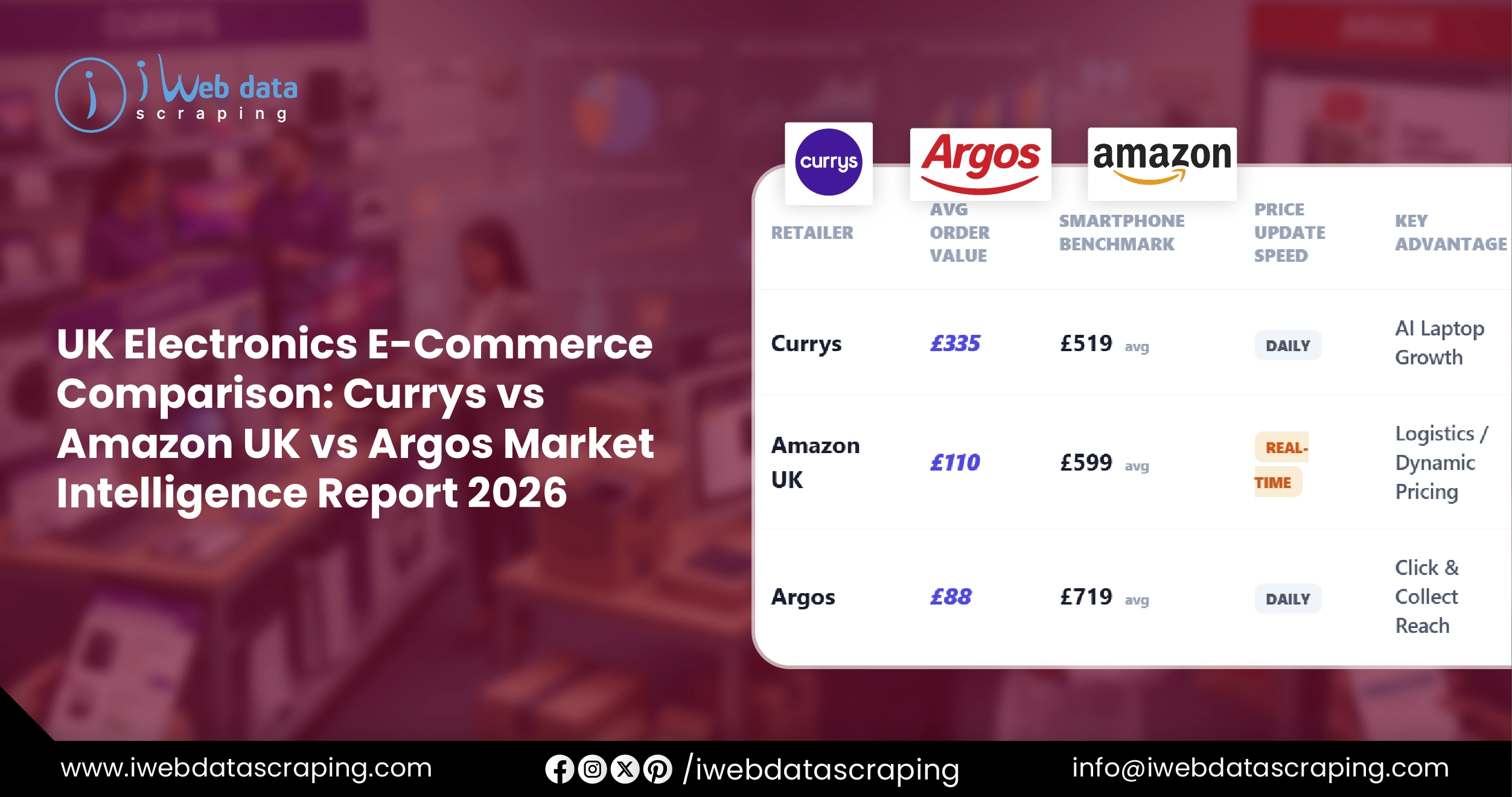
The UK consumer electronics market is one of the most competitive online retail
spaces globally, driven by high demand for smartphones, laptops, TVs, and smart home devices.
The rivalry between Currys, Amazon UK, and Argos defines pricing behavior, fulfillment strategy,
and customer experience across the sector.
In this research, we analyze platform positioning, pricing models, delivery
strategies, and competitive dynamics using structured e-commerce intelligence.
Key themes include marketplace dominance, omnichannel integration, and real-time
pricing volatility shaped by algorithmic systems and retail media competition.
UK Electronics E-Commerce Comparison: Currys vs Amazon UK vs Argos is increasingly
defined by data-driven pricing intelligence, where retailers continuously adjust margins to
remain competitive.
At the same time, the rise of UK electronics ecommerce price comparison tools has
intensified transparency, forcing retailers to align pricing strategies dynamically across
platforms.
Modern retail competitiveness is now heavily influenced by Scraping UK electronics
ecommerce data, enabling brands and analysts to track SKU-level fluctuations, promotions, and
stock availability in real time.
Market Position Overview
Amazon UK dominates overall scale, Argos leads in hybrid online-offline convenience,
and Currys maintains specialization in electronics expertise.
According to industry insights, Amazon holds the largest share in UK online general
merchandise and electronics sales, while Currys and Argos remain top-tier domestic competitors
with strong brand trust and omnichannel presence.
Table 1: Platform Performance & Operational Metrics (2026)
| Estimated UK Electronics Market Share |
18–22% |
45–50% |
20–24% |
| SKU Count (Electronics Category) |
~15,000 |
500,000+ |
~25,000 |
| Avg Discount Frequency (per month) |
6–10 cycles |
20–40 dynamic changes |
10–15 cycles |
| Avg Delivery Time |
1–3 days |
Same-day to 2 days (Prime) |
Same-day (click & collect) |
| Return Processing Time |
5–7 days |
2–5 days |
3–5 days |
| Price Update Frequency |
Daily–Weekly |
Real-time (algorithmic) |
Daily |
| Customer Satisfaction Score (est.) |
4.3/5 |
4.1/5 |
4.4/5 |
| In-store Presence |
300+ stores |
None |
850+ collection points |
| Electronics Category Focus |
High specialization |
Low specialization |
Medium specialization |
| Marketplace Sellers |
Limited |
1M+ sellers |
Growing (~10k+) |
Pricing & Strategy Intelligence
Amazon UK operates with highly dynamic pricing systems that adjust frequently
based
on demand, competition, and user behavior. This allows it to undercut competitors at scale
but
creates price instability.
Currys, in contrast, follows a more controlled pricing model with selective
discounts during promotional cycles like Black Friday and seasonal sales. Argos balances
both
approaches, often aligning prices with competitors while leveraging convenience-based value.
This competitive behavior is summarized in Currys vs Amazon vs Argos Pricing &
Strategy Analysis 2026, where Amazon leads in price aggressiveness, Argos leads in
convenience
value, and Currys leads in expert-driven product positioning.
The ongoing competition is also defined by Currys vs Amazon UK vs Argos
Electronics
pricing analysis, where SKU-level price tracking reveals frequent undercutting in
high-demand
categories like TVs and laptops.
Table 2: Electronics Category Price Benchmarking (2026 Sample Index)
(Index: Amazon UK = baseline 100)
| 55” 4K Smart TV |
102 |
100 |
105 |
10–35% |
High |
| Gaming Laptop |
104 |
100 |
108 |
15–40% |
Very High |
| iPhone / Flagship Smartphones |
103 |
100 |
106 |
5–25% |
Very High |
| Wireless Earbuds |
101 |
100 |
103 |
20–50% |
High |
| Smart Watches |
102 |
100 |
104 |
10–30% |
Medium |
| Home Appliances |
100 |
100 |
102 |
5–20% |
Medium |
| Smart Home Devices |
99 |
100 |
101 |
25–55% |
High |
| Gaming Consoles |
101 |
100 |
104 |
10–30% |
High |
Competitive Intelligence & Data Scraping Role
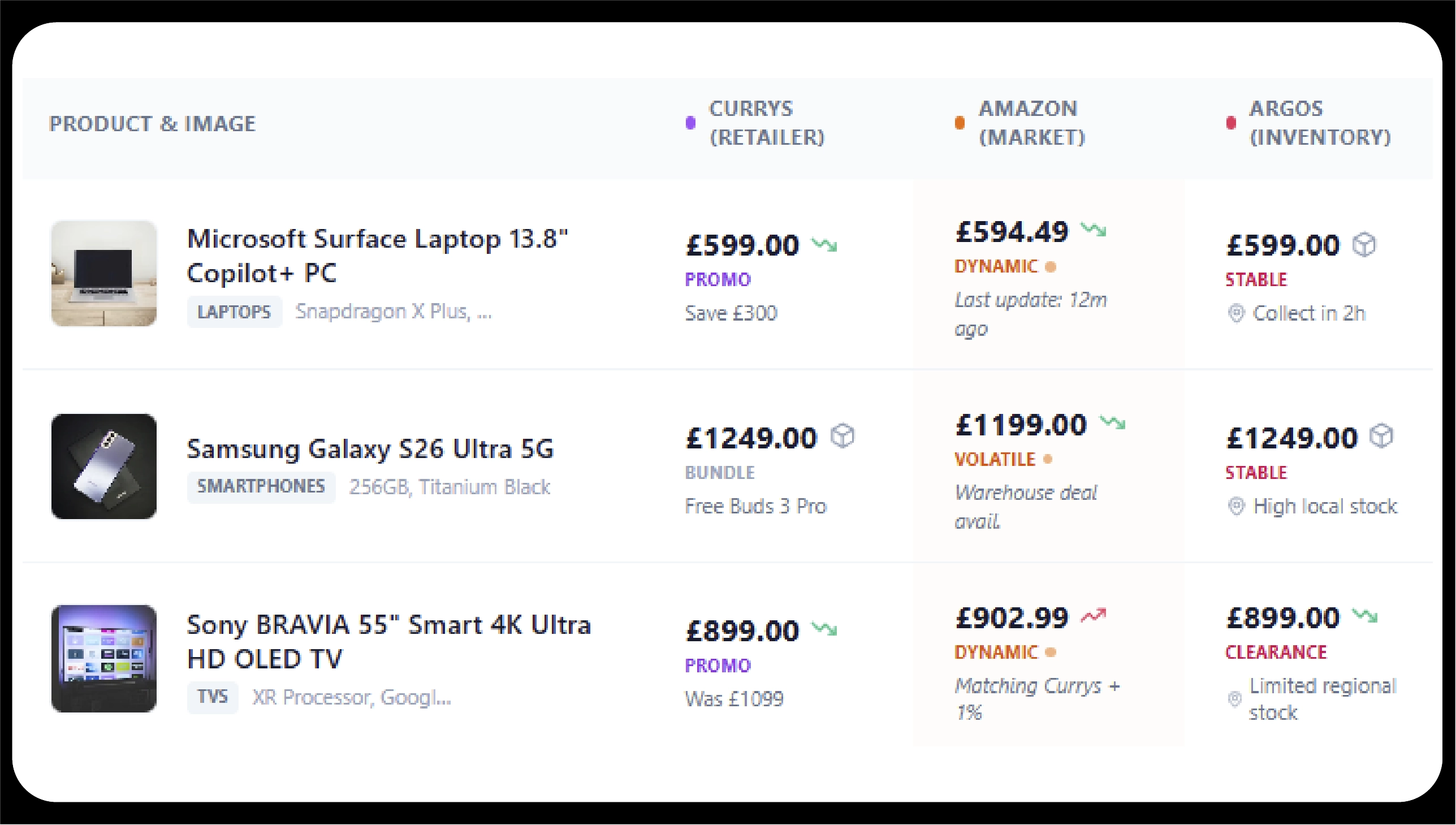
Modern retailers and analysts increasingly rely on automation to track pricing
and
inventory changes. For instance:
- Scrape electronics pricing trends across UK ecommerce platforms to enable detection of
real-time discount patterns and competitor undercutting.
- Currys focuses heavily on branded electronics, often maintaining stable pricing but
offering
bundled promotions.
- Amazon leverages algorithmic repricing, creating frequent fluctuations in identical
SKUs.
- Argos uses hybrid stock-based pricing tied to store availability.
Retail intelligence solutions such as Currys Electronics Product Data
Scraping
help
monitor category-level pricing shifts across laptops, TVs, and accessories.
Similarly, Amazon
Electronics
Product Data Scraping provides visibility into
marketplace seller competition and dynamic price adjustments.
Meanwhile, Argos
Electronics
Product Data Scraping is used to track
click-and-collect availability and localized pricing differences.
Omnichannel vs Marketplace Dynamics
Currys remains strong in physical-store-backed electronics expertise, giving it
credibility in high-value purchases like TVs and washing machines. Argos excels in same-day
fulfillment and hybrid retail, allowing customers to buy online and pick up quickly
in-store.
Amazon, however, dominates convenience, scale, and algorithmic efficiency. Its
marketplace model allows thousands of sellers to compete simultaneously, creating intense
price
compression.
This structural difference is why Amazon often appears cheaper, but not always
more
consistent in quality or warranty clarity.
Strategic Insights
- Amazon UK leads on price but not always on trust consistency
- Currys dominates expert-led electronics consultation and bundled offers
- Argos wins in speed and omnichannel convenience
- Price wars are most intense in smartphones, laptops, and smart devices
- Marketplace competition is driving continuous margin compression across all three
platforms
Future Outlook (2026 and Beyond)
The UK electronics e-commerce sector is moving toward:
- Hyper-dynamic pricing ecosystems
- Increased marketplace expansion (especially Argos launching third-party sellers)
- Greater reliance on retail media advertising
- AI-driven pricing optimization across SKUs
- Real-time competitor monitoring systems
Retailers are increasingly dependent on automated intelligence systems to remain
competitive in pricing and stock availability.
Conclusion
The comparison of Currys, Amazon UK, and Argos using Web Scraping Services highlight
a fragmented yet highly competitive electronics retail ecosystem in the UK. Amazon leads in
scale and pricing aggressiveness, Currys leads in expertise-driven retailing, and Argos
leads in
convenience-based fulfillment.
The integration of data intelligence systems is now essential to understand
SKU-level competition and pricing behavior in real time. Techniques such as Web Scraping
Electronics Product Data are becoming critical for competitive benchmarking and
strategic
decision-making.
Similarly, businesses increasingly rely on Web
Scraping API Services to automate
data extraction and pricing intelligence workflows.
Ultimately, success in the UK electronics e-commerce market depends on how
effectively retailers can adapt to dynamic pricing ecosystems, omnichannel expectations, and
real-time consumer demand shifts—making data the most powerful competitive advantage in
2026.
Experience top-notch web scraping
service
and mobile app scraping solutions with iWeb
Data
Scraping. Our skilled team excels in extracting various data sets, including retail store locations and beyond. Connect with us
today to learn how our customized services can address your unique project needs, delivering
the
highest efficiency and dependability for all your data requirements.