Introduction
The US coffee shop industry is one of the most resilient and habit-driven consumer markets in the country. Coffee is not merely a beverage in America—it is a daily ritual that fuels workdays, commutes, meetings, and social interactions. This research report provides a complete statistical breakdown of the industry, covering consumer behavior, total market size, growth forecasts, store distribution, major chain dominance, pricing trends, and operational stability.
Modern retail intelligence powered by US coffee shop location data scraping allows analysts to map every store footprint across states and cities. When combined with a Real-time coffee shop analytics dataset, businesses gain instant visibility into openings, closures, density patterns, and expansion hotspots. A structured Coffee shop store locator dataset USA further enhances geographic planning, site selection, and competitor benchmarking.
Coffee Consumption Habits: The Foundation of Industry Stability
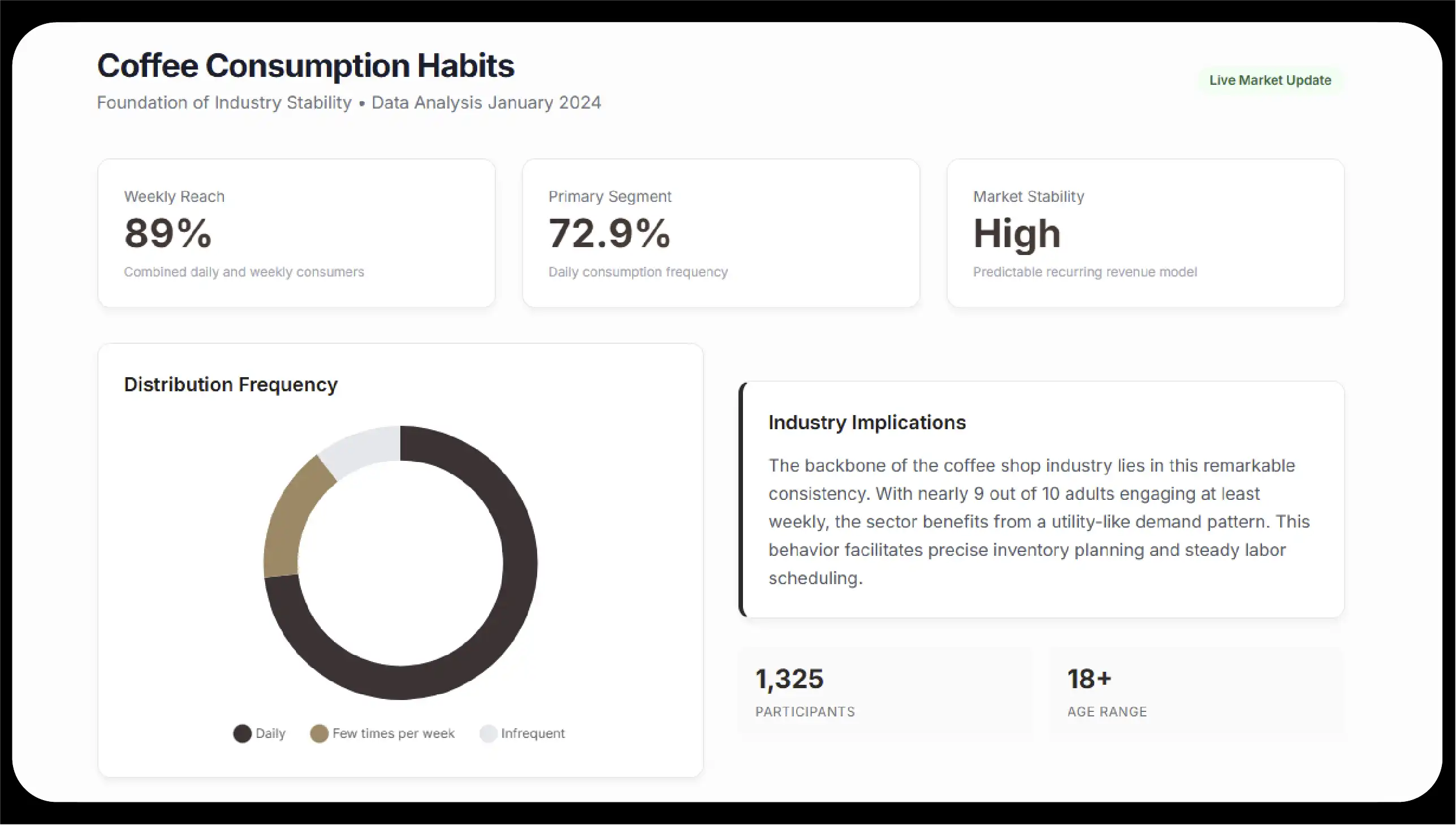
The backbone of the coffee shop industry lies in consumption frequency. Survey data from January 2024 (1,325 U.S. adults aged 18+) reveals a remarkably consistent demand pattern:
- 72.9% of Americans drink coffee daily
- 16.1% drink coffee a few times per week
- Only 10.4% consume coffee infrequently
This means nearly 89% of American adults drink coffee at least weekly. From a business perspective, that creates predictable foot traffic and recurring revenue.
What This Means for Operators?
Daily drinkers are not occasional customers—they are repeat visitors who contribute to stable weekday sales. This repeat demand supports subscription models, loyalty apps, and digital ordering systems. In contrast, the small infrequent segment represents a growth opportunity through targeted promotions and product innovation.
Coffee’s integration into morning routines ensures resilience even during economic uncertainty. While consumers may cut discretionary spending elsewhere, coffee remains an affordable daily indulgence.
Market Size and Growth Projections
The US coffee market is valued at $23.96 billion in 2025 and is projected to reach $28.94 billion by 2030. This represents:
- A $4.98 billion increase over five years
- A compound annual growth rate (CAGR) of 3.85%
This steady growth rate signals long-term sustainability rather than short-term volatility.
US Coffee Market Size and Growth Forecast
| Market Size (2025) |
$23.96 Billion |
| Projected Size (2030) |
$28.94 Billion |
| Total Growth |
$4.98 Billion |
| CAGR (2025–2030) |
3.85% |
| Average Annual Increase |
~$1 Billion |
For investors and franchise operators, this predictable expansion supports long-term planning, financing approvals, and equipment investments.
Number of Coffee Shops and Industry Structure
The United States has nearly 32,000 coffee shop locations currently in operation. The operational breakdown indicates strong industry health:
- 31,752 locations open
- 81 opening soon
- 18 temporarily closed
- 5 possibly closed
Less than 1% face operational uncertainty, confirming structural stability across the market.
The ability to perform Coffee pricing data extraction and store tracking helps analysts monitor performance shifts across regions, identifying whether closures are cyclical or localized.
Major Chains vs Independent Cafés
The US coffee shop landscape is highly concentrated at the top yet diverse overall. National chains dominate total store count, but thousands of independent cafés serve local communities.
Leading Coffee Chains by Location Count
- Starbucks – 17,137 locations
- Dunkin – 9,830 locations
- Dutch Bros Coffee – 1,020 locations
- Tim Hortons – 696 locations
- Caribou Coffee – 490 locations
- BIGGBY Coffee – 448 locations
Starbucks alone operates nearly twice as many stores as its closest competitor.
Largest Coffee Chains in the US by Store Count
| 1 |
Starbucks |
17,137 |
| 2 |
Dunkin |
9,830 |
| 3 |
Dutch Bros Coffee |
1,020 |
| 4 |
Tim Hortons |
696 |
| 5 |
Caribou Coffee |
490 |
| 6 |
BIGGBY Coffee |
448 |
The concentration at the top demonstrates strong economies of scale in procurement, branding, and technology adoption. However, independent cafés remain competitive in niche markets through specialty roasting, artisanal beverages, and hyperlocal branding.
Industry researchers often Scrape Coffee chains vs independent cafés US to measure density, pricing differences, and neighborhood penetration rates.
Geographic Distribution Across States
Coffee shop distribution strongly correlates with population size and urban density. The top states by number of coffee shops are:
- California – 4,063
- New York – 2,507
- Texas – 2,355
- Florida – 1,910
- Illinois – 1,483
- Massachusetts – 1,374
- New Jersey – 1,239
- Pennsylvania – 1,139
- Ohio – 1,035
- Michigan – 977
California’s dominance is driven by both high population and a deeply embedded café culture.
From a location intelligence perspective, Scraping Restaurant and café data API USA enables granular mapping of urban clusters, suburban growth corridors, and underserved regions.
City-Level Concentration
At the city level, coffee shop density highlights urban demand intensity.
Top cities by store count include:
- Chicago – 412
- New York – 388
- Houston – 281
- Las Vegas – 261
- Los Angeles – 232
- Brooklyn – 199
- Philadelphia – 178
- San Antonio – 176
- San Diego – 158
- Phoenix – 158
High-density cities support multiple formats: drive-thru chains, boutique cafés, kiosk models, and premium specialty coffee shops.
Starbucks’ Dominance by State
Starbucks maintains presence across 52 states and territories, making it the only fully national coffee chain.
Its strongest state markets are:
- California – 3,184 locations
- Texas – 1,471 locations
- Florida – 932 locations
- New York – 763 locations
- Washington – 728 locations
This scale creates unmatched brand visibility and purchasing leverage.
Pricing Trends and Revenue Implications
Coffee prices show consistent upward movement. The average price increased from $3.25 in January 2024 to $3.50 in May 2025, representing:
- $0.25 total increase
- Approximately 7.7% growth over 16 months
Most of the increase occurred gradually throughout 2024, with stabilization in early 2025.
Gradual price acceptance demonstrates that consumers tolerate incremental adjustments, especially when paired with digital rewards programs or perceived value upgrades.
Industry Stability and Investment Outlook
Operational data confirms that over 99% of coffee shops remain open. The combination of habitual demand, predictable growth, and gradual pricing flexibility positions the industry as one of the most stable foodservice segments.
From a strategic standpoint, US café and coffee shop market analysis reveals:
- High customer loyalty
- Scalable franchise models
- Urban saturation with rural expansion opportunities
- Resilience during moderate economic slowdowns
Investors view the industry as low-volatility compared to trend-driven restaurant segments.
Conclusion: A Dependable and Expanding Market
The US coffee shop industry stands as a $23.96 billion market with strong projected growth to $28.94 billion by 2030. Nearly 90% of Americans consume coffee weekly, supporting one of the most dependable recurring revenue models in foodservice.
This comprehensive Coffee shop industry report US extraction confirms:
- Massive daily consumer participation
- Dominance of large national chains
- Strong geographic clustering in major states
- Stable operational performance
- Consistent, moderate pricing growth
To extract Number of coffee shops in the US, location intelligence tools and structured datasets are essential for accuracy. Analysts also increasingly scrape Largest coffee chains in America to benchmark competitive scale and market share shifts.
Overall, the industry is built on deeply ingrained consumer habits that create reliable demand. With steady growth, geographic expansion potential, and strong operational health, the US coffee shop sector remains one of the most attractive and resilient retail categories in the American economy.
Experience top-notch web scraping service and mobile app scraping solutions with iWeb Data Scraping. Our skilled team excels in extracting various data sets, including retail store locations and beyond. Connect with us today to learn how our customized services can address your unique project needs, delivering the highest efficiency and dependability for all your data requirements.