The quick service restaurant (QSR) industry in North America is evolving rapidly, driven by digital ordering, pricing volatility, and changing consumer expectations. To stay competitive, brands, investors, and analysts increasingly rely on Web Scraping QSR market data of Canada vs USA to understand pricing strategies, menu innovation, and expansion patterns across borders. Data-driven insights are no longer optional—they are essential for navigating the fast-moving QSR landscape.
As competition intensifies, quick service restaurant Data Scraping enables stakeholders to monitor thousands of menu items, promotions, and store-level changes in real time. This approach eliminates guesswork and provides accurate intelligence on how leading chains adapt to inflation, labor costs, and consumer demand.
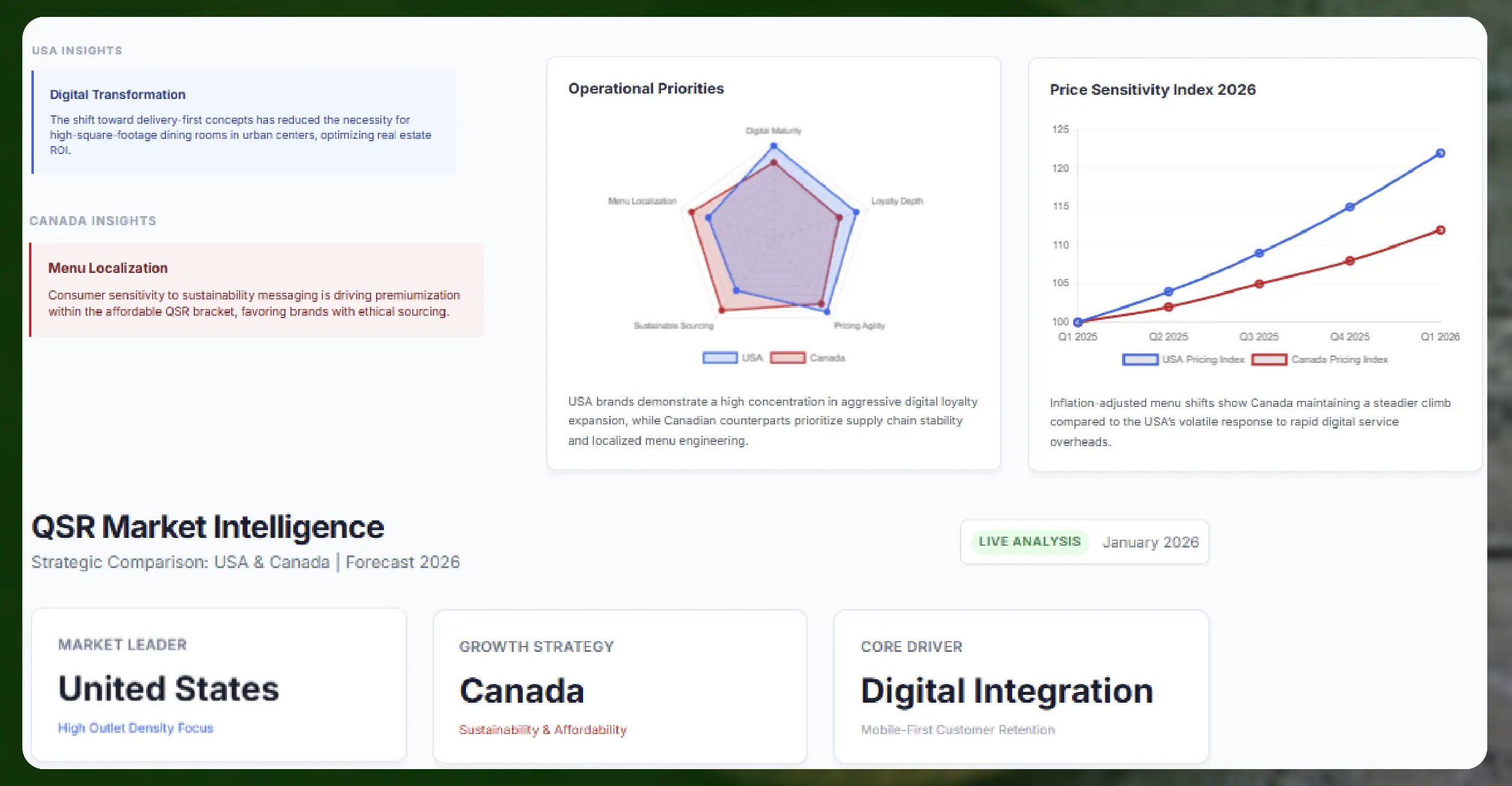
Looking ahead, the Canada vs USA QSR growth forecast 2026 highlights diverging but complementary trajectories. While the U.S. market continues to scale through technology-driven convenience, Canada’s QSR sector is showing strong momentum in value-driven menus and regional customization.
The U.S. remains the world’s largest QSR market, characterized by high outlet density, aggressive pricing strategies, and rapid adoption of digital platforms. USA QSR data insights reveal that mobile ordering, loyalty programs, and delivery-first concepts are reshaping how fast-food brands compete for repeat customers.
In Canada, QSR growth is steadier but highly strategic. Brands focus on affordability, localized flavors, and sustainability messaging. By analyzing pricing and menu data, operators can Extract Canada restaurant pricing trends 2026 to understand how inflation, supply chain shifts, and consumer sensitivity influence menu decisions.
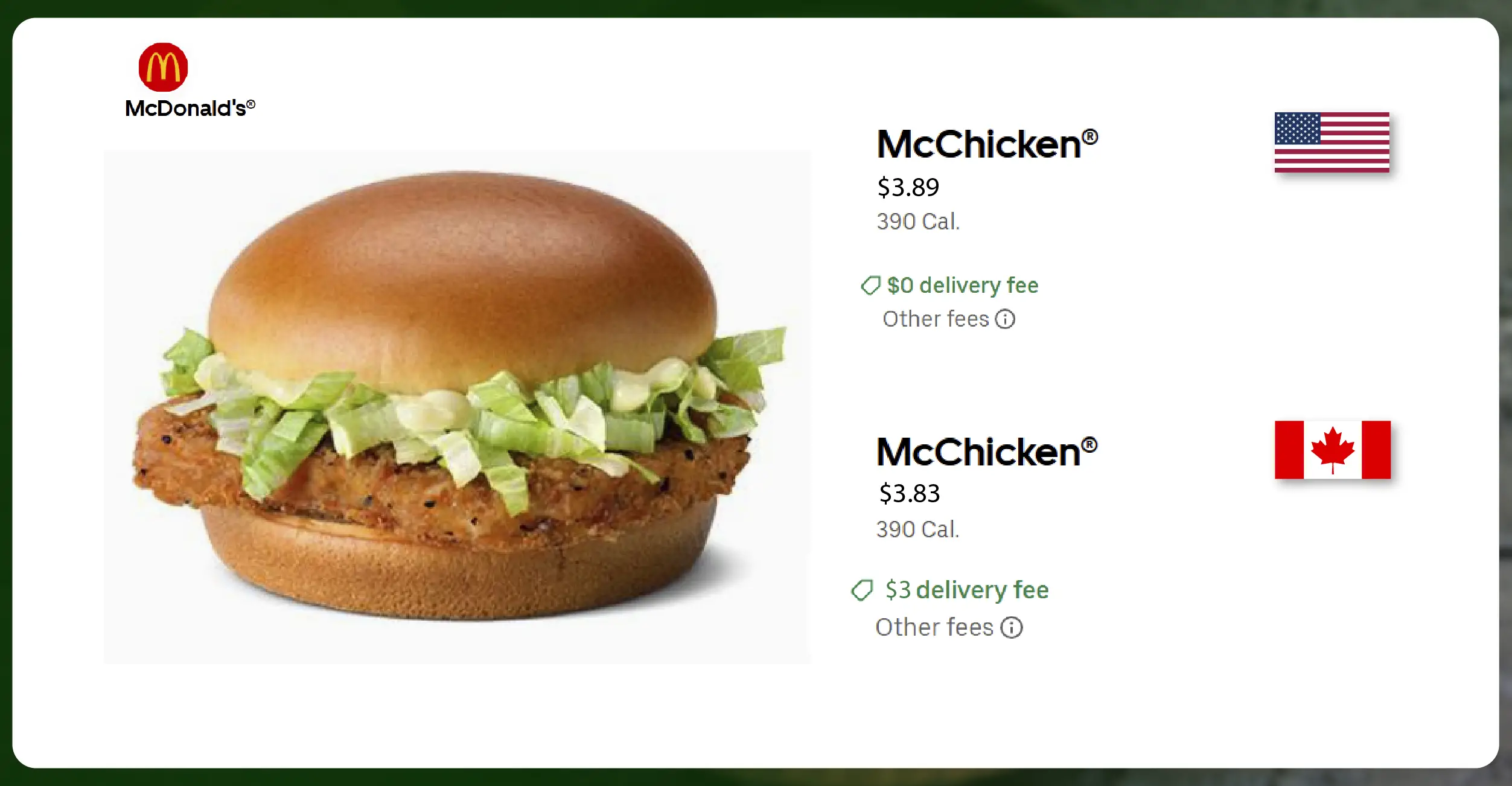
One of the most critical use cases for data scraping in QSR markets is pricing intelligence. Inflation and supply volatility have made dynamic pricing a necessity rather than a strategy. Brands increasingly Scrape fast food competitive pricing data for Canada vs USA to benchmark value meals, combo pricing, and promotional offers across regions.
This cross-border pricing comparison helps multinational chains decide whether to standardize prices or localize menus. It also allows investors and analysts to identify margin pressures and pricing resilience in different markets.
Consumer preferences play a decisive role in shaping QSR strategies. QSR consumer behavior insights of Canada vs USA show that U.S. consumers prioritize speed, convenience, and digital accessibility, while Canadian consumers place greater emphasis on value, portion fairness, and menu transparency.
By analyzing reviews, order patterns, and menu engagement, brands can tailor offerings more effectively. Understanding these behavioral differences is especially important for chains planning cross-border expansion or menu rollouts.
The ability to collect large-scale, structured information is what differentiates reactive brands from proactive ones. QSR data scraping for Canada vs USA allows businesses to monitor competitor moves, track seasonal pricing shifts, and identify emerging menu trends without manual research.
Data scraping transforms fragmented online information into actionable intelligence, enabling faster decision-making across marketing, pricing, and operations.
Expansion decisions require more than surface-level metrics. A true cross-border market comparison QSR for Canada vs USA includes store density, pricing elasticity, menu localization, and regional demand signals.
With scraped data, businesses can assess which market offers stronger growth potential for specific cuisines, price tiers, or service models. This insight reduces expansion risk and improves capital allocation.
Modern QSR intelligence relies on automation and scalability. QSR digital data extraction for Canada vs USA captures data from websites, apps, aggregators, and delivery platforms, providing a real-time view of how brands operate in different markets.
This digital-first approach ensures accuracy and consistency while enabling historical trend analysis for forecasting and strategy development.
Beyond pricing and menus, location strategy is critical to QSR success. Fast food Stores location Data Scraping : helps brands analyze outlet density, proximity to competitors, urban vs suburban performance, and underserved regions.
Location intelligence supports smarter site selection, franchise planning, and delivery radius optimization—key factors in both mature and emerging QSR markets.
Unlock actionable QSR market insights—Get started with our data scraping services today and stay ahead of the competition.
A reliable Restaurant Data Scraping Service supports multiple stakeholders:
By centralizing data from multiple sources, organizations gain a unified view of the competitive landscape.
Looking toward 2026, QSR growth in both Canada and the U.S. will be shaped by automation, AI-driven personalization, and value engineering. Pricing transparency and menu agility will become core competitive advantages.
Data scraping enables forecasting by identifying early signals—such as menu simplification, portion resizing, or increased value bundles—before they become widespread industry trends.
As the QSR industry becomes increasingly data-driven, structured intelligence will define market leaders. Access to Restaurant Menu Datasets allows brands to analyze offerings at scale and respond quickly to consumer expectations.
With advanced Food Data Scraping API Services, businesses can automate data collection, ensure accuracy, and integrate insights directly into analytics platforms.
Combined with forward-looking intelligence like the USA Fast Food Market Outlook 2026, web scraping empowers decision-makers to anticipate change, optimize strategy, and compete confidently in both the Canadian and U.S. QSR markets.
Experience top-notch web scraping service and mobile app scraping solutions with iWeb Data Scraping. Our skilled team excels in extracting various data sets, including retail store locations and beyond. Connect with us today to learn how our customized services can address your unique project needs, delivering the highest efficiency and dependability for all your data requirements.
QSR market data scraping involves collecting pricing, menu, location, and promotional data from fast-food brands. It helps businesses understand market trends, competition, and consumer demand more accurately.
Data scraping highlights differences in pricing strategies, menu localization, consumer preferences, and store density between the two markets, enabling better cross-border comparisons.
Businesses can analyze price movements, popular menu items, promotional frequency, expansion patterns, and customer behavior to improve strategy and forecasting.
QSR brands, food delivery platforms, investors, consultants, and market researchers benefit by gaining real-time competitive intelligence and trend visibility.
By tracking historical and real-time data, scraping helps identify early trend signals, allowing businesses to predict growth patterns, pricing shifts, and consumer behavior changes leading up to 2026.