Introduction
The rapid evolution of the U.S. mobility ecosystem has intensified the need to scrape EV vs gas stations US comparison datasets to understand infrastructure readiness, pricing competitiveness, and accessibility gaps. As electric mobility accelerates, stakeholders increasingly analyze the Electric vehicle charging network USA landscape to benchmark it against traditional fuel infrastructure. A detailed comparison of EV charging stations in the US and gasoline stations reveals differences in density, geographic distribution, operating models, and pricing structures.
This research report presents a structured comparison of EV and gas station networks across the United States, including infrastructure availability, cost patterns, growth trajectories, and data intelligence opportunities.
Overview of U.S. Fueling Infrastructure
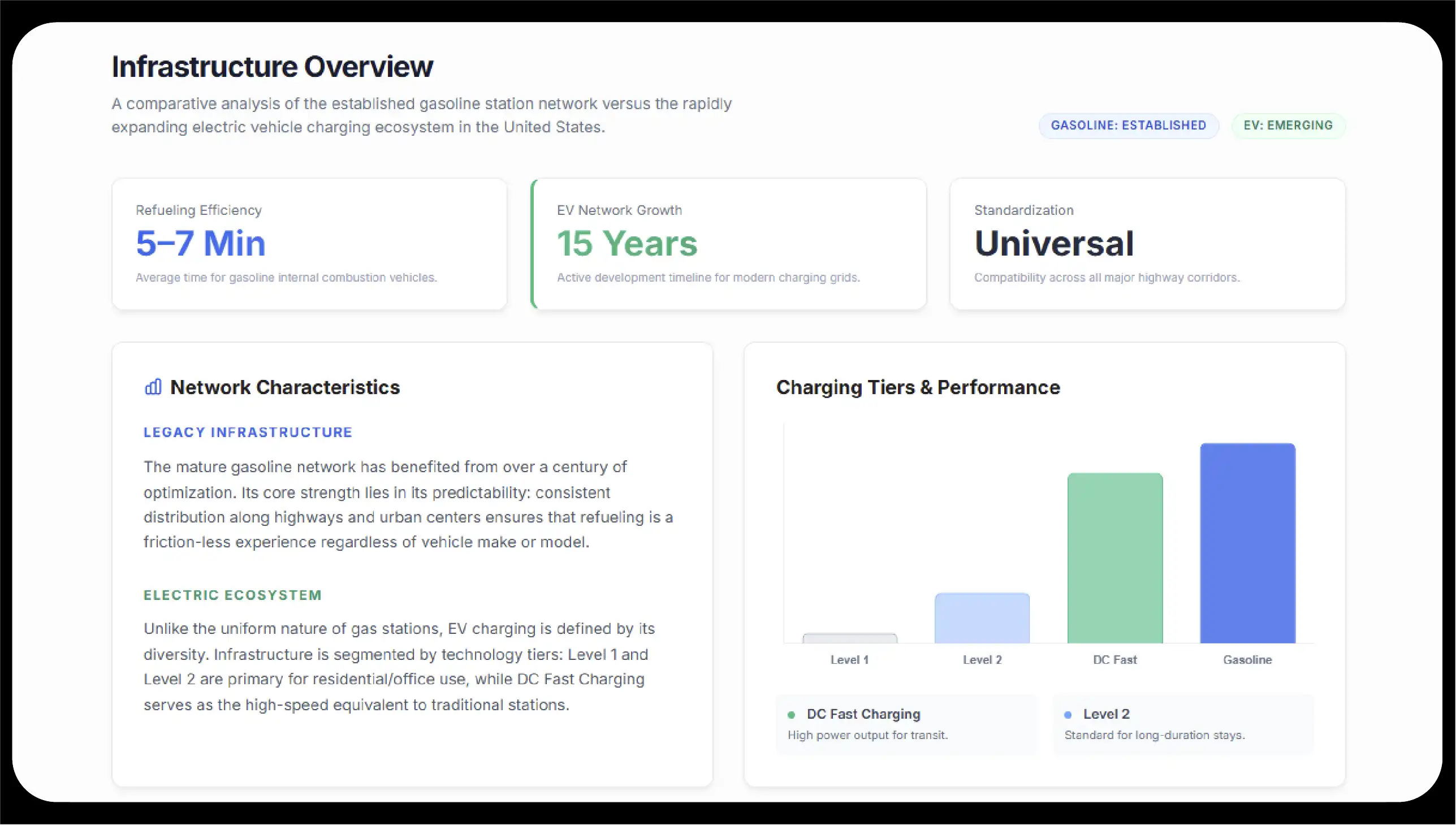
The U.S. fueling ecosystem consists of a mature gasoline station network developed over more than a century and a rapidly expanding EV charging ecosystem developed primarily over the past 10–15 years.
Gas stations typically offer quick refueling times (5–7 minutes), universal vehicle compatibility, and consistent distribution along highways and urban corridors.
EV charging networks, in contrast, vary by charger type (Level 1, Level 2, DC Fast Charging), charging speed, power output, connector type, and pricing model.
Infrastructure Availability & Geographic Coverage
A key debate revolves around Gas station vs EV charger availability across states and metropolitan regions. Gas stations still outnumber EV charging locations nationwide, but EV infrastructure is growing at a significantly faster rate.
US Gas Stations vs EV Charging Stations (Estimated 2025 Comparison)
| Total Locations |
~145,000 |
~65,000+ |
| Total Charging Ports / Pumps |
~900,000 fuel pumps |
~170,000+ charging ports |
| Urban Concentration |
High |
Very High |
| Rural Coverage |
Extensive |
Moderate, expanding |
| Highway Corridor Coverage |
Mature & dense |
Rapidly expanding (federal funding supported) |
| Average Refueling Time |
5–7 minutes |
20–45 mins (DC Fast), 4–8 hrs (Level 2) |
Although gas stations maintain a larger footprint, US EV charging infrastructure growth is outpacing new gas station development. Federal and state-level funding programs are accelerating charger installations along major corridors and underserved communities.
Pricing Comparison: Fuel vs Electricity
One of the most critical evaluation metrics involves comparing fuel prices with EV charging costs using structured intelligence from a Fuel price vs EV charging price dataset.
Gasoline prices fluctuate daily based on crude oil markets, regional taxes, and distribution logistics. EV charging prices vary depending on network operator, charger speed, time-of-use pricing, and state electricity rates.
Average Cost Comparison (US National Averages – 2025)
| Average Energy Price |
$3.50 per gallon |
$0.28 per kWh (public fast charger avg) |
| Cost per 100 Miles |
$12–$15 |
$8–$12 |
| Home Charging Option |
Not applicable |
$0.12–$0.18 per kWh |
| Price Volatility |
High (oil market dependent) |
Moderate (utility regulated) |
| Subscription/Member Pricing |
Rare |
Common in charging networks |
While EV charging can be more economical per mile, public fast-charging sometimes narrows the gap compared to gasoline.
Growth Trends & Expansion Dynamics
The evolution of EV infrastructure is strongly driven by federal investment programs and automaker commitments. The US EV charging infrastructure growth trajectory shows double-digit annual expansion rates, significantly faster than traditional gas station development.
Key Growth Drivers:
- Federal corridor funding programs
- Private network investments
- Corporate fleet electrification
- State zero-emission vehicle mandates
- Consumer EV adoption growth
Long-term projections indicate EV charging stations could approach parity with gas stations in key urban regions within the next decade.
Data Intelligence & Scraping Applications
The comparison between fueling models becomes significantly more powerful when powered by structured data collection methodologies.
Businesses leverage EV charging station data scraping techniques to monitor charger uptime, pricing shifts, connector types, and geographic gaps. A comprehensive US EV charger location dataset enables route planning, expansion analysis, and competitive benchmarking.
Similarly, petroleum analytics firms rely on Gas station location data scraping USA to track fuel price changes, retail branding shifts, and station closures.
Advanced platforms also Scrape EV charging station availability data to provide real-time occupancy, queuing patterns, and performance benchmarking.
This intelligence helps:
- Fleet operators optimize routing
- Investors identify expansion opportunities
- Urban planners evaluate accessibility gaps
- Competitors monitor pricing dynamics
Operational Differences: Speed, Scalability & User Experience
| Refueling Speed |
Extremely fast |
Varies by charger type |
| Infrastructure Cost |
Lower per pump |
Higher for DC Fast Chargers |
| Scalability |
Land dependent |
Grid-capacity dependent |
| Maintenance Complexity |
Moderate |
Higher (software + hardware) |
| Energy Source |
Fossil fuel |
Grid electricity (renewables increasing) |
EV charging networks introduce software-based management systems, making them more data-intensive and API-driven compared to traditional gas stations.
Strategic Outlook
The U.S. is transitioning toward a dual-infrastructure model, where gas stations will remain relevant for decades, but EV networks will continue aggressive expansion.
Infrastructure gaps remain in rural regions, though corridor-focused installations are improving national accessibility. Urban markets are approaching higher EV charger density relative to gasoline pumps in certain ZIP codes.
Data-driven infrastructure planning will define the next decade of transportation energy strategy.
Conclusion
The comparative analysis clearly demonstrates that while gas stations maintain broader national coverage, EV charging infrastructure is expanding at a substantially faster rate. Data-led intelligence is becoming central to infrastructure planning, pricing strategy, and competitive positioning.
Advanced methods such as Real-time EV charging station API scraping enable dynamic monitoring of availability and uptime. Integrating Electrify America charging network data provides insights into fast-charging corridor dominance and regional coverage gaps. Finally, large-scale EV charging station expansion analysis supports policymakers and private investors in evaluating infrastructure readiness for future EV adoption.
The shift from gasoline to electric mobility is not simply an energy transition—it is a data-driven transformation redefining how fueling infrastructure is built, monitored, and optimized across the United States.
Experience top-notch web scraping service and mobile app scraping solutions with iWeb Data Scraping. Our skilled team excels in extracting various data sets, including retail store locations and beyond. Connect with us today to learn how our customized services can address your unique project needs, delivering the highest efficiency and dependability for all your data requirements.