
1688 + 3
PRODUCT MARKETPLACES INTEGRATED

1688 Product Data API enables businesses to extract supplier listings, wholesale prices, product specifications, and sourcing intelligence for smarter procurement decisions.
This case study presents an enterprise import and resale intelligence scenario involving a business that wanted to establish a data-driven sourcing and product evaluation platform connecting Chinese supplier marketplaces with Saudi Arabian e-commerce channels. The organization required a unified system to identify profitable products, compare supplier quotations, monitor retail competition, calculate landed costs, and evaluate potential resale opportunities before committing to inventory purchases.
The project demonstrates how an integrated 1688 product data API solution can help importers and distributors collect structured product information, supplier details, wholesale prices, minimum order quantities, and product specifications from Chinese sourcing marketplaces.
It is designed for:
The client's primary objective was to eliminate disconnected research processes and develop a centralized intelligence environment that connected product sourcing information with actual retail market conditions. Instead of selecting products solely through supplier quotations or marketplace popularity, the business wanted to evaluate the complete commercial opportunity before purchasing inventory.
The client approached iWeb Data Intelligence to develop an integrated product intelligence platform connecting 1688, Alibaba, Amazon.sa, and Noon. Its objective was to understand how Chinese wholesale products could be evaluated against Saudi retail marketplace opportunities using continuously refreshed product and pricing information.
The implementation captured Noon Saudi product data to identify comparable listings, selling prices, product availability, promotional activity, seller positioning, and category-level competition. This helped analysts understand which products were already established in the Saudi marketplace and where potential assortment gaps existed.
The system also incorporated Amazon.sa price data to evaluate retail positioning across product categories, seller listings, price variations, ratings, and promotional changes. By combining retail marketplace information with supplier-side product intelligence, the platform established a consistent comparison framework for import decisions.
Another important component was import resale margin data, which connected wholesale purchase prices with estimated freight, customs, taxes, marketplace fees, packaging, and operational expenses. This enabled the client to calculate potential gross margins and compare products using more realistic landed-cost assumptions rather than relying on supplier prices alone.
The client operated in a complex cross-border sourcing environment where supplier marketplaces and Saudi retail platforms maintained separate product catalogs, pricing structures, seller information, and listing formats. Collecting information manually created delays and prevented consistent product comparisons.
Fragmented Supplier and Marketplace Information
The client struggled to combine supplier listings from 1688 and Alibaba with retail product information from Amazon.sa and Noon. Differences in product names, specifications, languages, variations, and identifiers made matching equivalent products difficult. The absence of centralized cross-border sourcing data restricted comprehensive commercial evaluation and delayed procurement decisions.
Unreliable Landed-Cost Calculations
Wholesale quotations did not represent the actual cost of importing products into Saudi Arabia. Freight charges, customs duties, applicable taxes, currency conversion, packaging, and marketplace commissions had to be considered separately. Without standardized cost calculations, the client faced difficulties estimating realistic selling prices and identifying profitable product opportunities.
Continuous Marketplace Price Changes
Retail prices across Amazon.sa and Noon changed frequently because of discounts, promotional campaigns, seller competition, and inventory fluctuations. The client lacked a consistent monitoring framework to identify these movements. Implementing a reliable web scraping API became essential for maintaining structured, regularly refreshed marketplace intelligence.
Manual Product Matching and Data Cleaning
Products available from Chinese suppliers often used different titles, descriptions, specifications, and measurement units compared with Saudi marketplace listings. The team needed to identify equivalent products despite these differences. Traditional research methods required extensive manual verification and created inconsistencies in the product comparison process.
Limited Scalability and Reporting Efficiency
The growing number of products, suppliers, and retail listings made spreadsheet-based research increasingly difficult. Analysts needed dependable ecommerce data scraping services to consolidate product information, standardize records, monitor market changes, and deliver actionable sourcing recommendations through automated reporting systems.
The client ultimately required an integrated platform that could connect supplier intelligence, marketplace competition, logistics assumptions, and commercial profitability within a single decision-making environment.
By adopting a centralized product intelligence system, the client replaced fragmented sourcing research and manual marketplace comparisons with automated data extraction and normalization. The new architecture connected Chinese supplier information with Saudi retail listings, allowing analysts to evaluate product opportunities through consistent product attributes, price benchmarks, and landed-cost calculations.
| Dimension | Manual Product Tracking | Client Data Intelligence System |
|---|---|---|
| Supplier discovery | Individual searches across sourcing marketplaces | Automated collection from 1688 and Alibaba |
| Wholesale pricing | Manual quotation collection | Structured supplier price and MOQ records |
| Retail benchmarking | Separate Amazon.sa and Noon searches | Unified marketplace price monitoring |
| Product matching | Manual title and specification comparisons | Attribute-based product matching |
| Currency conversion | Spreadsheet-based calculations | Standardized currency conversion inputs |
| Landed-cost analysis | Independent cost calculations | Integrated import cost estimation |
| Margin evaluation | Manual selling-price comparisons | Automated estimated margin calculations |
| Price monitoring | Periodic manual checks | Scheduled marketplace data refreshes |
| Product selection | Subjective sourcing decisions | Data-supported opportunity prioritization |
| Reporting | Disconnected spreadsheets | Centralized dashboards and structured exports |
The centralized system provided a consistent analytical foundation for comparing sourcing opportunities with Saudi retail conditions while reducing repetitive operational work.
The brand in focus is an emerging import and resale intelligence organization serving businesses interested in sourcing products from China and distributing them through Saudi Arabian e-commerce marketplaces.
Its operating model depended on identifying suitable products from wholesale sourcing platforms, comparing supplier quotations, and assessing whether those products could compete effectively in Saudi Arabia. The organization evaluated categories such as home accessories, kitchen products, electronics accessories, personal lifestyle products, storage solutions, and general consumer goods.
However, sourcing decisions were becoming increasingly complicated as the number of available suppliers and retail competitors expanded. A product with an attractive wholesale price did not necessarily represent a profitable resale opportunity. Logistics expenses, customs requirements, marketplace commissions, price competition, and product differentiation all influenced commercial viability.
The organization therefore wanted to move beyond traditional product sourcing methods and introduce a more structured intelligence framework.
iWeb Data Intelligence developed an end-to-end product intelligence architecture connecting supplier-side sourcing information with retail marketplace performance. The solution was designed to transform disconnected product listings into standardized commercial records that could support sourcing decisions, competitor analysis, import planning, and resale profitability assessment.
Supplier Marketplace Data Extraction
The first component focused on collecting product information from 1688 and Alibaba. The extraction framework captured product titles, descriptions, images, specifications, wholesale prices, minimum order quantities, supplier details, product variations, and availability information. Records were organized into standardized fields to simplify supplier comparisons. Multiple price tiers and quantity-based quotations were retained wherever available, allowing procurement teams to understand how purchasing volume could influence sourcing costs.
Saudi Marketplace Product Intelligence
The second component collected structured product information from Amazon.sa and Noon. The pipeline captured product titles, descriptions, categories, displayed prices, discounts, seller information, ratings, review counts, availability, and product variations. These records provided the retail benchmark required to assess whether imported products could compete with existing Saudi marketplace listings. The system also maintained historical observations to identify pricing movements and changes in product availability.
Product Matching and Catalog Normalization
One of the most important implementation stages involved identifying equivalent products across the four marketplaces. Product titles and specifications frequently differed because of translation, naming conventions, seller descriptions, and marketplace-specific catalog structures. We implemented attribute normalization and similarity-based matching using product titles, brand information, model identifiers, dimensions, materials, images, and technical specifications. Confidence scoring helped analysts distinguish strong matches from products requiring additional manual verification.
Import Cost and Resale Margin Intelligence
The fourth component connected supplier prices with import-related expenses and expected marketplace selling prices. The calculation framework incorporated purchase quantities, currency conversion, freight assumptions, applicable customs charges, taxes, packaging, fulfilment expenses, marketplace commissions, and other operational costs. This enabled the client to evaluate products using estimated landed costs rather than comparing wholesale and retail prices without accounting for additional expenses.
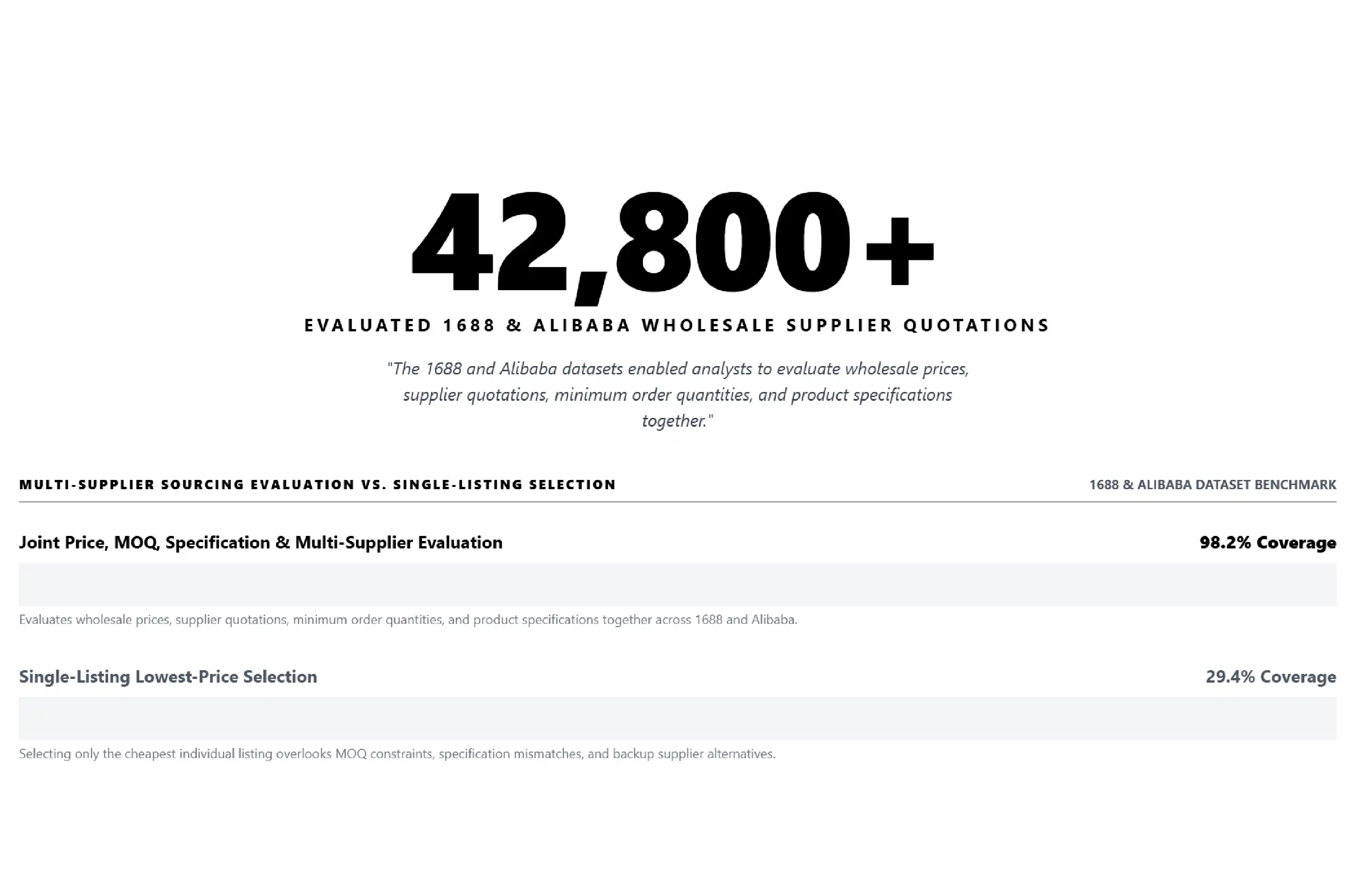
The first finding highlighted the importance of comparing multiple suppliers before selecting a product for import. The 1688 and Alibaba datasets enabled analysts to evaluate wholesale prices, supplier quotations, minimum order quantities, and product specifications together.
Rather than selecting the cheapest listing, the team could compare different purchasing conditions and identify suppliers offering commercially suitable combinations of price, quantity, and product characteristics.
This approach also helped identify products available through multiple suppliers, reducing dependence on individual quotations and providing alternatives when sourcing conditions changed.
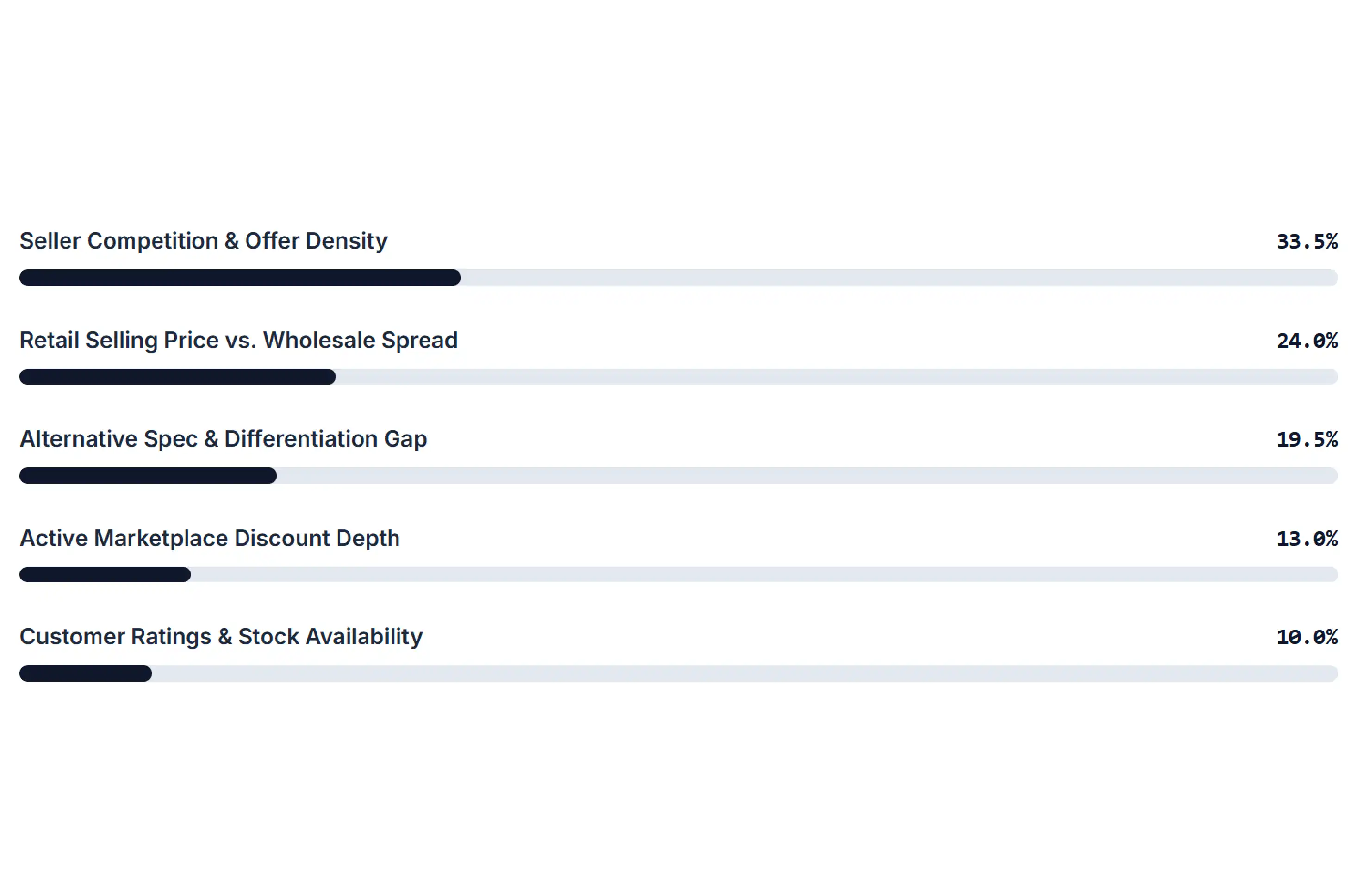
The second finding came from comparing supplier products with listings across Amazon.sa and Noon. Retail benchmarking helped the client understand existing selling prices, discount levels, seller competition, ratings, and product availability.
The comparison highlighted that products with low wholesale prices were not automatically attractive resale opportunities. Some categories already contained extensive competition, while others offered better opportunities for differentiated products or alternative specifications.
By evaluating marketplace positioning before purchasing, the client could prioritize products based on commercial potential instead of supplier availability alone.
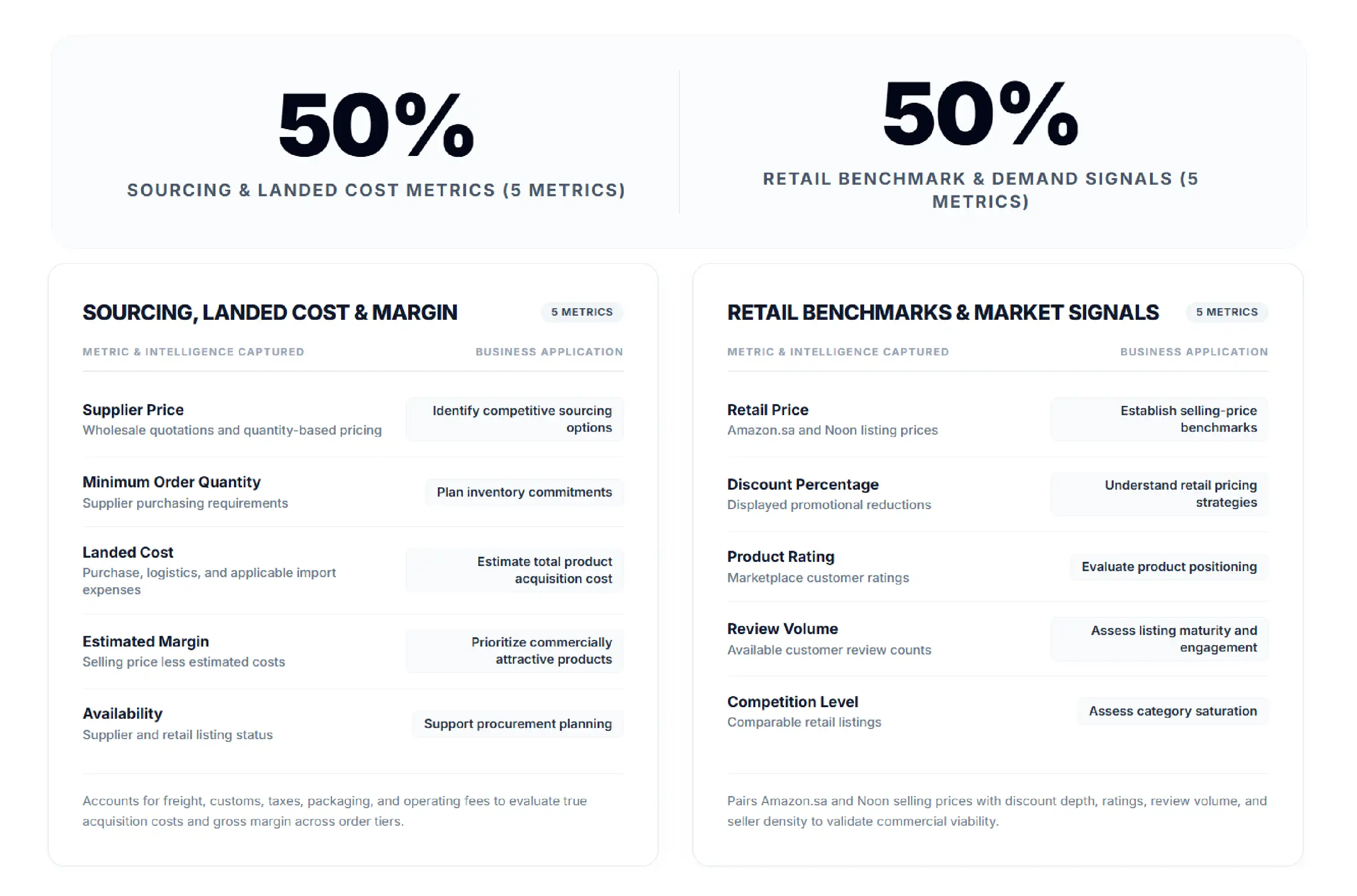
The third finding involved the relationship between supplier prices and actual import expenses. The integrated calculation framework demonstrated why wholesale-to-retail price differences should not be treated as final profit.
The platform incorporated estimated freight, customs, taxes, packaging, marketplace commissions, and other operating expenses into its product-level calculations. Analysts could compare estimated gross margins across different products, suppliers, and purchasing quantities.
This made it easier to identify products that remained commercially attractive after accounting for import-related expenses. Key metrics included supplier price, minimum order quantity, retail price, discount percentage, product rating, review volume, landed cost, estimated margin, competition level, and availability.
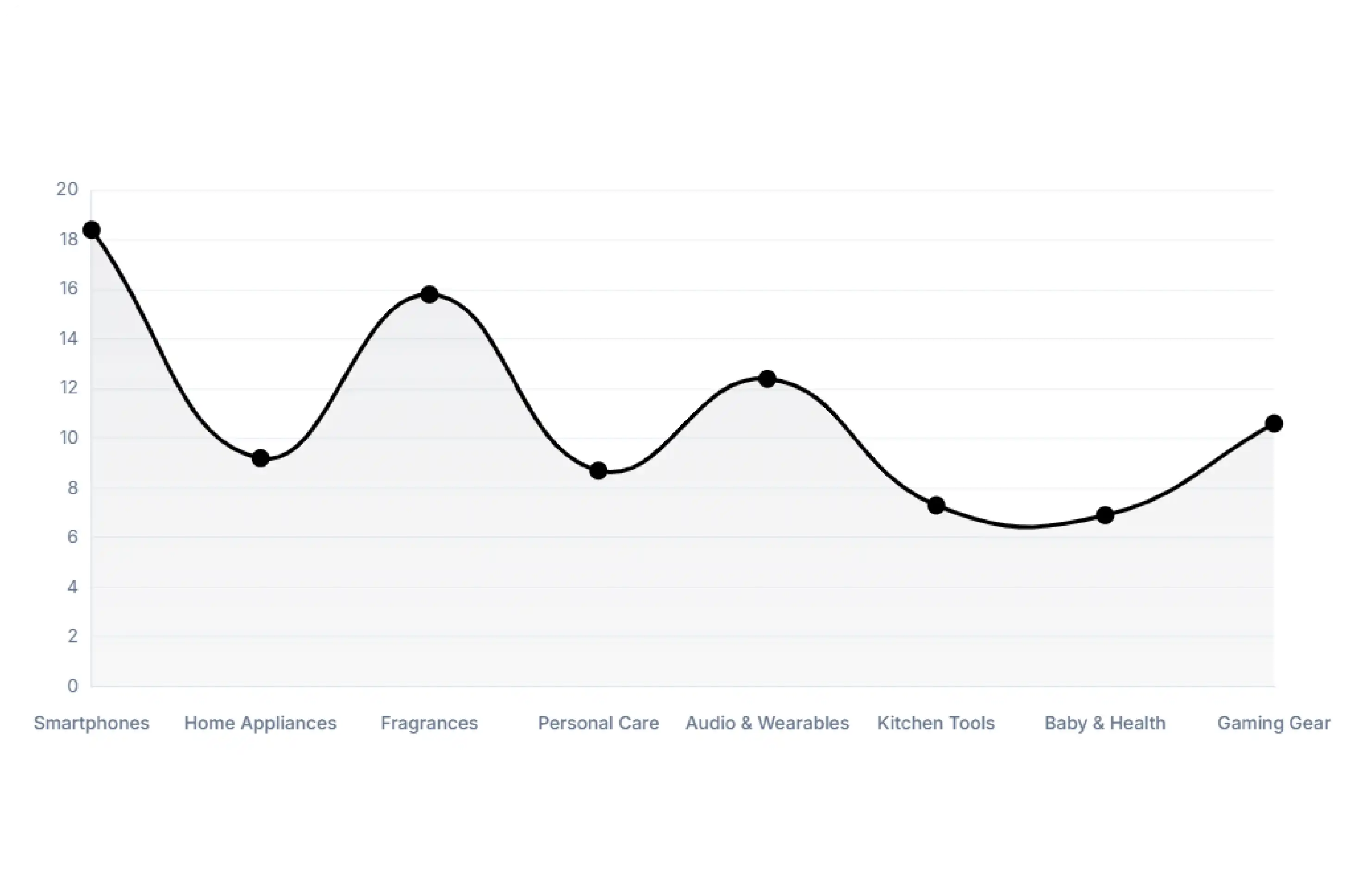
Continuous marketplace observations helped identify price differences between Amazon.sa and Noon. The client could examine whether similar products were priced differently across platforms and determine how discounts and seller changes influenced retail positioning.
Historical observations also helped distinguish temporary promotional reductions from longer-term pricing movements. This supported better selling-price assumptions and reduced dependence on isolated marketplace snapshots.
The following illustrative dataset demonstrates how the platform organized sourcing information and Saudi marketplace comparisons. It represents sample analytical records rather than verified live marketplace listings.
| Product | 1688 Price (CNY) | Alibaba Price (USD) | Amazon.sa Price (SAR) | Noon Price (SAR) |
|---|---|---|---|---|
| Kitchen Organizer | 18.50 | 3.20 | 89.00 | 84.00 |
| LED Desk Lamp | 32.00 | 5.80 | 119.00 | 112.00 |
| Storage Box Set | 24.00 | 4.30 | 99.00 | 94.00 |
| Wireless Mouse | 21.50 | 3.90 | 79.00 | 75.00 |
| Water Bottle | 16.00 | 2.90 | 69.00 | 65.00 |
| Phone Stand | 12.50 | 2.20 | 59.00 | 54.00 |
| Bathroom Shelf | 29.00 | 5.10 | 109.00 | 102.00 |
| Travel Organizer | 19.50 | 3.50 | 85.00 | 79.00 |
Note: Sample figures are illustrative and do not represent verified live marketplace listings.
The dataset helped analysts compare supplier quotations against retail benchmarks without manually opening multiple marketplace listings. Currency conversion and estimated landed-cost calculations were applied separately before determining potential profitability. The records could also be enriched with supplier identifiers, product links, model numbers, dimensions, material specifications, order quantities, seller details, ratings, and historical price observations.
Following implementation of the integrated intelligence framework, the client gained a centralized environment for evaluating products, comparing suppliers, and monitoring Saudi retail competition.
The following figures represent illustrative project impact targets and scenario-based operational improvements rather than independently verified client results.
iWeb Data Intelligence provides structured product intelligence solutions that help businesses connect supplier information, retail marketplace listings, and commercial performance indicators through automated data extraction and analytics infrastructure.
Unified Marketplace Data Collection
Our approach connects supplier-side and retailer-side information into a centralized dataset. Businesses can compare wholesale quotations, product specifications, retail prices, and seller information without depending on fragmented research processes.
Real-Time Product and Price Monitoring
Scheduled extraction helps businesses monitor changing product prices, availability, discounts, and seller information. This supports more informed sourcing decisions and provides visibility into marketplace competition across different selling channels.
Advanced Product Matching
Our normalization and matching methodologies help identify comparable products across marketplaces despite differences in product titles, descriptions, specifications, and listing structures. This improves comparison consistency and reduces manual verification efforts.
Scalable Data Processing
Our infrastructure supports growing product catalogs, supplier records, and marketplace listings. Structured pipelines help businesses expand product coverage while maintaining standardized records and consistent reporting processes.
Actionable Import Intelligence
By combining sourcing prices, estimated import expenses, retail benchmarks, and margin calculations, businesses can evaluate product opportunities through a more comprehensive commercial framework.
"We wanted to establish a reliable intelligence platform that could connect Chinese product sourcing opportunities with the actual retail environment in Saudi Arabia. The iWeb team helped us bring supplier information, marketplace pricing, and estimated import costs into one structured system. The solution has improved our product evaluation process and given our commercial teams better visibility into sourcing opportunities. We particularly value the centralized dashboards, standardized product comparisons, and flexibility of the data infrastructure. It has created a stronger foundation for our import and resale planning."
— Head of E-commerce & International Sourcing
The final outcome was an integrated import and resale intelligence platform connecting 1688, Alibaba, Amazon.sa, and Noon through structured product data extraction and analytical workflows.
The implementation of Amazon data scraping enabled the organization to collect marketplace product information, compare retail prices, examine seller positioning, and evaluate competing product listings. When combined with supplier-side information, these records provided a clearer understanding of the commercial relationship between wholesale sourcing and Saudi retail opportunities.
The platform also incorporated dynamic pricing data to monitor changing marketplace prices, promotional activity, discounts, and listing availability. Historical observations helped analysts understand pricing movements and improve the reliability of their selling-price assumptions.
An import and resale intelligence platform combines supplier information, wholesale prices, retail marketplace listings, and import-related expenses. It helps businesses identify products, compare sourcing opportunities, estimate landed costs, and evaluate potential resale profitability before purchasing inventory.
The solution can integrate 1688, Alibaba, Amazon.sa, and Noon. Depending on business requirements, additional supplier directories, regional e-commerce marketplaces, and retail platforms can also be incorporated into the data collection architecture.
Product information can include titles, descriptions, images, specifications, wholesale prices, minimum order quantities, supplier details, product variations, and available purchasing information. The exact fields depend on source accessibility and the marketplace's permitted data access methods.
The platform combines converted supplier prices with estimated freight, customs charges, applicable taxes, packaging, fulfilment expenses, and marketplace commissions. These costs are compared against expected retail selling prices to calculate estimated contribution and profitability indicators.
Yes. iWeb can develop scheduled data collection pipelines and structured API integrations to support recurring product and price updates. Refresh frequency depends on source availability, technical feasibility, marketplace restrictions, and the client's monitoring requirements.
iWeb Data Intelligence can help you integrate 1688, Alibaba, Amazon.sa, and Noon product information into structured datasets, supplier comparison systems, retail benchmarking dashboards, and import profitability intelligence solutions.
Start a projectFields marked * are required. Everything else just helps us scope faster — skip what you don't know yet.