

Introduction
Digital advertising has become one of the most competitive aspects of modern business. Brands invest in search advertisements, social media campaigns, display promotions, video commercials, and influencer collaborations to attract customers and increase conversions. However, advertising success depends on more than creative ideas and advertising budgets. Businesses must understand competitor strategies, customer preferences, promotional offers, messaging trends, and the performance indicators that influence purchasing decisions.
Ad and Creative Intelligence helps organizations transform publicly accessible advertising information into actionable marketing insights. By systematically analyzing competitor advertisements, businesses can identify emerging campaign themes, evaluate creative approaches, compare promotional strategies, and discover opportunities to differentiate their brands.
Through Competitor ad data scraping, companies can collect structured information about publicly available advertisements, including headlines, descriptions, creative formats, landing pages, promotional claims, and campaign dates where available. Similarly, Meta Ad Library data extraction can help marketing teams examine eligible advertisements across Meta platforms, identify recurring creative patterns, and understand how competing brands communicate their offerings.
When combined with analytical dashboards, historical datasets, and artificial intelligence, advertising intelligence enables marketers to move beyond assumptions and make evidence-informed decisions. It supports campaign planning, creative development, competitive benchmarking, audience research, and marketing budget allocation.
For businesses operating across multiple industries and digital channels, a structured intelligence framework provides a clearer understanding of the advertising landscape. Instead of manually reviewing individual advertisements, teams can organize large volumes of available information, compare competing campaigns, and identify meaningful patterns that inform their next marketing decisions.
What Is Ad and Creative Intelligence?
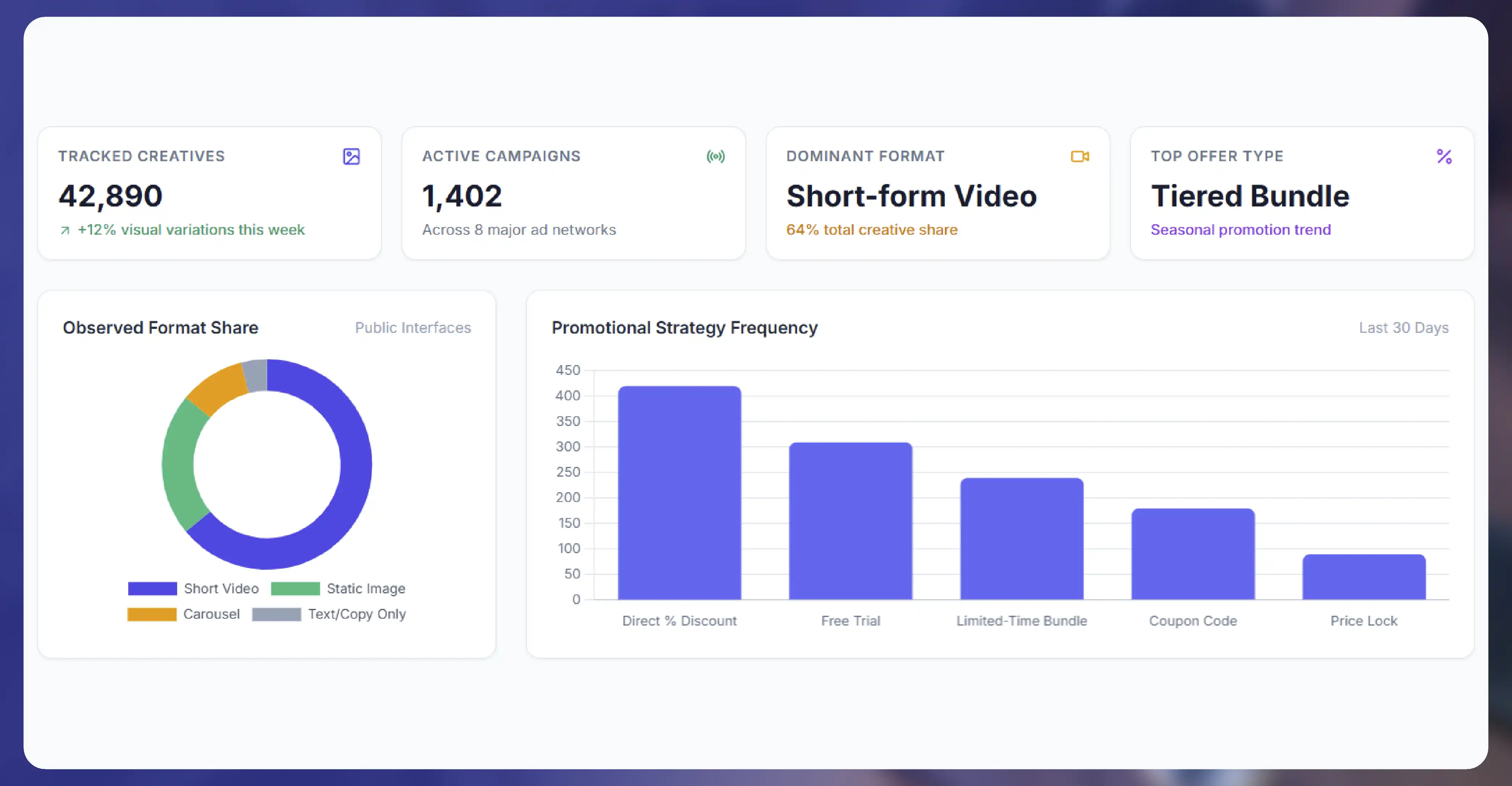
Ad and creative intelligence is the systematic collection, organization, and analysis of advertising information to understand how brands promote products, communicate value, and compete for customer attention.
It combines competitive research, creative analysis, promotional monitoring, and data-driven decision-making. The objective is not simply to collect advertisements but to understand the strategies behind their messaging, formats, offers, and distribution.
A comprehensive intelligence framework may examine:
- Creative elements: Images, videos, headlines, descriptions, calls to action, and visual themes.
- Campaign information: Advertiser identity, publication dates, available campaign duration, and advertising platforms.
- Promotional strategies: Discounts, coupon codes, limited-time offers, bundles, and seasonal campaigns.
- Landing-page experiences: Product positioning, promotional consistency, pricing information, and conversion pathways.
- Competitive positioning: Product benefits, brand messaging, value propositions, and differentiation strategies.
- Creative trends: Frequently used formats, emerging visual approaches, and changing promotional themes.
The information collected depends on the advertising platform, its public interfaces, permitted access methods, and available data fields. Advertisers' actual spending, audience targeting, conversion rates, and campaign performance are not necessarily publicly accessible and should not be inferred without reliable evidence.
Why Advertising Intelligence Matters in a Competitive Market?
Digital advertising changes rapidly. A competitor may introduce a new product, launch a seasonal campaign, test different creative formats, or change its promotional messaging within days.
Without a consistent monitoring process, marketing teams may overlook important developments or rely on outdated information.
Advertising intelligence addresses this challenge by creating a structured view of competitive activity. It helps businesses answer important questions: Which products are competitors promoting? What benefits appear repeatedly in their advertisements? Which offers are becoming more common? How do brands communicate their differences? What creative opportunities remain unexplored?
These insights are useful for marketing managers, advertising agencies, e-commerce companies, consumer brands, market researchers, and growth teams.
For example, an online retailer may discover that competitors increasingly emphasize free delivery rather than percentage discounts. A software company may observe that rival advertisements focus on automation and time savings. A restaurant chain may identify recurring campaigns centered on meal combinations, family offers, or limited-time products.
These observations do not automatically establish campaign effectiveness, but they provide valuable context for developing hypotheses, planning experiments, and improving creative decisions.
Major Data Sources for Ad and Creative Intelligence
1. Meta Advertising Resources
Meta's Ad Library provides public access to eligible advertisements across its platforms. Depending on the advertisement category, jurisdiction, and available interface, users can examine information such as creative content, advertiser details, and publication dates.
Businesses can use this information to understand how competitors present products, introduce new offers, and adapt messaging across campaigns.
For example, a fashion retailer could compare seasonal promotions from several competing brands, examining their creative themes, product imagery, and calls to action.
Collection methods must respect applicable platform terms, technical restrictions, privacy requirements, and available access mechanisms.
2. Google Advertising and Search Resources
Google advertising research can help businesses investigate visible search advertisements, advertising messages, and the relationship between paid search and organic search results.
Where permitted data sources provide relevant information, marketers can compare competitor headlines, descriptions, landing pages, and value propositions.
Google Ads competitor monitoring can help identify recurring promotional claims, messaging differences, and changes in the way competing businesses present their products in search environments.
Advertisers should distinguish publicly observable advertisements from private campaign information. Competitor bids, budgets, conversion rates, and actual returns on advertising spend generally cannot be established from advertisement visibility alone.
3. Landing Pages and Public Brand Websites

Competitor landing pages are valuable sources of contextual information. An advertisement may promise a discount, free trial, product demonstration, or exclusive bundle, while the destination page explains the actual terms.
Analyzing publicly accessible landing pages alongside advertisements helps businesses assess message consistency and understand how promotional claims translate into customer-facing experiences.
Useful fields include product names, offer descriptions, displayed prices, calls to action, campaign-specific URLs, and relevant terms and conditions.
4. Other Public Advertising and Creative Sources
Depending on the industry, businesses may also examine public video advertisements, display creatives, advertiser websites, promotional pages, and other accessible marketing materials.
Combining these sources provides broader competitive context. However, each source has different coverage, update frequency, and permitted collection methods. A reliable system should record source information and collection timestamps so analysts understand the limitations of the resulting dataset.
How the Ad Data Collection Process Works?
A structured intelligence workflow turns scattered advertising information into organized, usable datasets.
Step 1: Define Competitors and Research Objectives
The first step is identifying the brands, product categories, markets, and advertising channels that matter.
A company might monitor ten direct competitors in a specific country or analyze advertising strategies across an entire product category. Clearly defined objectives prevent unnecessary data collection and keep analysis focused.
Step 2: Identify Appropriate Data Sources
Researchers select accessible sources that provide relevant advertising information. These may include public advertising libraries, permitted platform interfaces, advertiser websites, and campaign landing pages.
Each source should be evaluated for coverage, reliability, collection restrictions, and update frequency.
Step 3: Collect Relevant Advertising Information
Depending on source availability, data collection may capture advertiser names, creative text, image or video references, calls to action, publication dates, landing-page links, and promotional details.
Automated collection can reduce repetitive manual work, particularly when monitoring many brands or markets. Collection systems should use permitted access methods and avoid bypassing authentication, access controls, or technical restrictions.
Step 4: Clean and Standardize the Dataset
Advertising information often contains inconsistent brand names, duplicated records, changing URLs, missing fields, and variations in promotional language.
Data cleaning addresses these issues by standardizing formats, identifying duplicates, normalizing dates, and organizing related advertisements into consistent categories.
For example, phrases such as "Save 20%," "20% off," and "Get twenty percent off" may be grouped under a common discount category while preserving the original creative text.
Step 5: Analyze Creative and Campaign Patterns
Once the dataset is organized, analysts can compare campaign themes, messaging styles, promotional formats, product positioning, and observable changes over time.
Text analysis and image classification can help identify recurring concepts, visual similarities, and differences in creative presentation.
Step 6: Build Dashboards and Alerts
Dashboards make the findings easier to interpret. Marketing teams can track newly observed advertisements, promotional changes, competitor activity, and creative trends through filters, charts, and scheduled reports.
Alerts can notify teams when a monitored source shows a relevant change, subject to source coverage and collection frequency.
Key Metrics for Advertising Intelligence
Effective analysis requires more than counting advertisements. Businesses should select metrics that support their specific research objectives.
| Metric | What It Reveals |
|---|---|
| Active advertisements observed | The number of advertisements visible in a defined source and collection period |
| Creative format distribution | The proportion of observed image, video, carousel, or other formats |
| Promotional offer frequency | How often particular discount or incentive categories appear |
| Message theme frequency | Common product benefits, claims, and positioning themes |
| Creative variation count | The number of distinct creative versions identified |
| Landing-page consistency | Whether destination pages reflect the associated advertisement's offer and message |
| New creative observations | The number of newly detected advertisements during a monitoring period |
| Campaign observation duration | The time between first and last observation within the monitoring dataset |
These metrics require careful interpretation. For instance, the number of visible advertisements does not directly indicate advertising expenditure or campaign success. Similarly, repeated observations may reflect the same advertisement appearing multiple times rather than a genuinely new creative.
Consistent definitions, deduplication, timestamps, and source documentation improve analytical reliability.
Advertising Creative and Offer Tracking
Advertising creative and offer tracking enables businesses to examine how competitors change their promotional messaging over time.
Instead of treating advertisements as isolated assets, organizations can group them by brand, product, campaign theme, creative format, and offer type.
This makes it easier to identify recurring approaches and compare how competing companies present similar products.
Consider a skincare business monitoring competitors during a seasonal shopping period. Its dataset might reveal that several brands emphasize bundled products, while others focus on ingredient benefits or introductory discounts.
The business can use these findings to develop differentiated campaigns, test alternative messages, and avoid relying exclusively on promotional tactics already common across the market.
Tracking should also account for offer conditions. A headline advertising a large discount may apply only to selected products, first-time customers, or specific purchase thresholds. Recording the relevant terms helps prevent misleading comparisons.
Turning Competitor Advertising Data into Business Strategy
Advertising intelligence becomes more valuable when it informs practical decisions.
- Creative development: Marketing teams can identify frequently used themes and explore alternative ways to communicate product benefits. Competitor research should inspire differentiated concepts rather than reproduce protected creative assets.
- Campaign planning: Historical observations can reveal seasonal messaging patterns, recurring promotional periods, and changes in product emphasis.
- Offer optimization: Businesses can compare publicly displayed discounts, bundles, and incentives to understand the competitive promotional environment.
- Market positioning: Examining competitor claims can reveal underrepresented benefits or customer needs that a brand could address through its own messaging.
- Testing priorities: Intelligence findings can help teams develop hypotheses for A/B testing. Actual creative effectiveness must still be established through the company's own campaign measurements.
This approach turns competitive research into a repeatable decision-making process instead of an occasional manual exercise.
Competitor Campaign Intelligence Across Industries
Competitor campaign intelligence is relevant to businesses across many sectors.
In e-commerce, retailers can compare product promotions, seasonal messaging, and category-specific advertising approaches.
In food delivery, analysts can study publicly displayed meal deals, restaurant promotions, delivery incentives, and campaign themes.
In travel, businesses can examine hotel offers, destination promotions, booking incentives, and seasonal travel messaging.
In financial technology and software, teams can compare product positioning, introductory offers, free trials, and feature-focused advertisements, while paying particular attention to applicable advertising regulations.
For consumer goods companies, advertising intelligence can help identify which product attributes competitors emphasize and how campaigns change across regions.
A consistent analytical framework makes cross-market comparisons more practical, provided the dataset accounts for differences in language, currency, local advertising rules, and source availability.
The Role of AI in Creative Analysis
Artificial intelligence can make advertising datasets easier to analyze at scale.
Natural language processing can categorize advertising text into themes such as affordability, convenience, quality, innovation, and sustainability. Image analysis can help classify creative formats, identify recurring visual elements, and group similar assets.
Large language models can assist with summarizing campaign themes, comparing messaging variations, and generating structured reports from collected information.
AI can also help flag unusual changes, such as a sudden increase in observed promotional messaging or a newly recurring product claim.
However, AI-generated findings require validation. Models can misclassify creative content, misunderstand cultural references, or produce incorrect conclusions when information is incomplete.
Human review, clear classification rules, representative samples, and documented confidence levels help improve reliability.
Importantly, observed advertising patterns should not be confused with proven performance outcomes. Conversion rates, customer acquisition costs, and return on ad spend require appropriate first-party analytics or other reliable evidence.
Challenges and Best Practices
Developing a dependable advertising intelligence system involves several challenges.
- Incomplete coverage: Not every advertisement or platform is publicly accessible. Teams should document the limitations of each source.
- Changing data structures: Platform interfaces and available fields can change, requiring maintenance and periodic validation.
- Duplicate advertisements: Similar or identical creatives may appear across multiple observations. Deduplication helps prevent inflated counts.
- Creative interpretation: Similar wording does not necessarily indicate identical strategies, and visual similarity alone does not establish copying or infringement.
- Legal and ethical considerations: Businesses should respect platform terms, copyright, privacy laws, and restrictions governing automated collection. Personal information should not be collected unnecessarily.
- Measurement limitations: Public advertising data rarely provides a complete view of competitor spending, targeting, or performance.
A strong implementation combines reliable source selection, standardized data models, transparent methodology, regular quality checks, and responsible analytical practices.
How iWeb Data Scraping Can Help You?
1. Centralized Advertising Data Collection
iWeb Data Scraping can help businesses organize publicly accessible advertising information from relevant sources into structured datasets, reducing repetitive research and supporting consistent competitor comparisons.
2. Creative and Messaging Analysis
Marketing teams can categorize collected headlines, promotional claims, creative formats, and calls to action to understand competitor positioning, discover messaging patterns, and identify opportunities for differentiation.
3. Promotional Offer Monitoring
Structured advertising datasets can help businesses compare visible discounts, bundles, limited-time promotions, and campaign terms across selected competitors, products, markets, and observation periods.
4. Customized Dashboards and Reporting
Organized datasets can feed customized dashboards and reports that summarize observed creative activity, campaign themes, offer frequency, and changes in competitor messaging for marketing and strategy teams.
5. Scalable Competitive Intelligence
iWeb Data Scraping can support repeatable advertising research workflows, helping organizations maintain historical observations, identify relevant changes, and develop evidence-informed marketing hypotheses across supported sources and markets.
Conclusion
Advertising has evolved into a data-rich competitive environment where creative decisions, promotional messaging, and market positioning influence how businesses attract customer attention. Organizations that systematically analyze publicly available advertising information can gain a clearer understanding of competitor activity and identify opportunities to differentiate their marketing strategies.
A well-designed Ad & Creative Intelligence framework combines structured data collection, creative categorization, offer tracking, historical comparisons, and analytical reporting. With appropriate source selection and data quality controls, businesses can transform fragmented advertising observations into useful insights for campaign planning and creative development.
Integrating advertising intelligence with AI Visibility Monitoring can further help businesses investigate how brands appear across relevant AI-powered discovery experiences, where supported data sources permit meaningful analysis. Similarly, SERP & Search Data Scraping can provide complementary insights into search visibility, observable competitor messaging, and the relationship between paid advertisements and organic search results.
Together, these capabilities can strengthen competitive research and support more informed marketing decisions. The ultimate objective is not simply to collect more data, but to interpret reliable evidence, test creative hypotheses, and build advertising strategies that respond effectively to changing market conditions.
Frequently Asked Questions
Ad and creative intelligence is the process of collecting and analyzing available advertising information to understand competitor messaging, creative formats, promotional offers, product positioning, and campaign trends.
Depending on the source and permitted access, datasets may include advertiser names, advertisement text, creative references, publication dates, calls to action, landing-page URLs, and publicly displayed promotional details.
It helps businesses organize advertising observations at scale, compare competitors systematically, identify messaging patterns, monitor visible promotional changes, and develop informed hypotheses for their own campaigns.
Not reliably from public advertisements alone. Public data may reveal creative content and certain campaign details, but actual spending, conversion rates, customer acquisition costs, and return on ad spend generally require additional reliable evidence.
iWeb Data Scraping can help collect and structure accessible advertising information, organize creative and promotional details, support competitor benchmarking, and prepare datasets for dashboards and analytical reporting, subject to source availability and applicable restrictions.