
41.7K+
TOTAL DATA RECORDS PROCESSED

AI-Powered Web Scraping for Intelligent Data Extraction, Automated Analytics, Enterprise Insights, and Scalable Business Intelligence Solutions Across Industries.
This case study explores how an enterprise intelligence team can transform complex online information into structured, actionable business intelligence through AI-Powered Web Scraping.
It demonstrates how AI-powered data extraction combines automated collection, intelligent parsing, machine learning, and validation to support organizations handling large volumes of constantly changing digital information. The framework is particularly relevant to businesses seeking scalable AI web scraping services for competitive research, market monitoring, operational analytics, and artificial intelligence development.
It is designed for:
The client's primary challenge was that valuable business information existed across numerous websites, formats, and digital environments, making comprehensive collection difficult. Conventional scraping systems frequently struggled with changing layouts, inconsistent product descriptions, dynamic content, and unstructured text. The organization required an intelligent, adaptable solution that could collect information responsibly, recognize meaningful patterns, validate extracted records, and deliver consistent datasets for business analysis. Its objective was to establish a scalable intelligence framework that connected online information with practical enterprise decisions.
Illustrative case-study metrics demonstrating the proposed intelligence framework, not independently verified client results.
This case study examines an enterprise data intelligence initiative designed to improve online information collection through artificial intelligence, automated processing, and structured data management. The organization implemented LLM-based web data extraction to interpret complex webpage content, identify relevant entities, and transform inconsistent information into standardized business records. Instead of depending exclusively on fixed selectors and predefined extraction rules, the proposed system combined contextual understanding with conventional parsing methods to improve adaptability across different website structures.
The implementation incorporated Self-healing web scrapers to detect changes in page layouts, identify broken extraction rules, and initiate controlled recovery workflows. Validation mechanisms prevented uncertain outputs from entering production datasets without appropriate checks. The architecture also supported AI scraping for unstructured data, enabling the extraction of meaningful information from descriptions, articles, specifications, reviews, and other text-heavy sources.
The resulting framework connected data collection with normalization, enrichment, quality assurance, and analytical reporting. Teams could compare market conditions, identify emerging opportunities, and investigate changes using structured information instead of manually reviewing hundreds of pages. Monitoring dashboards provided visibility into source availability, extraction success, missing fields, and processing exceptions. This approach established a foundation for scalable enterprise intelligence while maintaining human oversight, source permissions, and measurable data quality standards.
The client operated in a data-intensive environment where critical business information was distributed across e-commerce marketplaces, corporate websites, directories, industry publications, and digital platforms. Existing extraction workflows depended heavily on static selectors, repetitive scripts, and manual verification. As websites changed, extraction failures increased, creating incomplete records and inconsistent reporting. The organization needed AI-Powered Scraping to improve adaptability, interpret complex content, and maintain reliable information flows across multiple sources.
The primary challenges included the following.
1. Unstructured Content and Inconsistent Data Quality
Product descriptions, technical specifications, customer reviews, and industry articles contained useful information in inconsistent formats. Conventional extraction methods struggled to recognize equivalent attributes, distinguish relevant facts, and standardize different representations. The client needed better contextual interpretation, validation, and normalization to make collected information suitable for analytics and downstream applications.
2. Increasing Operational Costs and Manual Intervention
Expanding source coverage increased maintenance requirements, infrastructure usage, and quality-control workloads. Analysts repeatedly checked missing values, corrected formatting errors, and investigated duplicate records. The organization required scalable Web Scraping Services that could automate repetitive tasks, prioritize exceptions, and reduce unnecessary manual intervention without compromising accuracy.
3. Limited Integration With Enterprise Data Systems
Collected information was not consistently delivered in formats suitable for dashboards, databases, and AI applications. The absence of standardized interfaces created integration delays and duplicated processing efforts. A dependable Web Scraping API was necessary to deliver validated records to downstream systems through documented interfaces, scheduled exports, and controlled update mechanisms.
The client also struggled to answer several operational questions:
The client adopted an intelligent extraction framework to replace fragmented monitoring with a more adaptive data pipeline. Conventional scraping remained useful for predictable webpage elements, while AI-assisted interpretation handled ambiguous content, inconsistent structures, and complex text. This hybrid architecture improved flexibility without requiring every extraction task to depend on expensive language-model processing.
| Dimension | Traditional Scraping | AI-Powered Extraction System |
|---|---|---|
| Data collection | Fixed selectors and predefined rules | Rule-based collection combined with AI-assisted interpretation |
| Website changes | Manual script repairs frequently required | Change detection, recovery suggestions, and controlled selector updates |
| Content interpretation | Limited to predefined fields | Context-aware recognition of entities and attributes |
| Unstructured information | Extensive custom parsing | Semantic extraction from descriptions, reviews, and articles |
| Data quality | Rule-based validation | Schema checks, confidence scoring, and anomaly detection |
| Duplicate handling | Exact-match rules | Exact and similarity-based duplicate identification |
| Scalability | Maintenance grows with source complexity | Reusable extraction components and centralized orchestration |
| Error management | Failures investigated manually | Automated alerts, retries, exception queues, and audit logs |
| Enterprise integration | Custom exports and individual connectors | Standardized datasets, API delivery, and scheduled feeds |
| Human oversight | Frequent manual intervention | Review focused on low-confidence or sensitive results |
The distinction is not that AI eliminates every scraping challenge. Instead, AI adds contextual interpretation and adaptive assistance to conventional extraction, while deterministic rules and validation preserve control over critical business data.
The brand in focus represents an enterprise digital intelligence organization supporting businesses that depend on accurate, timely, and comprehensive online information. Its operational model combines website monitoring, data engineering, analytics, and intelligent automation to help stakeholders understand market developments and identify commercial opportunities.
As its coverage expanded, the organization encountered increasing variation in website structures, data formats, content quality, and update frequencies. Individual scripts could collect information from familiar pages, but maintaining hundreds of extraction workflows became increasingly difficult. Meanwhile, unstructured content contained insights that could not be captured effectively through simple field selection alone.
The organization therefore required a more adaptable data infrastructure that combined conventional scraping with artificial intelligence, structured validation, and centralized monitoring. The objective was to establish a consistent pipeline capable of processing information from diverse permitted sources while maintaining traceability and operational reliability.
We designed an end-to-end framework covering source discovery, extraction planning, intelligent parsing, data validation, and enterprise delivery. The system used conventional HTML parsing for predictable fields and AI-assisted interpretation when page content required contextual understanding.
Source discovery and prioritization: Websites were organized by business relevance, permitted access, update frequency, and structural complexity. Source-specific rules helped establish appropriate collection schedules and avoid unnecessary requests.
Intelligent extraction and normalization: AI models identified entities, attributes, and relationships within unstructured content. Extracted values were mapped to predefined schemas, standardized into consistent formats, and checked against field-level validation rules.
Automated monitoring and recovery: The framework detected missing fields, unexpected page changes, repeated failures, and unusual extraction volumes. Recovery workflows attempted safe retries and flagged uncertain structural changes for review rather than silently accepting unreliable output.
By combining these capabilities, the organization established a modular intelligence pipeline that could evolve alongside its sources, analytical requirements, and enterprise applications.
A typical normalized record contained:
After collection, the raw records passed through several processing stages.
Entity Normalization: Extracted entities and attributes were standardized so that equivalent information could be mapped consistently across sources.
For example, variations in product naming, category labels, and attribute descriptions were normalized to reduce duplicate records.
Schema Validation: Extracted values were checked against predefined field definitions to ensure that comparable records could be analyzed consistently.
Confidence Classification: The system categorized observations into states such as validated, review required, or exception, depending on the data returned during collection.
Duplicate Removal: Repeated records generated during overlapping collection cycles were identified and handled using entity, source, and timestamp combinations.
Historical Storage: Each observation was timestamped, enabling the client to calculate changes and extraction trends over time.
Alert Prioritization: The analytics layer identified high-priority situations, including sources showing significant extraction failures or repeated data quality issues.
The final dataset was connected to dashboards where analysts could filter information by source, entity type, confidence, and time period.
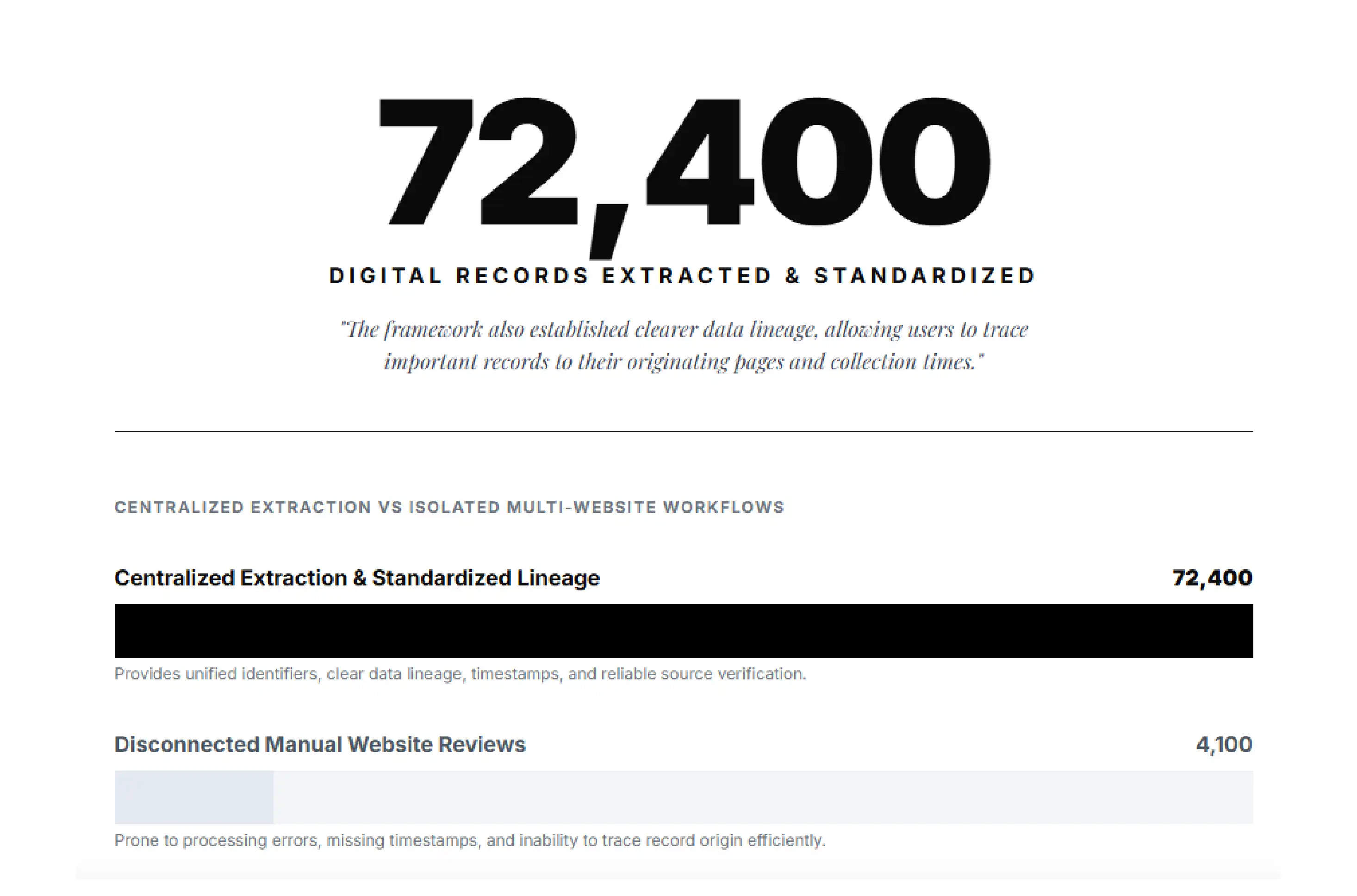
Centralized extraction provided a unified view of information previously distributed across multiple websites and separate collection workflows. Analysts could review records using common identifiers, standardized attributes, timestamps, and source references. This made it easier to compare competing offers, identify missing information, and investigate changes across monitored sources.
The framework also established clearer data lineage, allowing users to trace important records to their originating pages and collection times. As a result, business teams could investigate unusual findings more efficiently and distinguish newly observed changes from outdated information or processing errors.
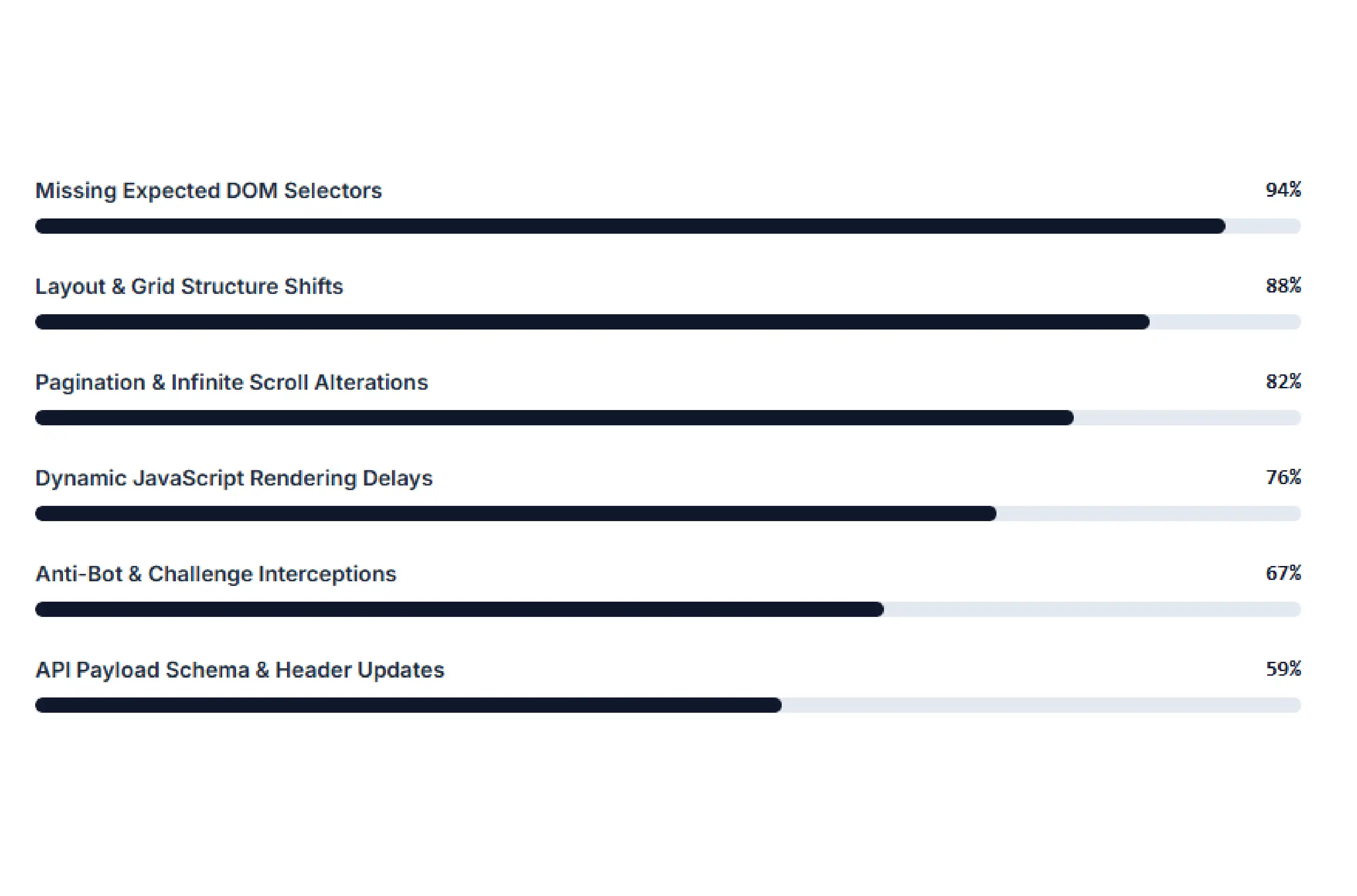
Automated monitoring helped identify structural changes that affected extraction performance. When expected fields disappeared or page layouts changed, the system generated alerts and initiated approved recovery procedures. AI-assisted diagnostics suggested potential adjustments, while validation checks prevented unverified changes from automatically affecting critical production datasets.
This approach reduced dependence on continuous manual inspection and made maintenance more systematic. Developers could prioritize failures according to business impact, source importance, and the number of affected records.
AI-assisted extraction enabled the organization to interpret descriptions, specifications, reviews, and editorial content using contextual information. For example, a product specification written within a paragraph could be mapped into a standardized attribute, while equivalent terminology across different sources could be normalized for comparison.
The resulting datasets supported more detailed analysis of product features, consumer feedback, market positioning, and emerging industry themes. Confidence scoring and verification rules helped identify ambiguous records that required additional attention.
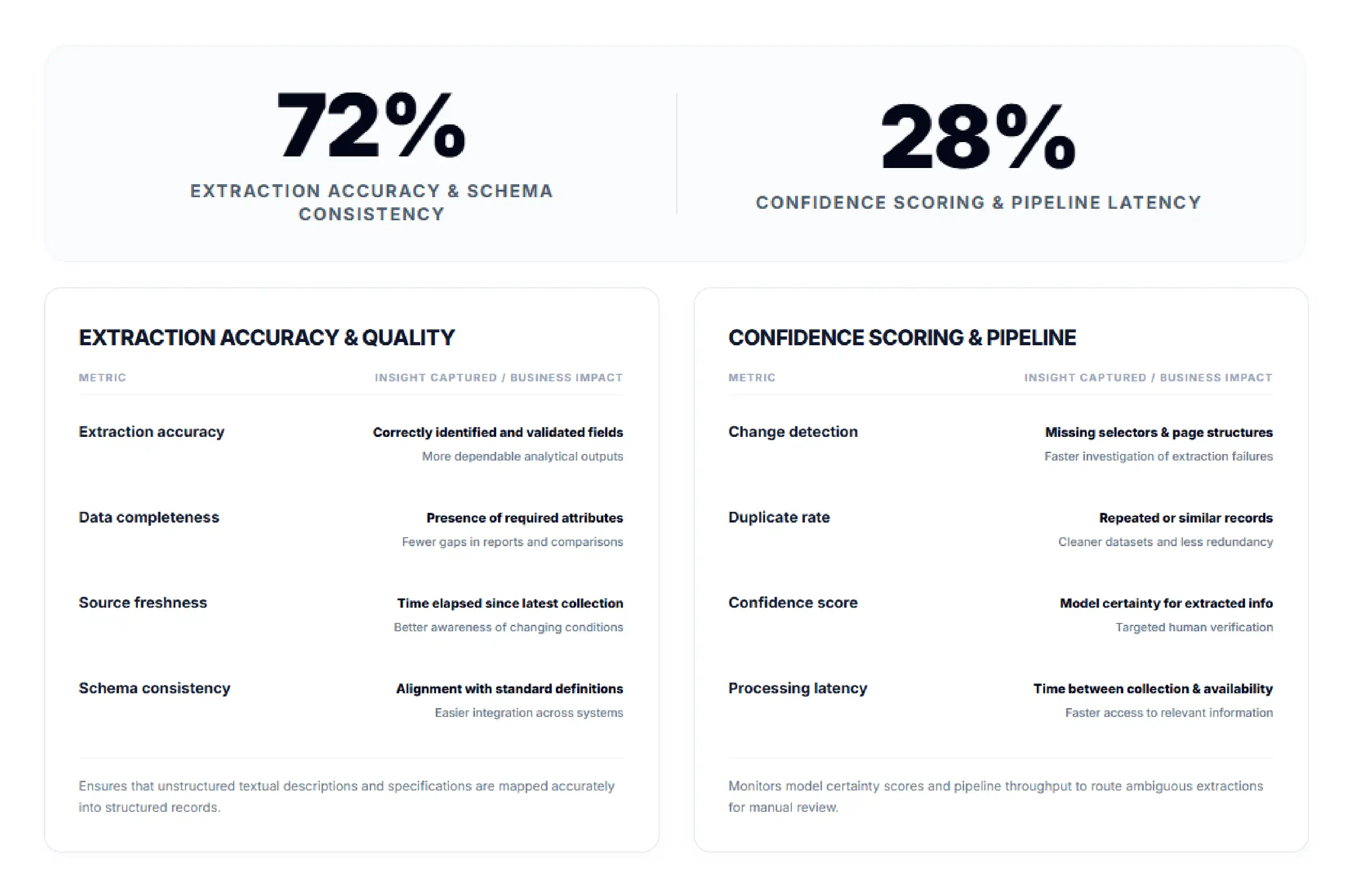
| Metric | Insight Captured | Business Impact |
|---|---|---|
| Extraction accuracy | Correctly identified and validated fields | More dependable analytical outputs |
| Data completeness | Presence of required attributes | Fewer gaps in reports and comparisons |
| Source freshness | Time elapsed since the latest successful collection | Better awareness of changing market conditions |
| Schema consistency | Alignment with standardized field definitions | Easier integration across systems |
| Change detection | Missing selectors and unexpected page structures | Faster investigation of extraction failures |
| Duplicate rate | Repeated or substantially similar records | Cleaner datasets and less redundant processing |
| Confidence score | Model certainty for extracted information | Targeted human verification |
| Processing latency | Time between collection and availability | Faster access to relevant information |
The modular architecture enabled the organization to expand coverage without rebuilding its entire extraction infrastructure for every new website. Shared validation components, reusable parsing functions, and centralized orchestration reduced duplication across workflows.
Additional sources could be onboarded through documented configurations and controlled testing. Performance monitoring helped teams identify bottlenecks involving request volume, model processing, storage, or downstream delivery. This supported more predictable capacity planning as data requirements increased.
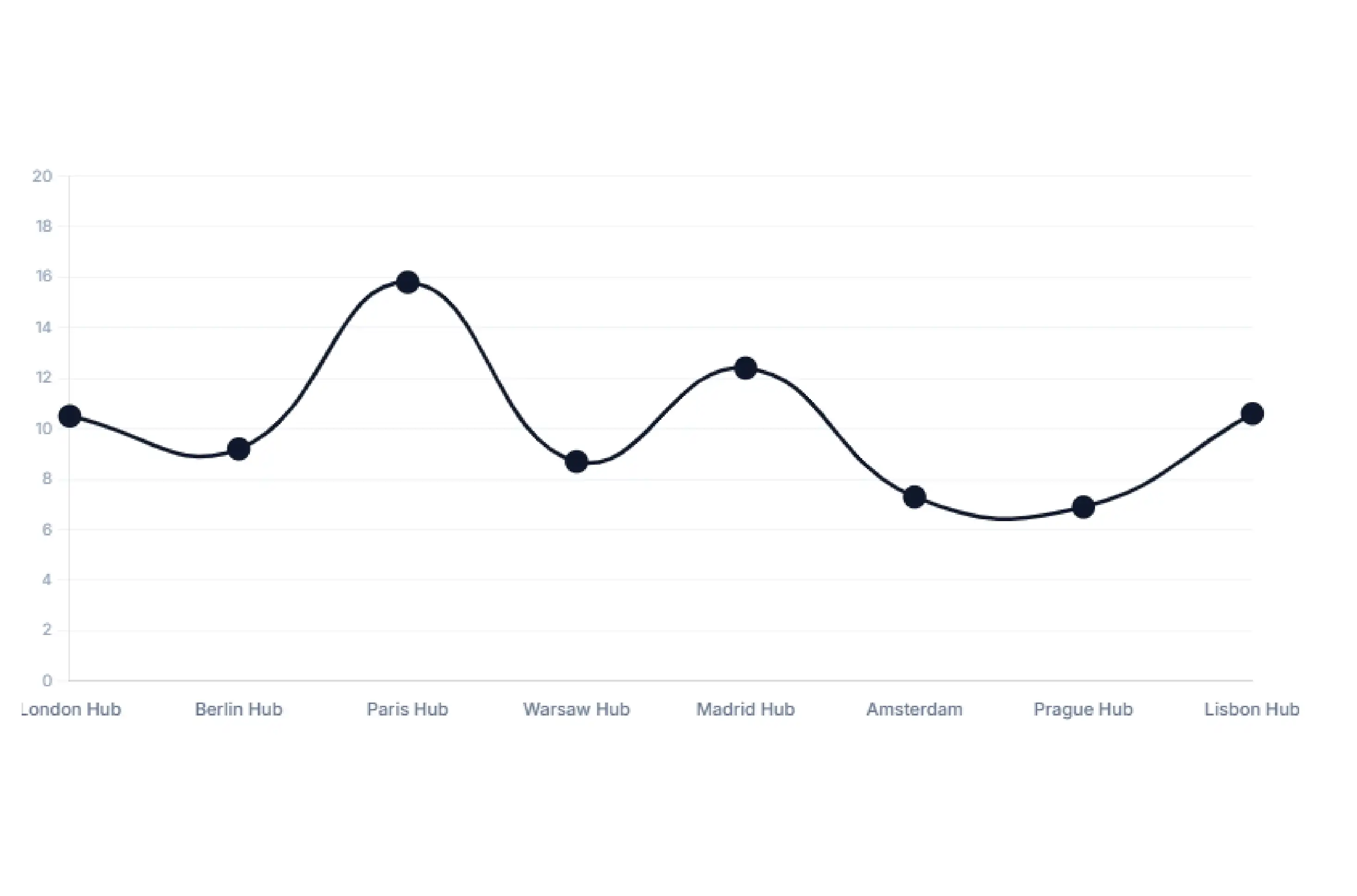
The following sample demonstrates how an AI-powered extraction pipeline could organize information collected from different permitted website categories. The figures are illustrative examples, not verified observations from actual commercial websites.
| Source Category | Records Processed | Extraction Method | Data Quality | Key Attributes |
|---|---|---|---|---|
| E-commerce marketplace | 12,500 | HTML parsing and AI-assisted mapping | 97.2% | Product name, price, availability |
| Retailer website | 9,800 | Structured extraction and validation | 96.8% | SKU, brand, pack size, promotion |
| Industry publication | 7,200 | LLM-based content extraction | 95.9% | Topics, entities, publication date |
| Business directory | 6,400 | Field extraction and normalization | 97.5% | Business name, category, location |
| Public product catalog | 5,800 | Attribute recognition and schema mapping | 96.4% | Specifications, identifiers, features |
| Total | 41,700 | Hybrid extraction pipeline | 96.9% | Standardized enterprise records |
The snapshot illustrates how different collection methods can coexist within a shared framework. Structured pages can be processed using conventional parsing, while complex descriptions and articles can be routed through AI-assisted extraction. A common validation layer makes the resulting records easier to compare and integrate.
A well-designed AI-powered scraping initiative can improve operational performance by reducing repetitive collection work and making digital information more accessible. In this illustrative scenario, the proposed solution establishes measurable indicators for evaluating business value.
To evaluate these outcomes, organizations should establish baseline measurements before deployment. Useful indicators include extraction success rate, required-field completeness, processing latency, recovery time, cost per validated record, and the proportion of AI-generated outputs accepted after quality checks.
iWeb Data Scraping helps organizations build structured information pipelines that connect online data collection with enterprise analytics. Its approach combines automated extraction, intelligent parsing, and quality assurance to make information easier to organize, compare, and use. By selecting appropriate extraction methods for different source types, businesses can improve data consistency without applying complex AI models to every task.
The framework supports flexible data delivery through structured files, databases, and APIs. Automated monitoring helps identify incomplete records and processing failures, while normalization and deduplication improve dataset usability. Organizations can also configure collection schedules according to business requirements, source update frequency, and infrastructure capacity.
Another important advantage is adaptability. Reusable extraction components help teams onboard additional sources, while AI-assisted interpretation supports complex content that requires contextual understanding. Validation rules, confidence thresholds, and review workflows maintain oversight over uncertain outputs.
Through these capabilities, businesses can strengthen competitive intelligence, improve operational reporting, and prepare information for advanced analytics. The emphasis remains on dependable data collection, transparent processing, and measurable business outcomes rather than automation for its own sake.
"The intelligent data extraction framework has helped us rethink how we collect and manage information from multiple online sources. By combining automated collection with contextual interpretation and quality checks, the solution has made our datasets more consistent and accessible. Our teams can investigate market developments more efficiently, identify extraction issues sooner, and spend less time correcting repetitive data errors. The centralized monitoring and standardized delivery process have also improved collaboration between our data engineering and analytics teams. We now have a more adaptable foundation for scaling our intelligence operations and supporting future AI-driven initiatives."
— Head of Data Intelligence
The project established a scalable data intelligence framework designed to transform fragmented online information into structured, validated, and reusable business assets. By integrating conventional extraction techniques with AI-assisted interpretation, the organization gained a more adaptable approach to processing complex website content and maintaining consistent datasets.
Implementation of Enterprise Web Crawling capabilities enabled centralized source management, scheduled collection, change monitoring, and controlled processing across diverse permitted websites. This architecture provided a foundation for expanding coverage while maintaining visibility into extraction quality, operational performance, and source-level exceptions.
The resulting datasets also supported AI & LLM Training Data preparation by organizing relevant information into normalized records with traceable source references, timestamps, and quality indicators. Appropriate licensing, privacy requirements, provenance checks, and content-use restrictions remained essential considerations when preparing information for model development.
Furthermore, Data Feeds for AI Agents & RAG created opportunities to deliver fresh, structured information to retrieval-augmented generation systems and other AI applications. With appropriate indexing, update schedules, access controls, and source attribution, these feeds could help applications retrieve relevant information for research, internal knowledge discovery, and decision support.
Overall, the framework established a practical foundation for improving data accessibility, reducing repetitive processing, and supporting future intelligence initiatives. Its long-term value depends on continuous validation, responsible collection practices, transparent monitoring, and alignment between extracted information and business objectives.
The company could now answer critical operational questions faster:
This shift from periodic reporting to continuous data intelligence strengthened the organization's ability to manage the rapidly evolving digital information environment.
Most importantly, the project demonstrated that data visibility is not simply a collection metric. In a competitive enterprise environment, intelligent data extraction is part of the analytical foundation and directly influences the opportunity to make informed business decisions.
AI-powered web scraping combines automated website data collection with artificial intelligence to interpret complex content, identify relevant information, normalize attributes, and validate extracted records. It is particularly useful when information varies across website layouts, descriptions, and formats.
AI can assist with semantic interpretation, entity recognition, classification, and extraction from unstructured text. Combined with conventional parsing, validation rules, and monitoring, these capabilities can improve adaptability and reduce certain repetitive maintenance tasks.
AI-assisted systems can detect anomalies, diagnose extraction failures, and suggest potential recovery strategies. However, they cannot guarantee that every website change will be handled automatically. Critical changes should undergo validation and testing before modified extraction rules are deployed.
Yes. A properly designed framework can support enterprise analytics, competitive intelligence, product monitoring, research, and AI data preparation. Suitable architecture, access permissions, security controls, data quality requirements, and monitoring procedures are important for reliable implementation.
Businesses should identify priority data sources, define required attributes, establish collection permissions, and determine acceptable accuracy and freshness thresholds. A pilot project can then evaluate extraction methods, processing costs, integration requirements, and business outcomes before wider deployment.
iWeb Data Scraping can help your organization develop intelligent extraction pipelines, improve dataset quality, monitor changing digital information, and prepare structured data for analytics and AI applications. A tailored approach can align collection methods, validation standards, and delivery formats with your operational goals.
Start a projectFields marked * are required. Everything else just helps us scope faster — skip what you don't know yet.