
48.6K+
TOTAL TRAINING DATA RECORDS PROCESSED

AI & LLM Training Data Solutions for Building Accurate, Scalable, Domain-Specific Models Through Structured Extraction, Cleaning, and Validation.
This case study explores an enterprise scenario in which an artificial intelligence development and analytics organization transforms fragmented digital information into structured, high-quality datasets for machine learning, generative AI, and large language model development. The implementation demonstrates how AI & LLM Training Data collection supports reliable model development, domain understanding, and scalable artificial intelligence applications across business environments.
It is designed for:
The client's primary challenge was straightforward: although enormous quantities of information were available online, that information was fragmented across websites, technical documentation, product catalogs, research resources, and industry publications. Inconsistent formatting, duplicated records, outdated content, and uncertain data provenance made reliable model development difficult.
The organization wanted to establish a unified data preparation framework that could transform authorized source material into usable training resources. Its objective was to improve data quality, reduce preparation time, strengthen domain coverage, and create a scalable foundation for developing more reliable AI applications.
This enterprise case study examines how an AI development organization improved its training data pipeline through automated collection, intelligent processing, and structured dataset preparation. The client needed dependable information to support foundation model experimentation, domain adaptation, supervised fine-tuning, and evaluation across multiple business applications.
The implementation introduced a systematic approach to Clean web data for AI training, transforming heterogeneous digital information into organized records suitable for downstream processing. Automated extraction pipelines collected permitted content from approved sources, while normalization and validation procedures helped maintain consistency across documents, text records, metadata, and other supported formats.
The team developed Domain-specific LLM datasets by organizing information according to subject, source type, content relevance, and intended application. This enabled the client to build specialized training collections for areas such as customer support, product knowledge, technical documentation, and business information.
The processing framework incorporated duplicate detection, language identification, formatting correction, quality scoring, and metadata enrichment. Records were assessed for relevance and completeness before being included in appropriate dataset partitions. Where necessary, sensitive information was identified for exclusion or approved privacy-preserving treatment.
The client was developing AI-powered applications but lacked a consistent process for gathering and preparing suitable training material. Information originated from numerous digital sources, each presenting different structures, content formats, terminology, and quality levels. These differences complicated integration and increased the time required to prepare usable datasets.
Challenge 1: Fragmented and Inconsistent Data Sources
The client collected information from documentation portals, public websites, product databases, and industry resources. Each source followed different formatting conventions, creating inconsistent records and complicated preprocessing. Engineers spent considerable time standardizing content before it could enter the training pipeline.
Challenge 2: Duplicate, Outdated, and Low-Quality Content
Repeated pages, copied descriptions, obsolete documentation, and irrelevant text reduced dataset usefulness. Without reliable filtering, these records could distort training distributions and introduce unnecessary repetition. The organization needed systematic quality controls to identify redundant material and retain relevant information.
Challenge 3: Complex Fine-Tuning Preparation
The absence of standardized AI fine-tuning data collection workflows made it difficult to organize examples for supervised learning and task-specific adaptation. Training examples required consistent structures, clear instructions, appropriate responses, and suitable validation. Manual preparation slowed experimentation and increased the risk of formatting errors.
Challenge 4: Data Governance and Traceability
The client needed visibility into where records originated, when they were collected, how they were transformed, and whether their use was permitted. Missing provenance information complicated reviews, dataset updates, and compliance checks. The organization required a scalable AI & LLM Training Data framework that incorporated governance alongside extraction and processing.
The client also struggled to answer several operational questions:
By implementing an automated dataset preparation framework, the client replaced fragmented collection practices with a repeatable pipeline that organizes authorized digital information into consistent, validated, and traceable training resources.
The comparison below illustrates the operational differences between conventional manual preparation and the structured system.
| Dimension | Manual Data Preparation | Structured Training Data Pipeline |
|---|---|---|
| Data collection | Individual browsing and disconnected downloads | Automated ingestion from approved sources |
| Processing speed | Dependent on repetitive human effort | Scheduled or continuous processing workflows |
| Data formatting | Inconsistent document structures | Normalized records and standardized schemas |
| Duplicate management | Manual identification and removal | Automated similarity checks and deduplication |
| Content relevance | Subjective selection and limited review | Rule-based filtering with quality assessment |
| Domain coverage | Dependent on available individual resources | Organized collections across selected subject areas |
| Data provenance | Incomplete source documentation | Source identifiers, timestamps, and transformation records |
| Dataset maintenance | Periodic manual updates | Repeatable refresh and version-control procedures |
| Quality assurance | Sample-based manual inspection | Automated validation supported by human review |
| Scalability | Increasing workload as volume grows | Expandable processing and storage infrastructure |
The structured pipeline did not eliminate expert oversight. Instead, it reduced repetitive work while allowing data specialists to concentrate on relevance, context, governance, and final quality decisions.
The organization in this case study is an enterprise AI and data intelligence provider developing specialized machine learning and language-based applications. Its work involves transforming digital information into structured resources that support model experimentation, intelligent automation, knowledge retrieval, and domain-specific application development.
As its development activities expanded, the organization encountered growing difficulties in maintaining consistent data quality across multiple sources. Technical documentation, reference material, product information, and industry content differed significantly in structure and reliability. Existing preparation methods were insufficient for managing increasing volumes while maintaining detailed provenance and repeatable quality standards.
The organization recognized that model performance depends not only on architecture and computational resources but also on the suitability of the underlying data. Incomplete coverage, duplicated information, and inconsistent terminology could undermine the usefulness of otherwise sophisticated systems.
To address these issues, the company adopted a structured data intelligence framework that connected collection, preprocessing, validation, categorization, and dataset delivery. The framework was designed to support different development objectives without forcing every source into an identical representation.
We implemented an end-to-end data preparation solution designed to transform approved digital information into structured resources for artificial intelligence development. The workflow combined automated collection, document parsing, data cleaning, metadata enrichment, quality validation, and organized dataset delivery.
The first stage established a source inventory covering relevant websites, technical resources, documentation repositories, and other permitted information sources. Each source was evaluated for relevance, accessibility, collection permissions, update frequency, and expected content structure.
Automated ingestion processes then captured suitable records while preserving source identifiers, collection timestamps, and available metadata. Parsing components converted supported formats into machine-readable representations without unnecessarily discarding meaningful headings, tables, contextual relationships, or document structure.
The cleaning layer standardized whitespace, encoding, repeated navigation elements, and inconsistent formatting. Duplicate detection compared exact matches and, where appropriate, near-duplicate content to reduce unnecessary repetition. Language identification and relevance filters helped organize material into appropriate collections.
For selected applications, the pipeline prepared structured examples for supervised fine-tuning and evaluation. Human reviewers assessed representative samples, checked potentially ambiguous content, and reviewed records flagged by automated quality controls.
The framework incorporated Web Scraping API integration where suitable, enabling approved extraction processes to deliver structured information to downstream systems. Access controls, source restrictions, retention rules, and provenance requirements were incorporated into operational procedures.
A typical normalized record contained:
After collection, the raw records passed through several processing stages.
Source Normalization: Source identifiers and categories were standardized so that equivalent records could be mapped consistently across the dataset.
For example, variations in source naming, content type labels, and domain descriptions were normalized to reduce duplicate records.
Content Normalization: Text formats were standardized to ensure that comparable content could be analyzed consistently across sources.
Quality Classification: The system categorized observations into states such as validated, human review, or exception, depending on the data returned during collection.
Duplicate Removal: Repeated records generated during overlapping collection cycles were identified and handled using content hashes, source identifiers, and timestamp combinations.
Historical Storage: Each observation was timestamped, enabling the client to calculate dataset changes and quality trends over time.
Alert Prioritization: The analytics layer identified high-priority situations, including sources showing significant content changes or repeated quality issues across domains.
The final dataset was connected to dashboards where analysts could filter information by source, domain, language, quality score, and time period.
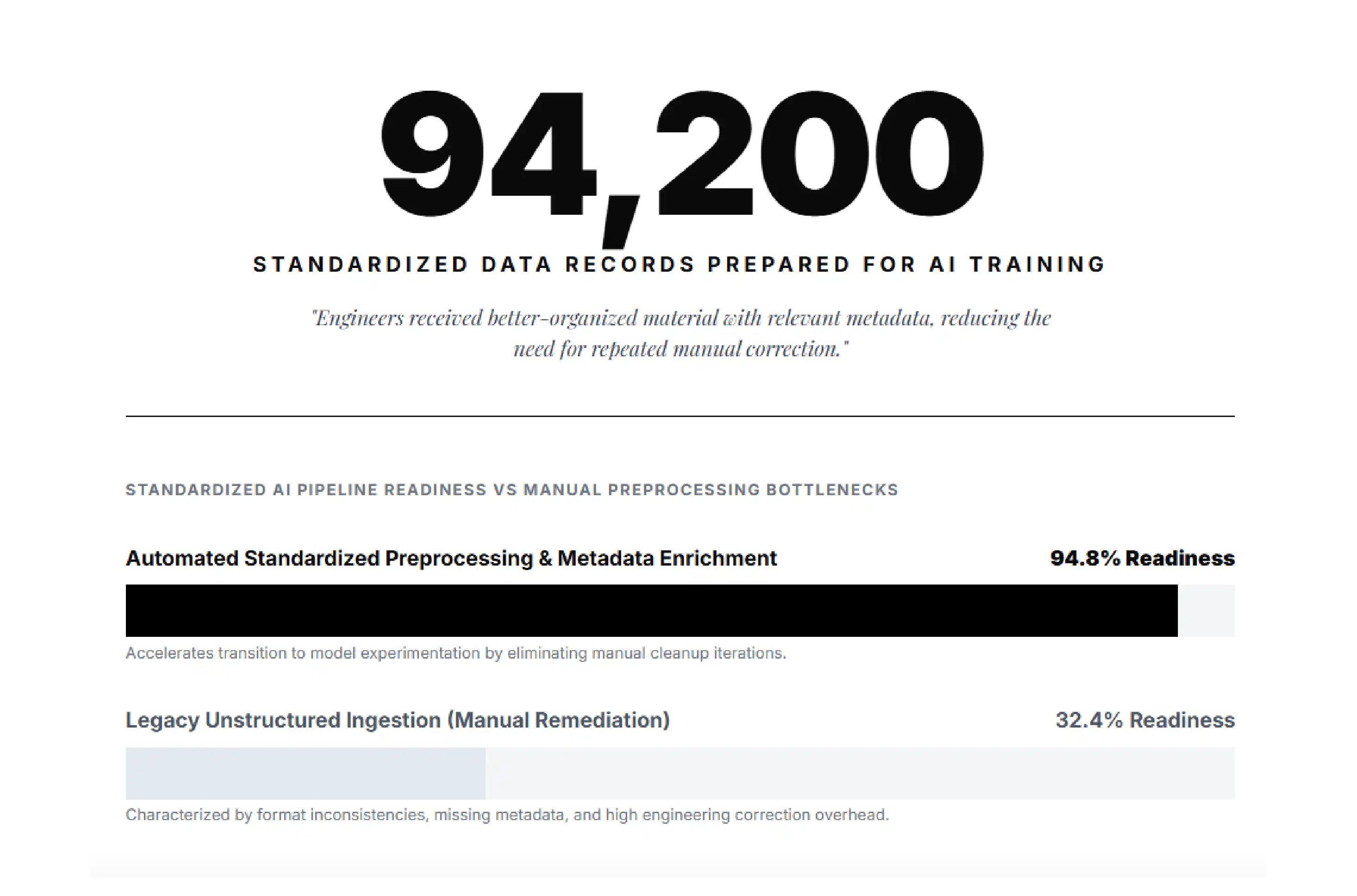
The new pipeline reduced inconsistencies across collected records by standardizing supported formats and introducing repeatable preprocessing procedures. Engineers received better-organized material with relevant metadata, reducing the need for repeated manual correction. This improved the transition from source collection to dataset preparation and helped development teams concentrate on model experimentation.
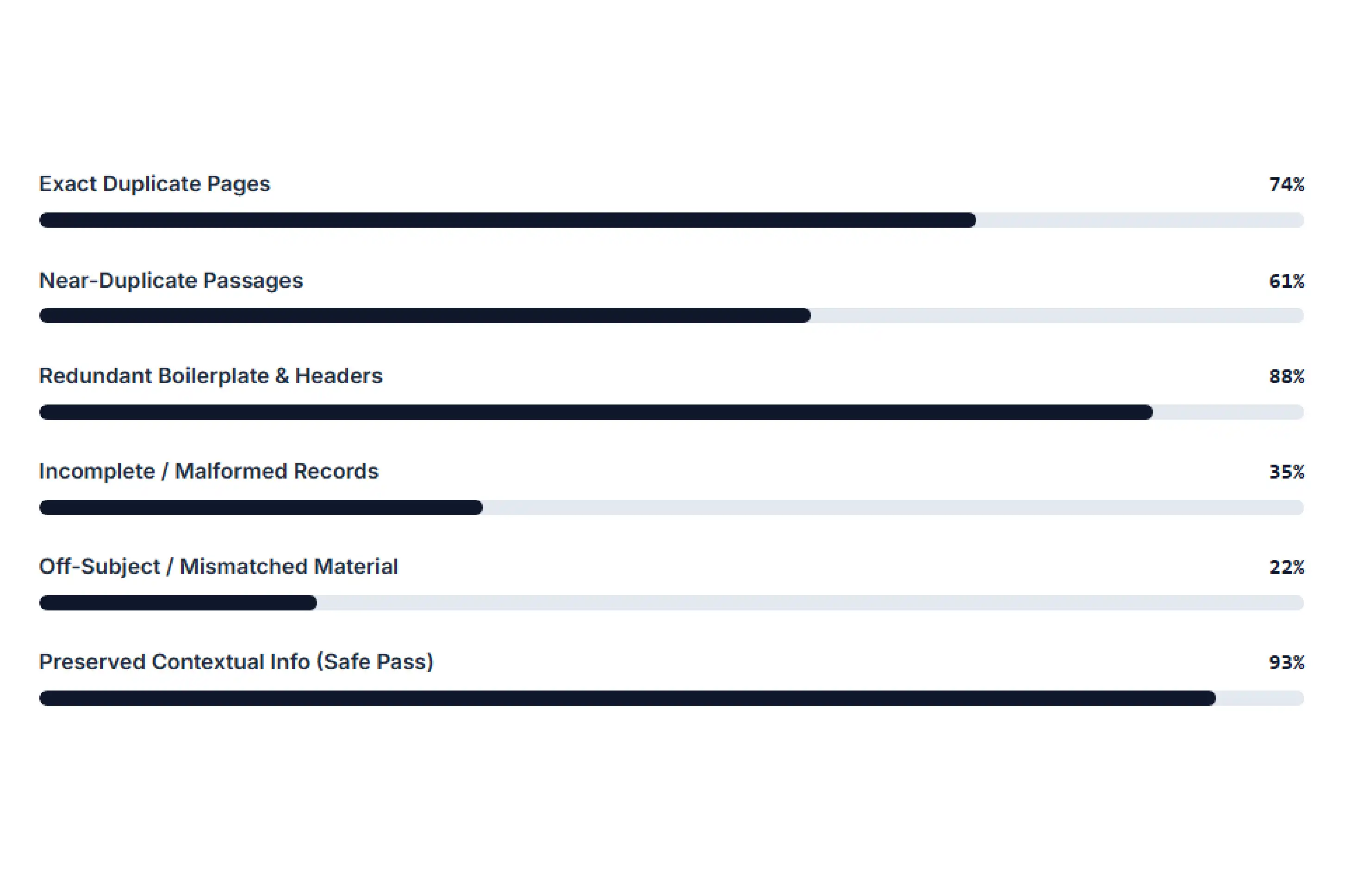
Automated comparison procedures identified repeated pages, near-duplicate passages, and unnecessary boilerplate. Quality rules also flagged incomplete records, malformed content, and material that did not match the intended subject. These controls helped reduce noise while preserving useful contextual information that might otherwise be removed by overly aggressive filtering.
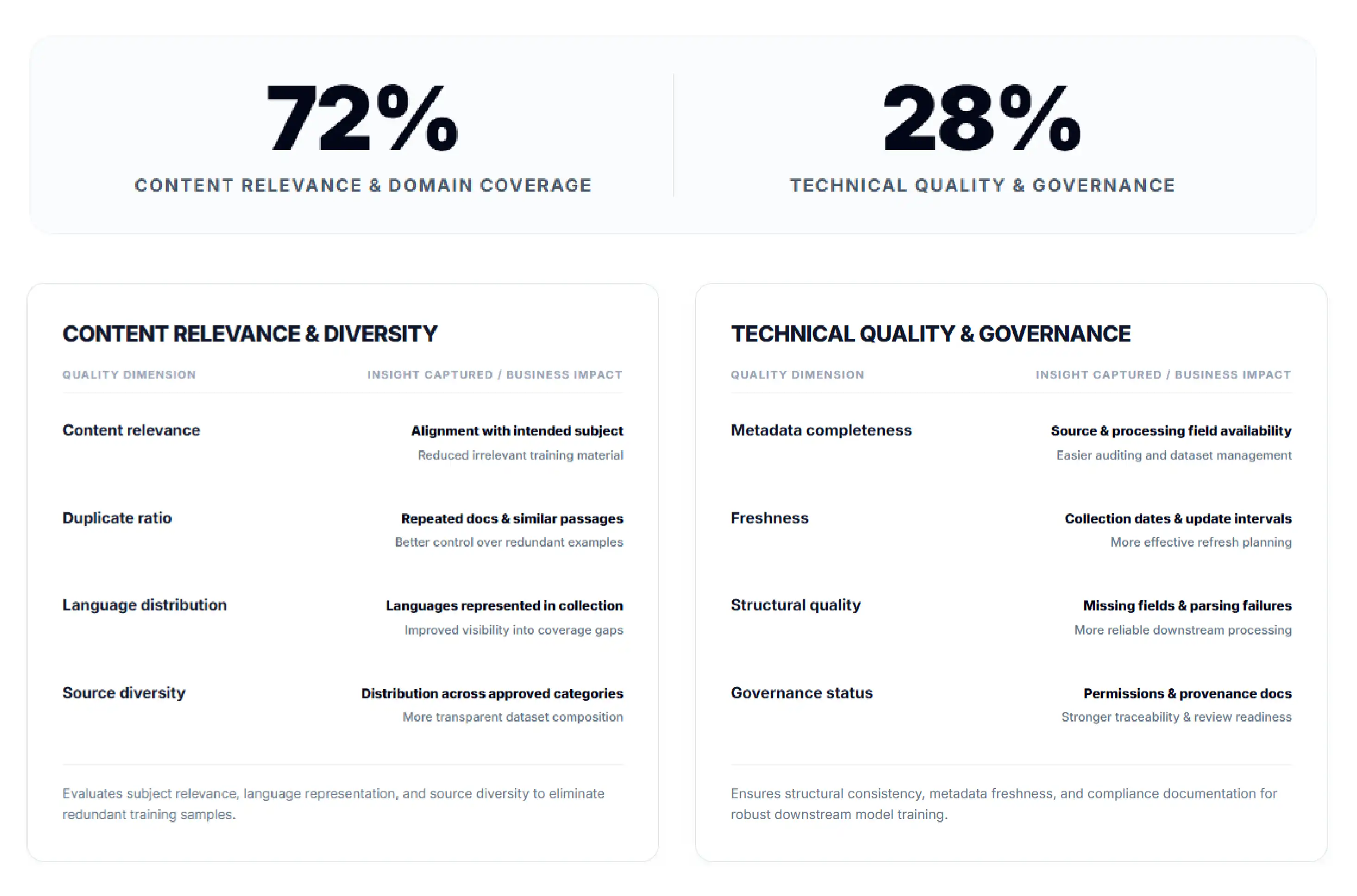
The client organized collected records into subject-specific groups based on source characteristics, content relevance, and development objectives. This improved visibility into which areas were well represented and which required additional information. More structured collections supported targeted experimentation without assuming that one dataset would suit every model or application.
| Quality Dimension | Insight Captured | Business Impact |
|---|---|---|
| Content relevance | Alignment between records and intended subject | Reduced irrelevant training material |
| Duplicate ratio | Repeated documents and similar passages | Better control over redundant examples |
| Language distribution | Languages represented in the collection | Improved visibility into coverage gaps |
| Source diversity | Distribution across approved source categories | More transparent dataset composition |
| Metadata completeness | Availability of source and processing fields | Easier auditing and dataset management |
| Freshness | Collection dates and update intervals | More effective refresh planning |
| Structural quality | Missing fields and parsing inconsistencies | More reliable downstream processing |
| Governance status | Permissions and provenance documentation | Stronger traceability and review readiness |
The following illustrative dataset demonstrates how records from different approved sources can be organized for training data preparation. The values are examples created to explain the framework and do not represent independently verified production measurements.
| Record ID | Source Category | Content Type | Domain | Language | Quality Score | Processing Status |
|---|---|---|---|---|---|---|
| AI-001 | Technical documentation | Tutorial | Software Development | English | 96 | Validated |
| AI-002 | Product knowledge base | Product description | E-commerce | English | 93 | Validated |
| AI-003 | Research publication | Abstract | Scientific Research | English | 95 | Human review |
| AI-004 | Support documentation | Question and answer | Customer Support | English | 98 | Validated |
| AI-005 | Industry website | Market overview | Retail Analytics | English | 91 | Validated |
| AI-006 | Developer resource | Code explanation | Programming | English | 94 | Validated |
| AI-007 | Documentation portal | Troubleshooting guide | Enterprise Software | English | 97 | Validated |
| AI-008 | Knowledge repository | Reference article | Finance Technology | English | 90 | Human review |
| AI-009 | Public educational resource | Explanatory text | Education | English | 92 | Validated |
| AI-010 | Product help center | Instructional content | Digital Services | English | 96 | Validated |
| AI-011 | Technical knowledge base | Process description | Manufacturing | English | 94 | Validated |
| AI-012 | Approved public resource | General information | Travel Technology | English | 89 | Human review |
The dataset structure helps data engineers assess coverage, identify records requiring further review, and track preparation progress. Additional fields can capture license status, source URLs, document hashes, collection timestamps, transformation history, and approved retention periods.
The value of this dataset was not limited to individual records.
The real advantage came from accumulating observations over time.
With thousands of records collected repeatedly, analysts could calculate quality trends, identify recurring content patterns, compare sources, and connect training data quality with model development decisions.
The structured pipeline improved the client's ability to manage information across AI development workflows. Its value extended beyond collection volume, creating a more repeatable approach to quality assurance, dataset organization, and operational oversight.
These outcomes illustrate the operational advantages of structured training data management. Actual improvements in model accuracy, inference quality, or business performance must be measured separately through controlled evaluations using appropriate baselines and task-specific metrics.
iWeb Data Intelligence helps organizations convert fragmented digital information into structured datasets that support AI development, analytics, and business intelligence. Its approach connects collection planning, data extraction, cleaning, normalization, and quality assessment within a unified workflow.
The framework supports flexible data structures for different applications, from product knowledge and customer support to technical documentation and specialized industry information. Rather than delivering undifferentiated volumes of text, the objective is to create datasets whose composition, origin, and intended use can be understood and reviewed.
Automated validation can identify missing fields, duplicate records, inconsistent formatting, and potentially irrelevant content. Metadata enrichment improves discoverability, while documented transformation procedures help teams maintain consistency across dataset versions.
Scalable processing also allows organizations to expand collections as their information requirements evolve. Scheduled refreshes, change detection, and modular integrations can support ongoing maintenance without making every update a manual project.
Responsible data management remains essential throughout the process. Source permissions, privacy considerations, applicable terms, retention requirements, and the suitability of collected content must be assessed before information enters a training workflow. Human review remains important wherever context, accuracy, sensitive information, or complex licensing questions cannot be resolved reliably through automation alone.
By combining technical processing with transparent governance and quality controls, iWeb Data Intelligence provides a structured foundation for organizations seeking to improve the reliability and maintainability of their AI data operations.
"The data intelligence solution provided our organization with a more structured and efficient way to prepare information for AI development. Previously, our teams spent considerable time collecting material from different sources, correcting formatting issues, and reviewing duplicate records. The new pipeline improved consistency, source visibility, and the organization of our datasets. We also gained better control over quality checks and preparation workflows. The ability to track metadata and maintain organized dataset versions has made collaboration between our data engineering and AI development teams easier. This initiative has established a stronger foundation for future model development and domain-specific applications."
— Head of AI Engineering
The project established a structured, scalable framework for collecting and preparing digital information for artificial intelligence development. By connecting authorized extraction, document parsing, deduplication, normalization, quality assessment, and metadata enrichment, the client improved the organization and traceability of its training resources.
Implementation of AI-Powered Web Scraping enabled automated collection workflows to process suitable information from approved sources and deliver records in consistent formats. The pipeline also supported content classification, source tracking, and repeatable dataset refreshes, helping teams manage changing information requirements more effectively.
The resulting framework made it easier to identify quality gaps, review dataset composition, and prepare information for different AI development tasks. Its modular design provided flexibility for adding new sources, supporting additional domains, and maintaining distinct dataset versions as requirements changed.
Deployment of Web Scraping Services further supported scalable collection and structured data delivery across approved digital sources. Governance controls, provenance records, validation procedures, and human review helped establish a more transparent foundation for responsible dataset management.
Overall, the initiative strengthened the client's data preparation capabilities and improved operational readiness for AI experimentation. It demonstrated that dependable training resources require more than large volumes of information: they require relevance, consistency, documented origins, appropriate permissions, and systematic quality control.
The company could now answer critical operational questions faster:
This shift from periodic reporting to continuous data intelligence strengthened the organization's ability to manage the rapidly evolving AI development environment.
Most importantly, the project demonstrated that training data visibility is not simply a collection metric. In a competitive AI environment, data quality intelligence is part of the model development foundation and directly influences the opportunity to build reliable applications.
AI and LLM training data consists of information used to teach, adapt, or evaluate artificial intelligence systems. Depending on the application, it may include text, documentation, structured records, code, question-answer pairs, and other appropriately licensed data. Its quality, diversity, relevance, and provenance influence how effectively models can learn the intended tasks.
Training data can be collected from approved websites and digital resources using automated extraction tools, APIs, or authorized downloads. The process typically includes source assessment, parsing, normalization, deduplication, metadata enrichment, and validation. Collection must respect applicable permissions, privacy requirements, website terms, and content licensing restrictions.
Data cleaning helps identify duplicate passages, malformed documents, irrelevant material, inconsistent formatting, and other quality problems. Better-prepared datasets are easier to audit and maintain. Cleaning must preserve meaningful context, however, because excessive filtering can remove important information or introduce unintended biases into the dataset.
Yes. Carefully selected datasets can provide relevant terminology, contextual information, and task examples for applications such as customer support, technical assistance, product discovery, and industry knowledge retrieval. Their usefulness depends on content quality, adequate coverage, appropriate permissions, and rigorous evaluation against the intended application.
iWeb Data Intelligence can support structured collection, extraction, normalization, deduplication, metadata enrichment, and quality validation workflows. The specific implementation depends on source accessibility, project requirements, and governance constraints. These capabilities help organizations create more organized, traceable datasets for AI development and related analytical applications.
Transform fragmented digital information into structured, quality-controlled data resources for machine learning and large language model development. A well-designed pipeline can improve dataset organization, simplify maintenance, strengthen traceability, and help your team prepare relevant information for responsible AI innovation.
Start a projectFields marked * are required. Everything else just helps us scope faster — skip what you don't know yet.