
52.6K+
MENU ITEMS MONITORED

AI Menu Price Monitoring on Swiggy and Zomato Enables QSR Chains to Track Competitor Pricing and Optimize Strategies Across Indian Cities.
This case study explores how a multi-city Quick Service Restaurant (QSR) chain leveraged artificial intelligence, automated data extraction, and competitive intelligence to monitor menu prices across Swiggy and Zomato. The organization wanted to understand how competitors positioned their dishes, adjusted prices, introduced promotional offers, and maintained consistency across different Indian cities. By implementing AI menu price monitoring Swiggy Zomato, the business established a structured framework for tracking menu-level pricing movements and identifying opportunities to improve its pricing strategy.
It is designed for:
The client's primary objective was to establish a unified view of restaurant menu prices across different locations and delivery platforms. It needed reliable information about competitor dishes, category-wise pricing, discounts, delivery charges, and promotional changes. The resulting intelligence would support informed pricing decisions, improve campaign planning, and help management identify regional differences in customer-facing menu prices.
A growing QSR chain operating across multiple Indian cities wanted to strengthen its competitive positioning on Swiggy and Zomato. Although its restaurants offered similar menus across locations, the prices displayed on food delivery platforms frequently differed because of regional competition, platform promotions, outlet-level adjustments, and changing customer demand.
The organization lacked a centralized system for monitoring these movements. Teams manually checked competitor listings, compared selected dishes, and maintained spreadsheets. This approach consumed considerable time and failed to capture frequent changes across hundreds of restaurant listings.
To address these limitations, iWeb implemented an AI-powered restaurant menu intelligence framework that continuously collected, normalized, and analyzed platform-level pricing information. The solution incorporated Zomato menu price data to understand competitor pricing structures, menu availability, item variations, and promotional movements. Similarly, Swiggy dish price monitoring enabled the client to compare dish-level prices, track discounts, and identify differences between outlets and cities.
The system processed information across 125+ QSR outlets in 12 Indian cities, covering categories such as burgers, pizzas, sandwiches, wraps, beverages, desserts, and meal combos. AI-assisted matching connected similar dishes across competing brands, even when product names, descriptions, and category labels differed.
The client operated in a highly competitive restaurant delivery environment where menu prices changed frequently across cities, outlets, and platforms. Maintaining an accurate understanding of competitor menu pricing became increasingly difficult as new QSR brands entered the market and existing competitors introduced aggressive discounting strategies.
Fragmented Pricing Information
Competitor menu information was distributed across different Swiggy and Zomato restaurant listings. Teams struggled to consolidate dish prices, portion variations, combo prices, and promotional information into a standardized dataset.
Inconsistent Regional Pricing
Identical dishes sometimes appeared at different prices across cities and restaurant outlets. Without centralized monitoring, management could not confidently determine whether these differences reflected local demand, operational costs, or competitive positioning.
Limited Promotional Visibility
Discounts, coupon-based offers, and platform-funded promotions frequently changed the final customer-facing price. Manual checks failed to capture these changes consistently, creating gaps in promotional benchmarking.
Difficulty Matching Similar Dishes
Competitors often used different names, descriptions, sizes, and category structures for comparable food products. Identifying equivalent dishes manually created inconsistencies in competitive comparisons and pricing analysis.
Delayed Market Intelligence
Traditional reporting methods could not provide sufficiently frequent updates. The business often discovered competitor price changes after they had already influenced customer purchasing decisions.
Absence of Unified Analytics
The client lacked a consolidated food delivery price intelligence framework that connected dish-level prices, outlet locations, discounts, and platform-specific variations. Consequently, pricing teams depended on separate spreadsheets and manual reporting.
Operational Inefficiencies
Employees spent significant time checking restaurant listings, recording prices, validating information, and preparing comparison reports. This limited their ability to focus on revenue optimization and strategic planning.
The organization therefore required an automated solution capable of collecting high-volume restaurant menu information, identifying comparable products, and delivering reliable pricing intelligence across its operating markets.
By implementing an automated Swiggy and Zomato menu intelligence pipeline, the client replaced manual competitor research with continuous data collection and AI-assisted analysis. The system improved monitoring coverage, standardized product comparisons, and enabled faster identification of pricing opportunities.
| Dimension | Manual Monitoring | AI-Powered Monitoring |
|---|---|---|
| Data collection | Individual restaurant checks | Automated platform-level collection |
| Price updates | Periodic spreadsheet entries | Scheduled and continuous monitoring |
| Dish matching | Manual product comparison | AI-assisted name and attribute matching |
| Discount tracking | Selective promotional checks | Structured offer and discount monitoring |
| City coverage | Limited locations | Multiple cities and outlets |
| Price comparison | Manual calculations | Automated competitive benchmarking |
| Historical analysis | Scattered records | Centralized historical datasets |
| Reporting | Manually prepared reports | Interactive analytical dashboards |
| Decision-making | Reactive pricing adjustments | Evidence-based pricing decisions |
| Scalability | Resource-dependent | Expandable monitoring infrastructure |
This transition enabled the QSR chain to evaluate competitive conditions more consistently while reducing the operational burden associated with manual market research.
The brand in focus is a multi-city QSR organization operating through dine-in, takeaway, and online food delivery channels. Its business model depends on maintaining competitive menu pricing, consistent product availability, and attractive promotional offerings across different customer segments.
Its menu includes popular quick-service categories such as burgers, pizzas, sandwiches, wraps, sides, beverages, and desserts. The organization maintains multiple outlets across metropolitan and developing urban markets, where competitive conditions and customer preferences vary considerably.
As online food ordering became an increasingly important revenue channel, Swiggy and Zomato emerged as critical platforms for customer discovery and order acquisition. However, the organization recognized that maintaining competitive pricing required more than periodically reviewing its own menu.
It needed to understand how rival restaurants priced similar products, how discounts affected displayed prices, and how menu strategies differed across locations.
The absence of a unified competitive monitoring framework restricted its ability to identify pricing gaps and regional opportunities. Therefore, the organization adopted an AI-enabled restaurant intelligence solution to improve pricing visibility and strengthen its competitive position.
iWeb designed an end-to-end restaurant menu intelligence solution combining automated data extraction, AI-based product matching, data validation, and analytical reporting.
The implementation focused on collecting structured information from relevant publicly accessible restaurant listings on Swiggy and Zomato, subject to platform permissions, applicable terms, and access restrictions.
The solution followed several interconnected stages.
Automated Platform Data Collection
The system collected restaurant and menu information, including restaurant names, outlet locations, dish names, categories, listed prices, descriptions, available offers, and menu availability indicators. This created a consistent foundation for comparing restaurant offerings across platforms.
Data Cleaning and Standardization
Raw information was processed to remove duplicate records, inconsistent formatting, incomplete entries, and irrelevant information. Prices were converted into standardized numerical fields, while restaurant and menu attributes were organized into common structures.
AI-Based Dish Matching
One of the most important components involved identifying equivalent food items across different restaurant brands. AI-assisted matching evaluated dish names, descriptions, categories, sizes, ingredients, and other available attributes.
For example, a competitor's Classic Veg Burger could be matched with a similarly positioned Vegetable Burger even when the naming conventions differed. Confidence scores helped identify uncertain matches for additional validation.
Promotional and Discount Analysis
The system captured available promotional information and differentiated listed menu prices from displayed discounted prices wherever the required information was available. This helped the client understand the impact of offers on customer-facing pricing.
City-Wise Competitive Benchmarking
Restaurant listings were mapped to their respective locations. The system compared similar menu items across cities, outlets, and delivery platforms, allowing management to identify local pricing differences and competitive gaps.
Dashboard Integration
Validated datasets were connected to analytical dashboards that displayed competitor comparisons, historical price movements, discount patterns, and category-level pricing trends.
This architecture transformed disconnected restaurant information into a unified intelligence framework that could support daily pricing decisions.
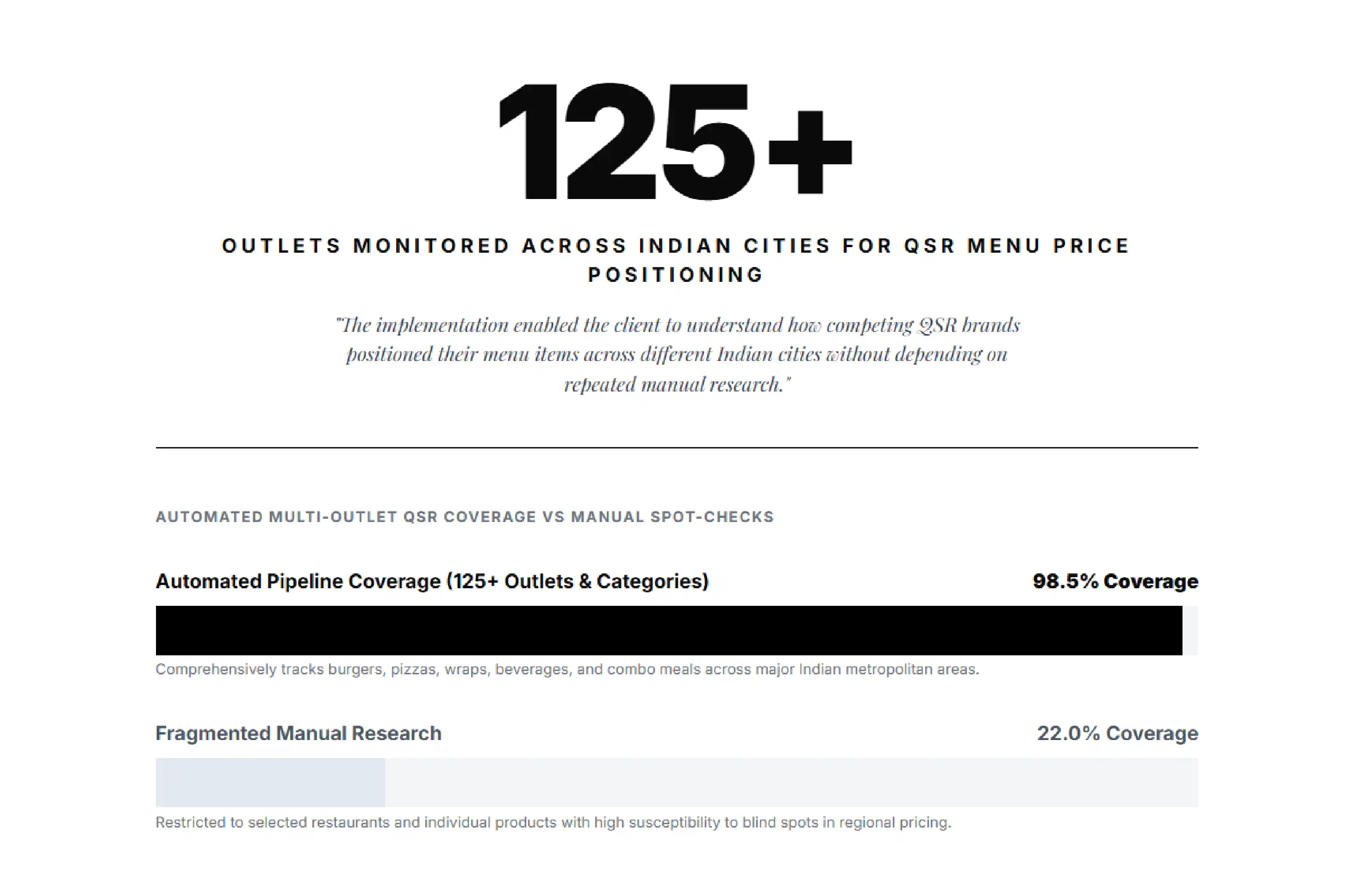
The implementation enabled the client to understand how competing QSR brands positioned their menu items across different Indian cities. Previously, pricing comparisons were restricted to selected restaurants and individual products.
The automated system expanded monitoring coverage across 125+ outlets, creating a more comprehensive view of competitive pricing. Management could compare similar burgers, pizzas, wraps, beverages, and meal combinations without depending on repeated manual research.
This visibility helped identify products priced significantly above or below comparable competitor offerings. It also allowed regional managers to understand where their menu positioning needed attention.
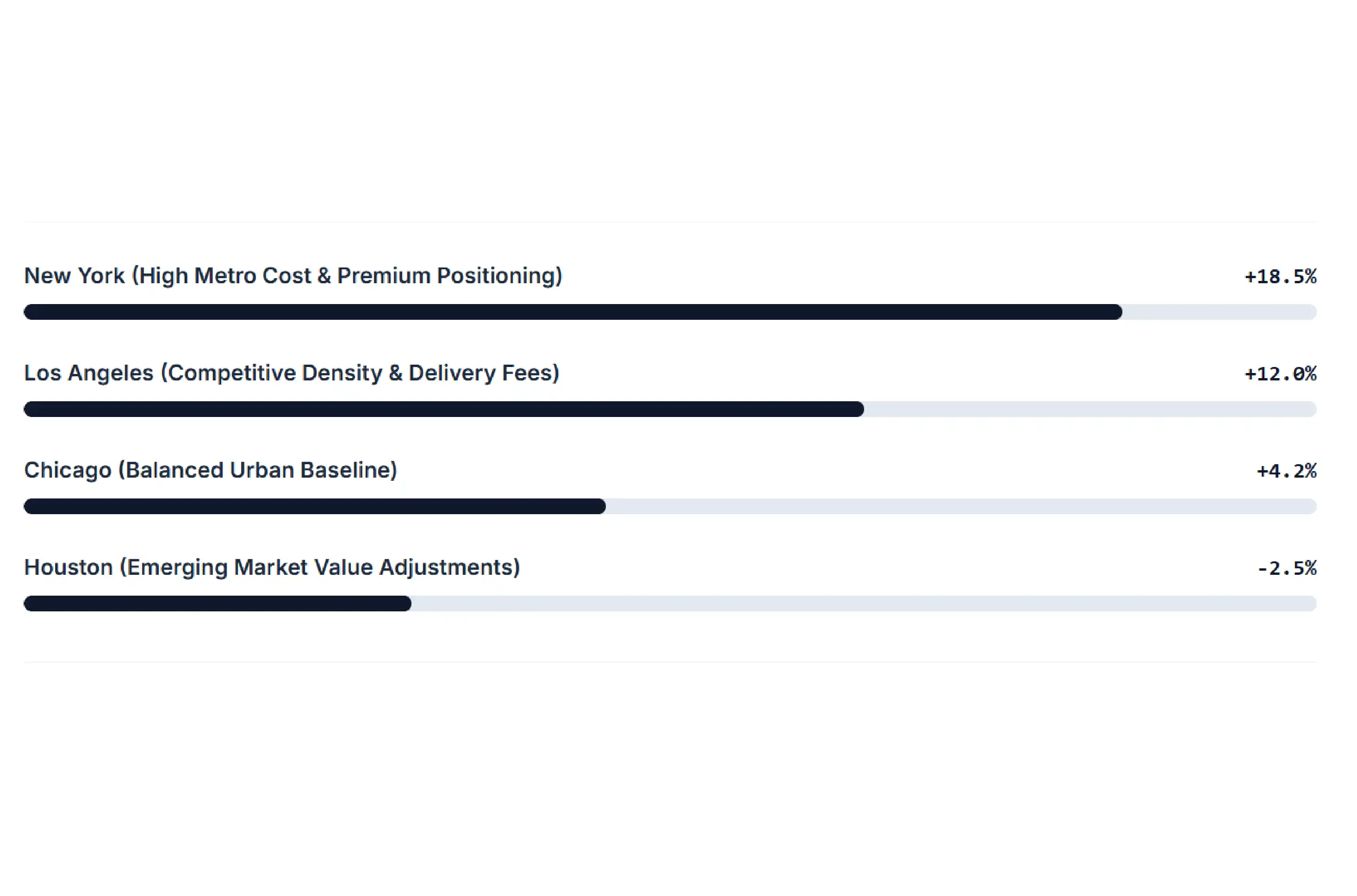
The analysis revealed that similar food products could have different displayed prices across metropolitan and emerging markets. These variations reflected differences in local competition, restaurant positioning, outlet-level strategies, and promotional activity.
The client used city-wise comparisons to evaluate pricing opportunities rather than applying identical adjustments across every location.
This approach supported more relevant regional pricing decisions. It also helped management identify cities where certain menu categories required stronger competitive positioning.
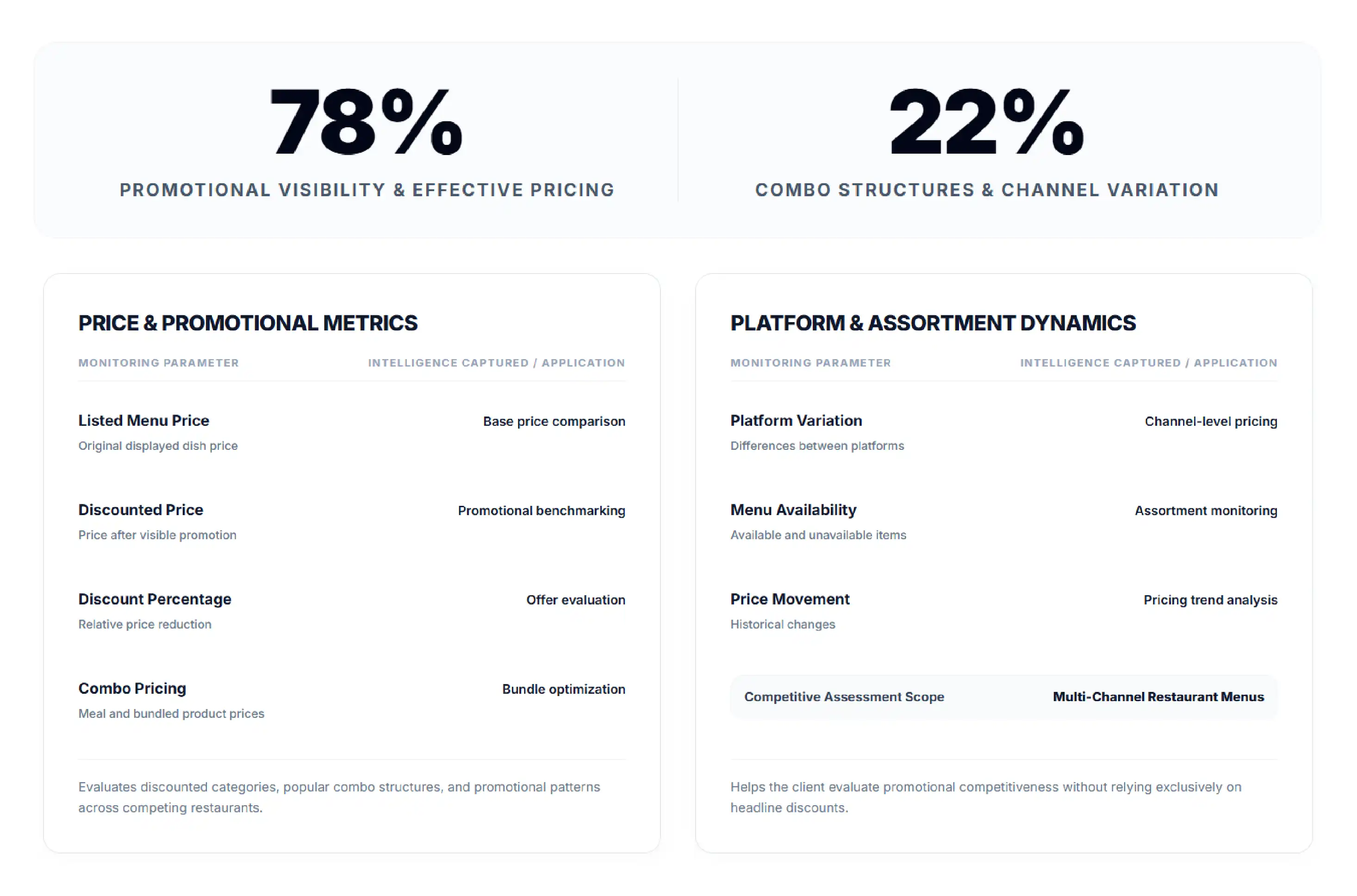
The monitoring framework provided visibility into competitor promotions and available discounts across restaurant listings.
Instead of comparing only original menu prices, the client could evaluate displayed prices after applicable offers whenever sufficient promotional information was available.
The analysis helped identify frequently discounted categories, popular combo structures, and promotional patterns across competing restaurants.
| Monitoring Parameter | Intelligence Captured | Business Application |
|---|---|---|
| Listed Menu Price | Original displayed dish price | Base price comparison |
| Discounted Price | Price after visible promotion | Promotional benchmarking |
| Discount Percentage | Relative price reduction | Offer evaluation |
| Combo Pricing | Meal and bundled product prices | Bundle optimization |
| Platform Variation | Differences between platforms | Channel-level pricing |
| Menu Availability | Available and unavailable items | Assortment monitoring |
| Price Movement | Historical changes | Pricing trend analysis |
These insights helped the client evaluate promotional competitiveness without relying exclusively on headline discounts.
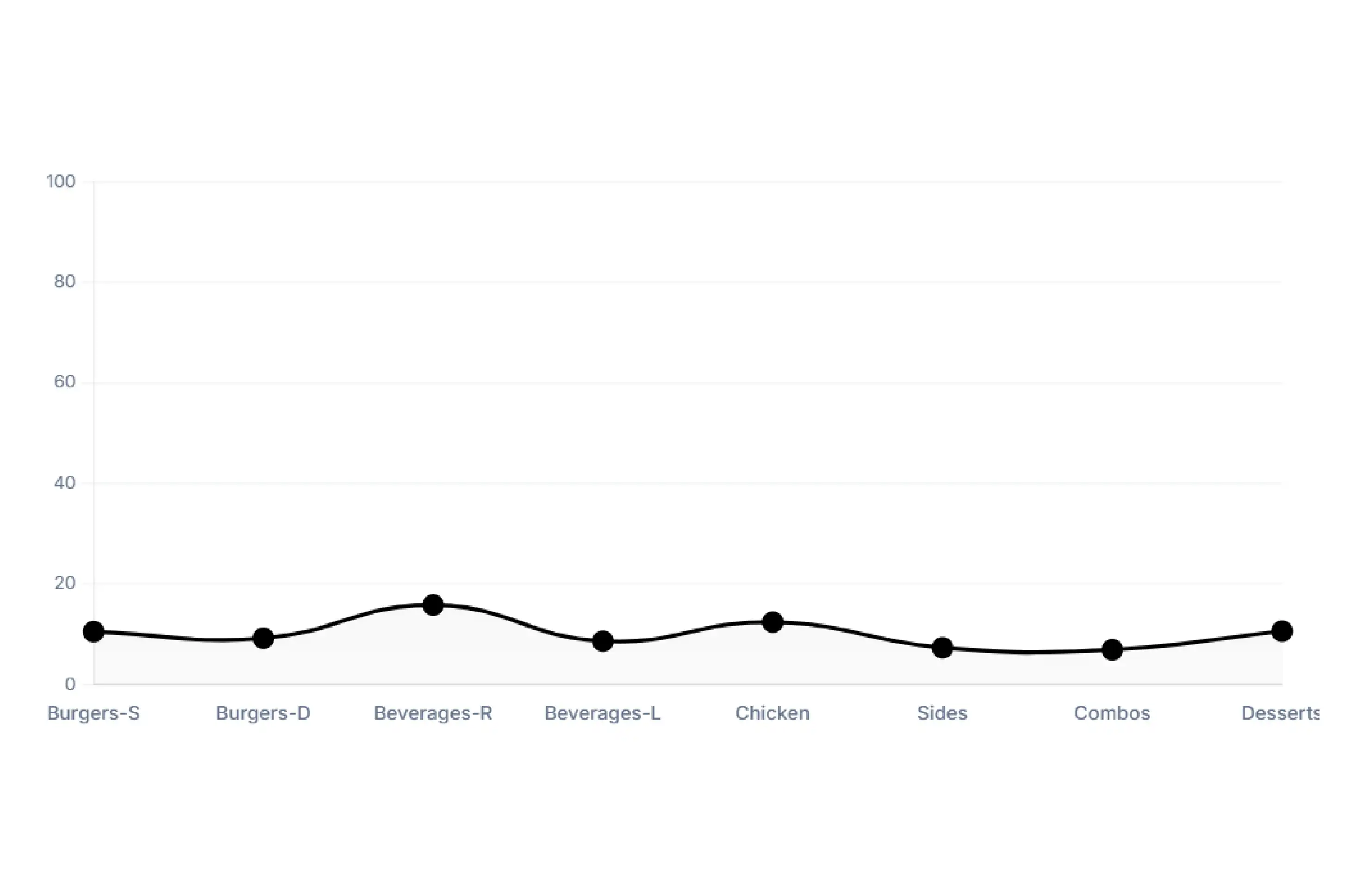
AI-assisted dish matching improved the accuracy of comparisons between similar products offered by competing QSR brands.
The system considered product names, descriptions, categories, sizes, and other available menu attributes to identify comparable dishes. This reduced the risk of comparing products with substantially different specifications.
For instance, a standard chicken burger was evaluated separately from a premium double-patty burger. Similarly, regular and large beverage sizes were maintained as separate comparison categories.
This enabled more meaningful price benchmarking and improved the reliability of category-level analysis.
The analysis highlighted differences between restaurant menu prices displayed on Swiggy and Zomato. Such variations could arise from platform-specific promotions, outlet configurations, or different pricing strategies.
The client gained a consolidated understanding of its restaurant listings across both platforms.
Management could evaluate whether a particular dish maintained consistent positioning, whether discounts were creating unexpected price differences, and where additional pricing validation was necessary.
This improved the coordination between digital marketing, revenue management, and restaurant operations.
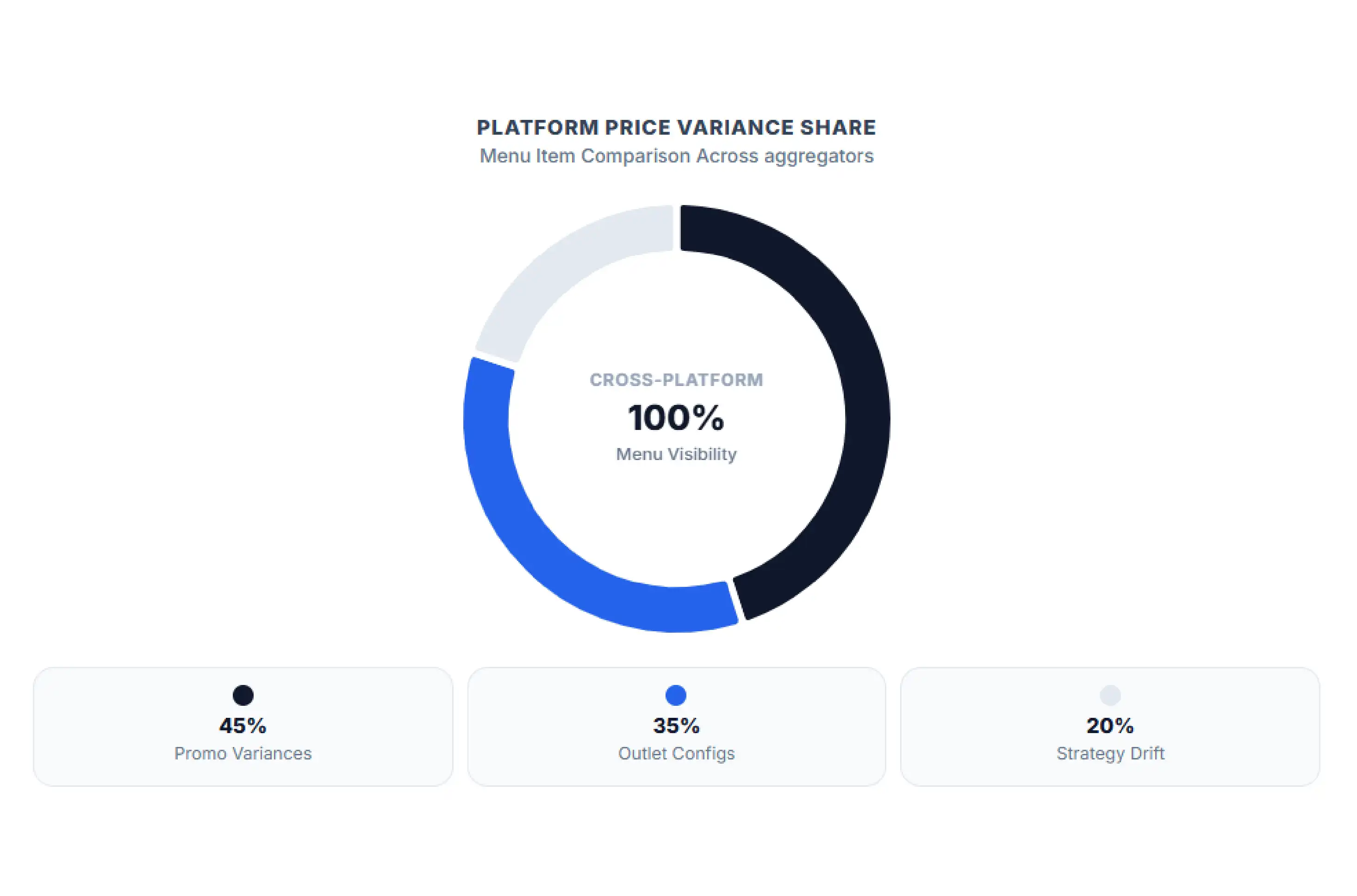
The following illustrative dataset demonstrates how the system organized competitor menu prices across different Indian cities and delivery platforms. It compares similar food categories and highlights differences between restaurant listings.
| City | Restaurant | Platform | Menu Item | Listed Price | Discounted Price |
|---|---|---|---|---|---|
| Delhi | McDonald's | Swiggy | Classic Veg Burger | ₹149 | ₹119 |
| Delhi | Burger King | Zomato | Veg Burger | ₹139 | ₹119 |
| Mumbai | McDonald's | Swiggy | Chicken Burger | ₹199 | ₹169 |
| Mumbai | KFC | Zomato | Chicken Burger | ₹189 | ₹159 |
| Bengaluru | McDonald's | Zomato | Regular Pizza | ₹229 | ₹199 |
| Bengaluru | Pizza Hut | Swiggy | Classic Pizza | ₹219 | ₹189 |
| Hyderabad | Burger King | Swiggy | Veg Wrap | ₹129 | ₹109 |
| Hyderabad | McDonald's | Zomato | Vegetable Wrap | ₹139 | ₹119 |
| Pune | KFC | Swiggy | Cold Coffee | ₹119 | ₹99 |
| Pune | McDonald's | Zomato | Cold Coffee | ₹129 | ₹109 |
| Jaipur | Pizza Hut | Zomato | Meal Combo | ₹249 | ₹219 |
| Jaipur | McDonald's | Swiggy | Burger Combo | ₹259 | ₹229 |
Note: Restaurant names are illustrative substitutions. Menu items and prices are not verified live listings.
Illustrative sample records, not verified live platform prices or actual client transaction data.
The dataset enabled the QSR chain to compare prices at product and city levels. It also helped distinguish listed prices from promotional prices, making competitive benchmarking more meaningful.
After implementing the AI-powered restaurant menu monitoring framework, the client gained better visibility into competitive pricing, promotional movements, and regional menu differences.
The following illustrative project outcomes demonstrate the operational improvements achieved through the implementation:
These improvements established a stronger foundation for continuous restaurant market intelligence and data-driven menu management.
iWeb Data Scraping provides an integrated approach to collecting and analyzing restaurant menu information across multiple digital platforms. Its solutions help businesses transform fragmented restaurant listings into structured datasets that support competitive benchmarking, pricing analysis, and operational planning.
Unified Data Collection
The approach combines automated data extraction with data cleaning, standardization, and validation. This ensures that menu prices, restaurant details, product categories, and promotional information are organized into consistent formats suitable for business intelligence applications.
AI-Assisted Product Matching
AI-assisted product matching further improves the comparison process by identifying similar menu items across different restaurant brands. Businesses can evaluate comparable products more accurately while reducing the inconsistencies associated with manual research.
Scalable Infrastructure
Scalable infrastructure supports monitoring across multiple cities, outlets, and restaurant categories. Historical datasets enable organizations to examine price movements, promotional patterns, and competitive changes over time.
Customized Dashboards
Finally, customized dashboards provide management teams with accessible pricing intelligence, helping them identify market opportunities, improve decision-making speed, and develop more effective restaurant pricing strategies.
"The solution has significantly improved our understanding of competitive menu pricing across Swiggy and Zomato. Earlier, our teams depended on manual checks and spreadsheets to compare restaurant prices across different cities. The automated intelligence framework has streamlined this process and provided better visibility into competitor offerings, discounts, and regional pricing variations. We particularly appreciate the AI-based product matching capabilities and structured dashboards, which have made our analysis more consistent and actionable. The solution has helped our teams make faster, more informed pricing decisions and strengthened our overall competitive monitoring capabilities."
— Head of Digital Strategy and Revenue Management
The project delivered a scalable restaurant menu intelligence framework that enabled the QSR chain to monitor competitor pricing across Swiggy and Zomato more efficiently. Through AI menu price monitoring Swiggy Zomato, the organization established a centralized system for evaluating dish prices, promotional movements, restaurant offerings, and city-level competitive differences.
The implementation of Swiggy data scraping services supported structured collection of relevant restaurant and menu information, while AI-assisted matching improved comparisons between similar dishes offered by competing QSR brands.
Integration of restaurant food delivery APIs, where authorized and available, further supported standardized data exchange and streamlined analytics workflows across restaurant intelligence systems.
The organization gained improved visibility into listed prices, discounts, menu availability, and platform-specific variations. Its pricing teams could evaluate competitive positioning more efficiently, identify regional opportunities, and develop better-informed promotional strategies.
The automated infrastructure also reduced repetitive manual monitoring and established a scalable foundation for expanding restaurant coverage and analytical capabilities.
Overall, the initiative transformed fragmented menu information into actionable business intelligence, strengthening competitive awareness, operational efficiency, and data-driven pricing decisions across the QSR chain's Indian operations.
AI menu price monitoring involves collecting and analyzing restaurant menu information from food delivery platforms. Artificial intelligence helps match similar dishes, compare prices, identify promotional changes, and generate competitive pricing insights across restaurants and cities.
QSR chains can compare competitor prices, identify regional pricing differences, evaluate promotional strategies, and understand how their products are positioned in different markets. These insights support better menu planning and competitive pricing decisions.
Depending on platform access and availability, datasets can include restaurant names, outlet locations, dish names, descriptions, categories, listed prices, discounted prices, promotional offers, ratings, and menu availability information.
Yes. AI-assisted matching can evaluate product names, descriptions, categories, sizes, and other available attributes to identify comparable dishes. Confidence-based validation helps improve matching accuracy and separates products with significantly different specifications.
Yes. A scalable monitoring framework can organize restaurant information by city, outlet, platform, and menu category. This enables businesses to compare regional pricing patterns and develop location-specific competitive strategies.
iWeb Data Intelligence helps QSR chains transform restaurant menu information into structured pricing intelligence through automated data extraction, AI-powered product matching, competitive benchmarking, and customized dashboards. Our solutions enable businesses to monitor market movements, understand competitor strategies, and make smarter pricing decisions across Indian cities.
Start a projectFields marked * are required. Everything else just helps us scope faster — skip what you don't know yet.