
52.8K+
TOTAL PRODUCT RECORDS PROCESSED

Amazon ASIN matching connects identical products across marketplace listings, improving catalogue accuracy, product identification, competitive intelligence, and e-commerce data management.
This case study is designed for organizations managing extensive product catalogues across Amazon marketplaces, particularly businesses operating in the United Arab Emirates and other competitive e-commerce markets. It demonstrates how structured product identification and automated matching processes can transform fragmented catalogue information into reliable product intelligence.
The solution is particularly relevant for:
The central business requirement was to establish a dependable mechanism for identifying corresponding products despite differences in product titles, descriptions, brand formatting, model numbers, packaging information, and seller-specific naming conventions.
The client wanted to replace fragmented spreadsheet comparisons and inconsistent manual verification with a scalable matching framework. Its objective was to create a unified product intelligence environment that could identify corresponding Amazon listings, validate product characteristics, and support accurate commercial decisions.
The initiative focused on improving catalogue consistency, reducing duplicate product records, and establishing a reliable foundation for marketplace monitoring and product-level analytics.
A growing e-commerce intelligence organization required an automated solution to identify matching products between its internal product catalogue and Amazon marketplace listings. Its existing processes depended heavily on manual searches, title comparisons, and spreadsheet-based verification, making product identification increasingly difficult as catalogue volumes expanded.
The organization needed ASIN lookup at scale to connect thousands of supplier and retailer product records with corresponding Amazon listings. The project also addressed product matching UAE ecommerce requirements, where product descriptions, regional availability, packaging specifications, and marketplace-specific listing structures created additional matching complexities.
The implementation introduced an automated product identification pipeline combining Amazon catalogue extraction, attribute normalization, similarity analysis, and confidence-based matching. The framework collected product information such as titles, brands, model numbers, identifiers, descriptions, specifications, images, and variations wherever available.
The extracted information was standardized before being compared against the client's source catalogue. Multiple matching techniques evaluated product attributes and generated candidate ASINs based on their similarity and consistency.
The client operated a growing product intelligence platform that consolidated product information from suppliers, distributors, internal catalogues, and online marketplaces. As the number of records increased, identifying identical products across different information sources became increasingly complicated.
Catalogue to ASIN Mapping
Supplier records frequently contained incomplete descriptions, inconsistent naming conventions, shortened model numbers, and different packaging references. Consequently, the same product could appear under several names, making direct comparisons unreliable.
Maintaining Amazon Product Match Confidence
Similar products often shared brand names, product categories, specifications, and titles but differed in important characteristics such as dimensions, capacity, model numbers, colours, or pack quantities. Incorrect associations could distort pricing comparisons and inventory analysis.
Reliable Amazon Data Scraping
The client also required reliable Amazon data scraping to collect relevant marketplace information consistently. Manual browsing could not support the required catalogue volume, while fragmented extraction methods created inconsistencies in product attributes, listing references, and update frequency.
To overcome these challenges, the client required an automated ASIN identification and product matching framework capable of continuous marketplace collection, attribute standardization, and confidence-based validation.
By implementing an automated ASIN identification and product matching framework, the client replaced fragmented manual research with a centralized product intelligence pipeline. The system continuously collected marketplace information, standardized product attributes, compared catalogue records, and generated potential ASIN matches with confidence scores.
This transformation improved product identification consistency and enabled the organization to process significantly larger product datasets without proportionately increasing manual verification requirements.
| Dimension | Manual Product Matching | Client's Automated Matching System |
|---|---|---|
| Product identification | Individual Amazon searches | Automated product identification across large catalogues |
| Catalogue comparison | Manual title and description checks | Multi-attribute similarity and comparison |
| ASIN identification | Manual identification and recording | Automated candidate ASIN discovery |
| Attribute validation | Spreadsheet-based verification | Standardized attribute comparison |
| Duplicate detection | Manual identification of repeated records | Automated duplicate identification |
| Product variations | Inconsistent size and model recognition | Variation-aware product validation |
| Match confidence | Subjective analyst decisions | Confidence-based scoring and validation |
| Processing speed | Dependent on analyst availability | Automated batch processing |
| Data maintenance | Periodic manual updates | Repeatable extraction and reconciliation |
| Reporting | Separate spreadsheets and documents | Centralized matching reports and dashboards |
The automated approach provided a more consistent process for identifying equivalent products while preserving distinctions between similar but non-identical listings. It also established a transparent verification mechanism, allowing analysts to understand why a particular ASIN was selected and where additional investigation was necessary.
The brand in focus is an enterprise e-commerce intelligence and product analytics organization specializing in marketplace data collection, product identification, catalogue management, and competitive intelligence. Its operations involve consolidating product information from multiple commercial sources to help businesses understand product availability, pricing structures, assortment differences, and marketplace performance.
As its client portfolio expanded, the organization began processing increasingly diverse product catalogues across consumer electronics, home appliances, beauty, personal care, grocery, fashion accessories, and household products. Each category introduced different identification requirements, making standardized product matching increasingly important.
For example, an electronic device could be identified through its manufacturer, model number, storage capacity, and technical specifications. A personal care product might require brand, formulation, volume, and packaging information. Similarly, household products could have multiple dimensions, colours, and pack quantities that needed to be considered before assigning an accurate product identifier.
We developed an end-to-end product intelligence solution that transformed fragmented catalogue records into standardized, match-ready datasets. The implementation combined marketplace data collection, product attribute extraction, normalization, entity resolution, and confidence-based validation.
The solution was designed around interconnected operational stages.
Source Catalogue Collection
The first stage involved collecting the client's existing product information from supplier files, retailer catalogues, distributor records, and internal product databases. Records were consolidated into a standardized input structure containing available product names, brands, model numbers, category information, descriptions, and external identifiers. The system preserved original source references to maintain traceability throughout the matching process.
Amazon Product Information Extraction
The second stage collected relevant Amazon marketplace product information through compliant extraction methods and available data access mechanisms. Product attributes included ASIN, product title, brand, model number, manufacturer, product description, identifiers, category, specifications, variations, and listing references wherever available. The collected information was organized into structured records to support consistent comparisons with the client's catalogue.
Product Attribute Normalization
Raw product information frequently contained spelling differences, abbreviations, inconsistent measurement units, formatting variations, and unnecessary descriptive text. The normalization layer standardized brand names, product titles, model references, quantities, dimensions, and category-specific attributes. It also identified missing information and preserved important product distinctions.
Candidate Product Identification
The matching engine generated potential product candidates by comparing multiple attributes rather than relying exclusively on title similarity. It evaluated brand consistency, model identifiers, GTINs, EANs, UPCs, specifications, product descriptions, and other available characteristics. Candidate records were ranked according to their relevance and attribute agreement.
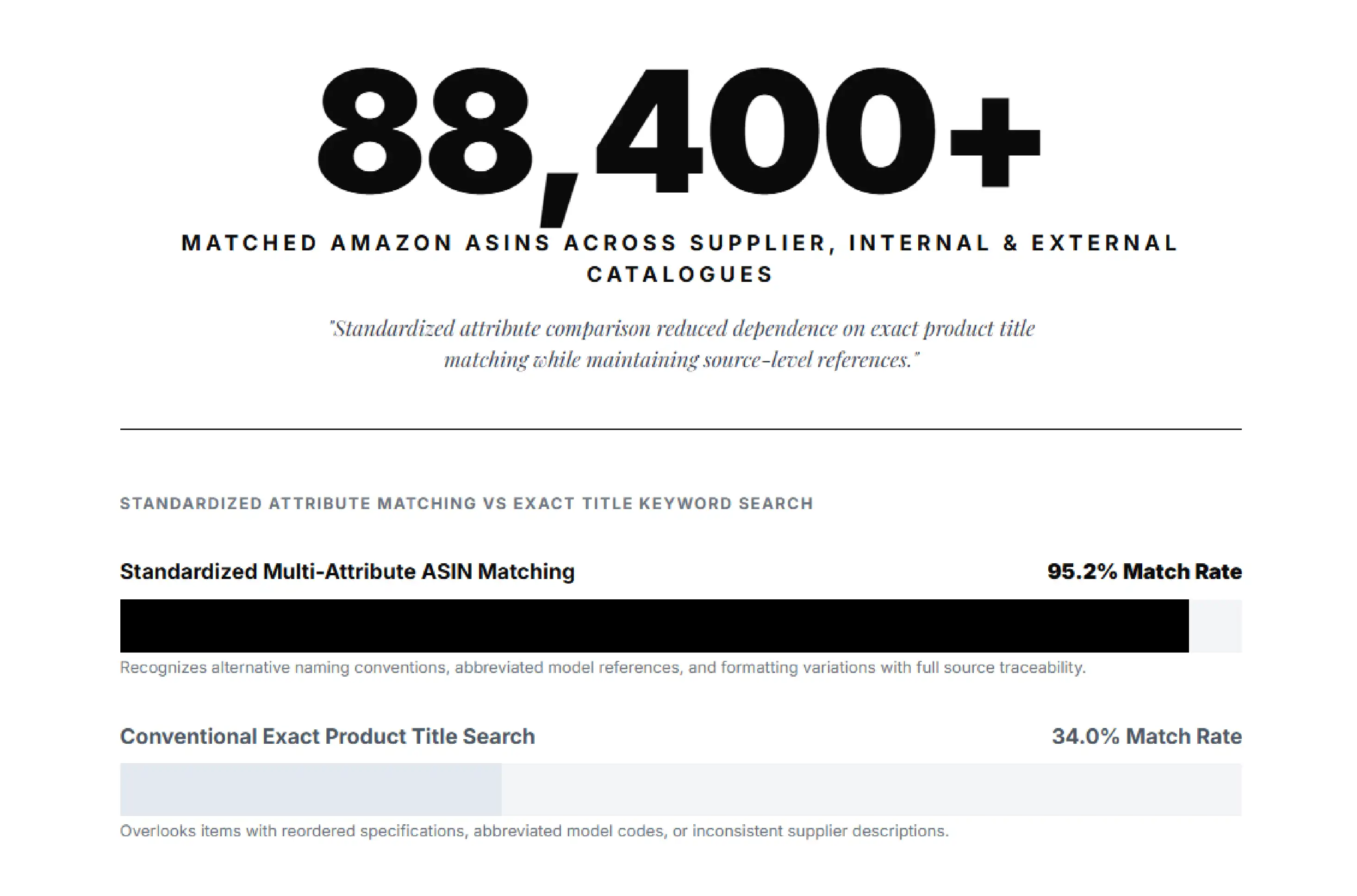
The automated matching framework enabled the client to identify corresponding Amazon products across supplier databases, internal inventories, and external product catalogues. Standardized attribute comparison reduced dependence on exact product title matching.
The system recognized alternative naming conventions, abbreviated model references, and differences in descriptive formatting. This helped analysts identify products that conventional keyword searches frequently overlooked.
The implementation also maintained source-level references, making it easier to trace each matched ASIN back to its original product record. Consequently, catalogue reconciliation became more consistent and product identification required less repetitive manual research.
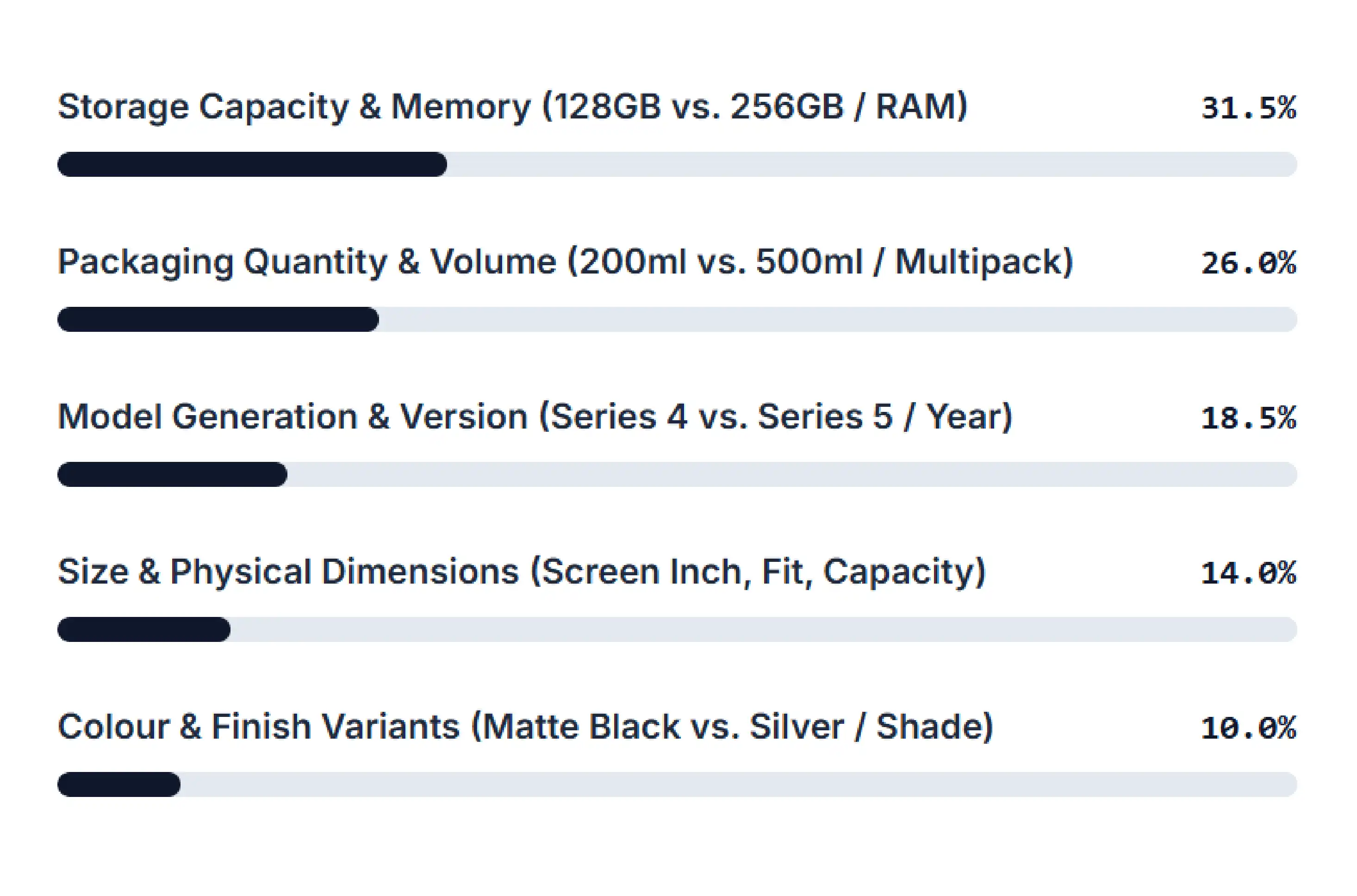
One important finding involved the distinction between identical products and closely related product variations. Similar listings frequently differed in colour, size, model generation, storage capacity, packaging quantity, or other commercially relevant specifications.
The matching framework introduced attribute-specific comparison rules to identify these differences before confirming product relationships.
For instance, two listings from the same electronics brand might share similar product titles but have different memory configurations. Likewise, personal care products could have different quantities despite identical brand names and formulations. The system evaluated these attributes alongside product identifiers, improving the reliability of product-level comparisons and reducing incorrect catalogue associations.
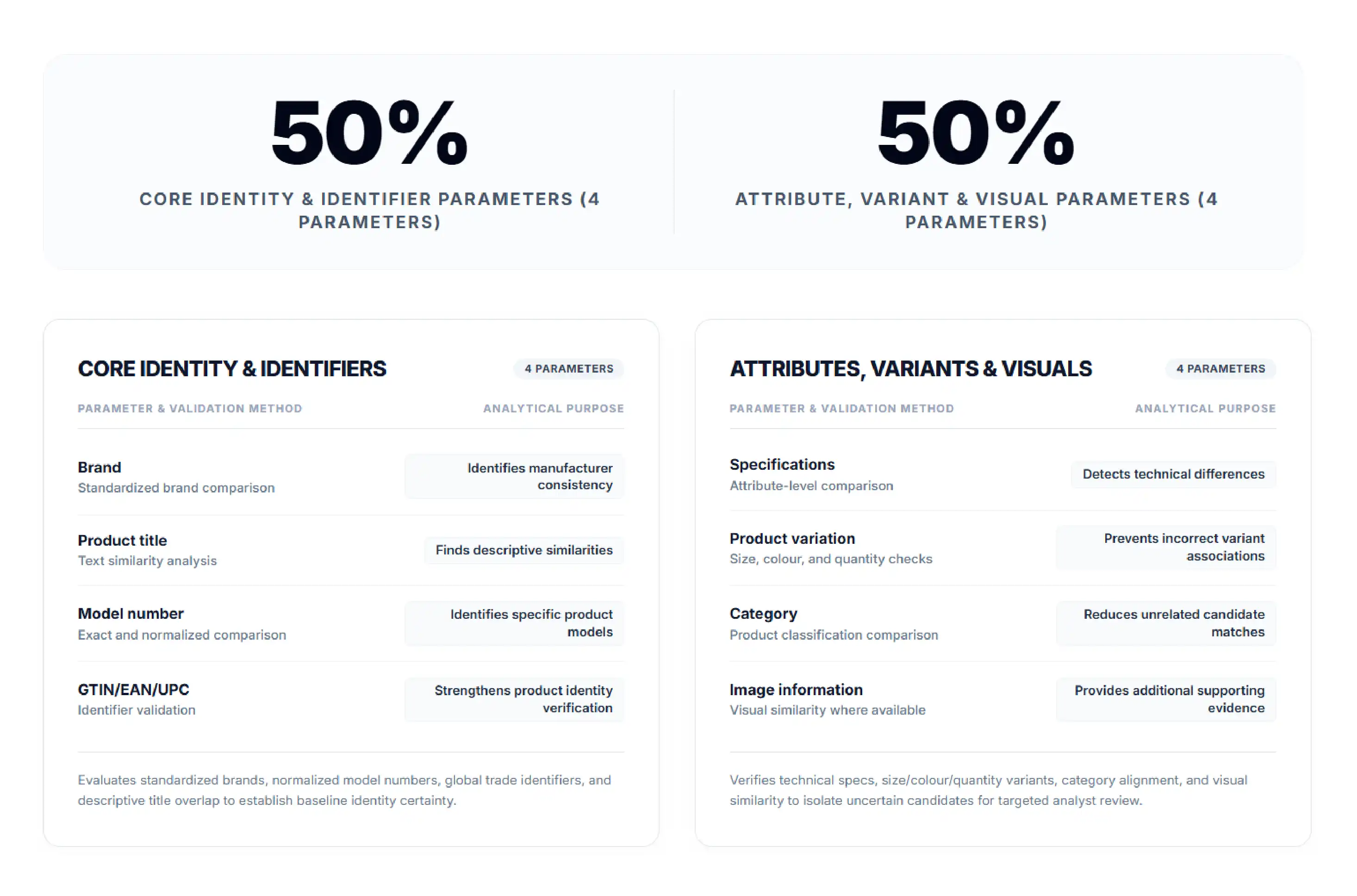
The confidence scoring framework enabled the organization to classify potential matches according to the strength of their supporting evidence. Instead of treating every candidate as an equally reliable match, the system considered the availability and consistency of product attributes.
Matching parameters included brand for manufacturer consistency, product title for descriptive similarities, model number for specific product models, GTIN/EAN/UPC for product identity verification, specifications for technical differences, product variation for size/colour/quantity checks, category for reducing unrelated matches, and image information for additional supporting evidence.
The scoring framework helped distinguish strong matches from possible matches and unresolved records. Analysts could review uncertain candidates instead of spending equal time checking every product record.
The following illustrative dataset demonstrates how source catalogue records can be connected with corresponding Amazon listings through standardized product attributes and confidence-based validation.
The sample includes different product categories to demonstrate the importance of comparing brand information, model references, product descriptions, and specifications before confirming a match.
| Source Product Name | Brand | Amazon ASIN | Category | Match Confidence | Status |
|---|---|---|---|---|---|
| Wireless Headphones WH-1000XM5 | Sony | B0B6G7KPJT | Electronics | 98.6% | Matched |
| Galaxy S24 Ultra 256GB | Samsung | B0DSC83YQ5 | Mobile | 97.8% | Matched |
| Air Fryer 5.5L | Philips | Not verified | Home Appliances | 96.4% | Manual Review |
| Instant Coffee 200g | Nescafe | B07MVKZ51T | Grocery | 95.2% | Matched |
| Vitamin C Face Serum 30ml | Minimalist | B08MVBF4P8 | Beauty | 91.7% | Matched |
| Stainless Steel Bottle 1L | Milton | B0DCJZ3FRJ | Home & Kitchen | 89.5% | Matched |
| Portable Bluetooth Speaker | JBL | B09GJMPRYW | Electronics | 98.1% | Matched |
| Electric Toothbrush Replacement Head | Oral-B | B0021ZFVXS | Personal Care | 76.8% | Manual Review |
Note: Sample figures are illustrative and do not represent verified Amazon.ae listing statistics or actual match results.
The structured dataset enables teams to evaluate product matches by brand, ASIN, category, confidence score, and verification status.
Following the implementation of the automated Amazon ASIN matching framework, the client achieved improvements in catalogue identification, product validation, processing efficiency, and marketplace intelligence. The centralized system enabled teams to work with standardized product records and reduced the operational challenges associated with fragmented catalogue information.
The following illustrative performance indicators demonstrate the business value delivered through the implementation:
iWeb Data Intelligence delivers structured product data solutions designed to help enterprises overcome complex catalogue management and marketplace intelligence challenges. Our approach combines automated extraction, intelligent matching, data validation, and scalable processing to support accurate product identification across multiple digital commerce environments.
Automated Product Identification
Our framework automates product identification by comparing multiple attributes instead of depending exclusively on product titles or keyword searches. This enables businesses to discover corresponding marketplace listings across extensive product catalogues while maintaining consistency and traceability throughout the identification process.
Advanced Attribute Standardization
We standardize product names, brand references, identifiers, descriptions, measurements, and specifications to establish consistent comparison structures. This reduces formatting-related discrepancies and enables businesses to evaluate product records using reliable and comparable attributes across different information sources.
Confidence-Based Matching
Our matching methodology evaluates available product information and assigns confidence scores to potential associations. This helps organizations distinguish reliable matches from uncertain candidates, prioritize manual verification, and reduce the possibility of incorrect product identification across commercial datasets.
"The product matching solution delivered by the iWeb Data Intelligence team significantly improved the way we manage and analyze our product catalogues. Earlier, identifying corresponding Amazon products across different supplier records required considerable manual effort and repeated verification. The automated framework helped us standardize product information, identify matching ASINs, and organize our catalogue information more efficiently. We particularly appreciated the confidence-based validation approach, which made it easier to distinguish reliable matches from records requiring additional investigation. The structured datasets improved our visibility into product information and supported more consistent marketplace comparisons. The team's approach to data accuracy, scalability, and reporting exceeded our expectations and provided a dependable foundation for our ongoing e-commerce intelligence operations."
— Head of E-commerce Analytics
The final outcome was a scalable Amazon ASIN matching framework that transformed fragmented product information into structured, standardized, and validated marketplace intelligence. The client established a centralized mechanism for connecting internal catalogue records with corresponding Amazon product listings, improving product identification and reducing the complexities associated with manual catalogue reconciliation.
Implementation of product data enrichment capabilities improved the completeness of product records by consolidating available descriptions, brand details, specifications, identifiers, model references, and marketplace information. This enabled stakeholders to work with more informative product profiles and improved the reliability of downstream product analysis.
The resulting ecommerce product datasets provided standardized records containing source product references, corresponding ASINs, product attributes, matching confidence scores, validation status, and other relevant marketplace information. These datasets supported catalogue synchronization, product comparison, competitive benchmarking, and marketplace monitoring.
The implementation also strengthened assortment intelligence by helping the organization understand product coverage, identify missing catalogue references, evaluate category representation, and compare equivalent products across Amazon listings. Businesses could use these insights to identify assortment gaps, evaluate competing products, and develop more informed marketplace strategies.
Furthermore, the automated pipeline improved operational consistency through repeatable extraction, normalization, matching, and verification procedures. Analysts gained better visibility into unresolved records and could prioritize manual checks based on matching confidence.
Amazon ASIN matching is the process of identifying the correct Amazon Standard Identification Number associated with a product in an external catalogue or database. It helps businesses connect equivalent products, standardize catalogue records, compare listings, and improve marketplace intelligence accuracy.
We use product attribute extraction, data normalization, identifier comparison, text similarity, and confidence-based validation. Available information such as brand names, model numbers, GTINs, EANs, UPCs, titles, and specifications helps identify suitable candidate ASINs.
Yes. The framework can support Amazon.ae catalogue matching by evaluating available regional product information, marketplace-specific listings, brand details, model references, descriptions, and product specifications. The matching rules can be customized according to the client's catalogue structure and UAE marketplace requirements.
We use multiple matching parameters and confidence-based validation rather than relying exclusively on title similarity. Important attributes such as model numbers, product identifiers, sizes, colours, and packaging quantities are evaluated to identify differences between closely related products.
Yes. Our data processing architecture supports large-scale catalogue operations through automated extraction, normalization, candidate identification, and validation. Output datasets can be delivered in structured formats suitable for reporting, analytics, and integration with existing business systems.
iWeb Data Intelligence helps businesses automate Amazon ASIN matching, connect fragmented product catalogues, validate product relationships, and build structured marketplace intelligence. Our scalable data solutions enable organizations to improve product identification, reduce manual verification, and make more informed e-commerce decisions.
Start a projectFields marked * are required. Everything else just helps us scope faster — skip what you don't know yet.