
128.6K+
AMAZON.DE REVIEWS PROCESSED

Amazon.de Review Data Scraping for Customer Sentiment Analysis, Product Ratings Monitoring, Competitive Intelligence, and E-commerce Performance Optimization.
This case study explores an illustrative enterprise scenario in which an e-commerce intelligence and analytics organization leverages large-scale Amazon Germany review extraction to transform unstructured customer feedback into structured business intelligence. Through automated data collection, sentiment classification, and review analysis, the organization aims to understand customer expectations, identify recurring product issues, and improve marketplace performance.
It is designed for:
The client's primary requirement was to establish a unified intelligence framework capable of capturing accessible customer reviews and converting them into actionable information. Traditional manual monitoring methods offered limited visibility into customer opinions and made it difficult to identify recurring issues across thousands of products.
The organization wanted to understand why customers rated products positively or negatively, which features influenced satisfaction, and how feedback changed over time. Its objective was to establish a scalable data collection and analytics infrastructure supporting better product positioning, reputation management, and strategic marketplace decisions.
The engagement examined how an enterprise organization could scrape all Amazon reviews available within its defined monitoring scope and transform customer feedback into structured analytical information. The initiative focused on collecting accessible product reviews, ratings, review dates, titles, and relevant listing information through an automated extraction framework.
The client required advanced Amazon review analytics to understand customer sentiment, identify frequently reported product problems, and compare satisfaction levels across competing products. The proposed solution combined automated extraction, data normalization, duplicate detection, sentiment classification, and dashboard-based reporting.
The extraction infrastructure organized review records using product identifiers, category information, ratings, and timestamps. This enabled analysts to compare customer experiences across product categories and reporting periods. German-language review processing helped identify recurring expressions, product complaints, positive attributes, and changing customer expectations.
The analytical framework also introduced automated topic identification to classify feedback into categories such as product durability, packaging, usability, compatibility, delivery experience, product design, and value for money.
Through structured dashboards, stakeholders could monitor rating distributions, identify negative sentiment patterns, and compare product-level performance. Historical snapshots supported the identification of emerging customer concerns and changes in review sentiment following product improvements.
The initiative demonstrated how automated review intelligence could reduce manual research, improve analytical consistency, and help enterprises make evidence-based decisions across product management, marketing, and marketplace operations.
The client managed a growing portfolio of products on Amazon Germany and faced difficulties understanding customer feedback across multiple categories. Reviews were distributed across individual product listings, making manual collection inefficient and preventing analysts from developing a comprehensive understanding of customer satisfaction.
Identifying 1-Star Review Data
One major challenge involved identifying 1-star review data and understanding the specific reasons behind extremely negative customer experiences. Low ratings frequently represented different problems, including defective components, poor product quality, misleading descriptions, missing accessories, and delivery-related dissatisfaction. Without structured classification, identifying recurring issues was difficult.
Absence of Consolidated Germany Ecommerce Review Data
Different departments maintained separate spreadsheets, resulting in inconsistent product identifiers, incomplete records, and fragmented reporting.
Continuous Reviews and Ratings Monitoring
Product ratings changed as additional feedback appeared, but manual tracking could not consistently capture these movements. Consequently, emerging customer complaints and declining satisfaction patterns were sometimes identified later than required.
German-Language Review Complexity
Customers frequently used informal expressions, abbreviations, spelling variations, and category-specific terminology. Traditional keyword-based analysis struggled to understand context and distinguish genuine dissatisfaction from neutral product observations.
Duplicate Records and Historical Tracking
The client also experienced difficulties identifying duplicate records and maintaining historical review information. Inconsistent collection methods made it challenging to compare feedback across different reporting periods.
Ultimately, the client required an integrated review intelligence solution that could reduce manual effort, improve feedback visibility, and support faster decision-making across its e-commerce operations.
By implementing an automated review intelligence framework, the client replaced fragmented manual monitoring with a structured pipeline capable of organizing accessible customer feedback across its defined Amazon Germany product portfolio.
The structured system provided consistent information across products and categories, helping stakeholders identify customer experience patterns without depending entirely on manual research.
| Dimension | Manual Review Tracking | Client Data Scraping System |
|---|---|---|
| Data collection | Individual product-page browsing | Automated collection across approved product listings |
| Review coverage | Limited manual sampling | Scalable monitoring of accessible review records |
| Data organization | Separate spreadsheets | Centralized structured datasets |
| Sentiment analysis | Subjective interpretation | Automated sentiment classification |
| Issue identification | Reactive complaint discovery | Recurring topic identification |
| Historical analysis | Limited historical records | Timestamp-based review comparisons |
| Reporting | Manual report preparation | Automated analytical dashboards |
| Data quality | Inconsistent formatting | Validation and duplicate detection |
The centralized system provided a consistent analytical foundation for comparing customer feedback across products while reducing repetitive operational work.
The brand in focus is an illustrative consumer-products organization operating across multiple categories on Amazon.de. Its business activities include marketplace management, product development, brand positioning, customer experience improvement, and competitive research.
As its product portfolio expanded, the organization experienced increasing difficulty managing customer feedback. Individual product listings generated substantial review volumes, while different departments required different insights from the same information.
Marketplace managers wanted to understand rating movements, product teams needed information about recurring quality concerns, and marketing professionals wanted to identify the features customers appreciated most.
However, fragmented review information prevented these teams from accessing a unified customer intelligence resource.
To address this challenge, the organization adopted a structured review data framework powered by automated extraction, normalization, and analytical processing. The framework connected product information with available customer feedback, making it possible to examine review patterns across different categories and reporting periods.
This transition helped the organization move beyond isolated customer comments toward a more systematic understanding of product satisfaction, competitive positioning, and changing consumer expectations.
We delivered an integrated data intelligence framework designed to transform accessible Amazon.de customer reviews into structured business information.
The process began with product identification and catalogue mapping. The client provided its priority product categories, brand names, product identifiers, and relevant listing references. These inputs established the monitoring scope and helped maintain consistent product mapping throughout the extraction process.
Automated Extraction Layer
The automated extraction layer collected available information, including product identifiers and product titles, review titles and customer comments, star ratings and review dates, available verified-purchase indicators, reviewer labels and helpfulness information, and product categories and associated listing information. The ingestion process included collection timestamps and source references to maintain traceability. Missing information was recorded appropriately rather than replaced with assumed values.
Data Cleaning and Standardization
The data cleaning layer standardized text formats, dates, ratings, and product identifiers. Duplicate detection helped eliminate repeated records, while validation checks identified incomplete entries and unexpected changes in source structures.
German-Language Text Processing
German-language text processing prepared customer comments for sentiment analysis. The system identified positive, negative, and neutral expressions while retaining original review content for additional investigation.
Topic Classification and Analytics
Advanced classification techniques grouped reviews into relevant topics such as durability, functionality, design, packaging, compatibility, instructions, and overall product value. The final analytics layer connected review information with product-level performance indicators. Interactive dashboards allowed stakeholders to filter information by category, brand, rating, sentiment, and reporting period.
This framework provided a scalable foundation for continuous review intelligence and customer experience analysis.
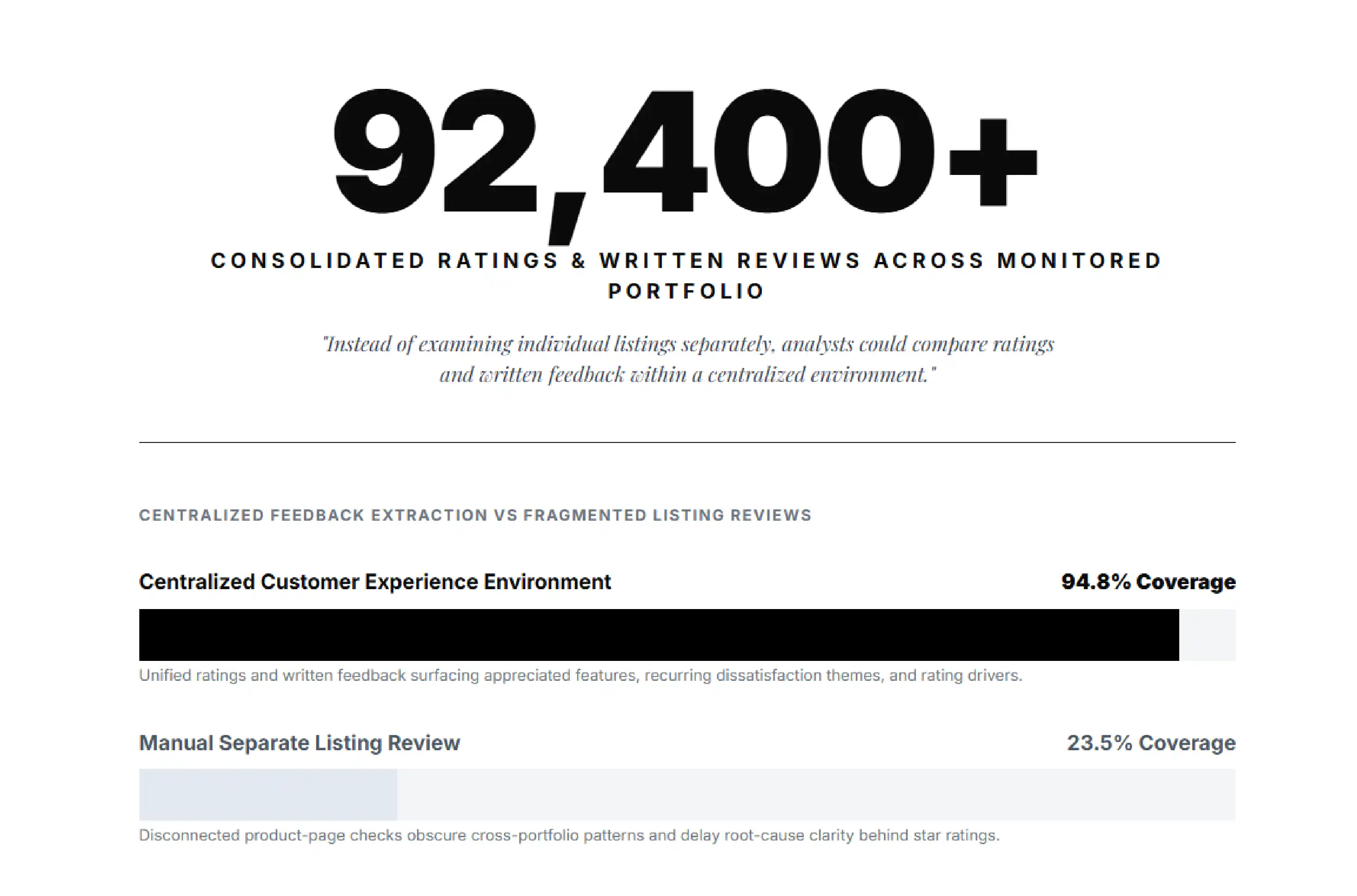
Automated extraction enabled the client to develop a consolidated understanding of customer experiences across its monitored product portfolio. Instead of examining individual listings separately, analysts could compare ratings and written feedback within a centralized environment.
The system helped identify frequently appreciated product features and recurring dissatisfaction patterns. This improved the quality of product discussions and enabled teams to understand the reasons behind customer ratings.
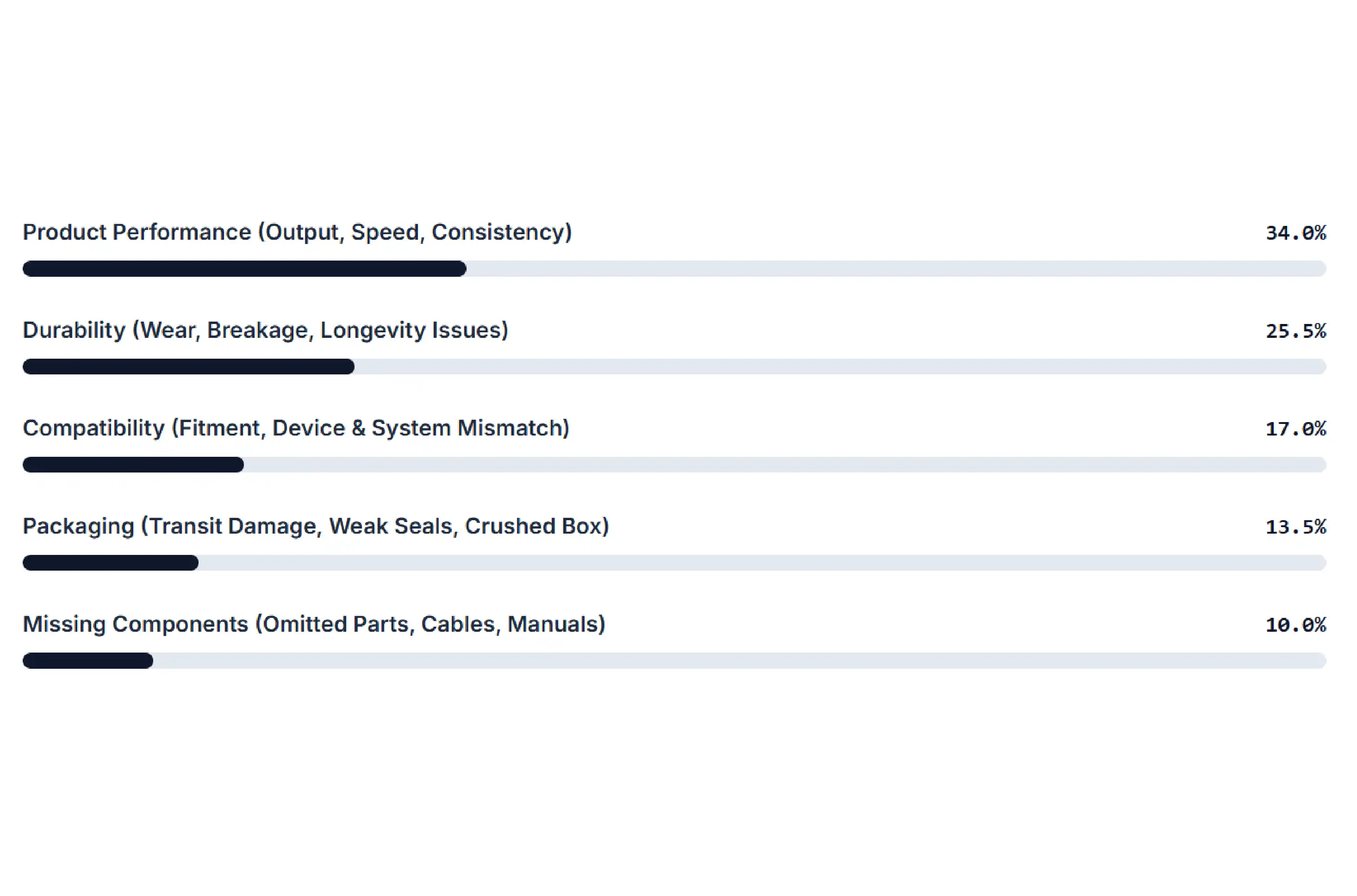
The analytical pipeline enabled faster identification of recurring complaints by grouping customer comments according to common themes.
Issues involving durability, packaging, compatibility, product performance, and missing components could be identified even when customers described similar problems using different expressions.
This allowed quality and product teams to prioritize further investigations using review evidence alongside internal product testing and customer support information.
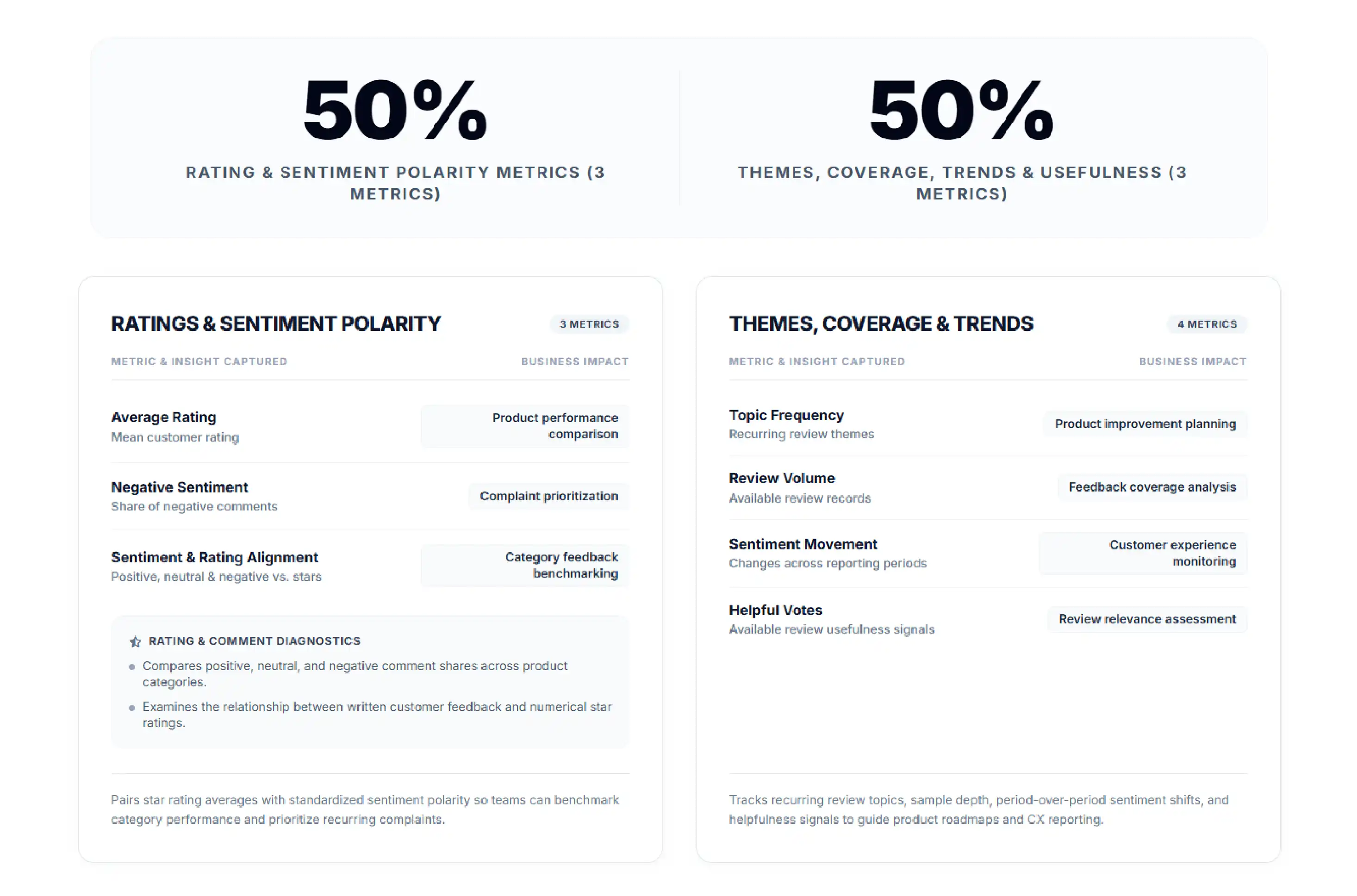
The system introduced standardized sentiment classification and rating analysis across the monitored product portfolio. Analysts could compare positive, neutral, and negative feedback across different categories while examining the relationship between customer comments and star ratings.
Key metrics included average rating for product performance comparison, negative sentiment share for complaint prioritization, topic frequency for product improvement planning, review volume for feedback coverage analysis, sentiment movement for customer experience monitoring, and helpful votes for review relevance assessment.
These indicators provided a consistent foundation for customer experience reporting.
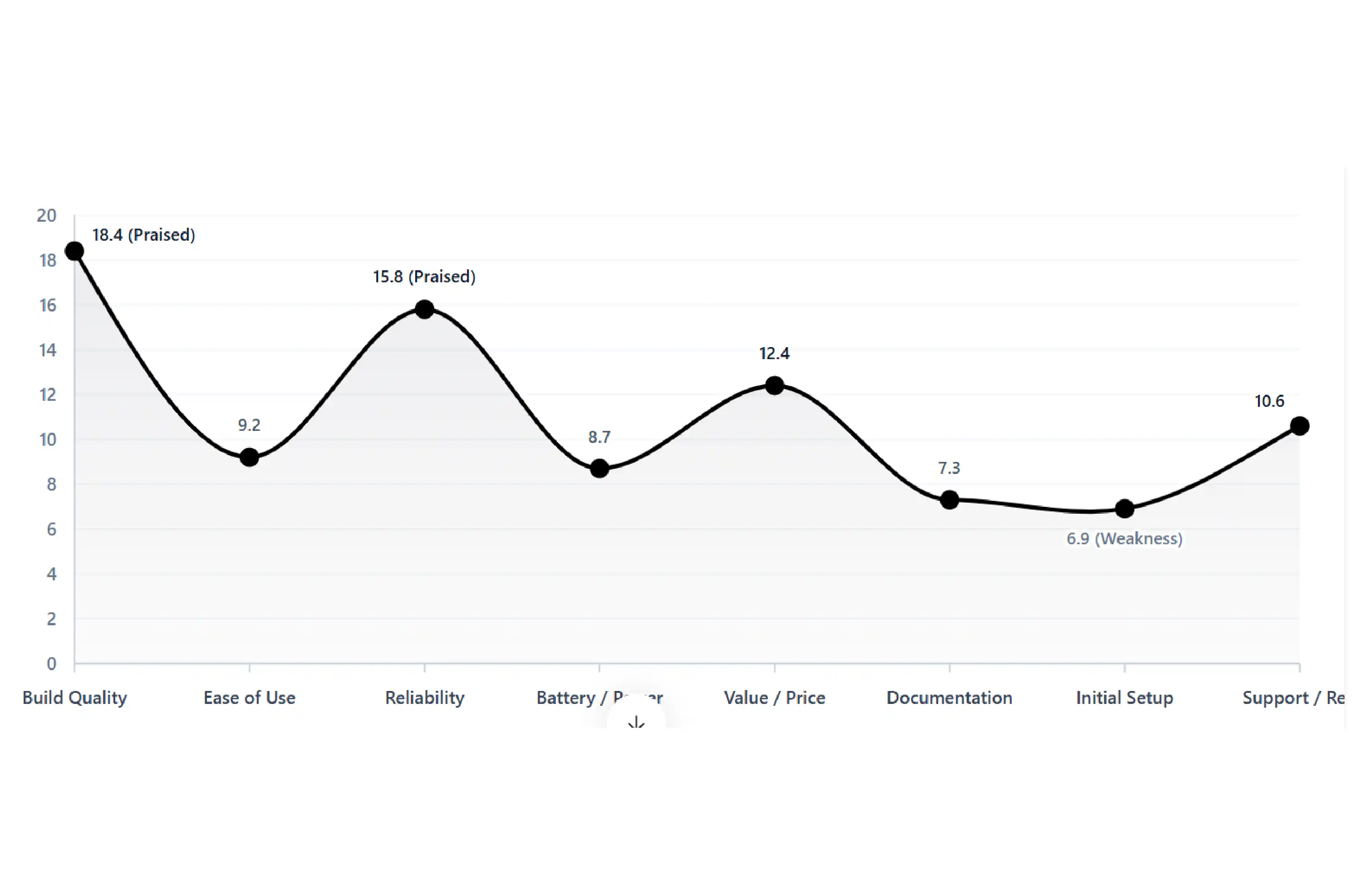
Standardized product information allowed the organization to compare selected competing listings across relevant categories.
Analysts could identify product attributes frequently praised by customers, examine recurring weaknesses, and understand how customer expectations differed across product segments.
This helped product managers identify potential improvement opportunities and supported marketing teams in developing more relevant product positioning strategies. Competitive comparisons were designed around similar products and defined reporting periods to avoid misleading conclusions arising from differences in product categories or review volumes.
The following illustrative dataset demonstrates how customer reviews can be organized into structured analytical records. The product names and numerical values are sample information created to demonstrate the reporting framework rather than verified Amazon.de listing statistics.
| Product Name | Category | Reviews Analyzed | Average Rating | Negative Share | Top Review Theme |
|---|---|---|---|---|---|
| Home Blender A | Kitchen Appliances | 8,450 | 4.2 | 14% | Noise and Cleaning |
| Wireless Earbuds B | Electronics | 12,600 | 4.0 | 19% | Battery Performance |
| Office Chair C | Furniture | 6,780 | 4.3 | 11% | Assembly and Comfort |
| Travel Backpack D | Accessories | 5,920 | 4.1 | 16% | Zipper Durability |
| Coffee Maker E | Kitchen Appliances | 9,150 | 3.9 | 22% | Temperature Consistency |
Note: Sample figures are illustrative and do not represent verified Amazon.de listing statistics.
The dataset demonstrates how review volume, ratings, and recurring customer concerns can be evaluated together. For example, a product with a relatively high average rating may still contain a recurring complaint that deserves attention. Similarly, comparing negative sentiment across similar products can help businesses investigate whether a particular product attribute influences customer satisfaction.
After implementing the structured review intelligence framework, the illustrative client achieved improvements in feedback visibility, reporting consistency, and product-level analysis.
The modeled project outcomes included:
iWeb Data Intelligence delivers structured data collection and analytical solutions designed to help enterprises understand complex digital information.
Unified Datasets
Our approach focuses on creating unified datasets by consolidating information from relevant sources into consistent formats. This reduces fragmentation and helps business teams access reliable information for reporting, comparison, and strategic planning.
Automated Collection
Automated collection reduces repetitive manual activities while supporting scheduled data refreshes. Data cleaning and validation techniques improve consistency by identifying duplicates, missing fields, and formatting irregularities before information reaches analytical dashboards.
Scalable Data Processing
The solution also supports scalable data processing. As the client's product catalogue expands, the infrastructure can accommodate additional monitoring requirements through modular collection, processing, and reporting components.
Advanced Analytical Capabilities
Advanced analytical capabilities help businesses understand customer sentiment, recurring complaints, product performance, and category-level differences. Furthermore, customized dashboards provide stakeholders with relevant indicators and filtering capabilities, making complex datasets easier to interpret.
Actionable Business Intelligence
By combining automated extraction, structured data processing, and analytical reporting, iWeb helps organizations transform accessible marketplace information into actionable business intelligence.
"The review intelligence solution has significantly improved how our organization understands customer feedback across our Amazon Germany product portfolio. Earlier, collecting reviews and preparing product comparisons required considerable manual effort. The structured datasets and dashboards have made it easier to identify recurring complaints, understand customer sentiment, and compare product performance. We appreciate the team's focus on data quality, reporting consistency, and scalable extraction capabilities. The solution has strengthened our ability to use customer feedback in product development and marketplace decisions."
— Head of E-commerce Intelligence
The project delivered a structured and scalable review intelligence environment that transformed accessible Amazon Germany customer feedback into actionable business information.
The client gained improved visibility into product ratings, customer sentiment, recurring complaints, and category-level performance. Centralized information reduced fragmented reporting and provided stakeholders with a consistent foundation for investigating customer experiences.
The resulting product reviews dataset included standardized product identifiers, available review information, collection timestamps, validation indicators, and analytical classifications. This enabled analysts to compare customer feedback across products, brands, and reporting periods.
Implementation of Amazon data scraping workflows established a repeatable framework for extracting and organizing accessible product-review information. Automated validation, duplicate detection, and source monitoring supported consistency and improved reporting reliability.
The integration of AI-powered scraping and language analysis capabilities further enhanced the ability to classify sentiment, identify recurring topics, and surface emerging customer concerns. These capabilities supported analyst productivity while retaining human validation for ambiguous or commercially important findings.
The organization also established a foundation for historical comparisons, product benchmarking, customer experience monitoring, and advanced analytical applications. Overall, the engagement improved operational efficiency, strengthened customer feedback visibility, and supported more informed product and marketplace decisions.
Amazon.de review data scraping involves collecting accessible product-review information from Amazon Germany listings and organizing it into structured datasets. Depending on source availability and permitted access, information may include product identifiers, review titles, customer comments, ratings, dates, and relevant metadata. Businesses use these datasets for customer sentiment analysis, product research, and competitive intelligence.
Available information may include product names, product identifiers, review titles, review text, star ratings, review dates, reviewer labels, verified-purchase indicators, and helpfulness information. Actual field availability depends on the source and approved collection scope. Missing information should be clearly identified rather than estimated.
Businesses can classify low-rated reviews according to recurring issues such as product durability, packaging, usability, compatibility, and performance. Sentiment analysis and topic classification help identify common complaints across products. These findings can support further investigation by product development, quality assurance, and customer experience teams.
Yes. A structured monitoring workflow can refresh selected product information according to an appropriate schedule, subject to source accessibility and applicable requirements. Historical snapshots can help businesses evaluate rating movements, emerging complaints, and changing customer sentiment across reporting periods.
Review scraping helps businesses understand customer expectations, identify product improvement opportunities, evaluate competitor feedback, and monitor satisfaction patterns. Structured datasets reduce manual research and support more consistent reporting, allowing organizations to make better-informed decisions regarding product development, marketplace operations, and customer experience.
iWeb Data Intelligence helps businesses collect, organize, and analyze accessible marketplace review information through scalable data scraping and analytics solutions. Our tailored frameworks support customer sentiment analysis, product benchmarking, review monitoring, and data-driven e-commerce decision-making.
Start a projectFields marked * are required. Everything else just helps us scope faster — skip what you don't know yet.