
58.6K+
TOTAL BABY CARE REVIEW RECORDS ANALYZED

Amazon Diaper Review Sentiment Analysis helps brands identify customer complaints, evaluate product performance, compare competitors, and improve baby care experiences.
This case study explores an enterprise e-commerce intelligence scenario in which a consumer analytics team uses structured Amazon review extraction, rating analysis, and sentiment classification to understand customer experiences across the baby diaper and personal care category. By transforming unstructured customer feedback into actionable insights, the organization identifies product quality concerns, purchasing preferences, brand performance differences, and opportunities for product improvement.
It is designed for:
The central business challenge was straightforward: Amazon generates extensive customer feedback, but individual reviews often contain overlapping product concerns, emotional language, inconsistent terminology, and highly specific usage experiences. The client needed a reliable framework to transform this fragmented information into structured intelligence that could support product development, brand benchmarking, customer experience management, and evidence-based commercial decisions.
The client wanted to understand why customers preferred certain diaper products while expressing dissatisfaction with others across Amazon's baby care marketplace. Existing monitoring methods provided basic star ratings but failed to explain the reasons behind customer satisfaction, negative feedback, repeat purchasing intentions, and product-specific complaints.
To address these limitations, the analytics team implemented a structured review intelligence framework designed to Extract Amazon diaper ratings API data through authorized, compliant data access methods and organize the resulting information into a consistent analytical dataset.
The solution incorporated Amazon diaper complaint analysis to identify recurring concerns related to leakage, absorbency, diaper rash mentions, sizing inconsistencies, adhesive performance, overnight protection, and packaging defects. Reviews were categorized according to product attributes, sentiment polarity, rating levels, verified-purchase indicators where available, and review publication dates.
The system also analyzed customer feedback across multiple diaper brands, pack sizes, product variants, and price segments. Natural language processing helped distinguish between positive experiences, neutral observations, and negative feedback while identifying the specific product attributes influencing those opinions.
The client operated in a competitive baby care marketplace where customer expectations extended beyond price and brand reputation. Parents evaluated diapers according to absorbency, comfort, fit, skin compatibility, overnight performance, and convenience. However, understanding these preferences at scale required more than reading individual reviews.
Challenge 1 — Limited Product-Level Visibility
The client lacked a unified method to evaluate customer feedback across diaper brands and variants. Basic star ratings could indicate dissatisfaction but rarely explained whether customers experienced leakage, poor fit, insufficient absorbency, or packaging problems. This limited the usefulness of product performance reports.
Challenge 2 — Inconsistent Competitive Benchmarking
Without structured Amazon diaper brand comparison, the team struggled to determine which products performed better on specific attributes. Differences in product sizes, pack quantities, price points, and review volumes also complicated comparisons, making normalized metrics essential for meaningful analysis.
Challenge 3 — Fragmented Customer Feedback
Each Baby care product review could describe several attributes simultaneously. A parent might praise softness while criticizing leakage protection or mention a sizing problem alongside positive comments about affordability. Manual analysis often failed to capture these overlapping sentiments consistently.
Challenge 4 — Difficulty Identifying Emerging Complaints
The organization needed to distinguish isolated negative experiences from recurring product concerns. Delayed analysis made it difficult to identify whether complaints about tabs, absorbency, fit, or packaging were increasing over time or concentrated within particular product variants.
Challenge 5 — Limited Category-Wide Intelligence
The wider Toys and baby products data scraping landscape offered opportunities to understand consumer expectations across related categories, but the client needed clear boundaries between diaper-specific findings and feedback concerning unrelated baby products. Category classification and product identification were therefore critical to maintaining analytical accuracy.
The client also struggled to answer several operational questions:
By replacing fragmented manual research with an automated analytical workflow, the client established a consistent process for transforming eligible Amazon review data into structured product intelligence.
| Dimension | Manual Review Monitoring | Structured Intelligence Pipeline |
|---|---|---|
| Data collection | Individual product pages and spreadsheets | Automated ingestion from authorized data sources |
| Review organization | Manually maintained records | Standardized product and review fields |
| Sentiment classification | Subjective analyst interpretation | NLP-assisted sentiment with quality checks |
| Complaint identification | Keyword searches and manual reading | Attribute-level complaint categorization |
| Brand comparison | Inconsistent rating comparisons | Normalized metrics with sample-size context |
| Trend monitoring | Periodic manual reporting | Scheduled refreshes and trend alerts |
| Product segmentation | Basic brand and SKU grouping | Brand, variant, size, pack, and price segmentation |
| Reporting | Static spreadsheets | Interactive dashboards and structured exports |
| Quality assurance | Manual spot checks | Validation, deduplication, and exception handling |
| Business application | Reactive issue investigation | Prioritized product and customer experience analysis |
The improved workflow did not eliminate the need for human judgment. Instead, it directed analysts toward high-impact findings, unusual feedback patterns, and ambiguous reviews requiring closer examination.
The brand in focus is an illustrative consumer intelligence organization supporting product manufacturers, e-commerce businesses, and market research teams operating in the baby care category.
Its responsibilities include evaluating customer satisfaction, monitoring competitive products, identifying emerging consumer expectations, and providing reliable information to stakeholders responsible for product development, marketing, merchandising, and customer experience.
The organization recognized that diapers represent a particularly important category for review intelligence because purchasing decisions involve repeated use and several interconnected product attributes. Parents may assess leakage protection during the day, overnight absorbency, softness against sensitive skin, waistband comfort, fit around the legs, ease of changing, and value across different pack sizes.
These factors also create analytical complexity. A product can receive a favorable overall rating while attracting recurring complaints about a particular size. Another product may receive mixed reviews because customers have different expectations regarding absorbency, fit, or overnight usage.
We designed an end-to-end review intelligence workflow that organizes eligible customer feedback into a standardized dataset for sentiment analysis, complaint tracking, and competitive product evaluation.
The pipeline begins with product identification and data acquisition. Product identifiers, titles, brands, variants, review text, star ratings, publication dates, and other permitted fields are collected where available through authorized sources and applicable platform requirements.
An Amazon Reviews Scraper workflow supports consistent collection and organization of review records, while validation rules check required fields, product associations, timestamp formats, and record uniqueness.
The data processing layer uses Amazon data scraping methods to organize eligible product and review information into a unified analytical structure. Access controls, applicable platform terms, privacy safeguards, and collection limits are incorporated into the operating process.
A typical normalized record contained:
After collection, the raw records passed through several processing stages.
Review Normalization: Review text and product identifiers were standardized so that equivalent products could be mapped consistently across listings.
For example, variations in product naming, pack-size notation, and variant descriptions were normalized to reduce duplicate records.
Sentiment Classification: Reviews were categorized into positive, neutral, negative, or mixed sentiment, with quality checks to validate classification accuracy.
Complaint Categorization: Negative feedback was grouped into attribute-level categories such as leakage, absorbency, fit, sizing, packaging, and value.
Duplicate Removal: Repeated records generated during overlapping collection cycles were identified and handled using product identifier, review text, and timestamp combinations.
Historical Storage: Each observation was timestamped, enabling the client to calculate sentiment trends and complaint patterns over time.
Alert Prioritization: The analytics layer identified high-priority situations, including products showing significant increases in negative feedback or repeated complaint themes across variants.
The final dataset was connected to dashboards where analysts could filter information by brand, product type, price segment, and time period.
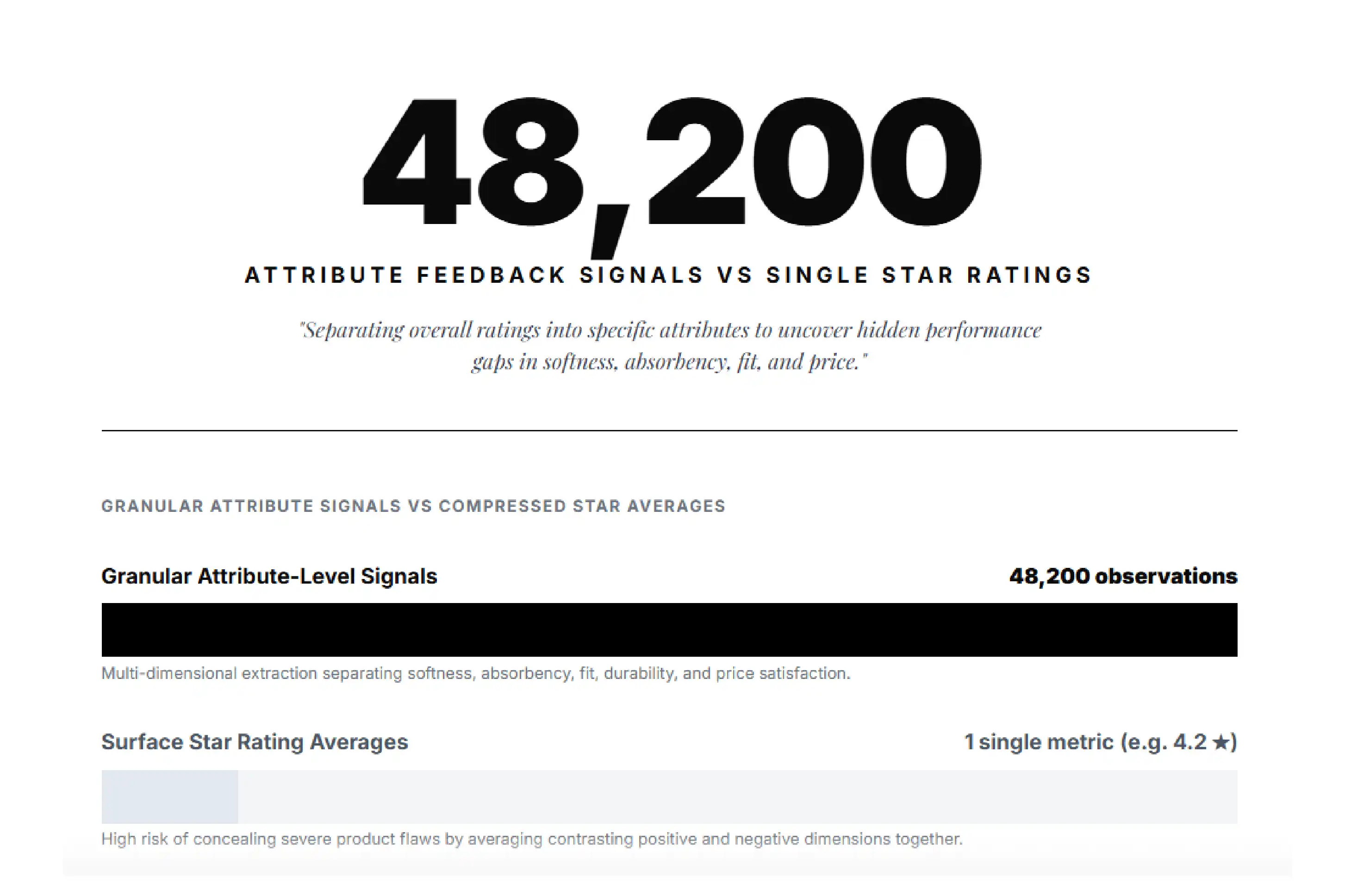
The analysis framework demonstrated the value of separating overall ratings from specific product attributes. A single star rating compresses several dimensions of customer experience into one number and can conceal meaningful differences between softness, absorbency, fit, and price satisfaction.
For example, a product might receive positive comments about comfort while attracting negative feedback about leakage during overnight use. An attribute-level dashboard makes these differences visible and allows product teams to investigate the underlying concern rather than relying exclusively on the overall rating.
This approach supports more precise product comparisons and helps stakeholders prioritize improvements based on recurring feedback patterns.
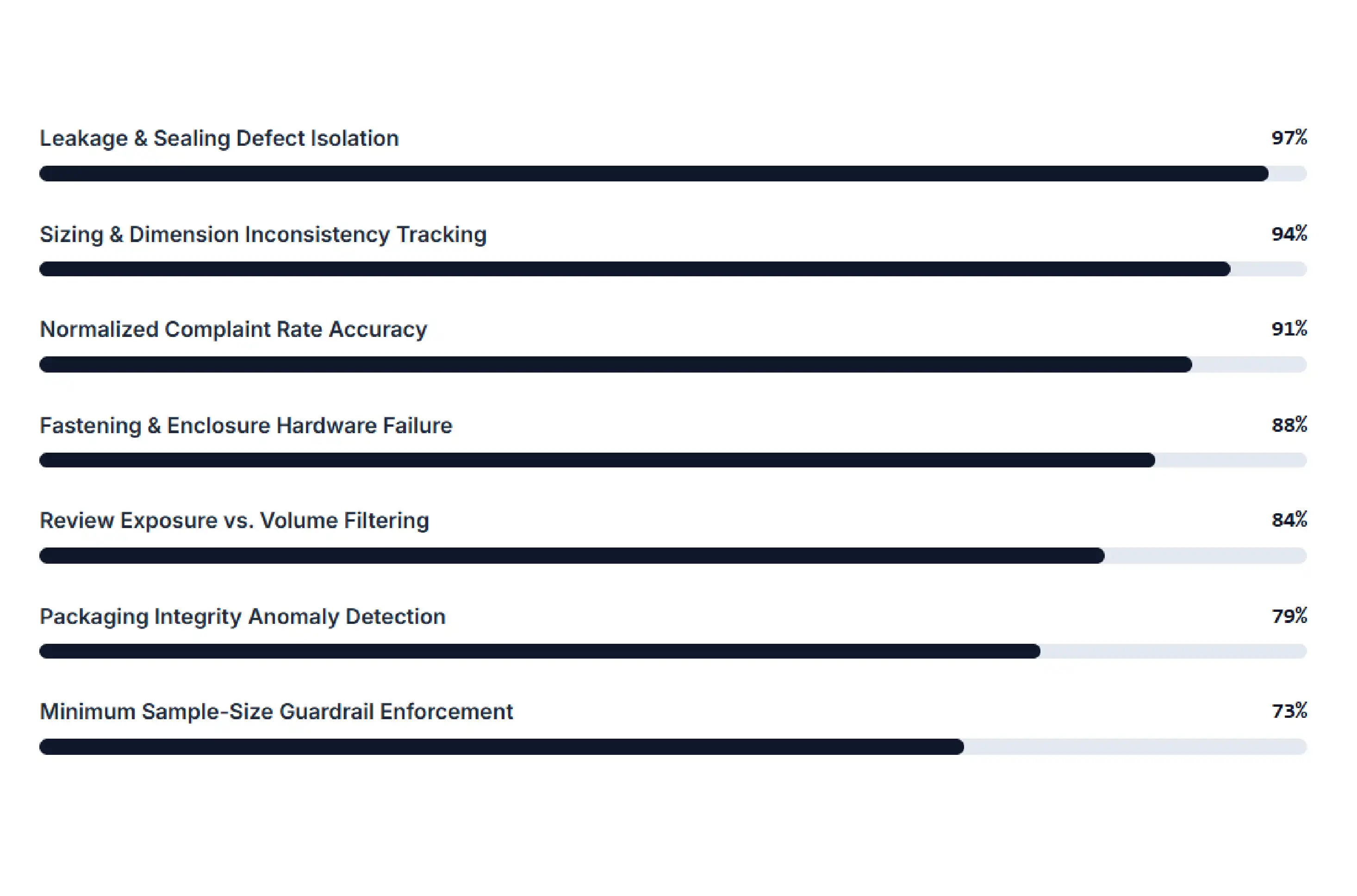
The system organized negative reviews into consistent complaint categories and measured their frequency across eligible review records. This made it easier to identify whether customers repeatedly mentioned leakage, fastening problems, sizing inconsistencies, or packaging concerns.
Complaint frequency was interpreted alongside review volume, product exposure, rating distribution, and changes over time. A product with more reviews may naturally generate more complaints in absolute numbers, even when its complaint rate is lower than that of a less-reviewed product.
Consequently, the analysis prioritized normalized rates and appropriate sample-size thresholds rather than relying exclusively on raw complaint counts.
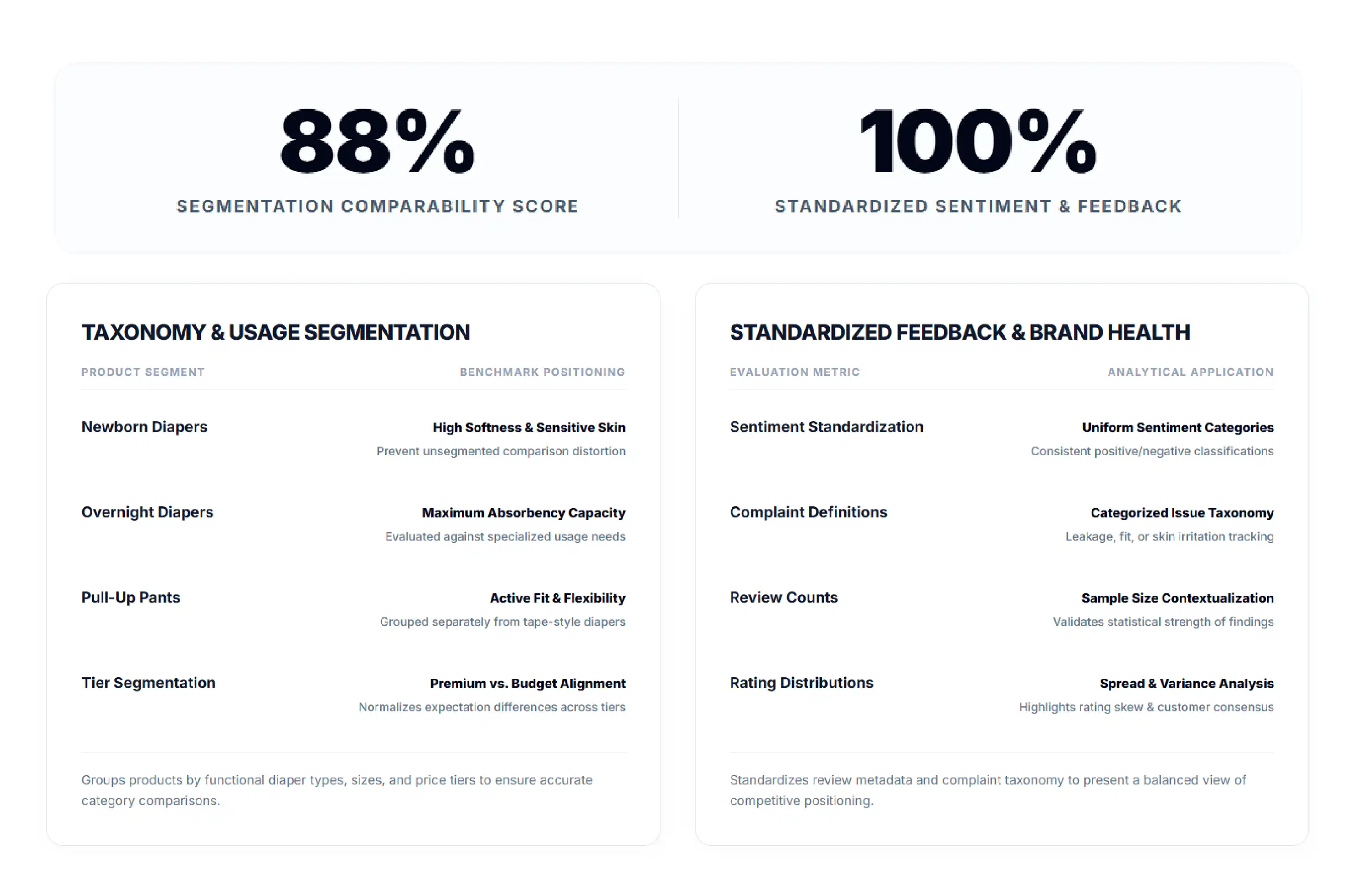
Brand benchmarking became more meaningful when products were grouped by comparable diaper types, sizes, and usage requirements.
Newborn diapers, overnight diapers, and pull-up pants serve different needs, so comparing them without segmentation can create misleading conclusions. Similarly, premium products may attract different customer expectations from budget-oriented alternatives.
The framework standardized sentiment categories and complaint definitions before producing comparisons. It also presented review counts and rating distributions to help stakeholders understand the strength and limitations of each finding.
This enabled a more balanced view of competitive positioning across relevant baby care segments.
The following illustrative dataset demonstrates how structured review analysis can support product comparisons. The figures are hypothetical examples for demonstrating the analytical framework and are not verified Amazon marketplace measurements.
| Brand | Product Type | Reviews Analyzed | Average Rating | Negative Review Share | Frequent Complaint |
|---|---|---|---|---|---|
| Pampers | Overnight diapers | 4,850 | 4.3/5 | 14.2% | Occasional leakage |
| Huggies | Newborn diapers | 3,920 | 4.5/5 | 10.8% | Pack quantity concerns |
| Pull-Ups | Pull-up pants | 4,410 | 4.1/5 | 18.6% | Fit and sizing |
| The Honest Company | Sensitive-skin diapers | 3,760 | 4.4/5 | 12.4% | Product availability |
| Luvs | Everyday diapers | 5,120 | 4.2/5 | 15.7% | Absorbency consistency |
| Millie Moon | Premium diapers | 2,980 | 4.3/5 | 13.1% | Price and perceived value |
Interpretation: The table illustrates how review volume, average rating, negative sentiment, and complaint categories can be evaluated together. Actual findings would depend on collected records, product comparability, and classification quality.
The value of this dataset was not limited to individual records.
The real advantage came from accumulating observations over time.
With thousands of records collected repeatedly, analysts could calculate sentiment trends, identify recurring complaint patterns, compare brands, and connect review feedback with product development decisions.
The structured intelligence framework was designed to help the client move from fragmented customer feedback toward repeatable, evidence-based decisions. Its principal value came from making customer opinions easier to categorize, compare, and investigate.
The following performance indicators are illustrative targets for the proposed operating model, not independently verified project outcomes.
The business impact would be assessed using documented baseline measurements, a defined evaluation period, and consistent operational metrics. This approach would separate measurable efficiency gains from longer-term commercial outcomes that may also depend on pricing, product changes, marketing, and market conditions.
iWeb Data Intelligence provides a structured approach to collecting and organizing permitted e-commerce information for business analysis. In a baby care review intelligence project, this approach helps teams transform dispersed customer feedback into standardized datasets that can be used across analytics, product development, and reporting workflows.
Unified Data Collection: Consolidating eligible review records into a consistent format helps reduce fragmentation across product catalogs. Standardized product identifiers, ratings, review text, and available metadata support more dependable comparisons and make it easier to connect customer feedback with relevant product variants.
Improved Data Quality: Validation rules, duplicate detection, missing-value handling, and product association checks improve dataset reliability. These controls help prevent incomplete records, repeated reviews, and incorrect product mappings from distorting sentiment analysis or complaint reporting.
Scalable Review Processing: A modular data pipeline can support expanding product catalogs and increasing review volumes. Scheduled processing, reusable classification rules, and standardized outputs help teams maintain consistent workflows as monitoring requirements grow.
Actionable Consumer Intelligence: Sentiment classification and attribute-level categorization turn unstructured reviews into interpretable business signals. Teams can identify reported concerns, understand perceived product strengths, and direct further investigation toward the issues that matter most to customers.
Flexible Reporting and Integration: Structured datasets can be exported into dashboards, spreadsheets, and analytical systems according to project requirements. This enables stakeholders to connect review intelligence with other permitted business information while maintaining clear definitions, appropriate access controls, and traceable reporting processes.
"The review intelligence framework gave our team a clearer way to understand customer feedback across the baby care category. Instead of relying on individual ratings and manual review reading, we could examine recurring complaints, compare relevant product attributes, and identify patterns that required further investigation. The structured dashboards improved the consistency of our reporting and helped our analysts spend more time interpreting findings rather than organizing raw information. We particularly valued the ability to distinguish overall sentiment from specific experiences involving fit, absorbency, comfort, and value. The solution created a practical foundation for more informed product discussions and customer experience improvements."
— Head of E-commerce Analytics
The project established a structured framework for transforming eligible Amazon diaper reviews into actionable consumer intelligence. By integrating review collection, data validation, sentiment classification, complaint categorization, and product-level reporting, the organization gained a more consistent way to understand customer experiences across the baby care category.
The framework enabled stakeholders to examine ratings alongside the specific attributes influencing customer opinions. Instead of relying exclusively on average scores, teams could investigate reported concerns involving leakage, absorbency, fit, softness, skin comfort, overnight performance, and perceived value.
The introduction of Reviews and ratings intelligence also provided a repeatable foundation for monitoring changes in customer feedback, comparing relevant product variants, and prioritizing investigations into recurring complaints. Standardized definitions and quality checks improved the interpretability of findings, while dashboards helped communicate results to product, marketing, merchandising, and customer experience teams.
The solution also created opportunities to integrate review intelligence with other authorized business datasets, including product catalog information, pricing observations, returns data, and customer service records. Such integration could help organizations investigate whether recurring review themes correspond with broader operational patterns.
The company could now answer critical operational questions faster:
This shift from periodic reporting to continuous review intelligence strengthened the organization's ability to manage the rapidly evolving baby care marketplace.
Most importantly, the project demonstrated that customer review visibility is not simply a rating metric. In a competitive consumer goods environment, review intelligence is part of the customer experience and directly influences the opportunity to convert demand into sales.
Amazon diaper review sentiment analysis is the process of examining customer reviews to classify opinions as positive, neutral, negative, or mixed. It also identifies specific attributes such as absorbency, fit, softness, leakage protection, and price to help businesses understand customer experiences.
Common attributes include leakage prevention, overnight absorbency, sizing, waistband comfort, softness, skin comfort, fastening tabs, packaging, ease of use, and perceived value. The relevant categories depend on the products being monitored and the information available in review text.
Structured extraction organizes product identifiers, ratings, review text, and available metadata into a consistent dataset. Businesses can compare similar products using standardized metrics, evaluate recurring complaint categories, and examine sentiment patterns while accounting for differences in review volume and product type.
Yes. Review analysis can highlight recurring customer-reported concerns and identify products requiring additional investigation. However, reviews alone cannot establish that a defect exists or prove medical causation. Findings should be assessed alongside product testing, quality assurance records, and appropriate expert evaluation.
Monitoring frequency depends on review volume, business priorities, data availability, and operational requirements. Scheduled daily or weekly updates may suit routine category analysis, while higher-frequency monitoring may be useful for established alerting workflows. Collection must follow applicable access permissions and platform requirements.
iWeb Data Intelligence helps businesses structure permitted e-commerce data, analyze customer sentiment, identify recurring product feedback themes, and develop consistent reporting workflows. A well-designed review intelligence framework can support better product comparisons, focused investigations, and more informed decisions across the baby care marketplace.
Start a projectFields marked * are required. Everything else just helps us scope faster — skip what you don't know yet.