

Introduction
The Asia-Pacific region is one of the world's fastest-growing food and beverage ecosystems, driven by rising disposable incomes, urbanization, digital commerce, and changing consumer preferences. From premium grocery products in Japan to quick commerce in India and online supermarket expansion in Australia, businesses need accurate, real-time intelligence to compete effectively. Modern APAC food and beverage market intelligence enables brands, retailers, manufacturers, distributors, and investors to monitor product launches, pricing strategies, promotions, inventory, and consumer demand across multiple countries.
As competition intensifies, organizations increasingly depend on APAC food and beverage analytics to identify emerging opportunities, benchmark competitors, and optimize regional expansion strategies. Likewise, comprehensive APAC food & beverage market intelligence empowers decision-makers with reliable insights gathered from online retailers, food delivery platforms, supermarkets, and digital marketplaces.
This article explores how market intelligence transforms business decisions across eight leading APAC countries and why data-driven strategies are becoming essential for long-term success.
Why APAC Demands Advanced Market Intelligence?
Asia-Pacific contributes a substantial share of global food production and consumption. The region includes mature economies with sophisticated retail infrastructure alongside rapidly developing markets experiencing explosive eCommerce growth.
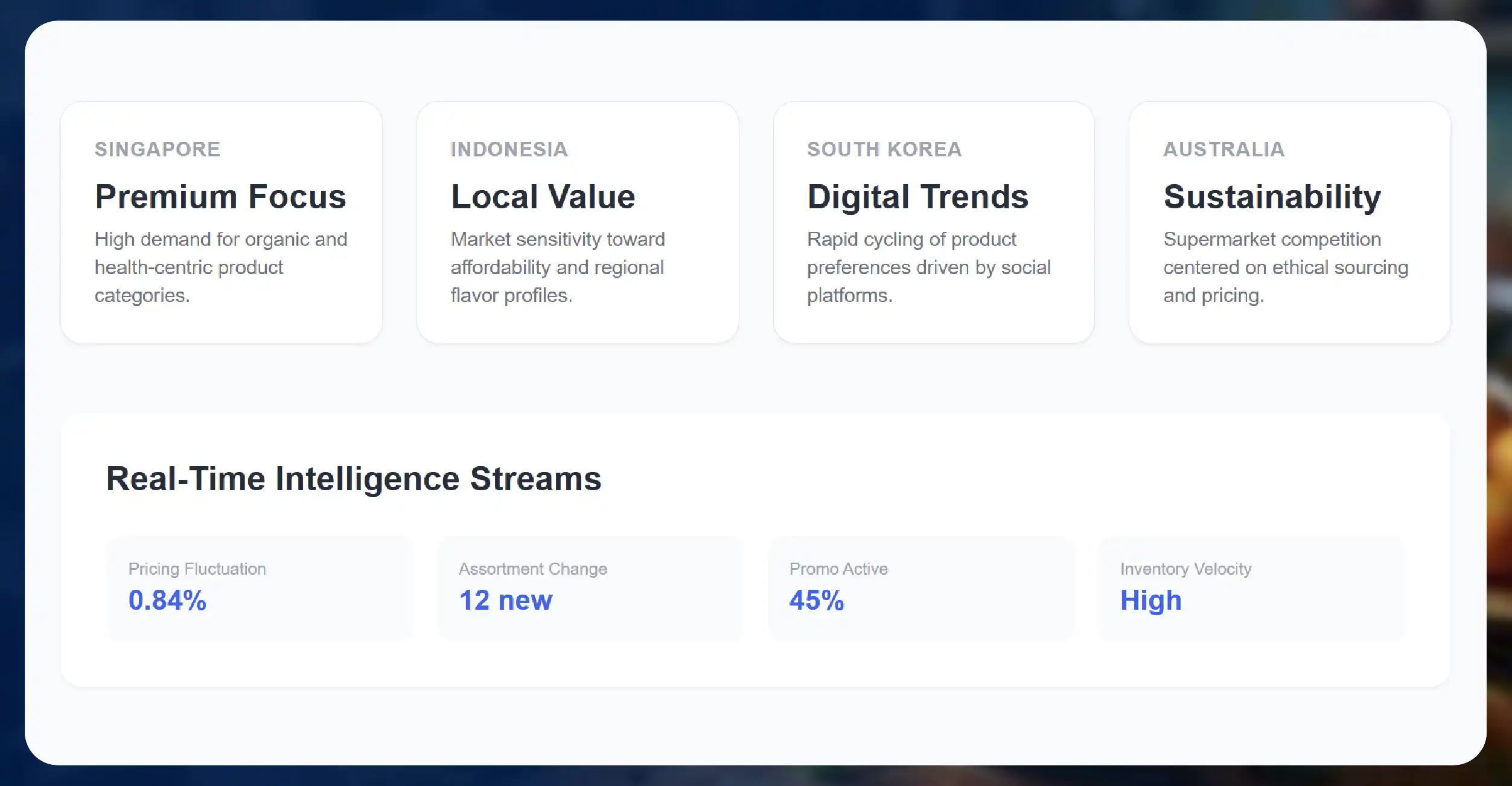
Consumer preferences also differ significantly between countries. Health-conscious shoppers in Singapore may prioritize organic products, while consumers in Indonesia could focus on affordability and local flavors. Meanwhile, South Korea experiences rapid food trend cycles driven by digital platforms, whereas Australia's supermarket competition revolves around pricing and sustainability.
These variations make traditional market research insufficient. Businesses require continuously updated digital intelligence capable of monitoring thousands of products across multiple platforms simultaneously.
Real-time market intelligence enables organizations to understand:
- Pricing fluctuations
- Product assortment changes
- Promotional campaigns
- Seasonal demand
- Inventory movement
- Brand positioning
- Consumer preferences
- Category performance
Instead of relying on quarterly reports, companies can react within hours to market changes.
Eight APAC Markets Driving Food and Beverage Innovation
India
India represents one of the fastest-growing digital grocery ecosystems globally. Rapid expansion of quick commerce, food delivery platforms, online supermarkets, and modern retail has transformed purchasing behavior. Companies monitor pricing, regional assortments, private-label expansion, and SKU availability across major grocery and delivery platforms to remain competitive.
China
China remains the largest digital commerce market in Asia. Online grocery platforms, supermarket chains, and food marketplaces continuously introduce new products, making competitive monitoring essential. Brands closely analyze regional preferences, premium product adoption, and localized pricing strategies.
Japan
Japan emphasizes premium quality, convenience foods, healthy ingredients, and innovative packaging. Frequent product launches require continuous monitoring of supermarkets, convenience stores, and online retailers. Manufacturers use intelligence to understand consumer demand, premium pricing opportunities, and seasonal product cycles.
South Korea
South Korea's food industry evolves rapidly due to strong digital engagement and trend-driven consumers. Convenience foods, ready-to-eat meals, beverages, and functional foods experience frequent innovation. Real-time intelligence allows businesses to identify fast-growing categories before competitors.
Singapore
Singapore serves as an innovation hub for premium grocery products, imported foods, sustainable packaging, and health-conscious offerings. Regional companies often use Singapore as a testing ground before expanding into neighboring Southeast Asian markets.
Indonesia
Indonesia's expanding middle class has accelerated food retail modernization. Online grocery shopping continues to grow alongside traditional retail channels. Brands monitor pricing consistency, product availability, and local market preferences to improve regional competitiveness.
Thailand
Thailand combines strong tourism demand with growing domestic food consumption. Beverage innovation, packaged foods, and restaurant chains continue expanding rapidly. Market intelligence helps organizations understand evolving customer expectations and promotional effectiveness.
Australia
Australia offers a mature retail environment characterized by sophisticated supermarket chains, premium grocery products, and highly competitive pricing. Manufacturers leverage digital intelligence to benchmark promotions, optimize assortment, and evaluate competitor strategies.
The Importance of Asia Pacific Food Market Data
Modern businesses rely on Asia Pacific food market data Extraction to collect structured information from multiple digital sources.
Instead of manually reviewing thousands of websites, automated systems gather standardized information including:
- Product names
- Categories
- Pricing
- Discounts
- Pack sizes
- Brand information
- Nutritional labels
- Availability
- Customer ratings
- Product images
- Promotional campaigns
- Regional variations
This structured dataset enables consistent comparison across countries while eliminating manual research limitations.
Monitoring FMCG Performance Across APAC
The FMCG industry changes rapidly due to inflation, supply chain disruptions, changing consumer habits, and competitive promotions.
Organizations increasingly depend on Asia Pacific FMCG market Data intelligence to understand category performance across multiple retail ecosystems.
Key applications include monitoring:
- Private label expansion
- Brand market share
- Pricing consistency
- Regional assortment
- New product launches
- Category growth
- Retail partnerships
- Promotion effectiveness
These insights support strategic planning, investment decisions, and product development initiatives.
SKU-Level Intelligence Creates Competitive Advantages
Many organizations no longer analyze markets solely at the category level. Instead, they evaluate individual products to understand competitive positioning.
Using method to Scrape SKU-level APAC food and beverage Data, businesses obtain detailed visibility into every product listed across retailers.
SKU-level monitoring reveals:
- Daily price changes
- Package size variations
- Flavor assortment
- Regional product availability
- Stock status
- Bundle offers
- Discount frequency
- Listing quality
- Image updates
- Specification changes
This granular intelligence enables brands to identify pricing inconsistencies and assortment gaps before they affect market performance.
Multi-Country Intelligence Simplifies Regional Expansion
Expanding into multiple APAC markets requires understanding local pricing structures, consumer preferences, regulatory differences, and competitive landscapes.
Businesses increasingly leverage Multi-country food & beverage market Data insights to compare market dynamics across countries using standardized datasets.
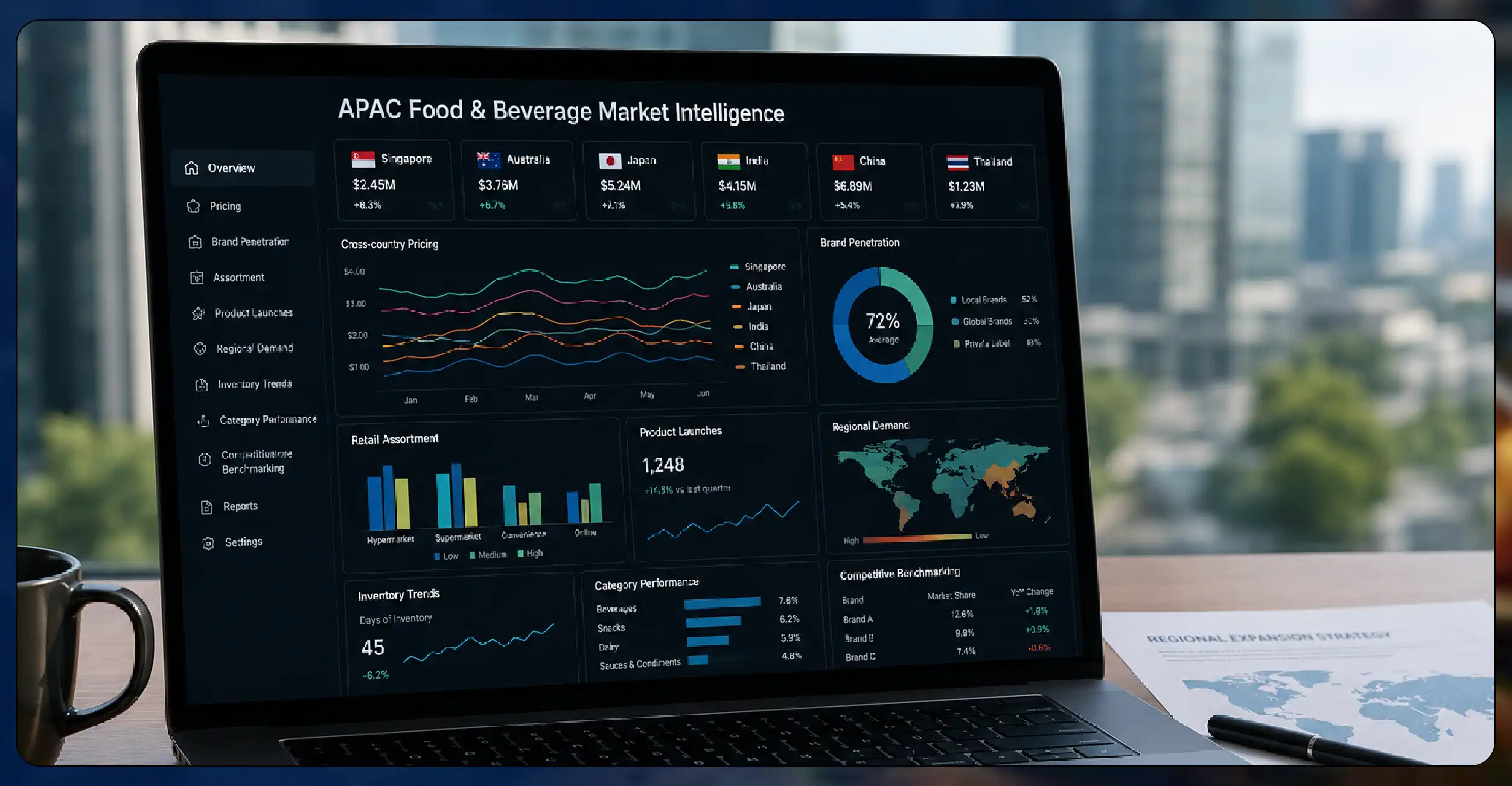
Instead of managing isolated country reports, executives gain unified dashboards showing:
- Cross-country pricing
- Brand penetration
- Retail assortment
- Product launches
- Regional demand
- Inventory trends
- Category performance
- Competitive benchmarking
This consolidated intelligence supports informed regional investment strategies.
Digital Menu Intelligence Beyond Retail
Restaurants and food delivery platforms have become major contributors to food consumption across APAC.
Monitoring restaurant menus helps businesses understand:
- Popular cuisines
- Pricing evolution
- Ingredient trends
- Consumer preferences
- Seasonal offerings
- New restaurant launches
- Menu innovation
- Regional dining behavior
Professional Food Menu Data Extraction Services provide structured datasets from restaurant platforms, helping brands identify food trends earlier than traditional market reports.
These insights are valuable for food manufacturers introducing new ingredients, beverage companies launching complementary products, and restaurant chains planning regional expansion.
Transforming Data into Business Decisions
Raw datasets become significantly more valuable when converted into actionable intelligence.
Companies combine food retail information with advanced analytics to generate dashboards showing:
- Price competitiveness
- Promotion effectiveness
- Category growth
- Brand visibility
- Regional opportunities
- Retail partnerships
- Product lifecycle trends
- Demand forecasting
Marketing teams use these insights to optimize promotional calendars. Sales teams negotiate better retailer partnerships. Supply chain managers improve inventory planning. Executives make investment decisions based on measurable market performance instead of assumptions.
AI Enhances Market Intelligence
Artificial Intelligence has dramatically improved food market analysis.
Machine learning algorithms automatically classify products, identify pricing anomalies, recognize new product launches, and detect promotional trends.
Natural language processing also analyzes customer reviews to identify recurring complaints, emerging preferences, and product strengths.
Image recognition validates product packaging changes and promotional displays across digital channels.
These AI capabilities significantly reduce manual analysis while increasing data accuracy.
Regional Challenges Businesses Must Overcome
Despite enormous opportunities, APAC presents unique complexities.
- Languages vary significantly across countries.
- Product naming conventions differ.
- Retail formats range from traditional supermarkets to ultra-fast delivery platforms.
- Currency fluctuations influence pricing.
- Tax structures vary.
- Seasonal demand differs between tropical and temperate markets.
- Regulatory requirements continue evolving.
Without standardized intelligence systems, comparing market performance across countries becomes extremely difficult.
Modern data extraction and analytics platforms address these challenges through automated normalization, multilingual processing, and standardized reporting.
Future Outlook
The APAC food and beverage market will continue expanding as digital commerce accelerates, urban populations grow, and consumers demand greater convenience.
Several trends will shape future market intelligence:
- AI-powered competitive monitoring
- Real-time pricing optimization
- Personalized consumer insights
- Cross-border retail expansion
- Sustainability tracking
- Health-focused product innovation
- Predictive demand forecasting
- Integrated omnichannel analytics
Organizations that invest in continuous market intelligence today will be better positioned to respond quickly to changing consumer expectations and competitive pressures.
How iWeb Data Scraping Can Help You?
Real-Time Market Monitoring
Our data scraping services help businesses collect real-time food and beverage market information, including pricing, promotions, product launches, competitor activities, and availability changes across multiple APAC digital platforms.
Comprehensive Product Intelligence
We extract detailed SKU-level product data, including names, categories, descriptions, prices, ratings, and inventory status, helping brands analyze product performance and make informed business decisions.
Competitive Pricing Analysis
Our solutions enable organizations to track competitor pricing strategies, discount patterns, and promotional campaigns across retailers, marketplaces, and food delivery platforms to optimize pricing decisions.
Multi-Market Data Collection
We provide structured data extraction across multiple APAC countries, allowing businesses to compare regional trends, consumer preferences, product assortments, and market opportunities through unified intelligence platforms.
Actionable Business Insights
Our scraped datasets transform complex market information into actionable insights, supporting demand forecasting, strategic planning, inventory optimization, product development, and expansion decisions for food businesses.
Conclusion
The APAC food and beverage sector offers tremendous opportunities, but its diversity demands accurate, timely, and comprehensive intelligence. Businesses operating across India, China, Japan, South Korea, Singapore, Indonesia, Thailand, and Australia require far more than periodic reports to stay competitive. Continuous monitoring of products, pricing, inventory, promotions, and restaurant trends enables organizations to make faster, smarter, and more profitable decisions.
Comprehensive Food Delivery App Menu Datasets provide visibility into evolving consumer dining preferences, while robust Web Scraping API Services automate large-scale data collection across retailers, marketplaces, and food delivery platforms. Combined with reliable Product Availability Services, organizations can track stock levels, assortment changes, and regional product performance with exceptional accuracy. Together, these capabilities empower food manufacturers, retailers, FMCG brands, investors, and market researchers to build resilient strategies, identify emerging opportunities, optimize pricing, and achieve sustainable growth throughout the dynamic Asia-Pacific food and beverage marketplace.
FAQs
APAC food and beverage market intelligence involves collecting, analyzing, and interpreting food industry data across Asia-Pacific markets. It helps businesses track pricing, products, competitors, consumer trends, availability, and market opportunities across countries like India, China, Japan, and Australia.
Food and beverage analytics help companies understand changing consumer preferences, optimize pricing strategies, monitor competitors, and identify growth opportunities. With diverse markets across APAC, analytics provide accurate insights required for regional expansion and better decision-making.
APAC market intelligence solutions can collect product names, SKU details, prices, discounts, availability, ratings, reviews, restaurant menus, promotional offers, and category trends from online retailers, supermarkets, grocery platforms, and food delivery applications.
SKU-level data helps brands monitor individual products, compare competitor pricing, track availability, analyze packaging changes, identify consumer demand patterns, and optimize product assortment across different APAC countries and retail channels.
Food data scraping services automate the collection of large-scale market information from multiple digital platforms. They enable businesses to access real-time pricing, menu data, product availability, and competitive intelligence to improve forecasting, strategy planning, and market performance.