
52.8K+
TOTAL DEALERSHIP LOCATIONS ANALYZED

Australia Automotive Dealer Network Analysis in 2026: Exploring Dealer Growth, Market Coverage, Competitive Insights, and Industry Intelligence Trends.
This case study is based on a real-world enterprise scenario where an automotive intelligence company built a nationwide dealership analytics platform by combining automated location discovery, dealership profiling, vehicle inventory monitoring, and regional market intelligence. Using Australia Automotive Dealer Network Analysis in 2026, the organization transformed fragmented dealership information into a centralized intelligence ecosystem that supported strategic expansion, competitive benchmarking, and dealer performance optimization.
It is designed for:
The client's primary challenge was straightforward yet complex. Australia's automotive retail ecosystem consists of thousands of dealerships spread across metropolitan cities, regional towns, and rapidly growing suburban markets. Dealer information existed across multiple websites, manufacturer portals, and regional directories, making it difficult to maintain an accurate and continuously updated nationwide database. The organization needed a scalable solution capable of collecting dealership locations, inventory availability, dealer attributes, and regional market indicators while transforming fragmented public information into structured business intelligence that could support expansion planning and competitive decision-making.
A leading automotive analytics organization sought to modernize dealership intelligence by building an automated nationwide monitoring platform covering Australia's rapidly evolving vehicle retail market. The objective was to replace fragmented manual research with continuous data collection capable of tracking dealership expansion, inventory movement, pricing behavior, and regional coverage patterns.
The implementation leveraged automated dealership discovery pipelines to identify dealer locations, normalize business information, classify vehicle brands, and monitor inventory updates across multiple public automotive platforms. Through this initiative, the organization successfully Extract largest car dealer networks in Australia 2026, enabling analysts to compare dealer concentration, regional distribution, and franchise expansion across major automotive brands.
Simultaneously, automated intelligence pipelines helped Scrape Automotive Industry Trends across Australia in 2026, allowing researchers to monitor dealership openings, market saturation levels, inventory availability, pricing movements, and consumer demand signals with significantly improved speed and consistency.
Large-scale data validation ensured that dealership records remained accurate despite frequent business updates, relocations, inventory changes, and ownership transitions. Machine learning models categorized dealerships according to vehicle segments, franchise affiliations, service capabilities, and geographic clusters while identifying underserved markets with strong expansion potential.
Interactive dashboards transformed millions of structured records into real-time insights for executive teams, enabling faster dealership benchmarking, territory planning, and competitive monitoring. Ultimately, the project demonstrated how automated dealership intelligence can significantly improve operational visibility while supporting evidence-based strategic decisions across Australia's automotive retail ecosystem.
The client encountered numerous operational challenges while attempting to maintain an accurate nationwide database of Australian automotive dealerships. Information was distributed across manufacturer websites, dealership portals, regional business directories, automotive marketplaces, and local listings, resulting in inconsistent data quality and incomplete geographic coverage.
One major challenge involved the inability to Analyze automotive dealership growth in Australia using traditional manual research methods. Dealer networks were continuously expanding, relocating, consolidating, or introducing new franchise partnerships, making historical datasets obsolete within short periods.
The organization also lacked comprehensive Automotive market intelligence Australia, limiting its ability to understand regional competition, dealership density, vehicle availability, and market saturation across different states and territories.
Another critical limitation involved the absence of scalable systems capable toExtract Australian Automotive Industry API datasets from multiple structured and semi-structured sources into one unified intelligence platform. Existing workflows depended heavily on manual verification, spreadsheets, and disconnected research efforts, resulting in delays and inconsistent reporting.
By implementing an automated dealership intelligence platform, the client replaced fragmented manual research with a centralized system capable of continuously monitoring dealer locations, inventory updates, regional expansion activities, and competitive market movements across Australia's automotive ecosystem.
| Dimension | Manual Dealer Research | Automated Dealer Intelligence Platform |
|---|---|---|
| Data Collection | Individual website searches | Automated nationwide dealership discovery |
| Coverage | Limited regional visibility | Australia-wide dealership monitoring |
| Update Frequency | Weekly or monthly | Continuous automated updates |
| Data Accuracy | Manual verification | Automated validation and normalization |
| Inventory Tracking | Occasional review | Real-time inventory monitoring |
| Dealer Mapping | Spreadsheet-based | Interactive geographic visualization |
| Competitive Analysis | Time-consuming | Continuous benchmarking dashboards |
| Reporting | Manual compilation | Automated executive reporting |
The organization featured in this case study is a rapidly growing automotive intelligence provider specializing in dealership analytics, vehicle inventory monitoring, regional market research, and automotive retail benchmarking across Australia.
Its business depends on maintaining highly accurate dealership databases covering franchise dealerships, independent retailers, service centers, certified pre-owned networks, and emerging electric vehicle dealerships operating throughout the country.
As Australia's automotive industry experienced rapid transformation through electrification, dealership consolidation, digital retailing, and regional expansion, the organization found it increasingly difficult to maintain comprehensive market visibility using traditional research methods.
Rapid changes in dealership ownership, evolving manufacturer partnerships, expanding suburban markets, and shifting consumer demand required continuous monitoring instead of periodic manual updates.
To overcome these limitations, the organization implemented an enterprise-scale automotive intelligence platform capable of automatically discovering dealership locations, validating business information, monitoring inventory, and identifying regional market developments across thousands of automotive businesses.
The new intelligence framework transformed fragmented dealership information into structured datasets supporting executive decision-making, competitive benchmarking, territory optimization, investment analysis, and long-term automotive market forecasting.
We implemented a comprehensive automotive intelligence platform designed to automate dealership discovery, inventory monitoring, business validation, and geographic market analysis across Australia's automotive retail landscape.
Automated crawlers continuously collected dealership information from manufacturer websites, dealer portals, automotive marketplaces, public business directories, and regional listing platforms. Extracted records were standardized through advanced cleansing pipelines that removed duplicate listings, corrected inconsistent business attributes, and enriched dealer profiles with geographic coordinates, franchise affiliations, operating status, vehicle brands, and contact information.
To further strengthen automotive intelligence capabilities, the solution incorporated Tyre Pricing Intelligence Services, enabling analysts to evaluate aftermarket pricing trends alongside dealership performance and regional service competitiveness.
The analytics ecosystem also integrated Fuel Pricing Intelligence, allowing businesses to correlate regional fuel price movements with dealership demand patterns, vehicle purchasing behavior, and broader automotive market activity.
Using advanced cloud infrastructure, scalable ETL pipelines, AI-powered classification models, and automated validation frameworks, the organization successfully transformed fragmented dealership information into reliable business intelligence supporting strategic planning, investment decisions, competitive benchmarking, and long-term automotive market analysis across Australia.
The implementation of the automated dealership intelligence platform provided the client with continuous visibility into Australia's rapidly evolving automotive retail landscape. Instead of relying on periodic manual research, the system continuously identified dealership openings, closures, franchise expansions, ownership changes, and showroom developments across metropolitan cities, regional centers, and emerging suburban markets.
This real-time visibility enabled analysts to understand how dealer networks evolved geographically while identifying regions experiencing accelerated automotive growth. Interactive mapping dashboards displayed dealership density, manufacturer presence, vehicle category distribution, and regional service availability through continuously updated datasets.
Business teams could instantly compare dealership coverage between states, evaluate manufacturer expansion strategies, and monitor changing competitive landscapes without waiting for monthly market reports. The organization significantly improved planning accuracy by identifying market opportunities as they emerged rather than after competitors had already responded.
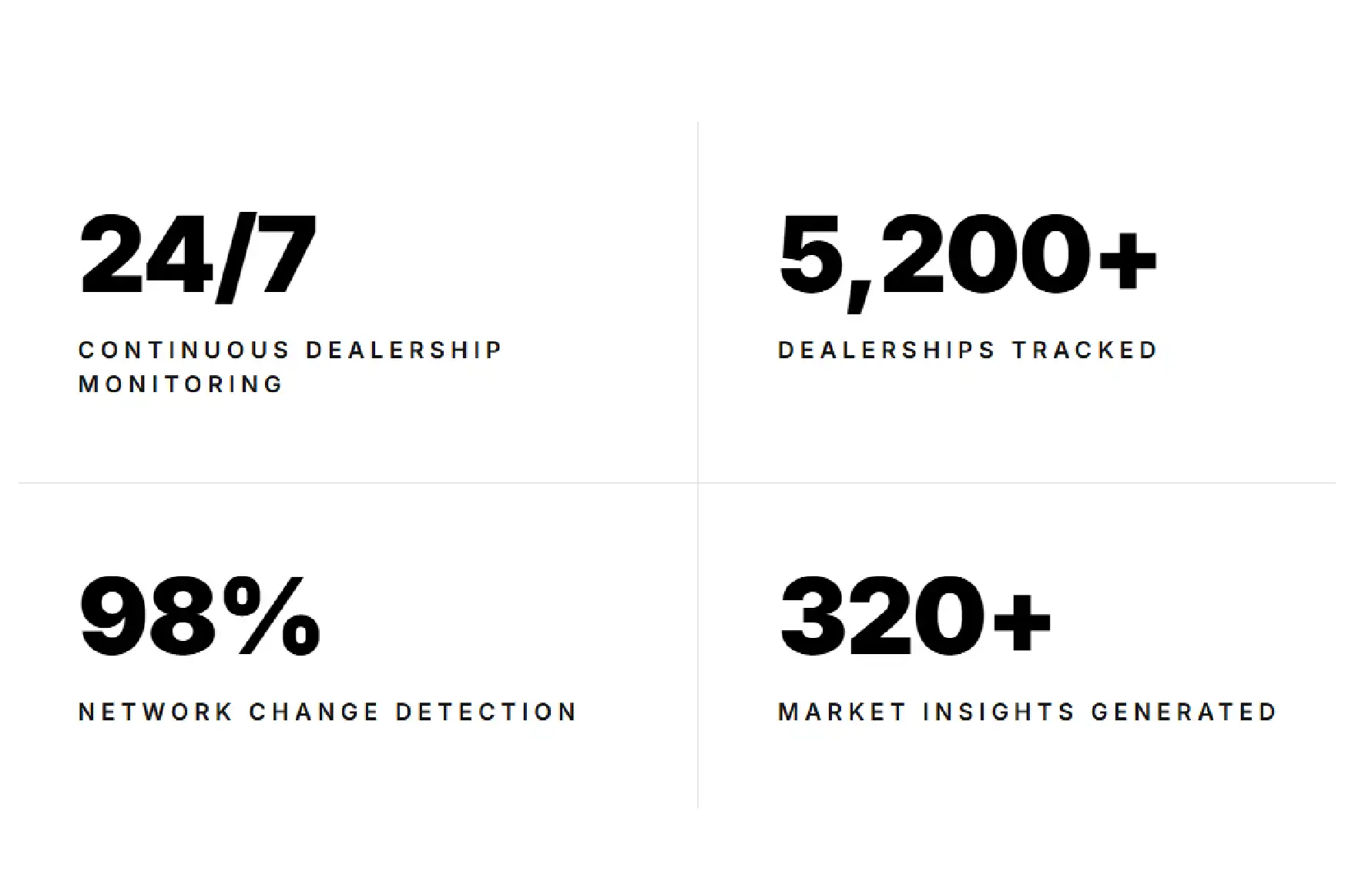
The intelligence platform enabled continuous benchmarking of Australia's largest automotive dealer networks by consolidating dealership information from multiple public sources into standardized analytical datasets.
Instead of manually comparing dealership directories across different manufacturers, analysts gained immediate visibility into franchise distribution, dealer concentration, geographic expansion, service capabilities, and inventory availability across hundreds of automotive retailers.
The platform categorized dealerships according to:
This structured benchmarking allowed executives to evaluate competitive positioning, identify underserved territories, compare regional dealer density, and measure long-term dealership expansion trends across Australia's automotive market.
As a result, strategic planning became significantly more data-driven while reducing research cycles from weeks to hours.
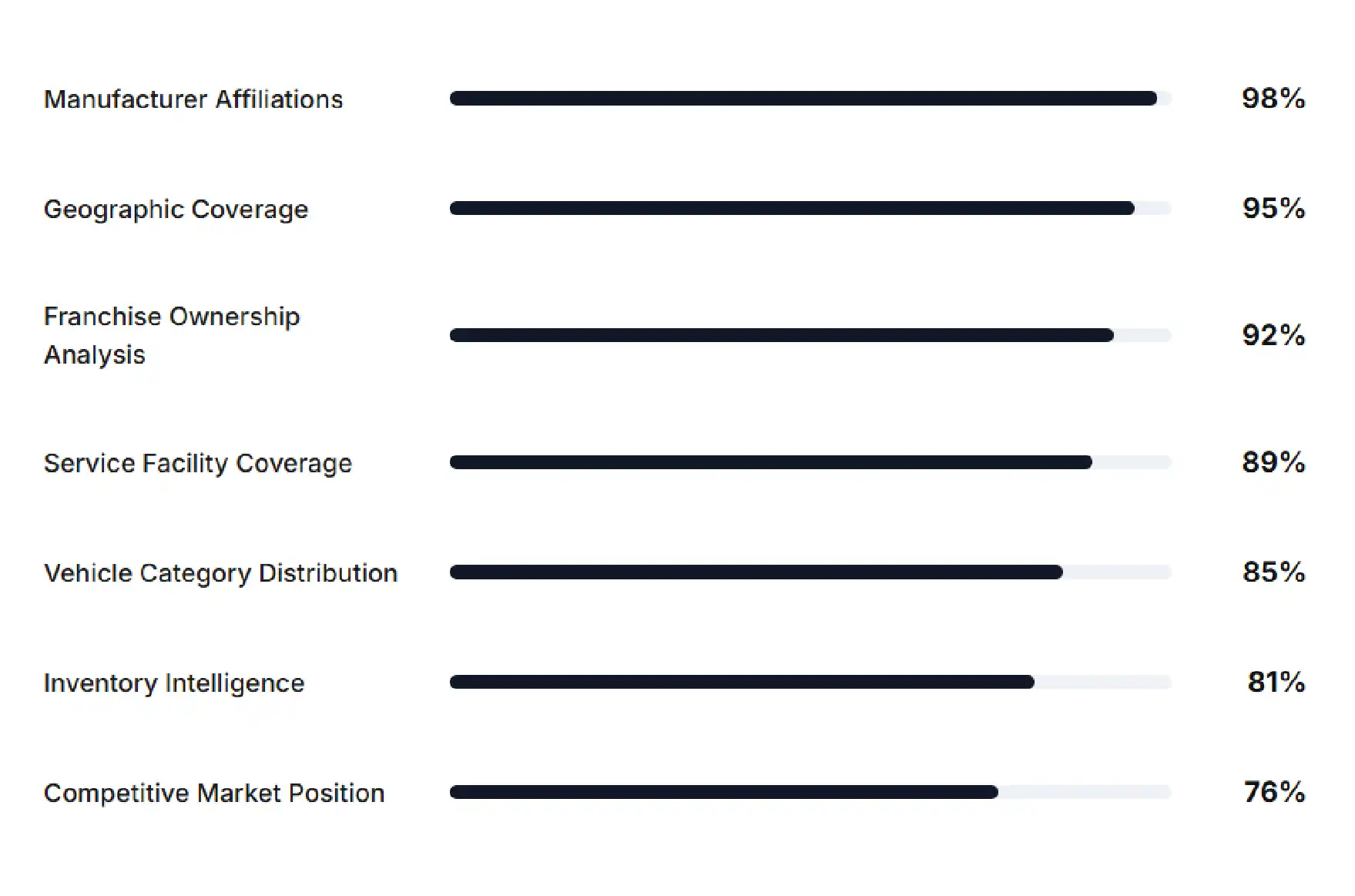
One of the most valuable outcomes was the transformation of fragmented dealership information into standardized business intelligence suitable for advanced analytics and executive reporting.
The automated platform collected information from diverse public sources before applying validation, normalization, enrichment, and classification processes. Duplicate records were eliminated, inconsistent business names were standardized, incomplete addresses were corrected, and dealer attributes were enriched with geographic and operational metadata.
This structured intelligence enabled consistent comparisons across thousands of dealerships regardless of source format.
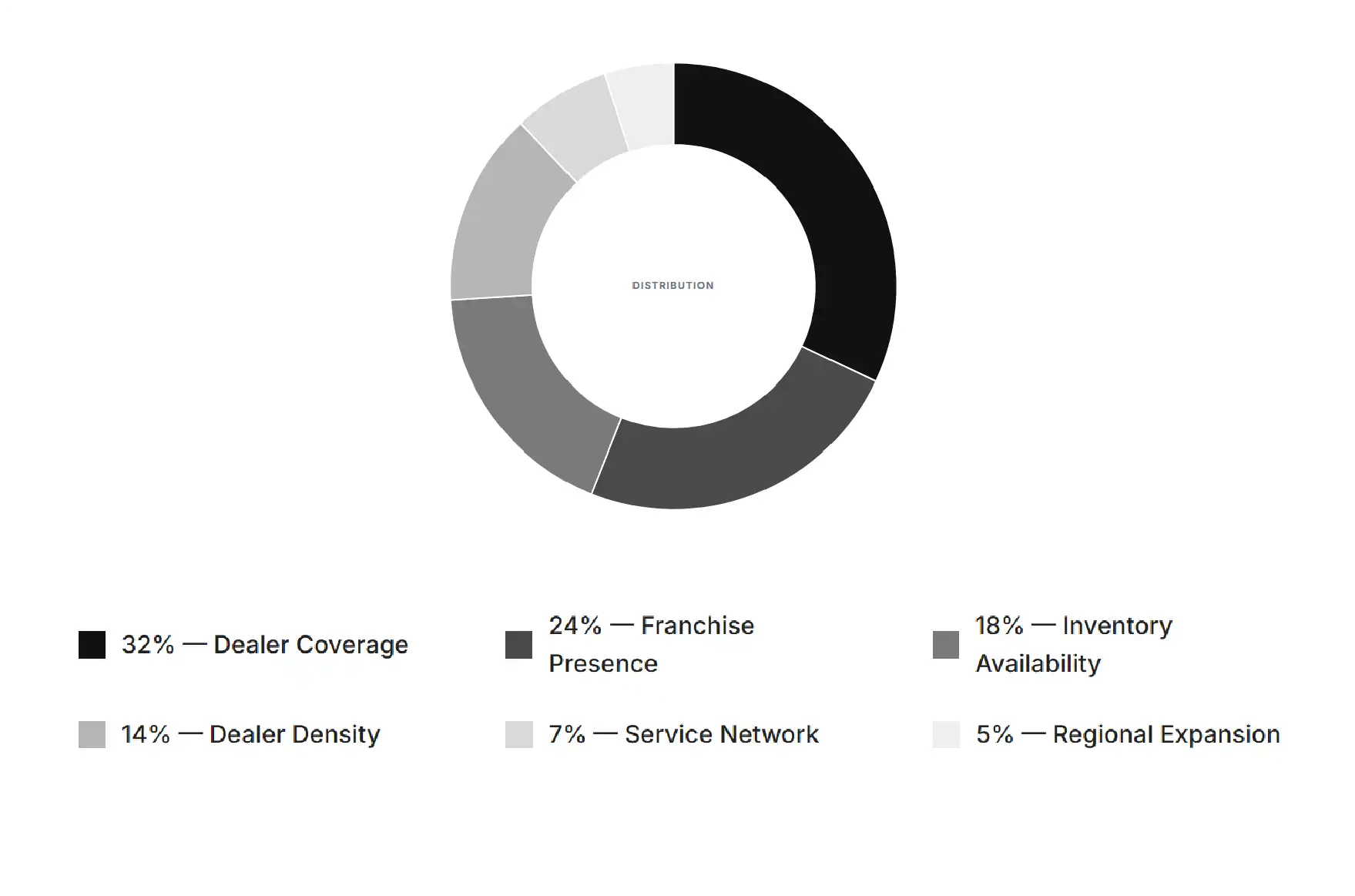
| Intelligence Metric | Insight Captured | Business Value |
|---|---|---|
| Dealer Coverage | Geographic distribution by state | Territory expansion planning |
| Franchise Presence | Brand-wise dealer count | Competitive benchmarking |
| Inventory Availability | Vehicle availability trends | Demand forecasting |
| Dealer Density | Dealers per metropolitan region | Market saturation analysis |
| Service Network | Workshop and aftersales coverage | Customer service optimization |
| Regional Expansion | New dealership activity | Investment opportunity identification |
The standardized datasets also improved downstream analytics by supporting predictive models, regional forecasting, dealer performance benchmarking, and executive reporting with significantly higher consistency than manual research methods.
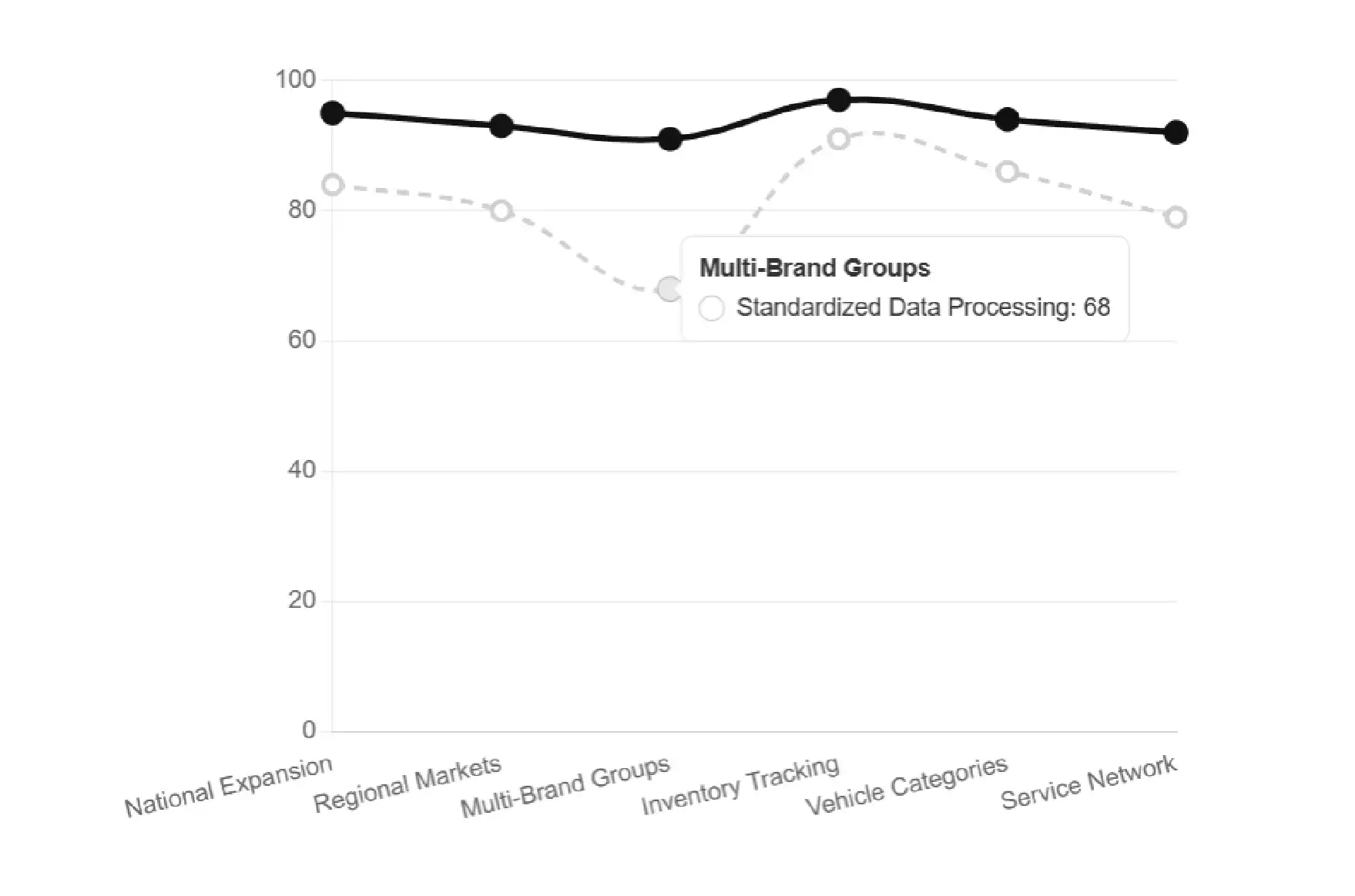
Unlike traditional dealer research approaches limited by manpower and reporting frequency, the automated intelligence platform scaled effortlessly across Australia's expanding automotive ecosystem.
The infrastructure continuously monitored thousands of dealership webpages, manufacturer directories, automotive marketplaces, and regional business listings simultaneously. Automated scheduling ensured dealership information remained updated without requiring manual intervention.
The scalable architecture processed large volumes of dealership records while maintaining consistent data quality through automated validation, anomaly detection, and duplicate resolution.
This scalability enabled the client to monitor:
Continuous monitoring significantly improved strategic responsiveness by providing executives with near real-time insights instead of relying on historical reports.
The following dataset illustrates how dealership information was standardized into structured records for nationwide automotive intelligence. The platform combines dealership attributes, geographic coverage, franchise information, and inventory indicators into a centralized analytics database.
| Dealer Name | State | Vehicle Brand | Dealer Type | Inventory | Service Center | Customer Rating | Market Status |
|---|---|---|---|---|---|---|---|
| Sydney Auto Group | NSW | Toyota | Franchise | 420 | Yes | 4.8 | High Growth |
| Melbourne Motors | VIC | Ford | Franchise | 365 | Yes | 4.7 | Stable |
| Brisbane Auto Hub | QLD | Hyundai | Multi-Brand | 318 | Yes | 4.6 | Expanding |
| Perth Drive Centre | WA | Mazda | Franchise | 276 | Yes | 4.5 | Growing |
| Adelaide City Cars | SA | Kia | Independent | 198 | No | 4.4 | Emerging |
| Canberra Auto World | ACT | Subaru | Franchise | 184 | Yes | 4.6 | Stable |
| Gold Coast Prestige | QLD | BMW | Luxury Franchise | 158 | Yes | 4.8 | High Growth |
| Newcastle Vehicle Hub | NSW | Volkswagen | Franchise | 214 | Yes | 4.6 | Expanding |
The intelligence platform also generated regional summaries that helped executives compare automotive retail activity across Australia's largest states.
| Region | Active Dealers | Major Brands | Market Coverage | Growth Trend |
|---|---|---|---|---|
| New South Wales | 315 | Toyota, Ford, Mazda | Very High | Strong |
| Victoria | 286 | Hyundai, Kia, Toyota | High | Growing |
| Queensland | 247 | Ford, Nissan, Mitsubishi | High | Expanding |
| Western Australia | 154 | Mazda, Toyota | Moderate | Stable |
| South Australia | 109 | Kia, Hyundai | Moderate | Improving |
Following implementation of the automated dealership intelligence platform, the client achieved measurable operational improvements across automotive market research, dealer benchmarking, and strategic planning activities.
Our automotive intelligence solutions are designed to transform fragmented dealership information into structured, reliable, and continuously updated business intelligence. By automating data collection from multiple public sources, we eliminate manual research while delivering comprehensive visibility into Australia's automotive retail landscape.
The platform centralizes dealership locations, franchise affiliations, inventory availability, contact information, and regional market indicators into a unified data ecosystem. This enables organizations to access standardized datasets that improve reporting accuracy, reduce operational complexity, and support faster strategic decision-making across sales, marketing, and network planning.
Advanced validation and data quality processes automatically remove duplicate records, normalize business attributes, verify dealership information, and enrich datasets with geographic and operational metadata. This ensures high-quality intelligence suitable for executive reporting, forecasting, and competitive benchmarking.
"The dealership intelligence platform has completely transformed the way we analyze Australia's automotive retail market. Previously, maintaining an accurate nationwide dealer database required extensive manual research and frequent verification. Today, we have access to continuously updated dealership information, regional market insights, and competitive benchmarks through a centralized analytics platform. The quality of the data, speed of reporting, and accuracy of the insights have significantly improved our strategic planning capabilities. The solution has strengthened our market visibility and enabled faster, more confident business decisions across our organization."
— Director of Automotive Market Intelligence
The project resulted in a fully automated and highly scalable automotive dealer intelligence platform capable of continuously monitoring dealership locations, franchise networks, inventory availability, and regional market developments across Australia.
Automated data pipelines replaced time-consuming manual research with continuous collection, validation, and enrichment processes, providing executives with accurate, real-time dealership intelligence for strategic planning, investment analysis, and competitive benchmarking.
Implementation of Web Scraping API Service enabled seamless integration of dealership information from multiple public automotive sources into centralized reporting systems, significantly improving data consistency, operational efficiency, and reporting accuracy across business functions.
The platform also expanded beyond dealership intelligence by integrating Car Rental Data Extraction Services, enabling organizations to compare vehicle availability, regional mobility trends, rental fleet distribution, and automotive demand patterns alongside dealership performance for a broader view of Australia's transportation ecosystem.
In addition, enterprise-grade Web Scraping Services ensured reliable, large-scale data collection infrastructure capable of processing continuously growing automotive datasets without compromising performance, scalability, or data quality.
Our solutions can collect publicly available dealership information including business names, locations, vehicle brands, franchise affiliations, contact details, inventory availability, operating hours, service facilities, geographic coverage, and other market intelligence that supports business analysis.
The platform supports automated scheduled updates ranging from multiple times per day to weekly refresh cycles, depending on business requirements. Continuous monitoring helps organizations maintain accurate dealership databases while identifying new openings, closures, relocations, and inventory changes promptly.
Yes. The architecture is designed to scale across Australia's entire automotive retail ecosystem, covering metropolitan cities, regional centers, and emerging suburban markets while maintaining high performance, data consistency, and reporting accuracy.
The solution applies automated validation, duplicate detection, address normalization, metadata enrichment, and quality assurance processes before data enters reporting systems. This ensures consistent, reliable, and standardized datasets suitable for analytics and executive decision-making.
Automotive manufacturers, dealership groups, vehicle marketplaces, investment firms, market research organizations, fleet operators, financial institutions, consulting companies, and mobility technology providers can all benefit from structured dealership intelligence for competitive analysis, expansion planning, forecasting, and strategic decision-making.
Unlock powerful automotive market insights with our Australia dealer network intelligence solutions and make smarter, data-driven business decisions today.
Start a projectFields marked * are required. Everything else just helps us scope faster — skip what you don't know yet.