

Introduction
Real estate businesses are entering an era where decisions are increasingly driven by data rather than assumptions. Property prices change, listings appear and disappear, neighborhoods evolve, and buyer preferences shift continuously. For brokers, investors, property marketplaces, developers, and market researchers, having access to fresh property information can make the difference between reacting to the market and anticipating it.
Automate Properati Data Collection Using API is an effective approach for organizations that need structured property information at scale. Instead of relying on manual searches and spreadsheets, businesses can establish automated workflows to collect relevant property listings, standardize important attributes, monitor changes, and transfer the resulting data into analytics platforms.
Properati can serve as a valuable source for studying property markets across Latin American locations. When property information is systematically collected and processed, businesses can move beyond individual listings and build broader insights into pricing, inventory, locations, property categories, and market behavior.
Why Automating Properati Data Collection Matters
Manual property research becomes increasingly difficult as the number of listings grows. An analyst may be able to compare a few dozen properties manually, but monitoring thousands of listings across multiple cities requires substantial time and resources.
This is where automation becomes valuable. A structured collection process can repeatedly gather relevant information according to predefined parameters, reducing repetitive research and improving consistency.
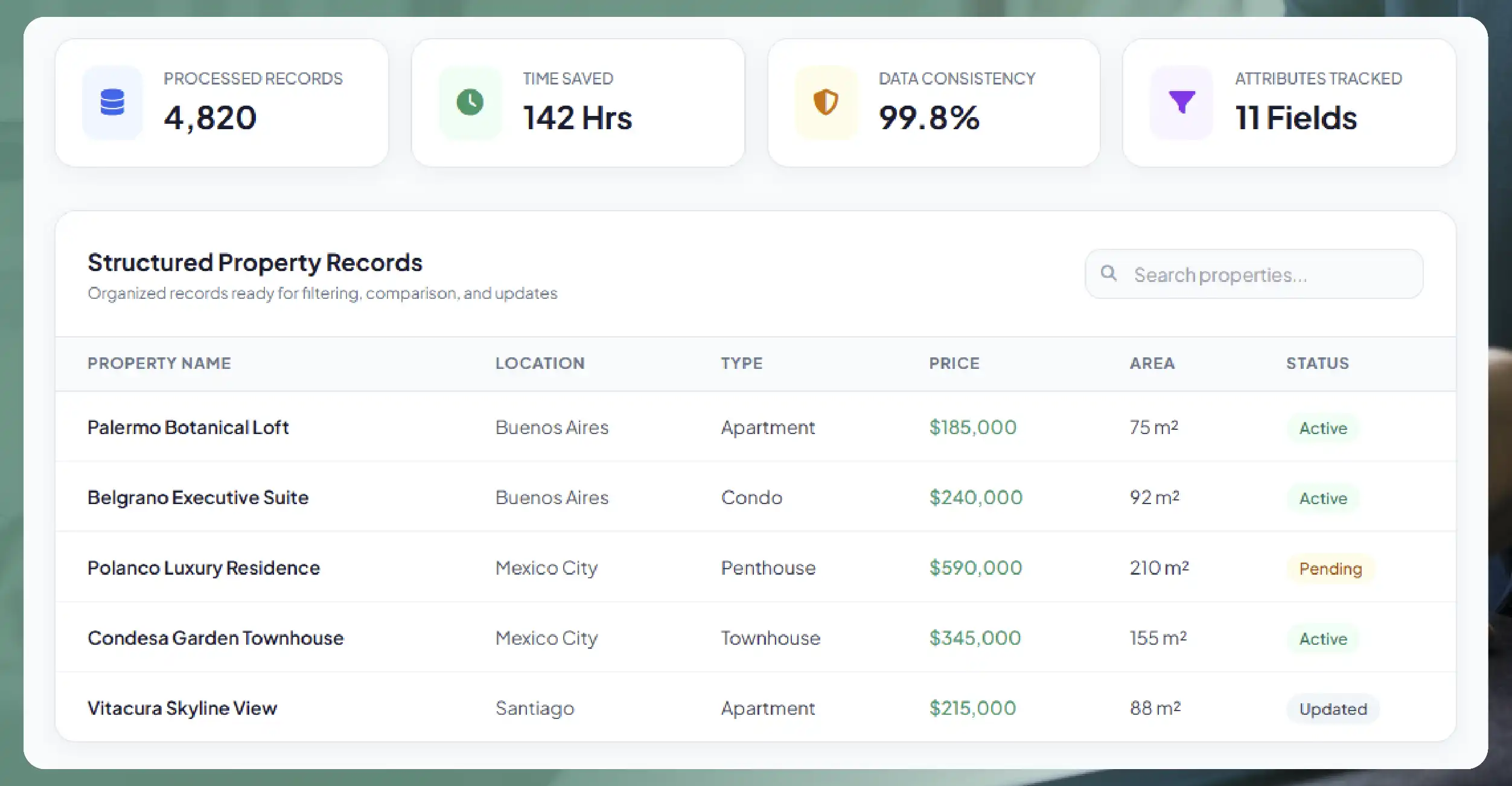
Businesses interested in Properati property data Scraping can create workflows that organize information such as property names, listing URLs, prices, locations, property types, floor areas, bedrooms, bathrooms, descriptions, amenities, and listing status, depending on the data available through permitted access.
The resulting information can then be standardized and stored for analysis. Instead of repeatedly visiting individual listings, analysts can work with structured records that are easier to filter, compare, visualize, and update.
How API-Based Property Data Collection Works
An API-driven property data workflow generally begins by defining the information required for the business objective. A company may need listings from particular cities, property types, price ranges, or rental and sales categories.
Once the requirements are established, the collection layer retrieves the permitted data through the relevant API or authorized access mechanism. The response is then parsed and transformed into a consistent structure.
Businesses looking to Extract Properati property listings data using API can organize the information into standardized fields. For example, property prices can be separated from currency information, geographic fields can be normalized, and property categories can be mapped to consistent classifications.
Data validation is another important stage. Automated checks can identify missing prices, invalid numerical values, incomplete locations, duplicate records, or unexpected changes in the source structure.
After processing, the information can be delivered to databases, cloud storage, spreadsheets, data warehouses, dashboards, or internal applications.
Building Automated Property Pricing Intelligence
Pricing is one of the most important components of property-market analysis. However, collecting a single price is rarely enough. Businesses need to understand how prices vary by location, property type, size, and time.
With Automated Properati real estate data collection, companies can establish recurring workflows that capture property information at scheduled intervals. These snapshots can be compared over time to identify changes in asking prices and market availability.
For example, an investment company could monitor apartment listings across several neighborhoods every week. By comparing historical records, analysts could determine whether asking prices are rising, falling, or remaining stable.
Price-per-square-meter analysis can provide an even deeper perspective. Two apartments may have similar total prices but significantly different sizes, making their market positions quite different. Standardized property data allows businesses to calculate and compare these metrics more efficiently.
Historical collection can also reveal how quickly listings disappear, how frequently new properties enter the market, and whether certain locations experience stronger pricing movements than others.
Understanding Locations and Neighborhood Markets
Real estate is inherently geographic. A property's location influences its value, demand, accessibility, rental potential, and long-term investment prospects.
Housing market analysis using Properati API can help businesses organize property records around geographic characteristics and compare markets more systematically.
Depending on available fields, property records can be grouped by city, neighborhood, district, postal area, coordinates, or other geographic classifications.
This makes it possible to examine questions such as:
- Which neighborhoods have the highest average asking prices?
- Where is property inventory increasing?
- Which locations offer lower price-per-square-meter levels?
- How does rental pricing differ between districts?
- Which property types dominate particular neighborhoods?
- Where are new listings appearing most frequently?
Combining property records with mapping technologies can further enhance analysis by creating visual representations of market activity.
Monitoring Property Competition
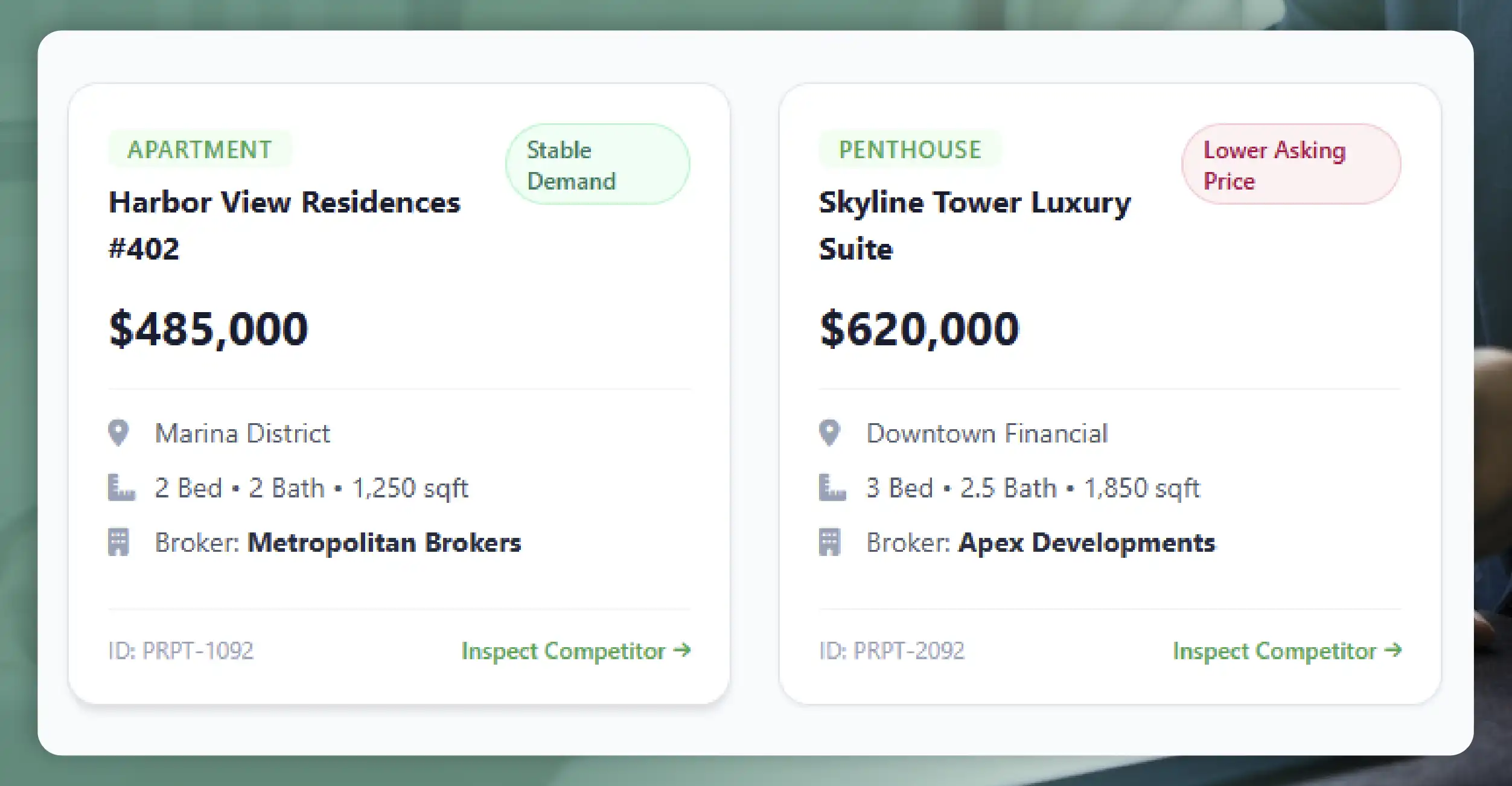
Real estate companies must understand what competing brokers, developers, and marketplaces are offering. Competitive monitoring becomes much easier when property information is available in a structured dataset.
Through Properati real estate data Scraping, businesses can analyze comparable listings and identify differences in pricing, property specifications, locations, and availability.
A brokerage, for example, could compare its listings against similar properties in the same neighborhood. If competing properties consistently have lower asking prices, the business can investigate its pricing strategy.
Developers can use similar information to assess market saturation. A neighborhood experiencing a rapid increase in available properties may indicate changing supply conditions, while a market with limited inventory and stable demand could represent a different opportunity.
The key benefit is not simply seeing individual competitors. It is being able to analyze competitive patterns across large groups of listings.
Creating Structured Property Pricing and Location Datasets
A major advantage of automation is the ability to transform unstructured listing information into a standardized dataset.
Properati property pricing and location data can become particularly valuable when price, geographic, and property attributes are connected within the same record.
For example, a standardized record could contain:
- Property ID or listing identifier
- Property type
- Sale or rental price
- Currency
- Location
- Neighborhood
- Property size
- Bedrooms
- Bathrooms
- Amenities
- Listing URL
- Availability information
- Collection timestamp
The collection timestamp is especially useful for historical research. It allows analysts to determine when a listing was observed and compare its attributes against later snapshots.
Supporting Investment and Market Research
Investors need to evaluate potential markets before allocating capital. Automated property information can provide a broad market perspective that supports preliminary research.
An investor looking for apartments below a particular price threshold can filter thousands of records instead of manually searching individual listings. Analysts can then compare properties by neighborhood, size, price, and other characteristics.
Rental-property investors can also combine purchase-price information with rental listings to estimate potential gross rental yields. These calculations should be treated as analytical estimates rather than definitive investment valuations, but they can help identify markets worthy of deeper investigation.
Researchers can similarly study housing affordability, property supply, neighborhood pricing differences, and changes in market inventory.
Improving Data Quality Through Automation
Collecting large quantities of information is only useful when the data is reliable. Poor-quality records can produce misleading conclusions and reduce confidence in analytics.
Automated data-processing workflows can apply validation rules to incoming records. They can identify duplicate listings, normalize numerical fields, standardize property categories, clean location information, and flag incomplete records.
Data-quality monitoring can also detect sudden anomalies. If a collection process normally retrieves thousands of records but suddenly returns a much smaller number, an automated alert can prompt technical investigation.
This makes automation useful not only for scale but also for maintaining repeatable data quality.
Scaling Real Estate Data Collection Across Markets
A property-data pipeline that works for one city may eventually need to support several cities or countries. Building a scalable architecture from the beginning can make this expansion easier.
Businesses can use separate collection jobs for different geographic markets while maintaining a common data schema. This approach allows analysts to compare markets without rebuilding their entire data infrastructure.
Scalable processing can also support large volumes of historical records. Instead of deleting previous snapshots when new data arrives, businesses can preserve them for trend analysis.
This creates a long-term intelligence asset that becomes more valuable as historical coverage grows.
Turning Property Data Into Actionable Intelligence
Raw property listings are only the starting point. The real value comes from transforming those records into meaningful business intelligence.
A dashboard can display average asking prices, median prices, price-per-square-meter trends, property counts, geographic distributions, and inventory changes. Analysts can filter the results by location, property category, price range, or time period.
Businesses can also connect property datasets with external information such as demographic statistics, transportation networks, commercial development, economic indicators, and geographic data.
This creates a broader analytical framework for understanding why particular property markets behave differently.
How iWeb Data Scraping Can Help You?
Scalable Property Data Collection
iWeb Data Scraping can develop scalable workflows for collecting large volumes of property information, helping businesses reduce repetitive research while maintaining consistent structures across extensive real estate datasets.
Automated Data Processing
Our data workflows can clean, normalize, validate, and organize collected property information, helping businesses transform raw listing records into structured data suitable for analysis and operational decision-making.
Historical Market Monitoring
We can support recurring collection processes that capture property information at scheduled intervals, enabling businesses to build historical records and identify changes in prices, inventory, locations, and listings.
Customized Data Delivery
iWeb Data Scraping can structure property datasets according to specific business requirements and deliver them in practical formats for databases, dashboards, analytics platforms, research systems, and internal applications.
Real Estate Intelligence Support
Our solutions can help businesses convert continuously collected property information into actionable intelligence for competitive monitoring, market research, pricing analysis, investment screening, and location-based decision-making.
Conclusion
Automating Properati data collection can help businesses replace repetitive property research with a scalable and structured intelligence workflow. Instead of analyzing isolated listings, organizations can build historical records that reveal pricing movements, inventory patterns, competitive positioning, and geographic differences.
When Real-estate datasets are continuously enriched with historical snapshots, businesses gain a stronger foundation for understanding market evolution. Adding Location intelligence can further connect property characteristics with geographic patterns, helping analysts identify differences between neighborhoods and markets.
For organizations seeking reliable automation, Web Scraping API Services can provide the technical foundation required to collect, process, structure, and deliver property information at scale.
Ultimately, the goal of automated property data collection is not simply to gather more listings. It is to transform property information into a continuously updated intelligence resource that supports smarter pricing, market research, investment analysis, competitive monitoring, and strategic real estate decisions.
FAQs
Properati data collection using an API involves programmatically retrieving permitted property information and converting it into structured records that can be stored, analyzed, monitored, or integrated into business applications.
Depending on the available and authorized data, businesses may collect property names, prices, locations, property types, sizes, bedrooms, bathrooms, descriptions, amenities, listing URLs, availability information, and timestamps.
Automation reduces manual research, improves consistency, supports larger datasets, enables recurring monitoring, and allows businesses to create historical property records for market and pricing analysis.
Structured property information can help businesses compare prices, analyze price per square meter, monitor inventory, identify geographic trends, study competing listings, and evaluate potential market opportunities.
Yes. Structured property data can be delivered to databases, cloud platforms, analytics systems, dashboards, and internal applications, depending on the required architecture and authorized data-access method.