
42.8K+
RERA PROJECT AND LENDING-RELEVANT RECORDS PROCESSED

Automated State-Wise RERA Data Extraction to Strengthen Real Estate Lending Intelligence, Improve Project Due Diligence, and Enhance Risk Monitoring Across India.
This case study explores how a listed Non-Banking Financial Company (NBFC) can modernize its real estate lending desk through structured, state-level regulatory data collection, automated document processing, and centralized project intelligence. It is designed for:
The central business challenge was straightforward: Indian real estate regulatory information is distributed across state and union territory portals, with differences in website structure, terminology, document availability, search methods, and update frequency. The lending desk needed a scalable approach to convert this fragmented information into standardized, searchable, and auditable intelligence without treating regulatory registration as a substitute for independent credit assessment.
A listed NBFC's real estate lending desk needs reliable project intelligence to evaluate developers, assess construction finance applications, monitor existing exposures, and identify emerging portfolio risks. However, relevant information is distributed across multiple Real Estate Regulatory Authority (RERA) portals, each following its own presentation and disclosure conventions. Manually gathering this information can create inconsistent records, lengthy verification cycles, and limited visibility into changes affecting financed projects.
The proposed initiative established a centralized framework for collecting and standardizing state-wise RERA project data for NBFC lending. The system captures available project registration details, promoter information, project timelines, declared completion dates, registration validity where published, project locations, and relevant regulatory disclosures. It preserves source references and timestamps so analysts can verify information against the originating authority.
Through Automated RERA data collection across Indian states, the lending desk can reduce repetitive portal visits and build a consistent project intelligence repository. State-specific extraction adapters accommodate differences in portal layouts and search interfaces, while validation rules standardize fields, identify duplicates, and flag missing or conflicting information.
The client was a listed NBFC with a real estate lending desk evaluating financing opportunities across multiple Indian markets. Its analysts needed timely access to project and promoter information to support construction finance assessment, developer due diligence, and ongoing portfolio surveillance. As the number of projects and geographic markets increased, manual research became increasingly difficult to maintain consistently.
Fragmented State-Level Regulatory Portals
Each RERA authority may use different search interfaces, field names, registration formats, downloadable documents, and project-status classifications. The client struggled to combine these records into a unified view. An Automated RERA data extraction API framework was therefore required to support repeatable collection, normalized outputs, and controlled integration with internal systems.
Time-Consuming Project Verification
Credit analysts frequently needed to search individual portals, download disclosures, reconcile project names, and verify registration details. This delayed preliminary assessment and reduced the time available for financial modelling and risk evaluation. Scraping RERA Site India State Wise became a potential automation approach, provided collection remained compliant with portal terms, applicable laws, and access restrictions.
Inconsistent Data Structures
Project names, promoter identifiers, addresses, registration dates, completion timelines, and status labels were not always presented in a consistent format. This created duplicate records and made cross-state comparisons difficult. Real estate data scraping needed to include normalization, validation, source tracking, and exception handling rather than merely collecting visible website content.
Limited Visibility Into Project Changes
Changes to published project details, extensions, updates, or other disclosures could be difficult to detect through periodic manual searches. Without a systematic comparison of successive observations, analysts risked overlooking information that deserved additional review. The client required a process for identifying changes while distinguishing confirmed updates from extraction errors or temporary portal inconsistencies.
The client also struggled to answer several operational questions:
By replacing fragmented manual research with an automated data intelligence workflow, the client could consolidate state-wise regulatory information, process records, and distribute validated outputs to internal lending systems.
| Dimension | Manual Research Process | Proposed Automated System |
|---|---|---|
| Data collection | Repeated searches across individual portals | Scheduled collection from supported, authorized sources |
| Data standardization | Spreadsheet-based formatting | Common schema and field normalization |
| Project matching | Manual name and address comparisons | Identifier-based matching with review for ambiguous cases |
| Update monitoring | Periodic manual checks | Scheduled comparisons and change alerts |
| Source verification | Links stored inconsistently | Source URL, timestamp, and extraction status retained |
| Data-quality control | Visual inspection and manual correction | Validation rules and exception queues |
| Lending integration | Manual copying into internal records | Structured exports or authorized API integration |
| Risk decisions | Analyst-dependent interpretation | Analyst-led decisions supported by consistent regulatory data |
This transition changed regulatory research from an occasional reporting exercise into an ongoing operational intelligence process.
The client operates in a lending environment where real estate exposure requires careful examination of borrower credentials, project characteristics, funding requirements, repayment capacity, and regulatory disclosures. Its lending desk reviews opportunities across different cities and states, each presenting distinct market conditions, development timelines, documentation requirements, and project execution risks.
As its coverage expanded, analysts encountered growing volumes of public regulatory information alongside borrower-submitted documents, financial statements, valuation reports, and legal records. RERA portal information formed one important component of this broader due-diligence process, but it was not available in a uniform structure suitable for portfolio-wide analysis.
The organization therefore needed an information architecture capable of organizing regulatory data independently of the lending decision itself. The proposed system creates a consistent foundation for preliminary project screening and ongoing monitoring while retaining source references for verification. This helps the NBFC improve operational consistency without assuming that registration alone establishes a project's financial strength, legal standing, or suitability for financing.
iWeb Data Intelligence designed a modular data pipeline to collect available regulatory information, normalize records, and deliver structured outputs for authorized internal use. The framework accommodates state-specific differences instead of assuming that every RERA portal supports identical searches or publishes the same fields.
1. State-Wise Source Mapping
The first stage identifies supported RERA portals, their available search functions, public disclosures, downloadable records, and technical constraints. Each source receives a documented collection method, refresh schedule, and field-availability profile. This prevents missing information from being silently treated as a negative finding and helps analysts understand differences in coverage.
2. Automated Collection and Parsing
Approved collection routines retrieve accessible project records and associated disclosures. State-specific parsers interpret portal layouts and map available values to common field definitions. Where permitted, structured downloads or official APIs are preferred. For portals without such facilities, collection methods are selected according to applicable access rules and technical restrictions.
3. Structured Real-estate Datasets
The collected information is transformed into standardized records covering project names, registration numbers, promoter details, project locations, published timelines, available registration statuses, and relevant source metadata. Optional fields remain explicitly marked as unavailable when the portal does not provide them. This creates a more reliable foundation for filtering, comparison, and internal data integration.
4. Location Intelligence and Project Matching
Geographic fields are normalized to support comparisons by state, district, city, and locality where those details are available. Project addresses and names are matched using registration identifiers and supporting attributes. Ambiguous matches are sent for review instead of being automatically merged, reducing the risk of associating information with the wrong development.
5. Data Quality and Validation
Validation rules identify missing mandatory fields, invalid date formats, duplicate registration numbers, inconsistent status values, and suspicious changes between collection cycles. Each record retains a source reference and timestamp. Confidence flags distinguish validated values from records that require further inspection, allowing analysts to focus on exceptions instead of rechecking every field.
6. Change Detection and Monitoring
The system compares new observations with previously stored records. Changes in published completion dates, registration details, project status, or other supported fields can trigger review alerts. The process records both the earlier and latest values where technically available. Alerts are treated as verification prompts rather than definitive conclusions about project distress or regulatory non-compliance.
A typical normalized record contained:
After collection, the raw records passed through several processing stages.
Project Normalization: Project names and identifiers were standardized so that equivalent records could be mapped consistently across states.
For example, variations in project naming, address formats, and registration notation were normalized to reduce duplicate records.
Promoter Normalization: Promoter names and identifiers were standardized to ensure that related records could be analyzed consistently across markets.
Status Classification: The system categorized observations into states such as validated, incomplete, under review, or conflicting, depending on the data returned during collection.
Duplicate Removal: Repeated records generated during overlapping collection cycles were identified and handled using registration number, project reference, and timestamp combinations.
Historical Storage: Each observation was timestamped, enabling the client to calculate published timeline changes and status movements over time.
Alert Prioritization: The analytics layer identified high-priority situations, including projects showing significant timeline changes or repeated data quality issues across states.
The final dataset was connected to dashboards where analysts could filter information by state, developer, project, status, and time period.
The centralized repository gives analysts a consolidated view of available project information from supported sources. Instead of repeatedly navigating separate websites, users can search and filter records through consistent fields. This improves the efficiency of preliminary screening and makes it easier to identify projects that require additional documentation or verification.
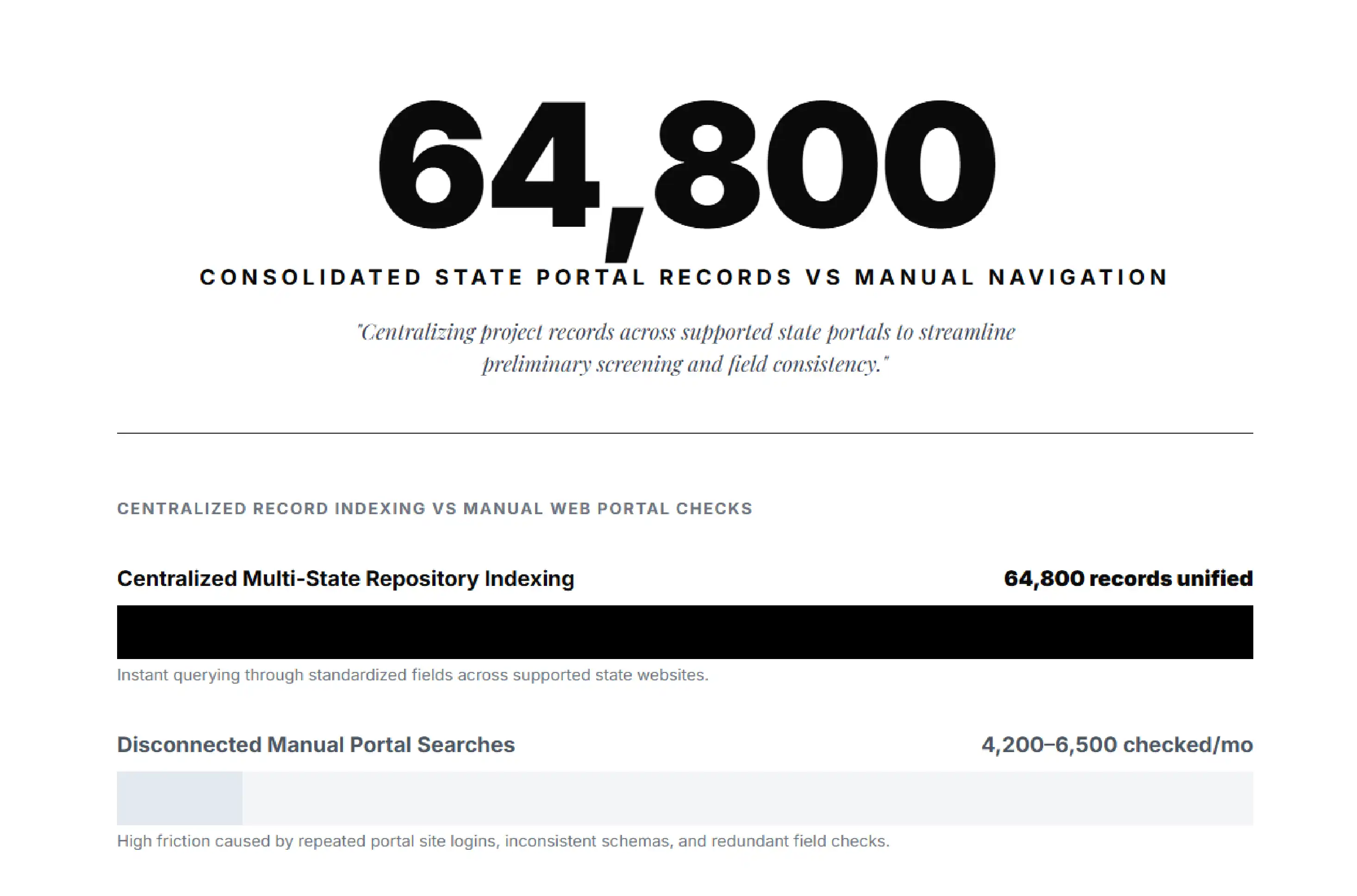
Automated validation highlights records with missing registration details, incomplete promoter information, unavailable timelines, or unresolved project matches. Analysts can prioritize these exceptions rather than manually reviewing every collected record. Importantly, missing portal information is classified as an information gap, not automatically interpreted as evidence of borrower misconduct or project risk.
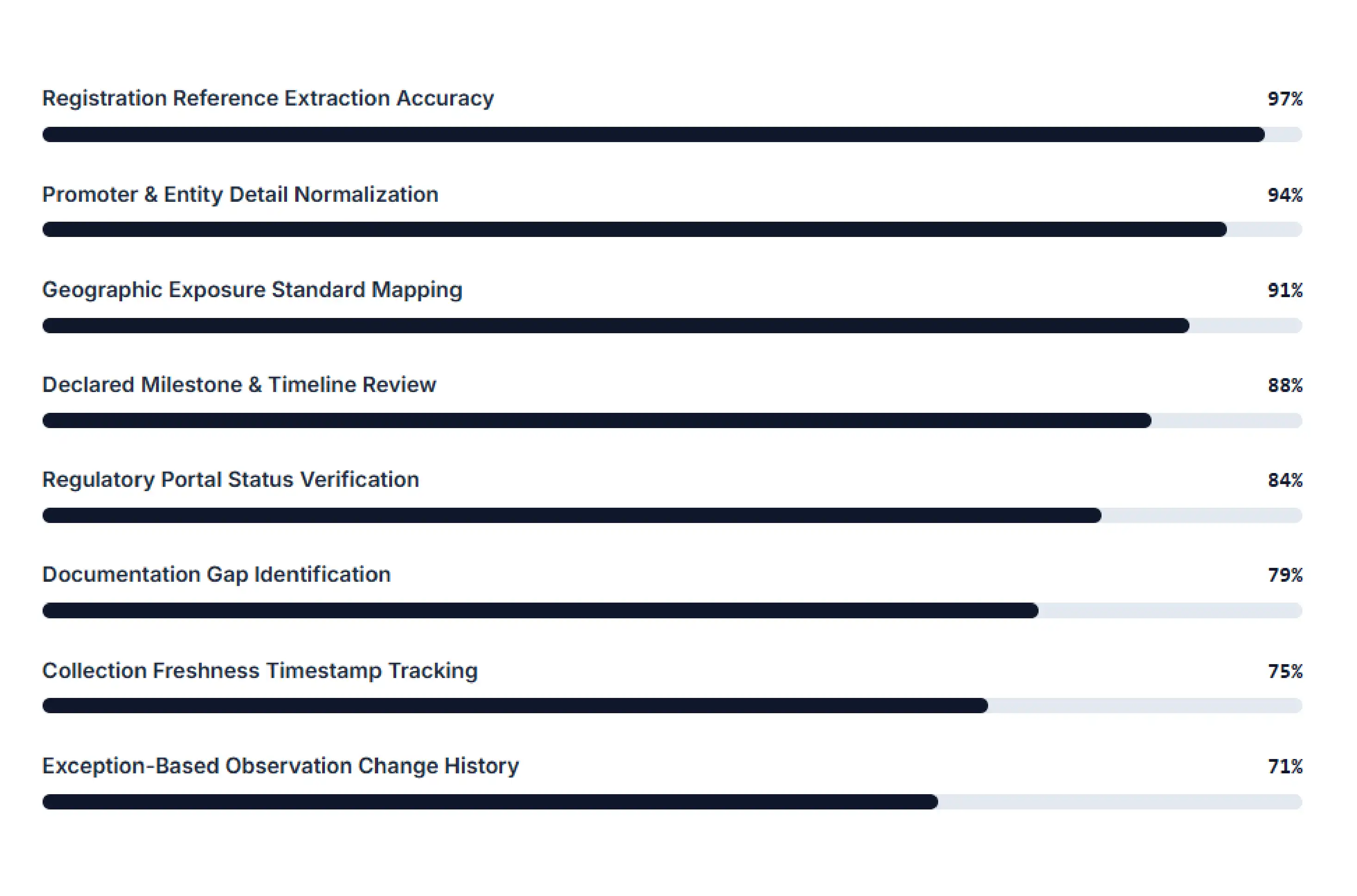
A standardized schema makes it easier to compare project characteristics across supported states. Promoter names, registration references, location fields, and published timelines can be reviewed using common filters. This helps analysts identify related records and prepare more consistent due-diligence summaries, while ambiguous relationships remain subject to human verification.
| Metric | Insight Captured | Potential Lending Application |
|---|---|---|
| Registration reference | Published project registration identifier | Project record matching |
| Promoter details | Available promoter or developer information | Borrower and entity due diligence |
| Project location | State, district, city, and locality where available | Geographic exposure analysis |
| Published timeline | Declared completion dates and related milestones | Timeline review and follow-up |
| Registration status | Status displayed by the relevant portal | Regulatory information verification |
| Disclosure availability | Presence of accessible documents or records | Documentation-gap identification |
| Record freshness | Last successful collection timestamp | Data recency assessment |
| Change history | Differences between successive observations | Exception-based monitoring |
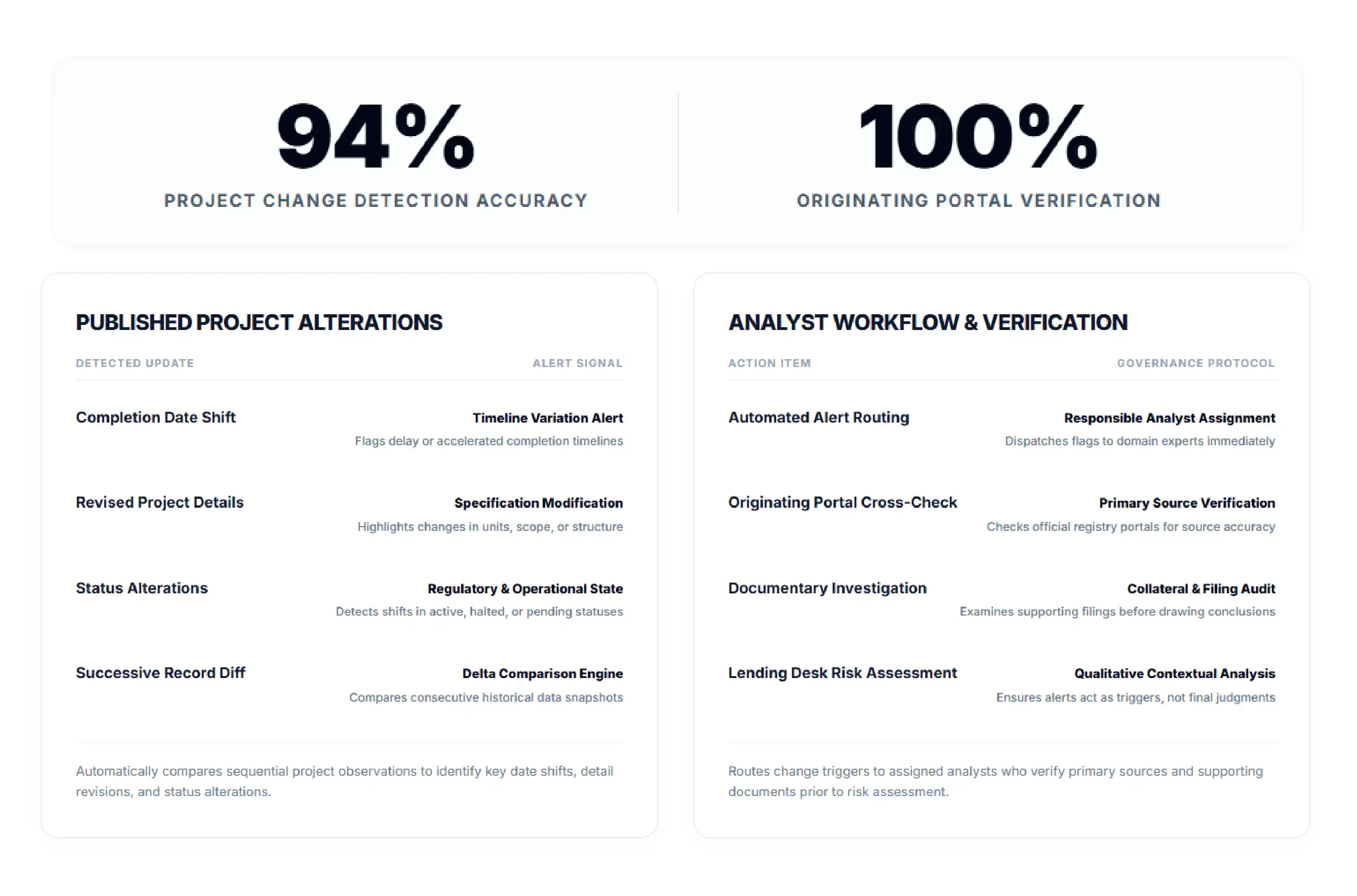
Comparing successive records helps the lending desk detect updates that warrant closer examination. A changed completion date, revised project detail, or status alteration can be routed to the responsible analyst. The alert does not determine the reason for the change; the analyst checks the originating portal and other relevant documents before drawing conclusions.
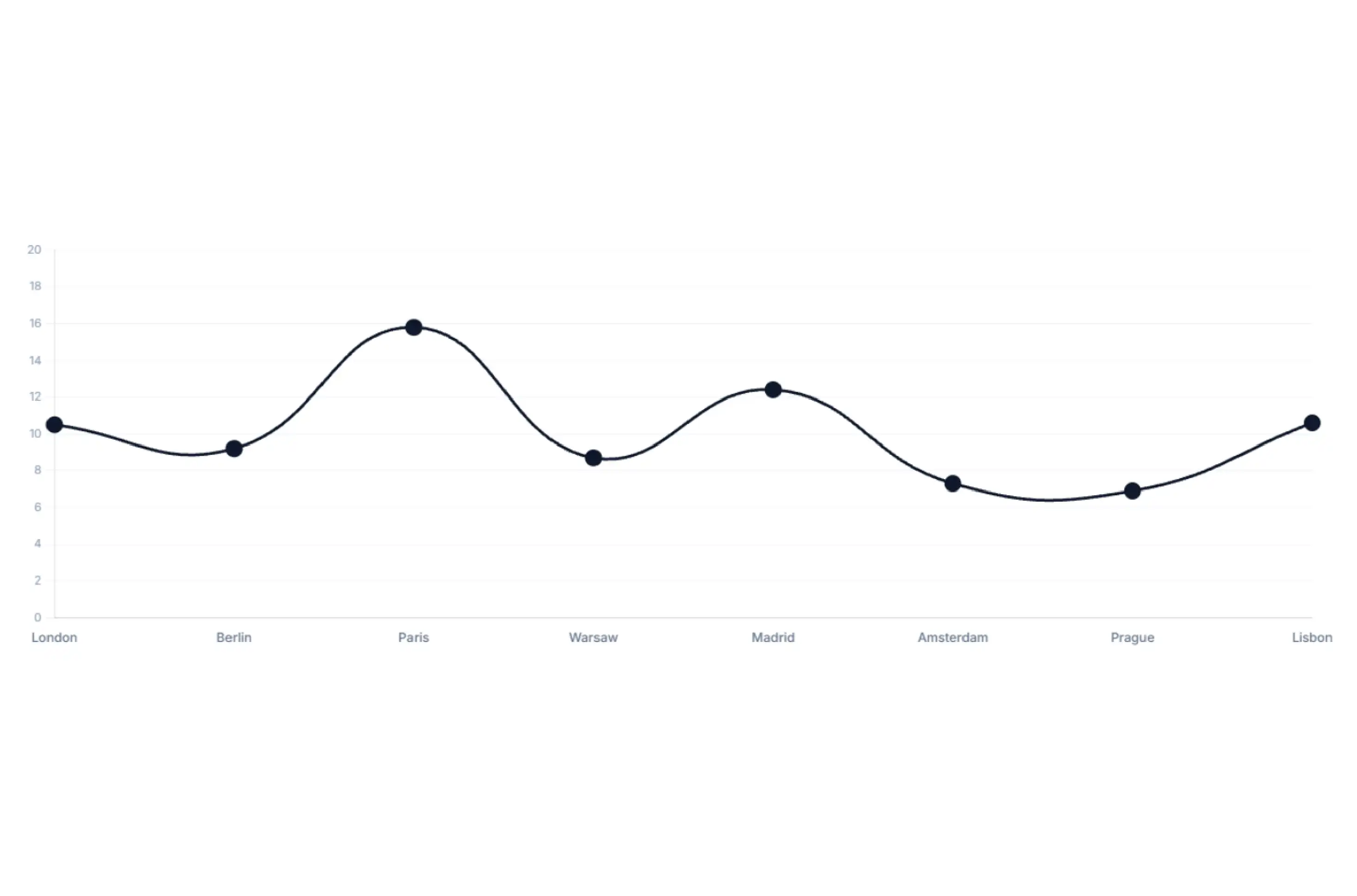
The following table demonstrates how standardized RERA information might be organized for an NBFC lending desk. These rows are fictional examples created to illustrate the data structure; they do not represent verified projects, actual borrowers, or current portal records.
| State | Project Reference | Project Location | Promoter Record | Published Completion Date | Data Status | Lending Desk Action |
|---|---|---|---|---|---|---|
| Maharashtra | MH-DEMO-001 | Pune | Available | 30-Jun-2027 | Validated sample | Verify disclosures |
| Karnataka | KA-DEMO-002 | Bengaluru | Available | 31-Dec-2027 | Timeline requires review | Request supporting documents |
| Uttar Pradesh | UP-DEMO-003 | Lucknow | Partial | 31-Mar-2028 | Incomplete record | Manual verification |
| Gujarat | GJ-DEMO-004 | Ahmedabad | Available | 30-Sep-2027 | Validated sample | Compare with credit file |
| Telangana | TS-DEMO-005 | Hyderabad | Available | Not available | Timeline missing | Check source documents |
| Rajasthan | RJ-DEMO-006 | Jaipur | Under review | 31-Dec-2028 | Entity match unresolved | Escalate for review |
| Tamil Nadu | TN-DEMO-007 | Chennai | Available | 30-Jun-2028 | Validated sample | Review project milestones |
| Delhi NCR | NCR-DEMO-008 | Delhi region | Partial | Not available | Coverage needs confirmation | Verify applicable authority |
This format separates the collected regulatory information from the action required by the lending desk. It also avoids treating unavailable dates or incomplete promoter fields as definitive adverse findings. In production, records would include source URLs, retrieval timestamps, registration identifiers where available, validation results, and the applicable portal's terminology.
The proposed framework supports several operational improvements across origination, underwriting support, and portfolio surveillance.
iWeb Data Intelligence supports organizations that need to transform fragmented online information into structured, analysis-ready datasets. For a real estate lending desk, the value lies in combining source-aware collection, field standardization, quality controls, and dependable delivery within a governed workflow.
The approach can help the NBFC consolidate publicly accessible regulatory information, reduce repetitive manual research, and maintain a searchable repository of project-level records. It can also support tailored validation rules, scheduled monitoring, and exception reporting aligned with the lender's internal processes.
The solution is designed to accommodate changing source structures and differences in state-level data availability. Where records are incomplete, inaccessible, or inconsistent, the system can preserve that limitation for review rather than silently filling gaps with assumptions.
By combining structured collection with analyst-led verification, iWeb Data Intelligence can help lending teams improve information availability while preserving the independent checks required for responsible credit decisions.
"The proposed data intelligence framework provides a more structured way to organize regulatory information across our real estate lending markets. Centralized project records, source traceability, and automated quality checks can reduce repetitive research and help our analysts identify missing information more efficiently. We see value in using consistent data to support preliminary screening and portfolio monitoring while retaining the verification and credit judgment essential to responsible lending."
— Head of Real Estate Credit Strategy
The proposed initiative establishes a scalable foundation for state-wise RERA intelligence by converting fragmented regulatory disclosures into standardized, traceable records for an NBFC's real estate lending desk. A common data model enables analysts to search projects, review available promoter information, compare published timelines, and identify documentation gaps across supported markets.
Implementation of Web Scraping API Services can enable controlled delivery of validated records into internal dashboards, research repositories, and authorized lending applications. Scheduled collection, source-level metadata, validation checks, and change logs support better data freshness and help teams investigate relevant updates without relying exclusively on manual portal searches.
The framework also establishes a pathway for future improvements, including additional state-specific connectors, richer project matching, configurable alerts, and integration with internal exposure data. These capabilities can help the NBFC build more consistent preliminary screening and portfolio monitoring processes as its real estate lending operations expand.
The company could now answer critical operational questions faster:
This shift from periodic reporting to continuous regulatory intelligence strengthened the organization's ability to manage the rapidly evolving real estate lending environment.
Most importantly, the project demonstrated that regulatory data visibility is not simply a documentation metric. In a competitive lending environment, project intelligence is part of the risk assessment process and directly influences the opportunity to make informed credit decisions.
It is a structured process for collecting available project and promoter information from supported state and union territory RERA portals. The data is standardized, validated, and organized into searchable records for research, preliminary screening, and portfolio monitoring.
RERA information can help analysts review published project registration details, promoter disclosures, locations, timelines, and available regulatory updates. It complements financial statements, legal checks, valuations, borrower information, and technical assessments rather than replacing them.
Coverage depends on portal accessibility, published information, technical restrictions, available download facilities, and applicable terms. A source-by-source assessment is required to determine which fields can be collected reliably and how often they can be refreshed.
Quality controls can include field normalization, duplicate detection, date validation, identifier matching, source timestamps, and exception handling. Unavailable or conflicting information is flagged for review instead of being treated as verified data.
Yes, subject to the NBFC's architecture and security requirements. Validated records can be delivered through authorized APIs, structured files, databases, or dashboards. Integration should include access controls, audit trails, and clear ownership of data-quality exceptions.
Turn fragmented state-level regulatory information into structured project intelligence with a governed data collection framework. iWeb Data Intelligence can help your team improve record accessibility, strengthen source traceability, and support more efficient real estate lending research across supported Indian markets.
Start a projectFields marked * are required. Everything else just helps us scope faster — skip what you don't know yet.