
125K+
USED CAR LISTINGS PROCESSED

AutoScout24 and mobile.de Data Scraping helps businesses track European used car listings, compare prices, monitor inventory, and analyze automotive market trends.
This case study explores an enterprise automotive intelligence scenario in which a vehicle marketplace analytics company uses automated AutoScout24 and mobile.de Data Scraping to transform fragmented used vehicle listings into structured, comparable, and actionable market intelligence. The objective is to establish a unified automotive dataset that supports competitive benchmarking, vehicle valuation, inventory monitoring, pricing analysis, and regional market research across European automotive markets.
It is designed for:
The central business requirement was to overcome the limitations of fragmented marketplace monitoring. Vehicle listings continuously change as sellers update prices, add specifications, modify availability, or remove advertisements. The client needed a scalable solution capable of consolidating these changing records into a consistent analytical environment.
The European second-hand automotive industry operates through multiple digital marketplaces where vehicle availability, asking prices, specifications, and seller information change continuously. For automotive businesses, understanding these movements requires more than periodically checking individual advertisements. It requires systematic monitoring across platforms, markets, manufacturers, and vehicle categories.
The project focused on extracting used car listings data Europe from AutoScout24 and mobile.de to establish a centralized automotive intelligence dataset. The solution captured essential listing attributes, including vehicle manufacturer, model, registration year, mileage, fuel type, transmission, engine capacity, location, seller category, and advertised price.
The initiative also incorporated used car price data EU to help analysts compare vehicle prices across different countries and identify regional variations. By standardizing vehicle attributes and normalizing available price information, the client could evaluate comparable vehicles across marketplaces without depending on inconsistent manual research.
The automated pipeline collected listing information, validated records, removed duplicates, and organized vehicle attributes into structured datasets. Historical snapshots supported price movement analysis, while recurring extraction cycles helped identify newly published advertisements, modified listings, and removed inventory.
The client operated within a competitive European automotive environment where vehicle information was distributed across multiple marketplaces. Although AutoScout24 and mobile.de provided extensive inventory visibility, collecting and comparing information consistently presented several operational difficulties.
Car Import Price Comparison
Vehicle prices varied between countries because of differences in demand, vehicle condition, mileage, taxation, transportation expenses, and local market conditions. The client lacked a consolidated dataset to compare equivalent vehicles across different European locations. Consequently, identifying attractive cross-border purchasing opportunities required extensive manual research.
Vehicle Listing Data Extraction
Listings contained different information structures, optional specifications, seller descriptions, and inconsistent vehicle naming conventions. Extracting comparable records from both marketplaces required a standardized collection framework capable of identifying relevant attributes and maintaining consistency.
Absence of Comprehensive Automotive Data Scraping Infrastructure
Existing research processes depended on manual browsing, spreadsheets, and periodic checks. These methods could not efficiently capture large inventory volumes or identify listing changes across multiple vehicle categories.
To overcome these challenges, the client required an automated AutoScout24 and mobile.de extraction framework capable of consolidating marketplace information into a consistent analytical environment.
By implementing an automated AutoScout24 and mobile.de extraction framework, the client replaced fragmented marketplace monitoring with a centralized automotive intelligence pipeline. The system established consistent collection procedures, standardized vehicle attributes, and enabled comparative analysis across both platforms.
The transformation improved the consistency of automotive information and reduced the operational effort associated with collecting and comparing vehicle advertisements. Analysts could focus on interpreting market movements instead of repeatedly gathering information.
| Dimension | Manual Marketplace Tracking | Client Data Scraping System |
|---|---|---|
| Data collection | Individual advertisement browsing | Automated multi-platform collection |
| Market coverage | Limited vehicle categories | Scalable inventory coverage |
| Price monitoring | Periodic spreadsheet updates | Recurring price snapshots |
| Vehicle specifications | Inconsistent manual recording | Standardized attribute extraction |
| Duplicate management | Manual identification | Automated matching and deduplication |
| Historical tracking | Limited historical records | Structured listing snapshots |
| Regional comparison | Separate country-level research | Consolidated regional datasets |
| Market intelligence | Reactive observations | Continuous analytical monitoring |
| Reporting | Manually prepared spreadsheets | Dashboard-ready structured datasets |
| Scalability | Dependent on analyst availability | Expandable automated infrastructure |
The centralized system provided a consistent analytical foundation for comparing vehicle performance across markets while reducing repetitive operational work.
The brands in focus are AutoScout24 and mobile.de, two established digital automotive marketplaces serving buyers and sellers across European vehicle markets.
AutoScout24 provides an online environment for discovering new and used vehicles, comparing advertisements, and connecting with automotive dealers and private sellers. Its marketplace contains information covering vehicle manufacturers, models, prices, specifications, mileage, registration details, and seller information across supported markets.
mobile.de is a major German automotive marketplace connecting vehicle buyers and sellers through extensive new and used vehicle advertisements. Its listings provide information about vehicle specifications, pricing, mileage, registration, fuel types, transmission, and seller details.
For automotive intelligence teams, monitoring these marketplaces together provides a broader perspective on vehicle availability and competitive positioning. However, their listing structures, descriptions, and market coverage require careful normalization before records can be compared reliably.
iWeb Data Intelligence designed an end-to-end automotive marketplace data extraction solution that converted individual vehicle advertisements into standardized datasets suitable for large-scale analysis.
The implementation followed a structured methodology covering source identification, field mapping, automated extraction, data validation, normalization, deduplication, historical storage, and dashboard integration.
Source Identification and Coverage Planning
The initial stage involved identifying relevant vehicle categories, manufacturers, models, locations, and listing attributes available through the two marketplaces. The collection framework was designed around the client's analytical requirements, with particular attention to used passenger vehicles, vehicle specifications, seller categories, and advertised prices. Collection scope was configured according to supported marketplace access, applicable permissions, and available listing information.
Automated Vehicle Listing Collection
Automated extraction workflows captured relevant advertisement information from AutoScout24 and mobile.de. Each record was associated with its source marketplace and available listing identifier to maintain traceability. The system collected vehicle information such as manufacturer and vehicle model, model variant and trim, registration year and first registration, advertised selling price and currency, mileage and vehicle condition, fuel type and transmission, engine capacity and power output, body type and vehicle category, exterior colour and available equipment, seller type and dealership information, listing location and country, and advertisement URL and collection timestamp.
Data Cleaning and Standardization
Raw advertisements frequently contained inconsistent descriptions and incomplete specifications. The processing framework standardized common attributes, normalized text fields, and identified missing values. Vehicle manufacturers and model names were mapped into consistent categories wherever sufficient information was available. Mileage, registration years, currencies, and engine specifications were converted into standardized formats.
Duplicate Identification
The system applied matching rules using available identifiers and combinations of vehicle attributes. Manufacturer, model, registration year, mileage, location, and seller information helped identify potentially duplicated records. This process improved inventory accuracy and reduced the possibility of counting identical advertisements multiple times.
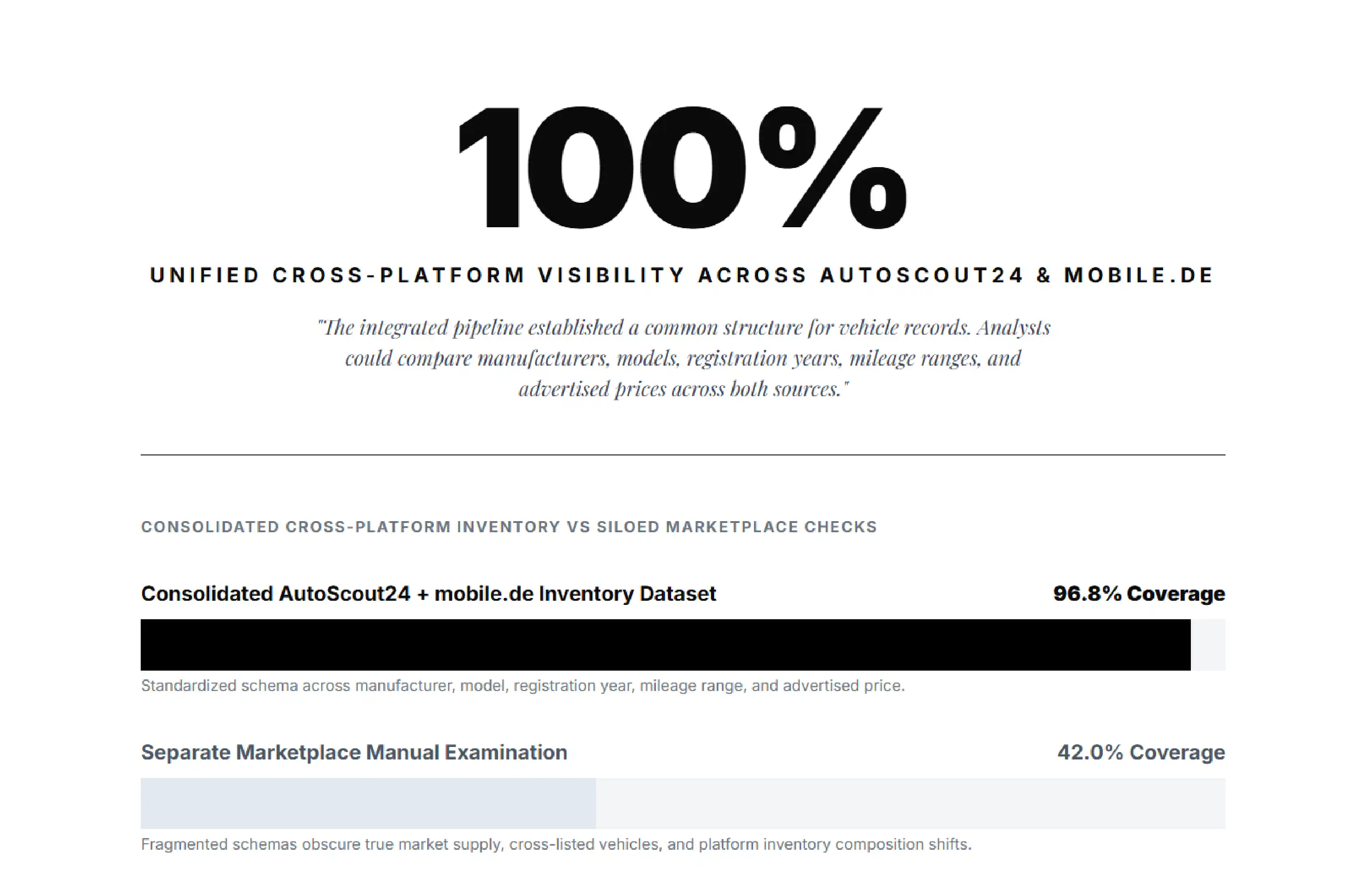
The first major finding was the value of consolidating AutoScout24 and mobile.de advertisements into a single vehicle inventory dataset. Previously, analysts examined each marketplace separately, which made it difficult to understand overall vehicle availability and identify differences between platform inventories.
The integrated pipeline established a common structure for vehicle records. Analysts could compare manufacturers, models, registration years, mileage ranges, and advertised prices across both sources.
This approach also helped identify vehicle categories receiving greater listing activity and highlighted differences between marketplace inventory compositions. The resulting visibility supported more informed decisions about dealership sourcing, vehicle positioning, and competitive benchmarking.
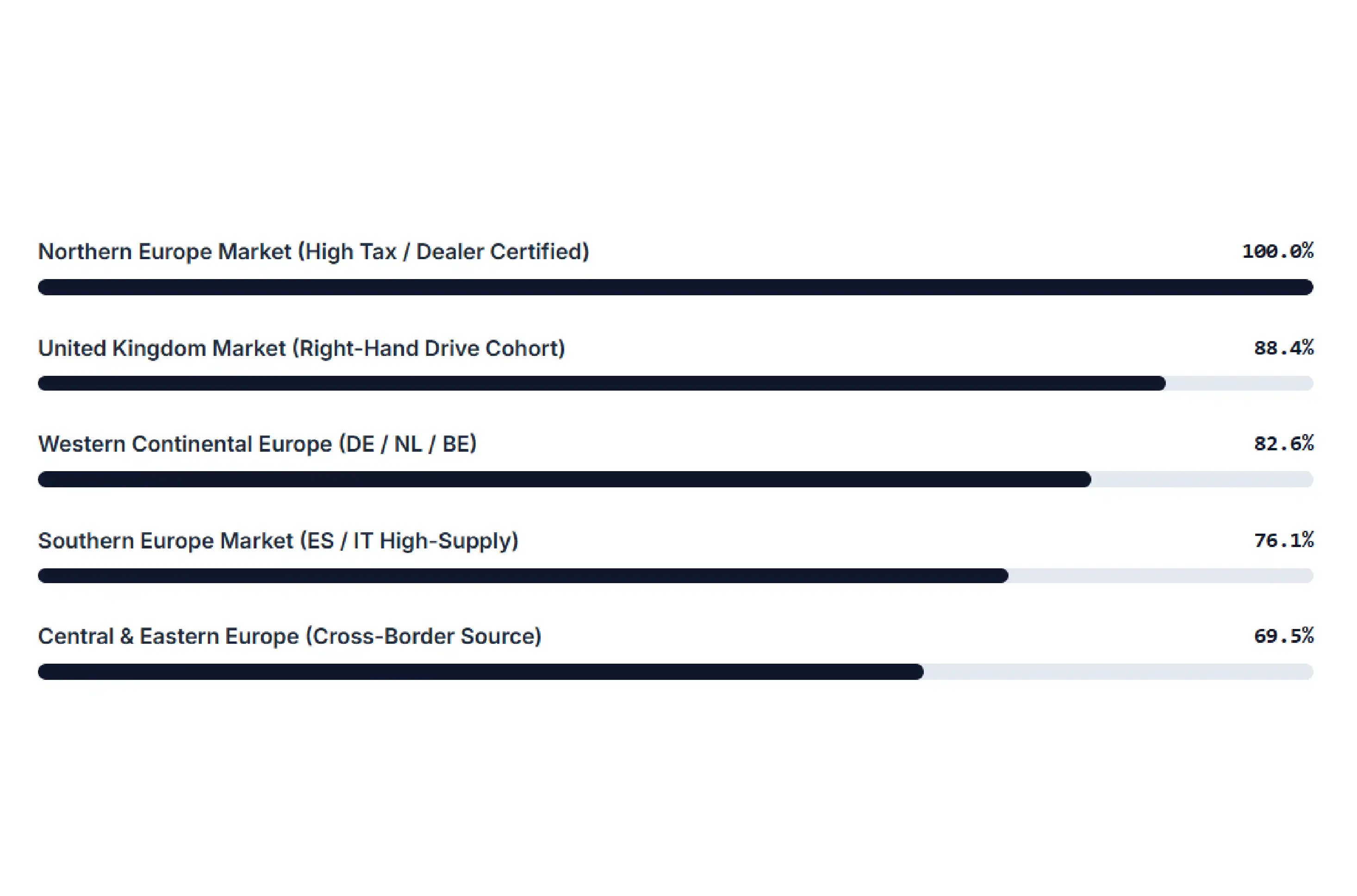
The second finding involved regional differences in advertised vehicle prices. A vehicle's asking price is influenced by several factors, including registration year, mileage, fuel type, engine configuration, condition, location, and seller category. Therefore, comparing advertisements solely by manufacturer and model can produce misleading conclusions.
The solution introduced comparable vehicle segments using multiple specifications. Analysts could examine similar vehicle configurations across available countries and locations while retaining their original advertised currencies.
Where currency conversion was required, exchange-rate information and collection timestamps could be incorporated as separate analytical fields. This enabled more meaningful comparisons of regional asking prices and supported research into cross-border vehicle sourcing opportunities.
Importantly, advertised prices were treated as asking prices rather than confirmed transaction values. Transportation, registration, import duties, taxes, inspection expenses, and other applicable costs required separate consideration before evaluating actual purchase economics.
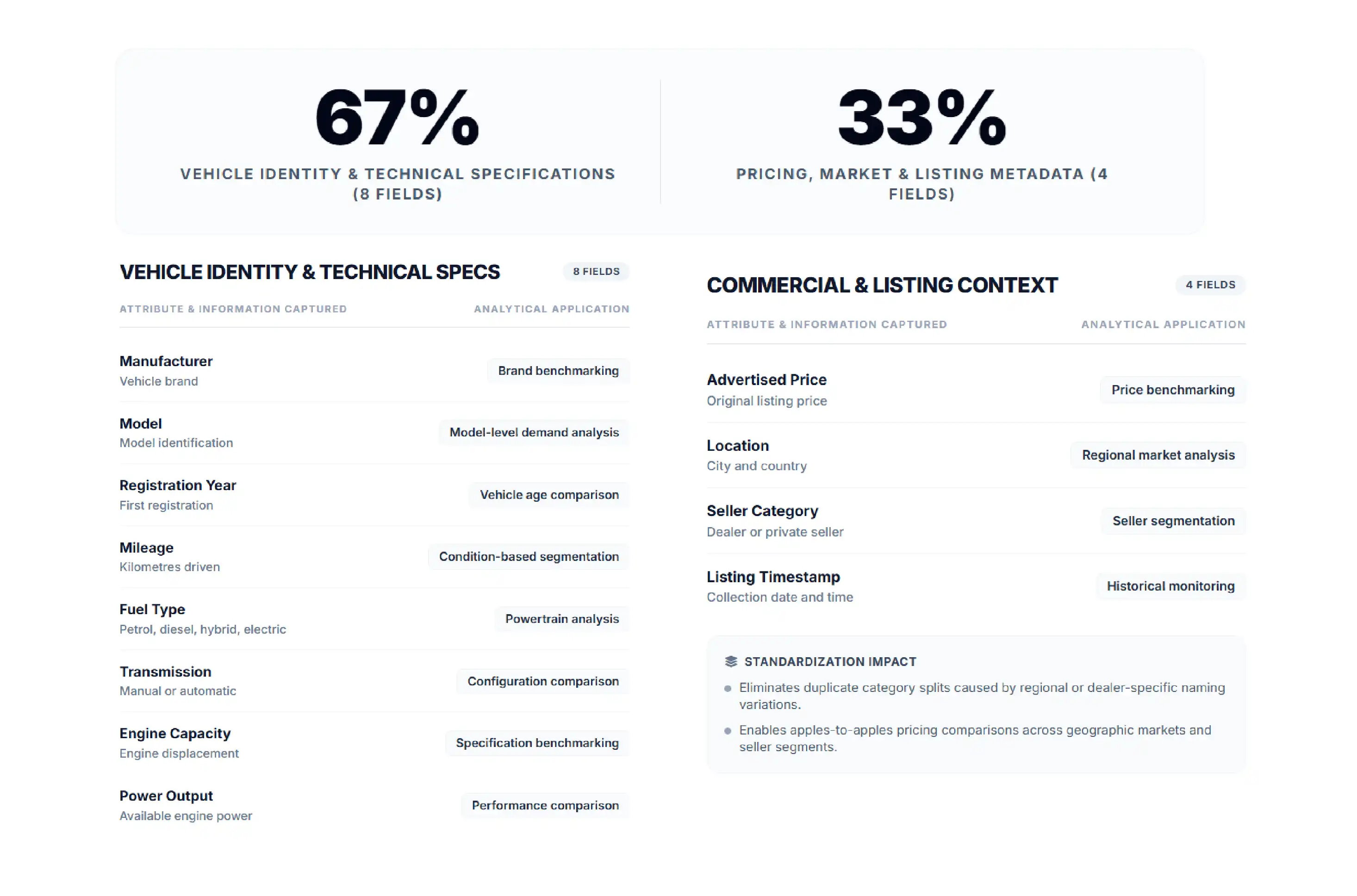
The third finding demonstrated the importance of standardized vehicle specifications. Marketplace advertisements frequently use different terminology to describe similar configurations. Without normalization, identical vehicle categories can appear as separate records in analytical reports.
The extraction framework established consistent fields for vehicle identification and comparison, covering manufacturer, model, registration year, mileage, fuel type, transmission, engine capacity, power output, advertised price, location, seller category, and listing timestamp.
The structured information enabled analysts to create more accurate vehicle segments and improve the reliability of comparisons across different marketplace advertisements.
The following illustrative dataset demonstrates how extracted marketplace information can be organized into a common analytical format.
It includes marketplace, brand, model, year, mileage, fuel type, and price information.
| Marketplace | Brand | Model | Year | Mileage | Fuel Type | Price (€) |
|---|---|---|---|---|---|---|
| AutoScout24 | BMW | 320d | 2021 | 48,000 km | Diesel | 29,900 |
| mobile.de | BMW | 320d | 2021 | 52,000 km | Diesel | 28,750 |
| AutoScout24 | Volkswagen | Golf | 2022 | 32,000 km | Petrol | 22,400 |
| mobile.de | Volkswagen | Golf | 2022 | 35,000 km | Petrol | 21,950 |
| AutoScout24 | Audi | A4 | 2020 | 61,000 km | Diesel | 26,800 |
| mobile.de | Audi | A4 | 2020 | 58,000 km | Diesel | 27,200 |
| AutoScout24 | Mercedes-Benz | C-Class | 2021 | 45,000 km | Petrol | 34,500 |
| mobile.de | Mercedes-Benz | C-Class | 2021 | 49,000 km | Petrol | 33,900 |
| AutoScout24 | Tesla | Model 3 | 2022 | 39,000 km | Electric | 31,800 |
| mobile.de | Tesla | Model 3 | 2022 | 42,000 km | Electric | 30,950 |
Note: Sample figures are illustrative and do not represent verified live marketplace prices or actual vehicle listings.
The structured dataset enables analysts to compare vehicle categories, manufacturers, models, mileage, fuel types, and advertised prices across both platforms.
Following implementation of the structured marketplace intelligence framework, the illustrative project scenario demonstrated several operational improvements.
iWeb Data Intelligence delivers structured marketplace data solutions designed to help businesses convert fragmented digital information into actionable intelligence.
Comprehensive Data Collection
Our automotive data extraction approach focuses on reliable information collection, consistent field mapping, and scalable processing. By consolidating vehicle listings from multiple sources, businesses can establish a centralized dataset that supports inventory analysis, price comparison, and competitive research.
Reliable Data Processing
The solution also emphasizes data quality. Validation, deduplication, normalization, and missing-value identification help maintain consistent records across large datasets. This is particularly important when comparing vehicles with different descriptions, configurations, and marketplace attributes.
Scalable Infrastructure
Our infrastructure supports recurring data collection and historical storage, allowing businesses to examine market developments rather than relying exclusively on individual marketplace snapshots.
Flexible Delivery Formats
Flexible delivery formats make the resulting information suitable for business intelligence dashboards, databases, analytical models, and internal reporting systems.
Configurable Solutions
Whether an organization needs a focused vehicle dataset or a broader automotive intelligence platform, iWeb provides configurable data extraction solutions aligned with its operational and analytical requirements.
"The automotive marketplace data intelligence solution provided by the team significantly improved how we collect and analyze used vehicle information. Previously, our analysts spent considerable time checking individual advertisements and comparing vehicle specifications across different platforms. The structured extraction framework helped us consolidate marketplace information into a consistent dataset. We gained improved visibility into vehicle pricing, inventory availability, and regional differences. The historical monitoring capabilities also helped us understand changes in advertised prices and identify important movements across vehicle categories. The solution reduced repetitive manual work and provided a stronger foundation for competitive benchmarking, dealership research, and automotive market analysis. We particularly appreciated the flexibility of the data structure and its suitability for our internal analytical systems."
— Head of Automotive Market Intelligence
The final outcome was an integrated automotive marketplace intelligence framework that transformed individual vehicle advertisements into standardized and analysis-ready business information.
The client gained a consolidated view of used vehicle inventory across AutoScout24 and mobile.de, enabling more consistent comparisons of vehicle manufacturers, models, specifications, advertised prices, and regional availability.
Implementation of enterprise web crawling capabilities established a scalable collection framework for processing large volumes of marketplace information while maintaining structured records and source-level traceability.
The integration of real-time web scraping workflows supported recurring monitoring of newly available advertisements, changing prices, and updated vehicle specifications, subject to source accessibility and collection frequency.
Through managed web scraping services, the client obtained an adaptable infrastructure for data extraction, validation, normalization, historical storage, and structured delivery without depending entirely on manual marketplace monitoring.
The resulting dataset supported several important business applications, including vehicle price benchmarking, cross-market inventory comparison, dealership intelligence, automotive market research, and predictive valuation development.
AutoScout24 and mobile.de data scraping involves collecting publicly accessible vehicle advertisement information from these automotive marketplaces and organizing it into structured datasets. Extracted information may include manufacturer, model, registration year, mileage, fuel type, transmission, advertised price, location, and seller details, depending on availability and permitted access.
The dataset can include vehicle identification details, model specifications, registration information, mileage, engine capacity, fuel type, transmission, advertised prices, seller categories, locations, and listing URLs. Additional attributes depend on the information displayed in individual advertisements and the agreed collection scope.
Automotive businesses can use structured vehicle information for competitor price monitoring, inventory benchmarking, dealership research, vehicle valuation, regional market analysis, and sourcing decisions. Historical snapshots can also support research into advertised price movements and changes in available inventory.
Yes. A configured data extraction solution can collect available vehicle advertisements across supported European markets and organize their prices into comparable datasets. Currency normalization, vehicle specification matching, and regional segmentation can improve comparison quality. Additional import expenses and applicable taxes must be evaluated separately.
Yes. Structured datasets can be delivered in formats suitable for databases, spreadsheets, APIs, and business intelligence platforms. Organizations can use these datasets to build interactive dashboards, compare vehicle prices, monitor marketplace inventory, and generate automotive market intelligence reports.
Transform AutoScout24 and mobile.de advertisements into structured vehicle intelligence with iWeb Data Intelligence. Our automotive data scraping solutions help businesses monitor used car prices, compare marketplace inventories, identify regional opportunities, and build scalable automotive analytics systems.
Start a projectFields marked * are required. Everything else just helps us scope faster — skip what you don't know yet.