

Introduction
France continues to be one of the world's most dynamic hospitality markets, attracting millions of domestic and international travelers every year. Hotels, vacation rentals, tourism boards, investment firms, and revenue management companies increasingly rely on historical accommodation data to understand changing traveler behavior, optimize pricing strategies, and forecast future demand. Benchmarking Hotel Rates & Reviews via OTA Data has emerged as a powerful approach for comparing hotel performance across multiple booking platforms while identifying pricing trends, guest satisfaction levels, and competitive positioning.
In addition, OTA hotel rate and review data scraping enables businesses to collect structured information from leading online travel agencies, making it easier to analyze hotel pricing, customer reviews, room availability, and booking trends at scale.
Organizations also benefit significantly from hotel rate and review benchmarking using OTA data, allowing them to evaluate historical performance, compare competitors, and improve long-term revenue strategies using reliable market intelligence.
Historical Airbnb occupancy rate, Average Daily Rate (ADR), and revenue datasets covering every major French city from 2022 to 2026 provide invaluable insights into how the accommodation industry evolved following global tourism recovery. Rather than relying on isolated market snapshots, these datasets help businesses understand seasonal demand, long-term pricing behavior, occupancy fluctuations, and revenue growth across different regions of France.
Why Historical Hospitality Data Matters?
The hospitality industry changes continuously due to seasonal tourism, international events, economic conditions, airline connectivity, consumer preferences, and local festivals. A five-year historical dataset offers a much deeper understanding than current market prices alone.
Hotels can identify recurring seasonal demand patterns, investors can evaluate long-term market stability, tourism authorities can monitor destination growth, and revenue managers can optimize pricing strategies based on proven historical trends rather than assumptions.
Historical Airbnb occupancy and hotel pricing data also help businesses measure market recovery, understand competitive landscapes, and forecast future accommodation demand with greater confidence.
Understanding Airbnb Occupancy Trends Across France (2022–2026)
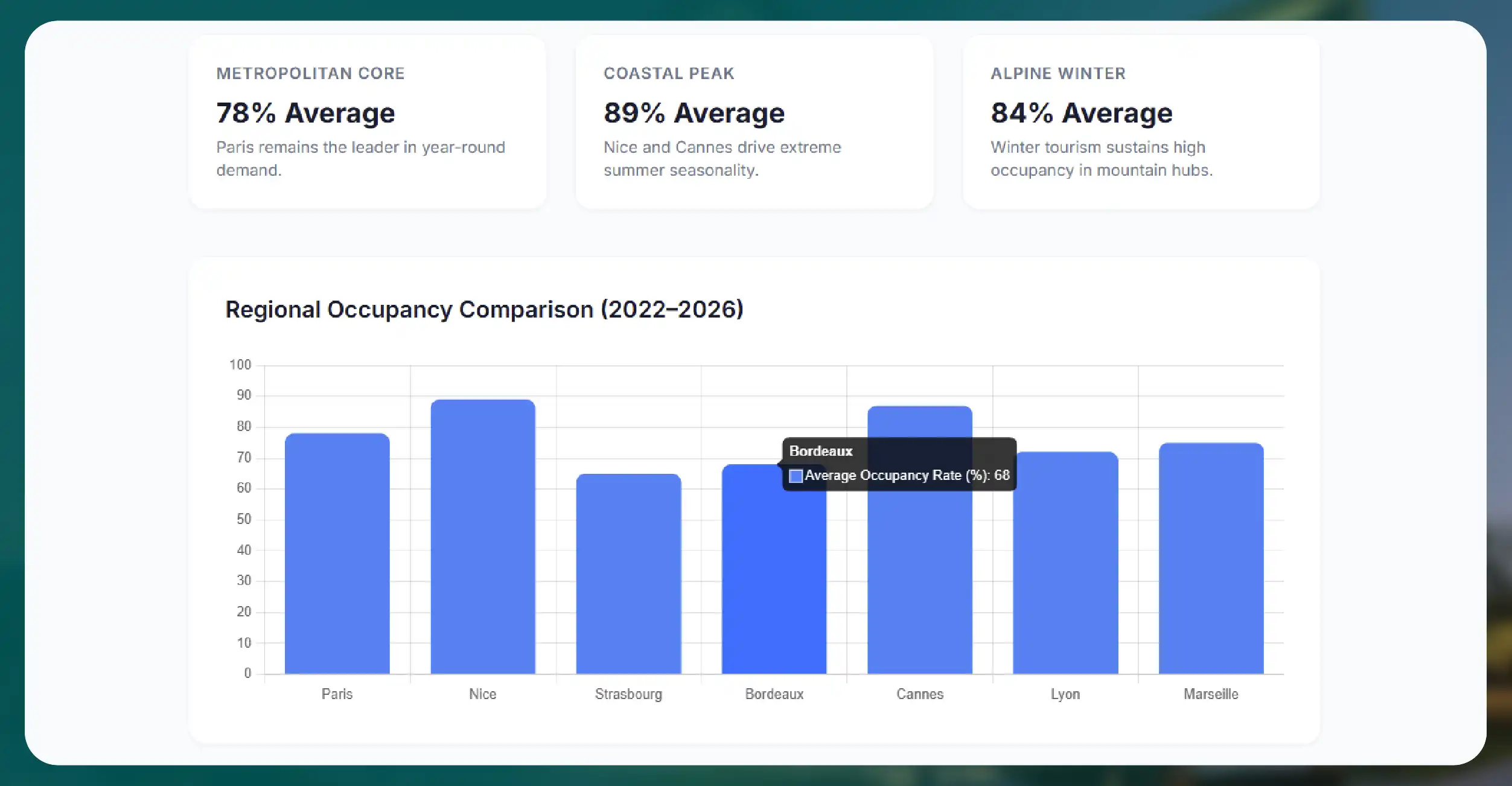
Occupancy rate represents one of the most important hospitality performance indicators. It measures how frequently accommodation properties remain booked over a given period and reflects the overall strength of tourism demand.
Between 2022 and 2026, occupancy trends varied considerably across French destinations. Paris maintained strong year-round demand due to business travel, luxury tourism, international events, and cultural attractions. Coastal cities including Nice, Cannes, and Marseille experienced pronounced summer peaks, while Alpine regions benefited from winter tourism.
Smaller cities such as Strasbourg, Bordeaux, Toulouse, Montpellier, Dijon, and Avignon displayed unique booking behaviors driven by regional festivals, conferences, university populations, wine tourism, and domestic travel.
Historical occupancy datasets enable businesses to identify:
- Stable year-round destinations
- Highly seasonal tourism markets
- Emerging travel hotspots
- Regions with increasing accommodation supply
- Markets experiencing competitive saturation
The Importance of ADR Analysis
Average Daily Rate (ADR) measures the average revenue earned per occupied room and serves as one of the primary indicators of pricing performance.
ADR data from 2022 through 2026 reveals how hotels and Airbnb hosts adjusted prices during periods of changing demand, inflation, international travel recovery, and local events.
Revenue managers use ADR analysis to determine:
- Optimal room pricing
- Seasonal pricing strategies
- Premium pricing opportunities
- Discount effectiveness
- Event-based rate adjustments
Historical ADR also highlights how different French cities respond to tourism demand. Luxury destinations often command significantly higher ADR during peak seasons, while business-focused cities maintain relatively stable pricing throughout the year.
Revenue Data Provides Complete Market Visibility
Occupancy alone does not reveal business performance. Revenue combines occupancy with ADR to provide a complete financial picture.
Historical revenue datasets allow hospitality businesses to understand:
- Annual revenue growth
- Market profitability
- High-performing neighborhoods
- Seasonal income variations
- Investment potential
For hotel owners and investors, revenue benchmarking reduces uncertainty before expanding into new locations or acquiring hospitality assets.
Hotel Reviews Reveal Guest Expectations
Guest reviews provide detailed feedback regarding service quality, cleanliness, amenities, food, staff behavior, location, room comfort, and overall guest satisfaction.
Hotels can analyze millions of reviews to identify recurring strengths and weaknesses. Positive review trends often correlate with higher occupancy and premium pricing, while repeated complaints frequently result in declining bookings.
Review benchmarking enables businesses to improve operational efficiency while strengthening their online reputation.
Why Competitive Benchmarking Matters?
Competitor hotel price monitoring has become an essential part of modern revenue management.
Hotels frequently adjust room prices several times each day depending on occupancy forecasts, booking pace, cancellation rates, competitor promotions, local demand, and available inventory.
Monitoring competitor pricing allows hotels to:
- Respond quickly to market changes
- Avoid unnecessary discounting
- Maintain competitive positioning
- Improve revenue optimization
- Increase booking conversions
Instead of reacting after losing reservations, hotels can proactively adjust pricing based on real-time competitive intelligence.
Benefits of Real-Time OTA Rate Comparison
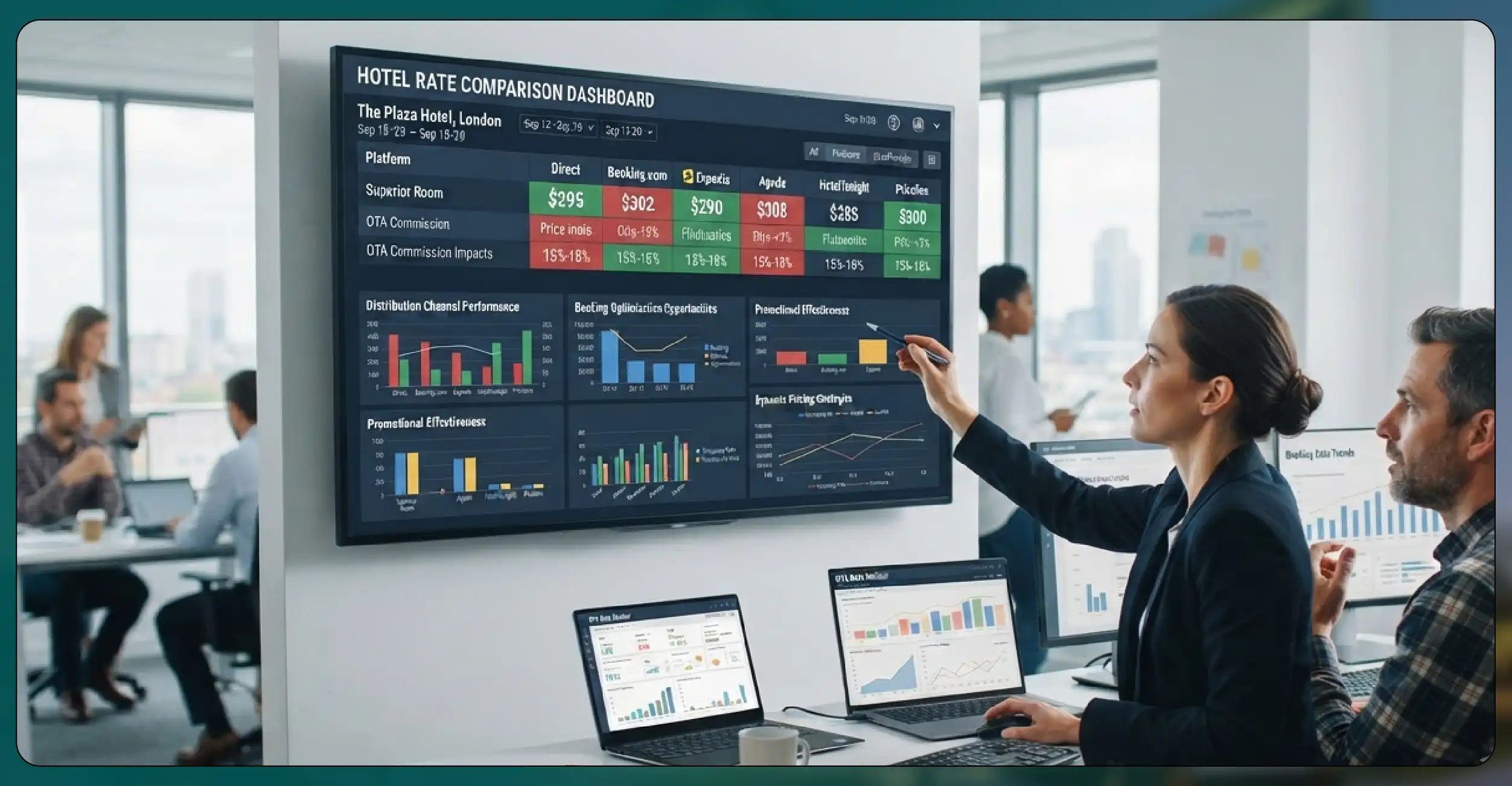
Another major advantage is real-time hotel rate comparison via OTA Data, which enables hospitality businesses to compare pricing across multiple booking platforms simultaneously.
Hotels often list rooms on several OTAs while maintaining direct booking websites. Differences between these channels can influence booking behavior and profitability.
Rate comparison helps organizations identify:
- Price inconsistencies
- Distribution channel performance
- Promotional effectiveness
- OTA commission impacts
- Booking channel optimization opportunities
Real-time monitoring also supports dynamic pricing strategies that maximize occupancy without sacrificing revenue.
Key Data Points Collected from OTA Platforms
Modern OTA datasets contain thousands of structured attributes that support comprehensive hospitality analytics.
Commonly extracted information includes hotel names, property categories, room types, nightly rates, availability, taxes, cancellation policies, breakfast inclusion, amenities, guest ratings, review counts, review content, photographs, geographic coordinates, booking restrictions, and promotional discounts.
When integrated with Airbnb occupancy, ADR, and revenue datasets, these variables create a complete hospitality intelligence platform for advanced benchmarking and forecasting.
Applications Across the Hospitality Industry
Historical OTA datasets serve multiple stakeholders across the travel ecosystem.
- Hotel revenue managers optimize room pricing using historical occupancy trends.
- Investment firms evaluate long-term market performance before purchasing hotel assets.
- Tourism boards measure destination growth and visitor distribution.
- Consultants benchmark operational performance against competing properties.
- Technology companies build pricing dashboards, forecasting systems, and hospitality analytics platforms powered by large-scale historical accommodation data.
- Academic researchers also use these datasets to study tourism recovery, regional development, traveler behavior, and the economic impact of major events.
AI and Predictive Revenue Management
Machine learning has become increasingly important in hospitality analytics.
Historical occupancy, ADR, revenue, pricing, review sentiment, local events, holidays, airline schedules, and weather forecasts are combined to build predictive demand models.
These AI-powered systems help hotels forecast occupancy months in advance, automate pricing decisions, optimize inventory allocation, and maximize long-term profitability.
Historical datasets spanning five years significantly improve forecasting accuracy because they capture multiple seasonal cycles and market changes.
Hospitality Intelligence for French Cities
France offers one of the most diverse hospitality markets in Europe.
- Paris demonstrates strong year-round international demand.
- Nice and Cannes experience substantial seasonal tourism driven by Mediterranean travel.
- Bordeaux benefits from wine tourism.
- Lyon attracts both business and leisure travelers.
- Strasbourg experiences demand spikes during Christmas markets.
- Marseille combines cruise tourism with business travel.
Each city follows unique occupancy and pricing patterns, making historical benchmarking essential for accurate market analysis.
Hospitality Market Intelligence Through Data Integration
Organizations leveraging Hospitality market intelligence using OTA data combine multiple data sources into centralized analytics platforms.
Historical Airbnb performance, OTA pricing, customer reviews, airline schedules, tourism statistics, event calendars, weather conditions, and local demographics together provide a comprehensive understanding of accommodation demand.
This integrated approach enables better forecasting, smarter pricing strategies, stronger competitive positioning, and improved investment decisions.
Extracting Actionable Travel Market Insights
Businesses increasingly seek to Extract travel market analysis by transforming raw OTA information into meaningful business intelligence.
Historical datasets help organizations answer critical questions such as:
- How has occupancy changed since 2022?
- Which French cities experienced the fastest ADR growth?
- Where are guest satisfaction scores improving?
- Which destinations generate the highest annual revenue?
- How do hotel pricing strategies differ across regions?
These insights support data-driven decision-making across every segment of the hospitality industry.
How iWeb Data Scraping Can Help You?
Comprehensive Hotel Rate Benchmarking
Our data scraping services collect hotel rates from multiple OTA platforms, enabling businesses to benchmark pricing across French cities, identify competitive trends, optimize revenue strategies, and respond quickly to changing market conditions.
Historical Airbnb Performance Intelligence
We deliver structured historical Airbnb occupancy, ADR, and revenue datasets that help investors, revenue managers, and hospitality businesses analyze long-term market performance, forecast demand, and make confident investment decisions.
Review & Reputation Analytics
Our solutions extract hotel ratings and guest reviews at scale, allowing businesses to monitor customer sentiment, identify service improvements, benchmark competitors, and strengthen their online reputation using actionable insights.
Real-Time Market Monitoring
Our automated scraping infrastructure continuously captures hotel prices, room availability, promotions, and booking trends, helping hospitality organizations react faster to demand fluctuations and maintain competitive pricing across OTA platforms.
Custom Data Delivery & API Integration
We provide clean, structured hospitality datasets in CSV, JSON, Excel, database exports, or APIs, enabling seamless integration with revenue management systems, business intelligence dashboards, forecasting models, and hospitality analytics platforms.
Conclusion
Historical Airbnb occupancy rate, ADR, and revenue datasets covering all French cities from 2022 through 2026 provide an exceptional foundation for hospitality intelligence, investment analysis, pricing optimization, and competitive benchmarking. Combined with OTA hotel rates and guest reviews, these datasets enable hotels, tourism organizations, investors, and technology providers to understand long-term market evolution while preparing for future demand.
As hospitality competition becomes increasingly data-driven, organizations that leverage Travel & Tourism App Datasets can build advanced analytics platforms capable of monitoring occupancy, pricing, guest satisfaction, and revenue performance across thousands of accommodation properties.
Comprehensive Travel Data Extraction Services further simplify large-scale collection of hotel, Airbnb, and OTA information, ensuring businesses always have access to accurate and structured hospitality intelligence.
Finally, scalable Web Scraping API Services make it possible to automate continuous data collection, support real-time benchmarking, and power intelligent revenue management systems that deliver sustainable competitive advantages in the rapidly evolving travel industry.
FAQs
Hotel rate and review benchmarking using OTA data is the process of collecting and analyzing hotel prices, guest ratings, reviews, and availability from online travel agencies (OTAs). It helps hotels, investors, and travel businesses compare performance against competitors and optimize pricing and service quality.
Historical Airbnb occupancy, Average Daily Rate (ADR), and revenue data provide valuable insights into seasonal demand, pricing trends, market growth, and investment opportunities. Multi-year datasets help businesses forecast future performance and make informed strategic decisions.
Comprehensive datasets generally cover major French cities such as Paris, Lyon, Marseille, Nice, Bordeaux, Toulouse, Strasbourg, Cannes, Lille, Montpellier, Nantes, Dijon, Avignon, Rennes, and many other urban and tourist destinations across France.
OTA platforms provide a wide range of data, including hotel names, room rates, availability, room types, amenities, guest reviews, ratings, review counts, cancellation policies, promotional offers, location details, booking restrictions, and historical pricing information for market analysis.
Hotel chains, independent hotels, Airbnb hosts, revenue managers, tourism boards, travel agencies, investors, hospitality consultants, market researchers, and travel technology companies all use OTA hotel rate and review data to improve pricing strategies, monitor competitors, forecast demand, and enhance guest experiences.