
19.8M+
HOTEL RATE UPDATES PROCESSED

Real-time Data Collection from Booking & Expedia Enables Smarter Hotel Pricing, Inventory Tracking, Competitive Benchmarking, and Revenue Optimization Worldwide
The global hospitality industry is experiencing unprecedented pricing volatility. Hotels listed on major Online Travel Agencies (OTAs) now update room rates, promotional offers, and inventory availability several times a day in response to occupancy forecasts, local events, airline traffic, competitor activity, and changing traveler demand. This constant movement creates a significant challenge for travel businesses that rely on accurate market intelligence for pricing, forecasting, and revenue optimization.
To address this challenge, a multinational travel analytics company implemented Real-time Data Collection from Booking & Expedia to transform fragmented OTA information into structured business intelligence. Instead of relying on delayed reports, the organization established a continuous monitoring framework capable of collecting hotel pricing, inventory, review, and availability data across thousands of destinations.
The initiative also deployed booking.com & expedia real-time hotel data collection pipelines that captured live changes throughout the booking cycle, enabling travel businesses to understand market behavior as it evolved rather than after opportunities had passed.
This case study is designed for:
The client's objective was straightforward yet ambitious: build a scalable intelligence platform capable of monitoring millions of hotel data points every day while providing historical insights that support faster commercial decisions and stronger competitive positioning.
The rapid growth of online travel has transformed hotel pricing into a continuously changing ecosystem. Static reports and manual monitoring methods no longer provide the visibility required to understand modern OTA marketplaces.
The client developed an enterprise intelligence platform using booking.com and expedia data extraction api capabilities to collect structured hotel information including room prices, discounts, inventory status, hotel rankings, ratings, amenities, cancellation policies, and booking availability.
The solution was designed to scrape hotel prices from Booking.com and Expedia continuously, allowing analysts to compare pricing behavior across destinations, identify rate parity issues, monitor occupancy-driven pricing, and detect promotional activity before competitors responded.
Historical datasets enabled the organization to analyze how hotel prices changed over time, identify recurring seasonal trends, measure destination demand, and forecast future pricing behavior.
The intelligence platform supported:
Rather than simply collecting hotel listings, the organization created a complete travel intelligence ecosystem capable of converting OTA activity into actionable business insights.
The client managed hospitality intelligence across multiple global markets where hotel pricing changed rapidly throughout the day. Existing reporting systems depended on manual observations and periodic data collection, making it impossible to capture the full complexity of OTA marketplaces.
One of the biggest challenges involved collecting structured Expedia hotel listings and review data from thousands of properties while maintaining consistency across hotel categories, room types, and geographic regions.
The organization also required continuous booking.com hotel price monitoring because hotel rates frequently changed according to booking windows, occupancy forecasts, promotional campaigns, airline schedules, local events, and competitor pricing.
Several operational issues affected decision-making:
Another challenge involved understanding market behavior over time.
A hotel that appeared expensive today might have been competitively priced only two days earlier. Without historical intelligence, analysts could not distinguish temporary pricing fluctuations from long-term market shifts.
The organization therefore required an automated intelligence system capable of continuously collecting OTA information while preserving historical records for trend analysis, forecasting, and strategic planning.
Before implementing the new intelligence platform, the client relied on analysts who manually compared hotel prices, room availability, promotions, and guest ratings across multiple OTA websites. Although this approach generated useful snapshots, it failed to capture continuous market changes. Hotel prices often changed several times within a day, while promotional campaigns and inventory availability shifted even more rapidly. As a result, pricing reports became outdated before they reached decision-makers, reducing their value for revenue management and competitive planning.
To eliminate these inefficiencies, the organization adopted hotel competitor analysis using OTA data to automate pricing comparisons, rate parity checks, promotional tracking, and hotel ranking analysis across thousands of properties.
The platform also integrated Travel & Tourism App Datasets, enabling analysts to combine OTA intelligence with destination-level travel demand, booking activity, and tourism trends for a broader market perspective.
| Monitoring Area | Manual Process | Automated Intelligence Platform |
|---|---|---|
| Hotel Coverage | Limited sample properties | 158,000+ hotels continuously monitored |
| Price Monitoring | Periodic manual checks | Real-time price updates |
| Inventory Tracking | Occasional observations | Continuous room availability monitoring |
| Review Analysis | Manual reading | Automated review aggregation |
| Historical Records | Spreadsheet-based | Structured historical database |
| Reporting | Daily or weekly | Live dashboards with instant updates |
The automated framework significantly reduced manual effort while providing a complete view of hotel pricing behavior, inventory movement, and competitor activity across multiple travel destinations.
The organization featured in this case study is a global travel intelligence provider serving hotel chains, online travel agencies, tourism boards, travel technology companies, and hospitality investors.
Its primary objective is to convert rapidly changing OTA information into structured business intelligence that supports pricing optimization, revenue management, destination analysis, and competitive benchmarking.
As international travel demand increased, the company recognized that traditional reporting systems could no longer keep pace with dynamic hotel pricing. Room rates, promotions, review scores, and inventory availability changed continuously, making periodic reports insufficient for strategic planning.
To improve data collection, the organization implemented Mobile app scraping technology to capture real-time pricing and inventory information from mobile booking environments, where promotional offers often appeared before desktop platforms.
The intelligence ecosystem also incorporated Travel Data Extraction Services to standardize millions of hotel records into consistent datasets suitable for forecasting, visualization, and enterprise analytics.
The transformation enabled the company to move beyond descriptive reporting and develop predictive hospitality intelligence based on live market signals.
The solution was developed as an end-to-end OTA intelligence ecosystem capable of collecting, validating, processing, and analyzing millions of hotel observations every day.
The first stage focused on automated data collection from Booking and Expedia. Product pipelines captured hotel names, room categories, prices, promotional discounts, availability status, guest ratings, review counts, amenities, location details, and booking conditions.
Collected information then passed through a validation layer where duplicate listings were removed, hotel names standardized, room categories normalized, and historical identifiers assigned to each property.
The platform utilized Web Scraping API Services to ensure reliable enterprise-scale collection while maintaining high processing speed and data quality across global hotel marketplaces.
Advanced analytical models then identified pricing anomalies, occupancy-driven demand changes, destination performance, seasonal travel trends, and promotional behavior.
Finally, interactive dashboards presented structured intelligence to business users, enabling them to compare destinations, monitor pricing volatility, evaluate competitor strategies, and forecast future market movements.
The platform converted millions of independent OTA observations into a unified intelligence layer supporting faster decision-making across pricing, marketing, and revenue optimization.
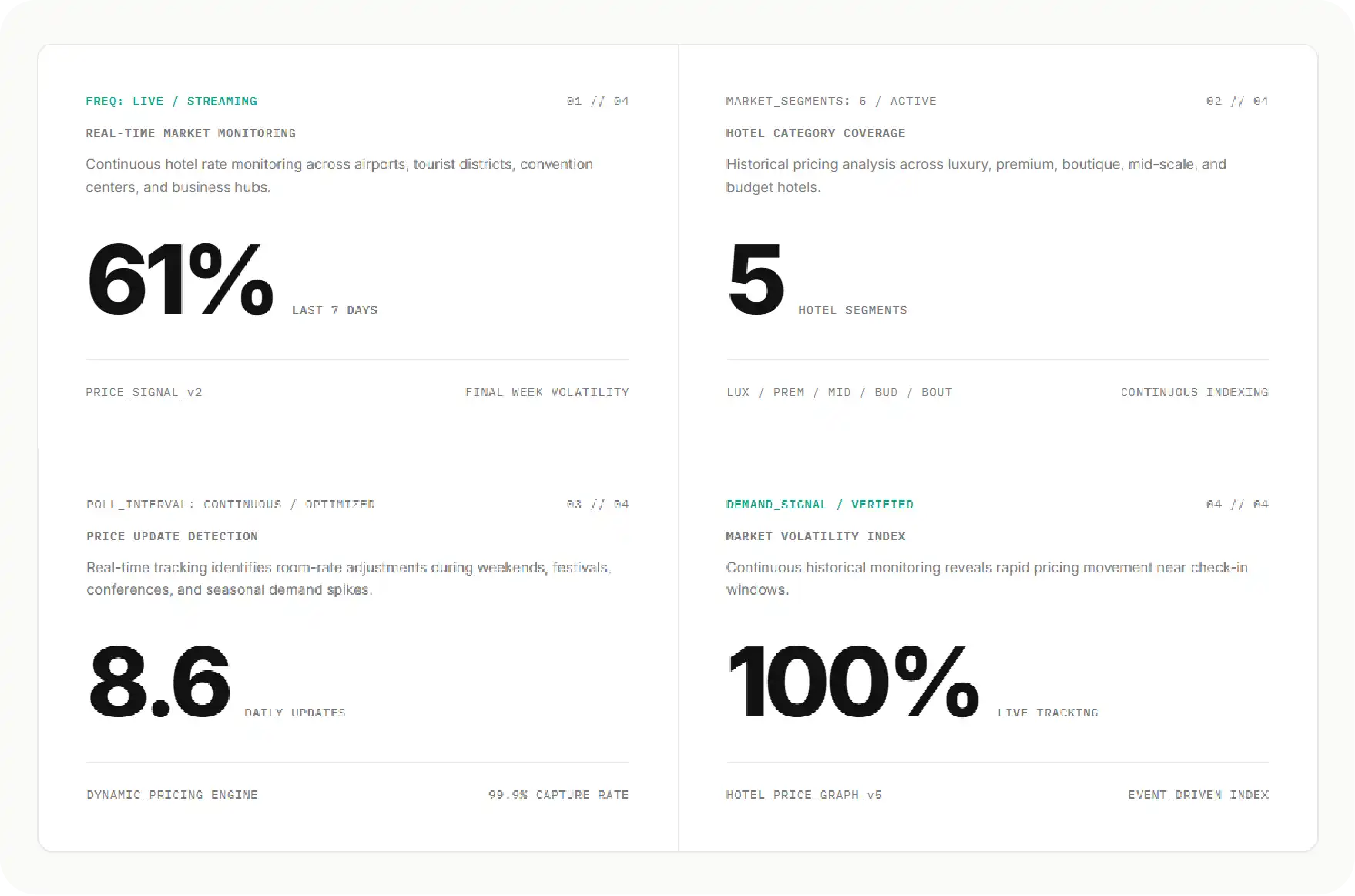
One of the most significant findings involved the frequency of hotel price changes across major destinations.
Historical analysis showed that premium hotels updated room rates far more frequently than economy properties, particularly during weekends, festivals, sporting events, conferences, and holiday seasons.
Hotels located near airports, convention centers, and tourist attractions demonstrated the highest pricing volatility because demand fluctuated rapidly throughout the booking cycle.
| Hotel Category | Average Daily Price Changes | Weekly Discount Campaigns | Key Insight |
|---|---|---|---|
| Luxury | 8.6 | 16 | Highest dynamic pricing activity |
| Premium | 6.8 | 13 | Strong competitor response |
| Mid-Scale | 5.3 | 9 | Stable weekday pricing |
| Budget | 3.9 | 6 | Lower volatility |
| Boutique | 7.1 | 11 | Event-driven demand spikes |
Historical comparisons revealed that approximately 61% of significant pricing movements occurred within the final seven days before check-in, highlighting the importance of continuous market monitoring.
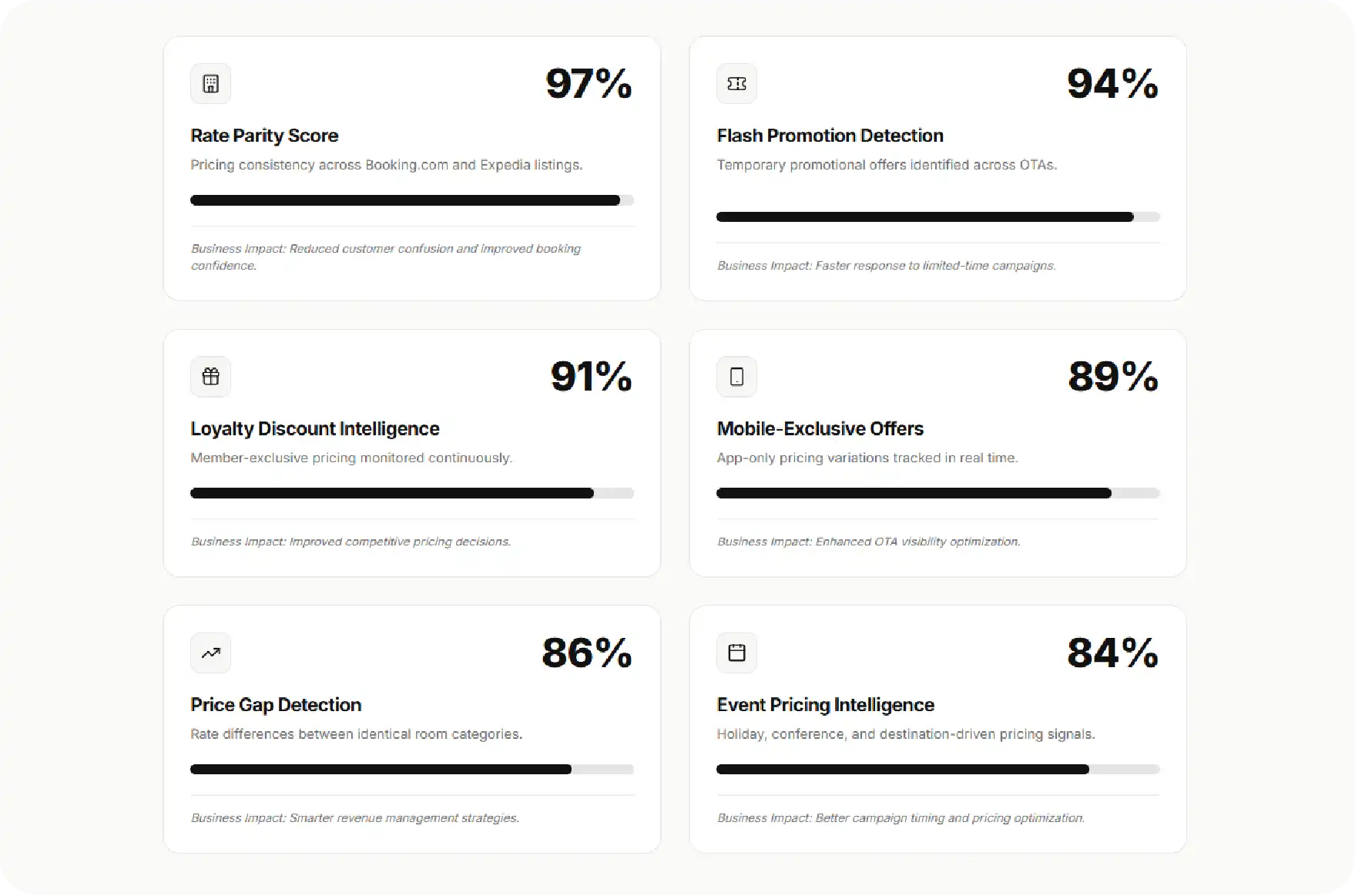
Another major outcome involved identifying pricing inconsistencies between Booking and Expedia listings.
Although hotels generally attempted to maintain consistent rates, temporary pricing differences frequently appeared due to flash promotions, loyalty discounts, regional campaigns, mobile-exclusive offers, and inventory adjustments.
The intelligence platform continuously compared identical room categories across OTAs, enabling analysts to detect pricing gaps before they influenced booking behavior.
Hotels maintaining strong rate parity generally experienced more stable booking patterns, while properties with inconsistent pricing often generated customer confusion and reduced conversion rates.
Historical analysis also showed that promotional intensity increased significantly during holiday periods and destination-specific events, creating opportunities for hotels to improve visibility through carefully timed campaigns.
The ability to monitor rate parity continuously helped revenue managers respond faster, improve pricing consistency, and strengthen competitive positioning across increasingly dynamic travel markets.
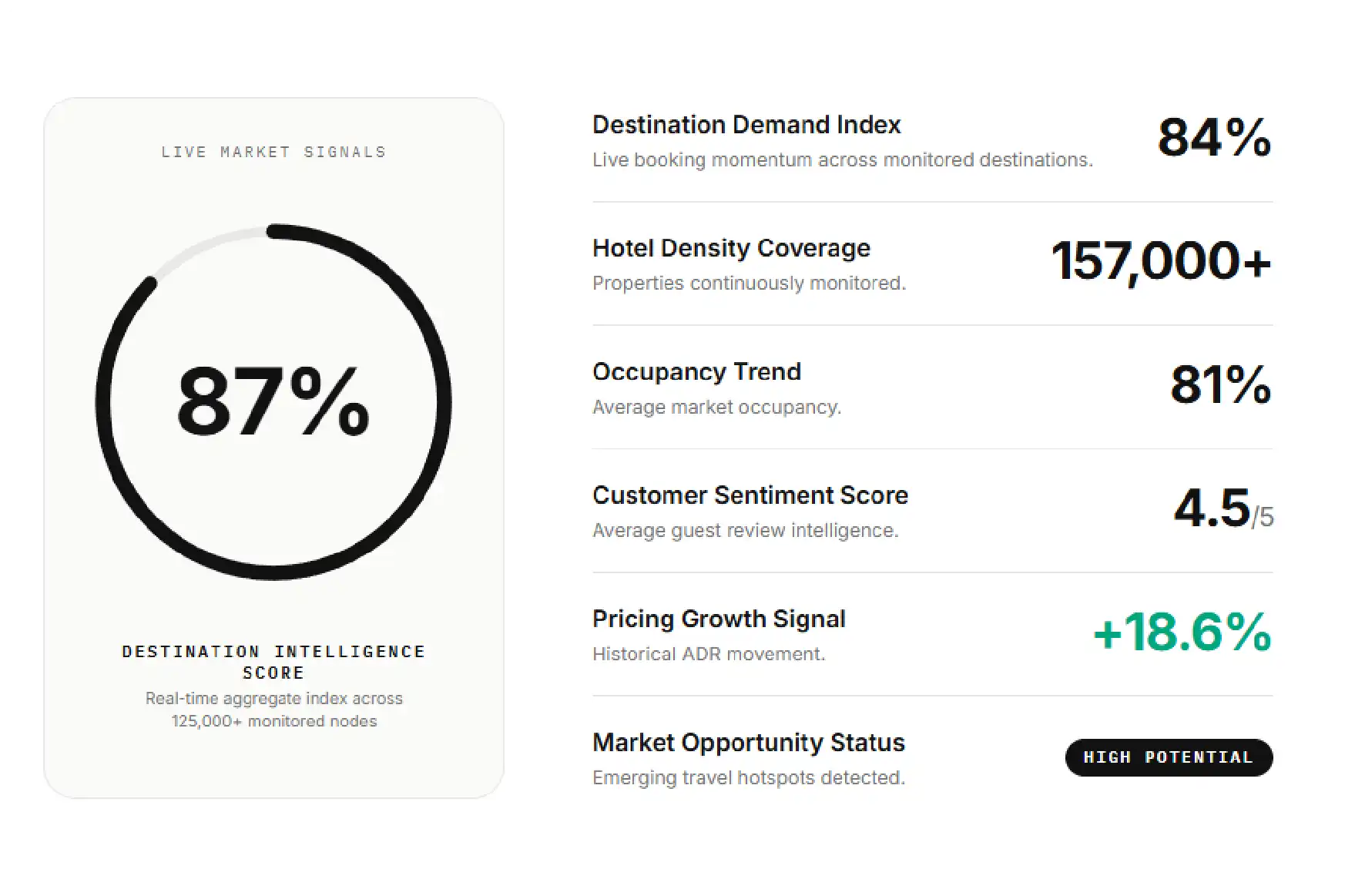
Beyond pricing intelligence, the project revealed important relationships between destination demand, hotel density, inventory availability, and guest sentiment. Historical monitoring showed that destinations with rapidly increasing booking activity often experienced reduced room availability and higher average daily rates several weeks before peak travel periods.
The analytical framework measured hotel concentration, review performance, occupancy indicators, and pricing movement together, allowing the client to understand why some destinations outperformed others despite having similar accommodation capacity.
One significant observation was that hotels maintaining consistently high guest ratings experienced lower pricing volatility than properties with mixed customer feedback. Positive reviews increased traveler confidence, allowing hotels to sustain premium pricing without relying heavily on promotional discounts.
The platform also identified emerging travel hotspots where hotel supply remained limited while booking demand continued increasing. These market gaps provided valuable opportunities for hotel groups, travel agencies, and hospitality investors planning future expansion.
| Destination Cluster | Hotels Monitored | Average Occupancy Trend | Average Review Score | Pricing Growth |
|---|---|---|---|---|
| Metropolitan Cities | 41,800 | 84% | 4.5/5 | +18.6% |
| Beach Destinations | 28,900 | 81% | 4.4/5 | +21.3% |
| Mountain Resorts | 19,600 | 78% | 4.6/5 | +17.8% |
| Business Districts | 34,700 | 86% | 4.3/5 | +16.4% |
| Heritage Locations | 33,000 | 75% | 4.5/5 | +19.2% |
The findings demonstrated that combining review intelligence with pricing and inventory data created a far more accurate picture of market competitiveness than monitoring room rates alone.
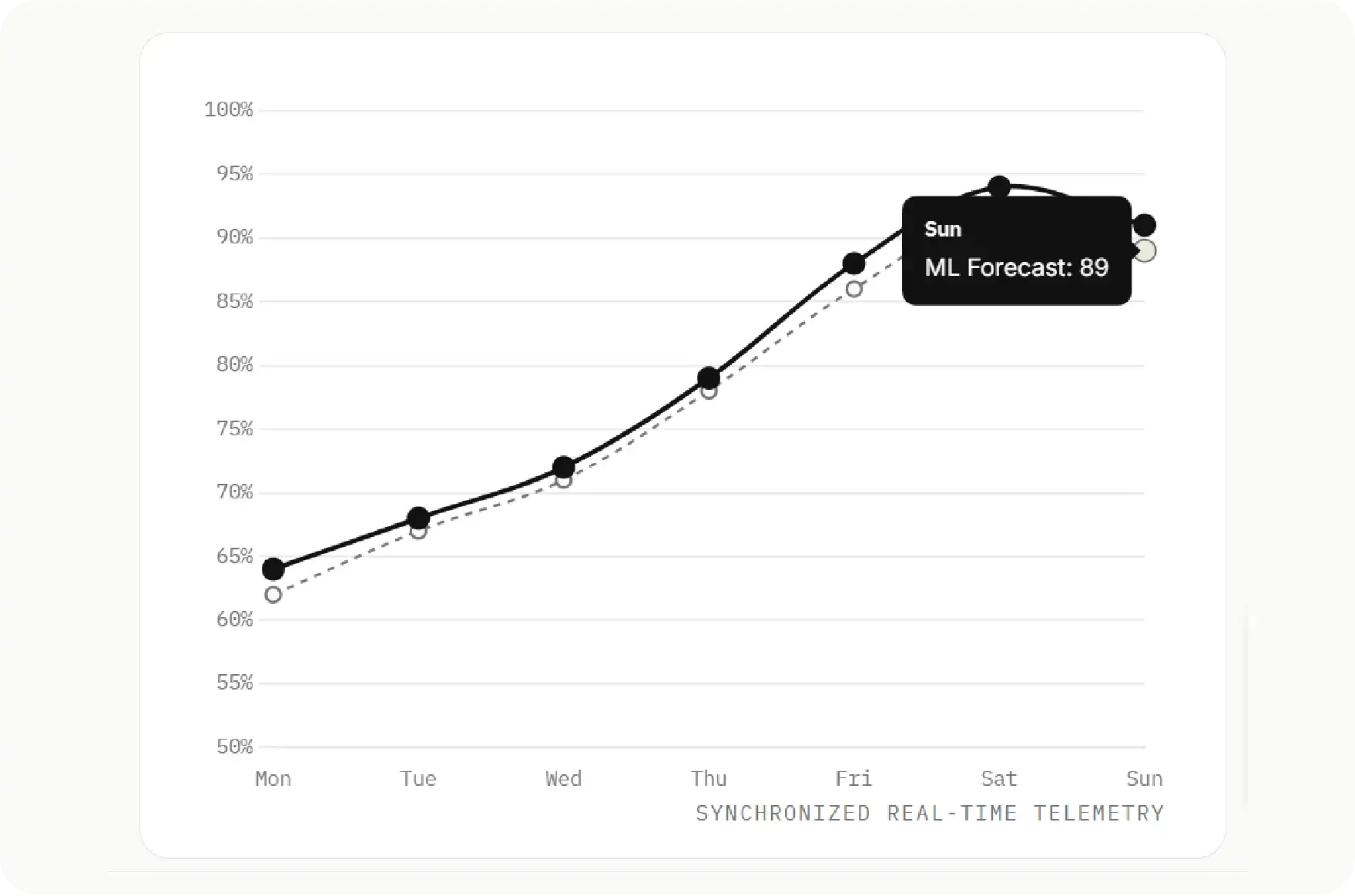
The final research finding highlighted the importance of preserving historical OTA datasets rather than relying only on current marketplace observations.
By maintaining continuous records of hotel pricing, inventory availability, guest reviews, and promotional activity, the organization identified recurring demand cycles associated with holidays, business conferences, airline schedule changes, festivals, and seasonal tourism.
Machine learning models analyzed historical observations to forecast pricing behavior before demand peaks occurred.
The platform successfully identified:
Instead of reacting to market changes after they affected revenue, stakeholders gained advance visibility into evolving travel patterns, enabling proactive pricing, inventory planning, and marketing decisions.
The following dataset illustrates the structured information generated by the automated intelligence platform.
| Hotel | City | OTA | Room Rate | Availability | Guest Rating | Reviews | Market Trend |
|---|---|---|---|---|---|---|---|
| Grand Skyline Hotel | Singapore | Booking | $218 | Available | 4.6 | 8,420 | Rising Demand |
| Marina Central Suites | Dubai | Expedia | $245 | Limited | 4.5 | 6,870 | High Occupancy |
| Ocean Breeze Resort | Bali | Booking | $182 | Available | 4.7 | 9,540 | Seasonal Growth |
| City Business Inn | London | Expedia | $196 | Available | 4.4 | 5,930 | Stable Market |
| Alpine View Lodge | Zurich | Booking | $271 | Limited | 4.8 | 4,860 | Premium Demand |
The structured dataset enabled analysts to compare hotel performance across destinations while identifying pricing opportunities, occupancy pressure, and customer satisfaction trends from a single intelligence platform.
The implementation of continuous OTA intelligence produced measurable improvements across pricing strategy, revenue optimization, and operational efficiency.
Major business outcomes included:
The project also improved collaboration between revenue managers, marketing teams, commercial analysts, and executive leadership by providing a unified source of travel intelligence for strategic planning.
Modern hospitality businesses require more than isolated pricing snapshots. They need continuous visibility into market behavior, traveler demand, competitor positioning, inventory availability, and customer sentiment.
Our travel intelligence framework transforms rapidly changing OTA information into structured, analytics-ready datasets that support pricing optimization, demand forecasting, revenue management, and investment planning.
By combining enterprise automation with advanced validation, historical intelligence, and scalable processing architecture, organizations gain reliable insights while significantly reducing manual effort.
The platform enables businesses to identify market gaps, monitor destination performance, understand customer behavior, and respond quickly to pricing changes occurring across global travel marketplaces.
"The intelligence platform fundamentally changed how we monitor hotel markets. Instead of relying on delayed reports, we now receive continuous insights into pricing movements, inventory availability, review performance, and competitor activity across thousands of properties. The historical datasets have significantly improved our forecasting capabilities and enabled faster commercial decisions. The solution has become an essential component of our revenue management and market intelligence strategy."
— Director of Global Travel Analytics
The project successfully established a fully automated hospitality intelligence ecosystem capable of monitoring hotel pricing, inventory availability, review sentiment, and destination performance across Booking and Expedia in real time.
The organization replaced fragmented manual monitoring with a scalable data platform that continuously collected, validated, and analyzed millions of OTA observations. Historical intelligence enabled stronger forecasting, while live dashboards improved operational visibility across pricing, occupancy, promotions, and competitive positioning.
As a result, the client achieved faster decision-making, improved pricing accuracy, better revenue optimization, enhanced destination analysis, and a stronger competitive advantage within an increasingly dynamic global travel marketplace.
The platform captures hotel names, room categories, prices, discounts, availability, guest ratings, reviews, amenities, cancellation policies, locations, and promotional offers for structured analysis.
Continuous monitoring detects pricing changes immediately, helping revenue managers respond faster to competitor activity, occupancy shifts, and promotional campaigns.
Yes. Historical pricing, inventory, and review datasets reveal recurring seasonal patterns that improve forecasting accuracy and revenue planning.
Yes. The architecture is designed to process millions of OTA observations daily while maintaining high accuracy and consistent performance across international destinations.
Hotel chains, online travel agencies, tourism boards, hospitality consultants, travel technology providers, and investment firms all benefit from structured OTA intelligence for pricing, benchmarking, and strategic planning.
Contact iWeb Data Scraping today to build scalable Booking.com and Expedia data solutions tailored to your business needs.
Start a projectFields marked * are required. Everything else just helps us scope faster — skip what you don't know yet.