
41.7K+
PRODUCT RECORDS PROCESSED

Retail Data Scraping from Boots UK delivers structured product, pricing, availability, ratings, and review insights for smarter retail decisions.
This case study presents a real-world retail intelligence scenario where an enterprise leveraged Retail Data Scraping from Boots UK to collect, structure, and analyze extensive product information from the Boots UK retail ecosystem. The solution transformed product catalog, pricing, availability, ratings, and category-level information into actionable datasets for competitive intelligence and retail analytics.
It is designed for:
The client's core challenge was the scale and frequency of Boots UK product changes. Product prices, promotional offers, stock status, ratings, and assortment information could change frequently, making manual monitoring inefficient. The objective was to establish a reliable automated data pipeline capable of continuously collecting retail intelligence and converting it into structured datasets for faster commercial decisions.
The project focused on building a scalable retail intelligence pipeline for extracting detailed product information from the Boots UK digital retail ecosystem. The solution captured Boots UK SKU-level product data extraction across categories, brands, product pages, pricing structures, promotional offers, and product attributes.
The system also supported Boots UK product availability monitoring, allowing the client to identify changes in stock status and product accessibility across monitored categories. Automated extraction pipelines collected product names, SKUs, prices, discounted prices, brands, categories, pack sizes, ratings, reviews, and availability information.
The resulting datasets enabled the client to compare retail pricing, monitor promotions, analyze assortment changes, and identify emerging product trends. Historical records further supported price movement analysis and competitive benchmarking across health and beauty categories.
The project ultimately transformed frequently changing retail information into a structured intelligence layer that supported pricing strategy, assortment planning, availability tracking, and data-driven e-commerce decisions.
The client needed to monitor a large and continuously changing retail catalog while maintaining reliable historical records of products, prices, promotions, and availability. Manual product tracking created substantial operational overhead and made frequent updates difficult to capture consistently.
One major challenge involved accessing and organizing information through Boots.com data extraction services, particularly when product pages contained different attributes, promotional structures, category relationships, and availability signals.
The client also required scalable eCommerce Data Scraping Services capable of handling thousands of product pages while maintaining standardized fields and consistent extraction logic.
Other challenges included:
The client therefore required an automated solution capable of collecting high-volume retail data, normalizing product records, validating extracted information, and delivering regularly refreshed datasets for analytics.
By implementing an automated Boots UK data collection framework, the client replaced manual product monitoring with a structured retail intelligence pipeline capable of continuously capturing product, pricing, promotional, availability, and customer feedback information.
| Dimension | Manual Retail Tracking | Client Data Scraping System |
|---|---|---|
| Data Collection | Manual browsing of selected Boots UK pages | Automated collection across monitored categories and product pages |
| Product Coverage | Limited to manually selected products | Scalable SKU-level product coverage |
| Price Monitoring | Periodic manual checks | Automated recurring price collection |
| Promotions | Manually recorded offers | Structured discount and promotion fields |
| Availability | Checked intermittently | Continuous product availability monitoring |
| Product Attributes | Manually copied into spreadsheets | Standardized product attributes and metadata |
| Reviews | Manual collection and sampling | Structured ratings and review datasets |
| Historical Analysis | Limited historical records | Time-series datasets for price and availability analysis |
| Data Accuracy | Higher risk of manual errors | Automated validation and normalization |
| Reporting | Spreadsheet-based reporting | Structured datasets supporting dashboards and analytics |
| Scalability | Difficult to expand | Designed for large product catalogs |
| Insight Speed | Delayed | Faster access to refreshed retail intelligence |
Boots UK is one of the UK's most recognizable health, beauty, pharmacy, and personal care retail brands, offering an extensive digital assortment spanning cosmetics, skincare, haircare, fragrance, wellness, toiletries, baby care, and other consumer categories.
For retail intelligence teams, such a broad digital catalog creates significant opportunities for analyzing product assortment, price positioning, promotional strategies, customer feedback, and product availability.
The client wanted to establish continuous visibility into this dynamic retail environment. Rather than relying on isolated manual observations, the organization required structured product datasets that could be refreshed regularly and integrated into its existing analytics workflows.
The resulting intelligence framework provided a consistent foundation for tracking product-level changes, identifying competitive pricing movements, analyzing category trends, and supporting strategic retail decisions.
We developed an end-to-end retail data extraction pipeline designed to collect, clean, standardize, and organize product information from the Boots UK digital retail environment.
The system captured product names, SKUs, brands, categories, product descriptions, pack sizes, regular prices, promotional prices, discounts, availability, ratings, reviews, product URLs, images, and other relevant attributes.
A dedicated Ecommerce Product Ratings and Review Dataset was incorporated into the solution to help the client analyze customer feedback, rating distributions, review volumes, and product-level perception.
The architecture also integrated eCommerce Data Intelligence capabilities to convert raw product records into structured analytical datasets. Data validation, deduplication, normalization, and field-level quality checks were applied before delivery.
Historical snapshots enabled the client to compare price changes over time, identify promotional patterns, monitor assortment movements, and analyze availability trends. The final dataset could be delivered in structured formats suitable for business intelligence platforms, analytics systems, databases, and machine learning workflows.
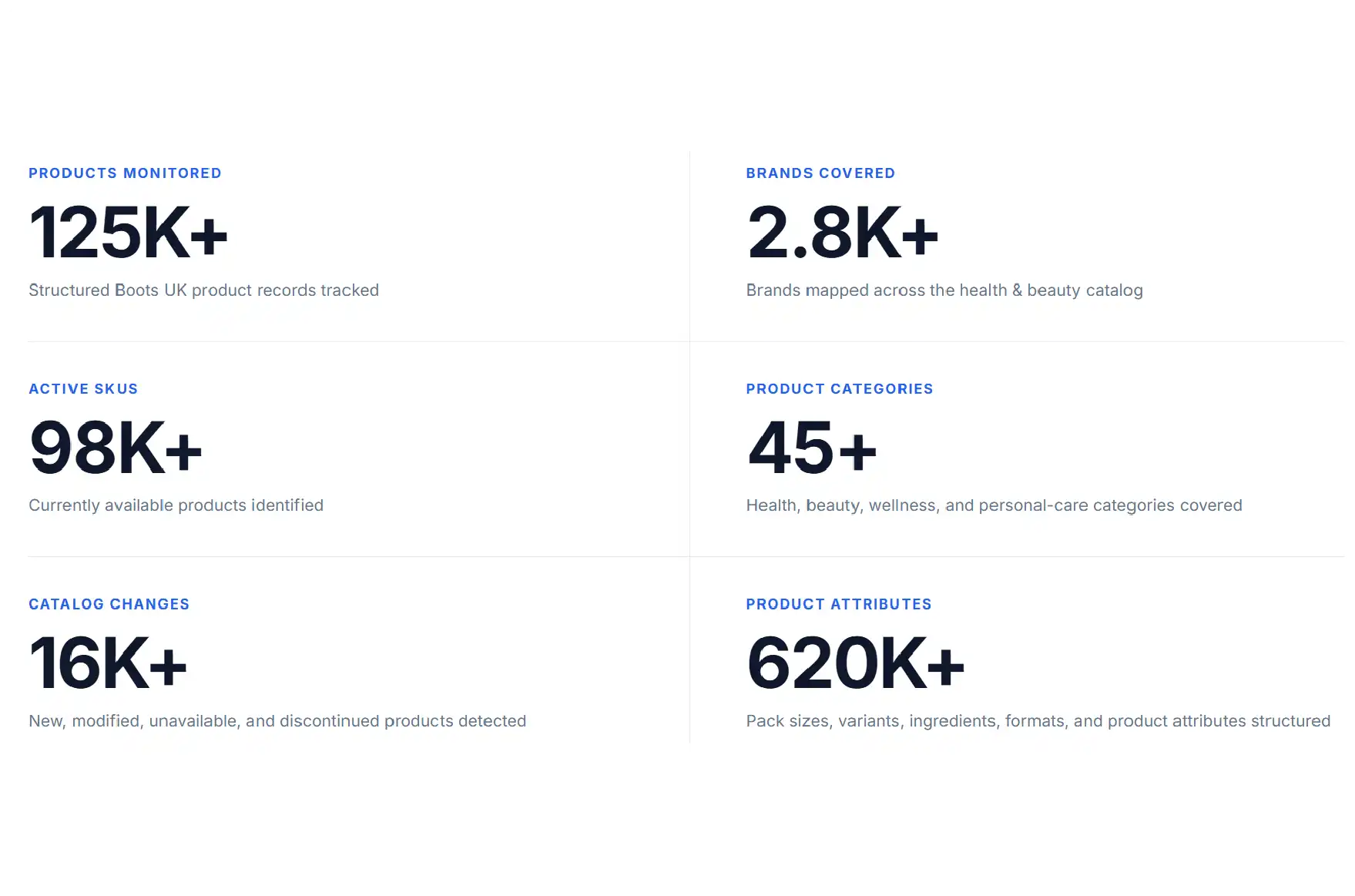
The automated extraction framework provided broader visibility into the Boots UK product catalog than manual monitoring could achieve. Product records were systematically organized according to categories, brands, SKUs, and product attributes.
This enabled analysts to understand assortment depth and identify newly introduced, modified, unavailable, or discontinued products more efficiently.
The structured catalog also created a reliable foundation for category-level analysis, allowing businesses to compare product counts, brand representation, pack sizes, and assortment changes across health and beauty segments.
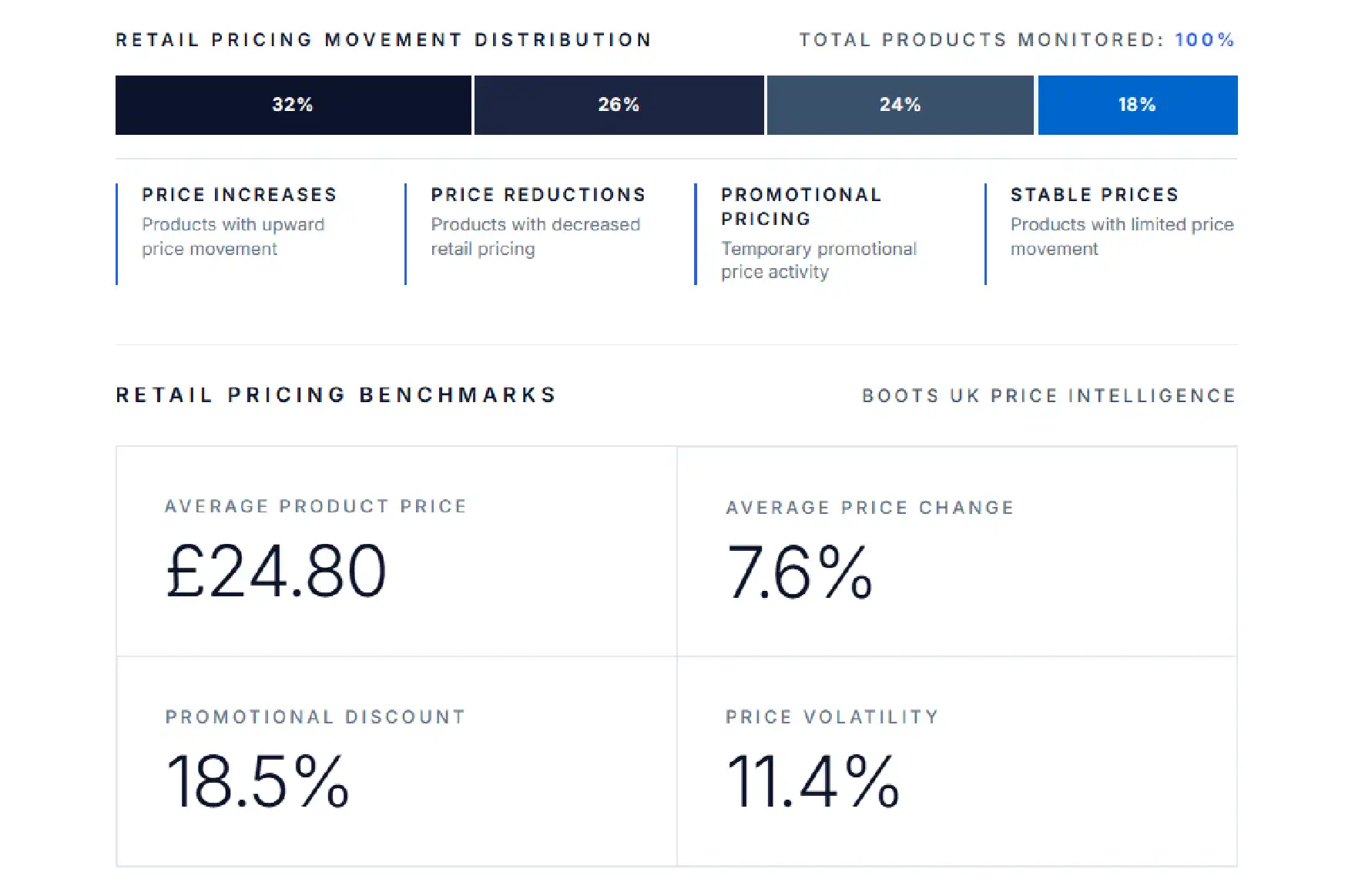
Automated collection of regular prices, promotional prices, and discount information enabled the client to monitor retail pricing changes at product level.
Historical observations made it possible to identify price increases, reductions, promotional cycles, and recurring discount patterns. This significantly improved the client's ability to understand market positioning and evaluate pricing movements across categories.
The resulting Boots UK retail pricing intelligence helped analysts identify competitive pricing opportunities and support more informed pricing and promotional decisions.
The system continuously captured product availability signals, allowing the client to identify products that moved between available and unavailable states.
This created greater visibility into potential stock disruptions and assortment changes. Availability data could also be analyzed alongside price and promotional information to identify relationships between discount activity, demand signals, and product accessibility.
| Metric | Insight Captured | Business Impact |
|---|---|---|
| Product Availability | Available, unavailable, or changing status | Improved stock visibility |
| Price Change | Previous and current price observations | Faster pricing analysis |
| Discount Rate | Promotional reduction percentage | Promotion benchmarking |
| SKU Coverage | Product-level records | Detailed assortment analysis |
| Category Count | Number of products by category | Assortment planning |
| Rating Score | Average customer rating | Product performance analysis |
| Review Volume | Number of customer reviews | Customer engagement assessment |
| Brand Presence | Product distribution by brand | Competitive assortment intelligence |
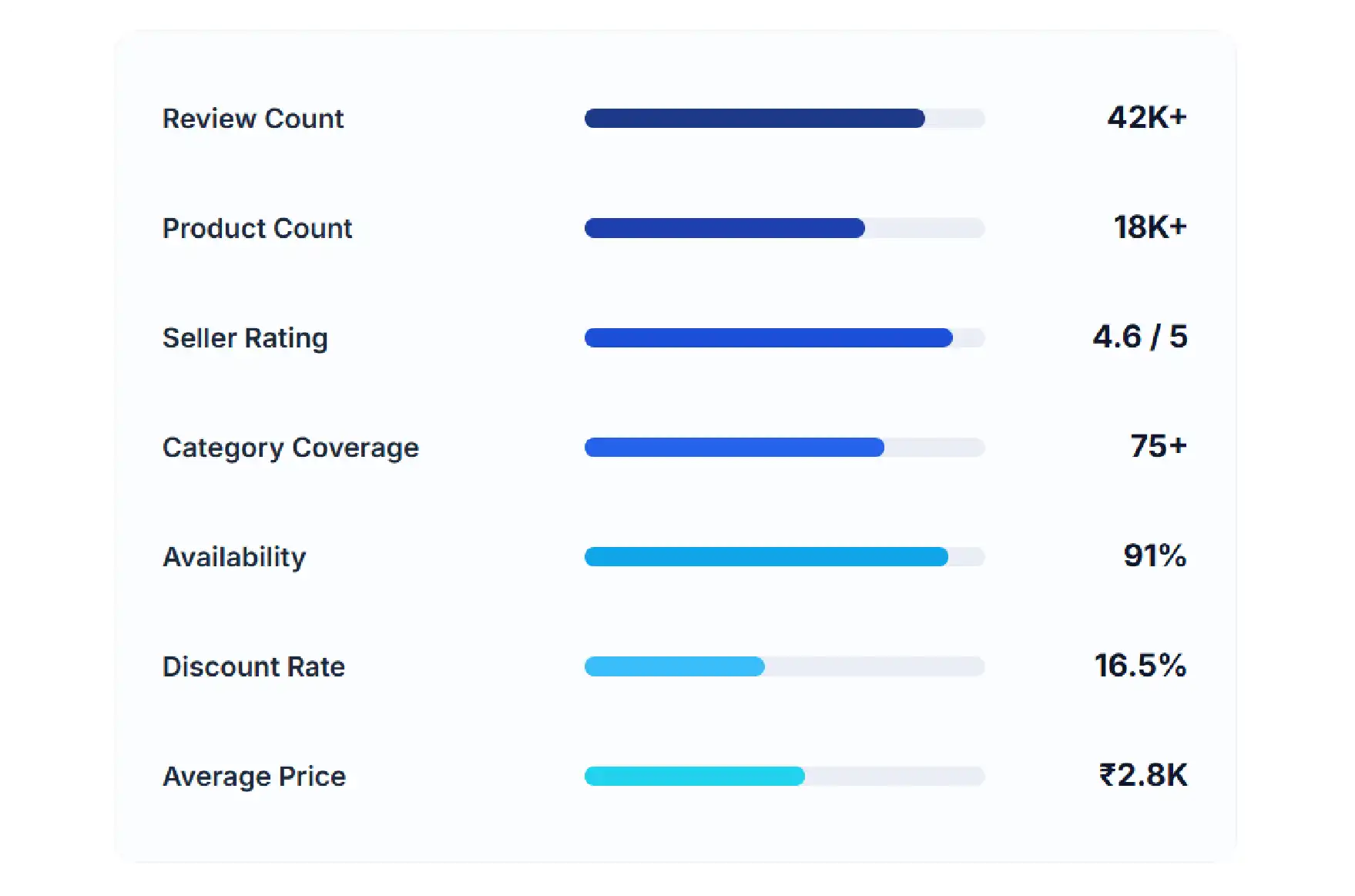
The integration of product ratings and reviews enabled the client to evaluate customer response alongside product and pricing information.
Analysts could identify products with strong ratings, high review volumes, and changing customer sentiment. Combining these signals with pricing and availability created a more comprehensive view of product performance.
This approach helped distinguish products receiving strong customer engagement from those requiring closer monitoring based on rating changes, review activity, or declining customer feedback.
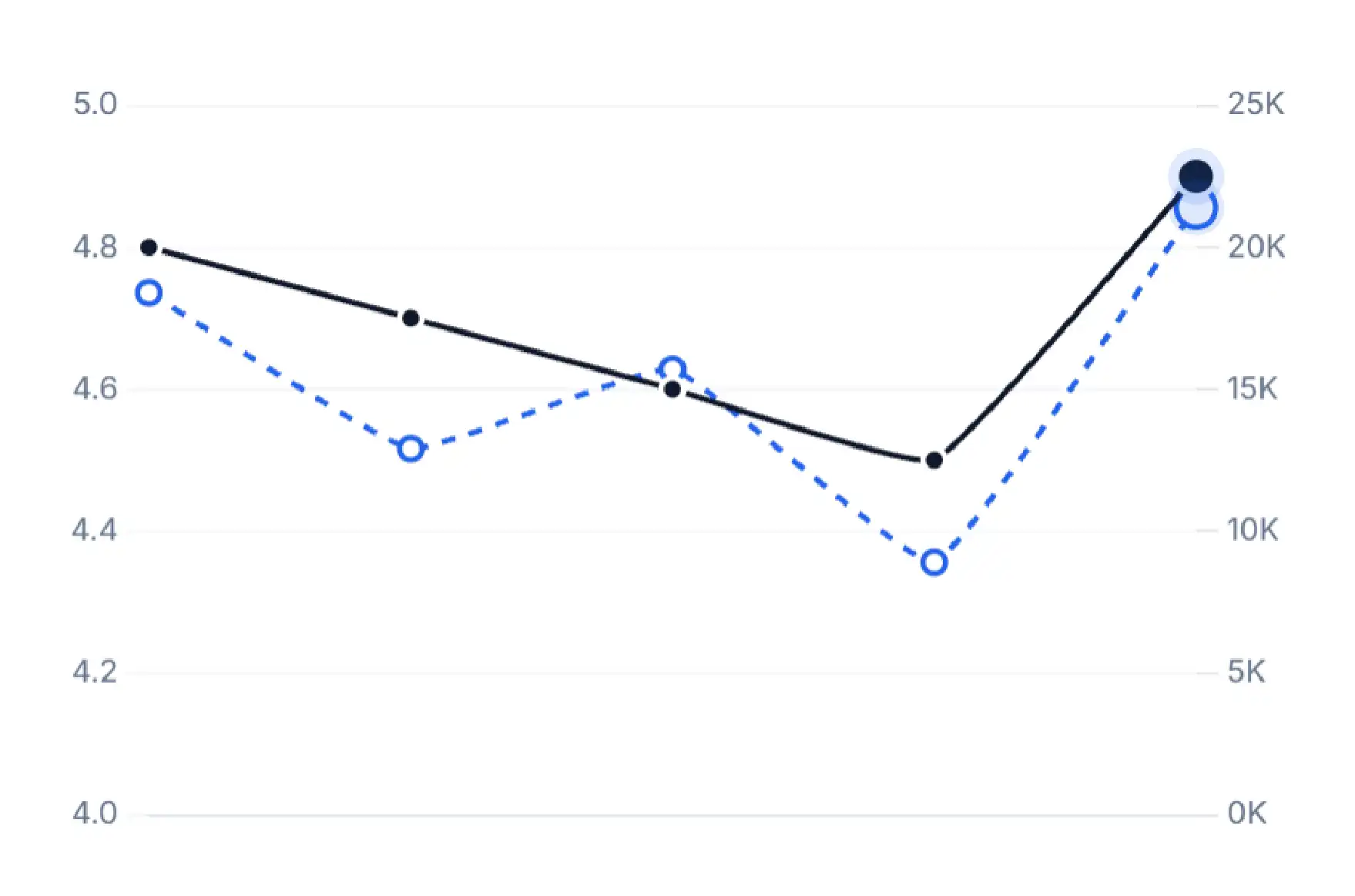
The automated framework provided the scalability required to monitor a large and evolving health and beauty retail assortment.
Instead of manually reviewing individual pages, the client could process structured product records through automated workflows. This improved operational efficiency while supporting recurring data refreshes and historical comparisons.
The scalable architecture also allowed additional product categories, fields, and analytical requirements to be incorporated as the client's retail intelligence needs expanded.
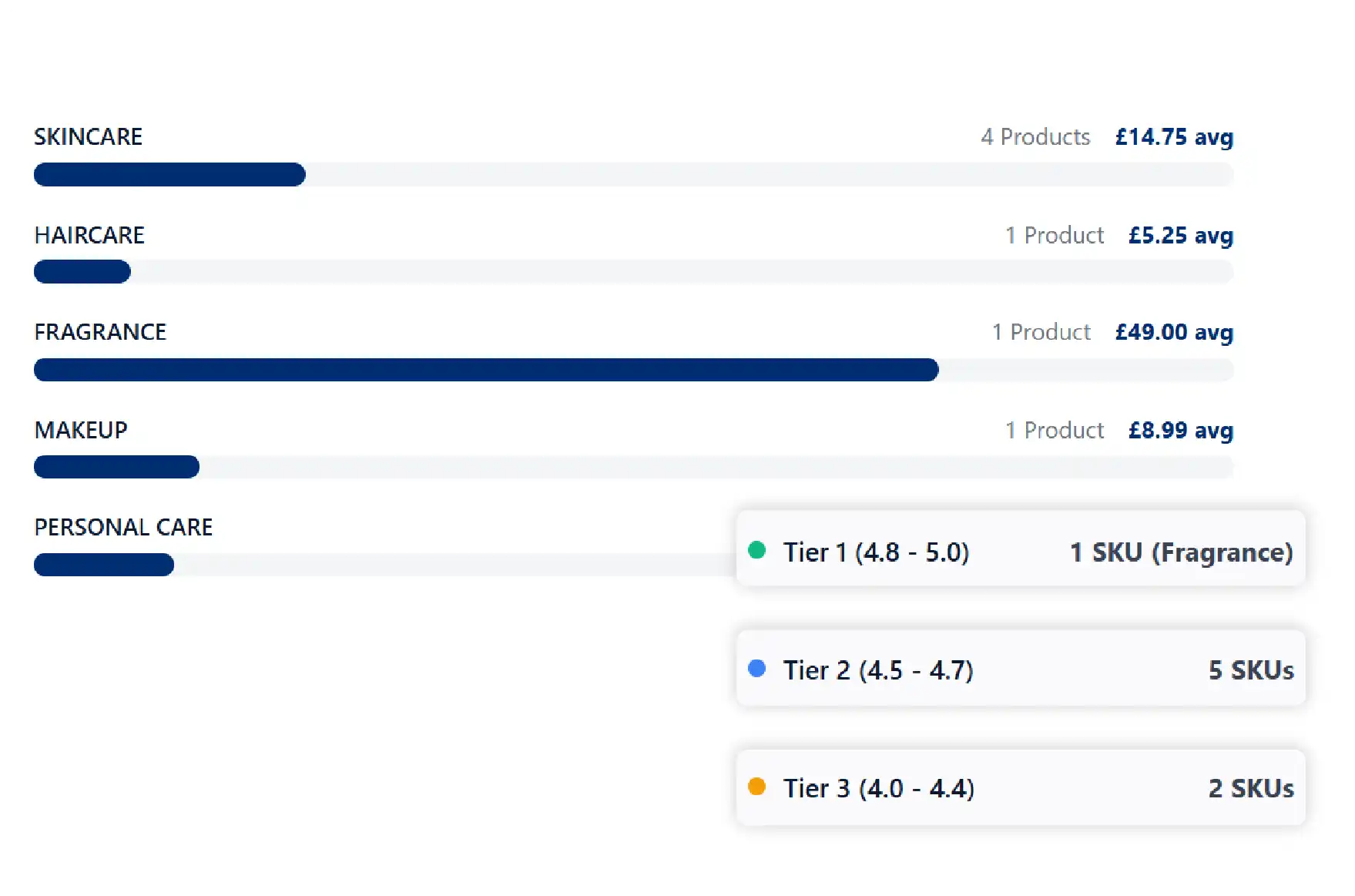
The sample dataset demonstrates how Boots UK retail information can be organized into a structured product intelligence format for pricing, availability, assortment, and customer feedback analysis.
| Product Name | Brand | Category | SKU | Regular Price | Sale Price | Discount | Availability | Rating | Reviews |
|---|---|---|---|---|---|---|---|---|---|
| Hydrating Facial Cleanser | CeraVe | Skincare | SKU10021 | £12.50 | £9.99 | 20.1% | In Stock | 4.7 | 2,845 |
| Vitamin C Serum | No7 | Skincare | SKU10035 | £24.00 | £18.00 | 25.0% | In Stock | 4.6 | 1,932 |
| Moisturising Cream | E45 | Skincare | SKU10048 | £8.50 | £6.80 | 20.0% | In Stock | 4.5 | 1,176 |
| Shampoo 400ml | L'Oréal | Haircare | SKU10063 | £7.00 | £5.25 | 25.0% | In Stock | 4.4 | 986 |
| Eau de Parfum | Hugo Boss | Fragrance | SKU10079 | £65.00 | £49.00 | 24.6% | Limited Stock | 4.8 | 3,214 |
| Daily Moisturiser | Olay | Skincare | SKU10094 | £15.00 | £11.25 | 25.0% | In Stock | 4.6 | 1,524 |
| Mascara | Maybelline | Makeup | SKU10108 | £11.99 | £8.99 | 25.0% | In Stock | 4.5 | 2,105 |
| Body Wash | Aveeno | Personal Care | SKU10125 | £9.50 | £7.60 | 20.0% | Out of Stock | 4.7 | 1,346 |
After implementing the structured Boots UK retail data scraping framework, the client gained faster access to product, pricing, availability, and customer feedback intelligence.
Our approach combines automated extraction, structured data processing, validation, and scalable infrastructure to transform dynamic retail information into business-ready datasets.
The solution reduces manual research requirements by continuously collecting product information and organizing it into standardized fields. This creates consistent records that can be used across pricing analysis, assortment planning, market research, competitive intelligence, and reporting workflows.
Our data pipelines also support historical tracking, enabling businesses to compare product prices, availability, discounts, and customer feedback across multiple collection periods. This historical perspective makes it easier to recognize recurring patterns and evaluate retail changes over time.
Another advantage is scalability. As the number of monitored products and categories increases, automated infrastructure can expand processing capacity without requiring proportional increases in manual effort.
The solution also prioritizes data quality through validation, normalization, duplicate removal, and structured formatting. This helps ensure that analytical teams receive dependable information suitable for dashboards, databases, forecasting systems, and advanced analytics.
We are extremely pleased with the retail intelligence solution delivered by the team. The project gave us a much clearer view of product pricing, availability, assortment changes, and customer feedback across the Boots UK ecosystem. Previously, collecting this information required considerable manual effort and provided only limited historical visibility. The automated system significantly improved the speed and consistency of our data collection while making product-level analysis much easier. The structured datasets have strengthened our competitive intelligence capabilities and helped our teams make faster, more informed pricing and assortment decisions.
—Head of Retail Intelligence
The final outcome was a scalable retail intelligence infrastructure capable of continuously transforming Boots UK product information into structured, analysis-ready datasets.
The client achieved improved visibility into product assortment, SKU-level pricing, promotional activity, availability, ratings, and customer reviews. Automated data collection significantly reduced manual monitoring requirements while improving consistency across recurring data updates.
Implementation of Web Scraping API Services enabled the organization to integrate continuously refreshed retail datasets into downstream analytics, dashboards, databases, and decision-support systems.
The structured historical dataset also enabled price movement analysis, promotion tracking, availability comparisons, and product performance evaluation over time.
Deployment of Web Scraping Services further provided the scalable infrastructure needed to accommodate expanding product coverage, additional categories, and evolving retail intelligence requirements.
Overall, the project established a reliable data foundation for competitive pricing analysis, assortment optimization, product monitoring, customer intelligence, and data-driven retail strategy.
A retail scraping solution can collect product names, SKUs, brands, categories, descriptions, prices, sale prices, discounts, availability, ratings, reviews, images, product URLs, and other relevant product attributes.
Yes. Recurring data collection can create historical price records that help businesses analyze price increases, reductions, promotional cycles, and other retail pricing movements.
Yes. Automated monitoring can capture changes in product availability, helping businesses identify products that become available, unavailable, or limited in stock during different collection periods.
Yes. Product-level ratings and review information can be structured alongside product, pricing, and availability fields to support customer feedback and product performance analysis.
Structured Boots UK retail data can support competitive pricing analysis, assortment benchmarking, promotional intelligence, product performance analysis, availability monitoring, market research, and retail strategy development.
Get accurate, scalable product data tailored to your business needs today.
Start a projectFields marked * are required. Everything else just helps us scope faster — skip what you don't know yet.