

Introduction
Grocery shopping is rapidly moving from physical aisles to intelligent digital experiences. Consumers now expect grocery applications to provide accurate product information, competitive prices, current availability, personalized recommendations, convenient search, and seamless shopping journeys. Behind these features lies one critical requirement: reliable and continuously updated grocery data.
Businesses developing grocery applications can use structured Esselunga data to build powerful shopping experiences around product discovery, pricing, promotions, availability, categories, and assortment intelligence. Instead of manually maintaining thousands of grocery records, developers can establish automated data pipelines that continuously collect, process, normalize, and deliver relevant information to their applications.
If your objective is to Build Grocery Shopping Apps Using the Esselunga API, the first step is understanding how product information can become a reliable application-ready data layer.
Why Use Esselunga Data for Grocery Applications?
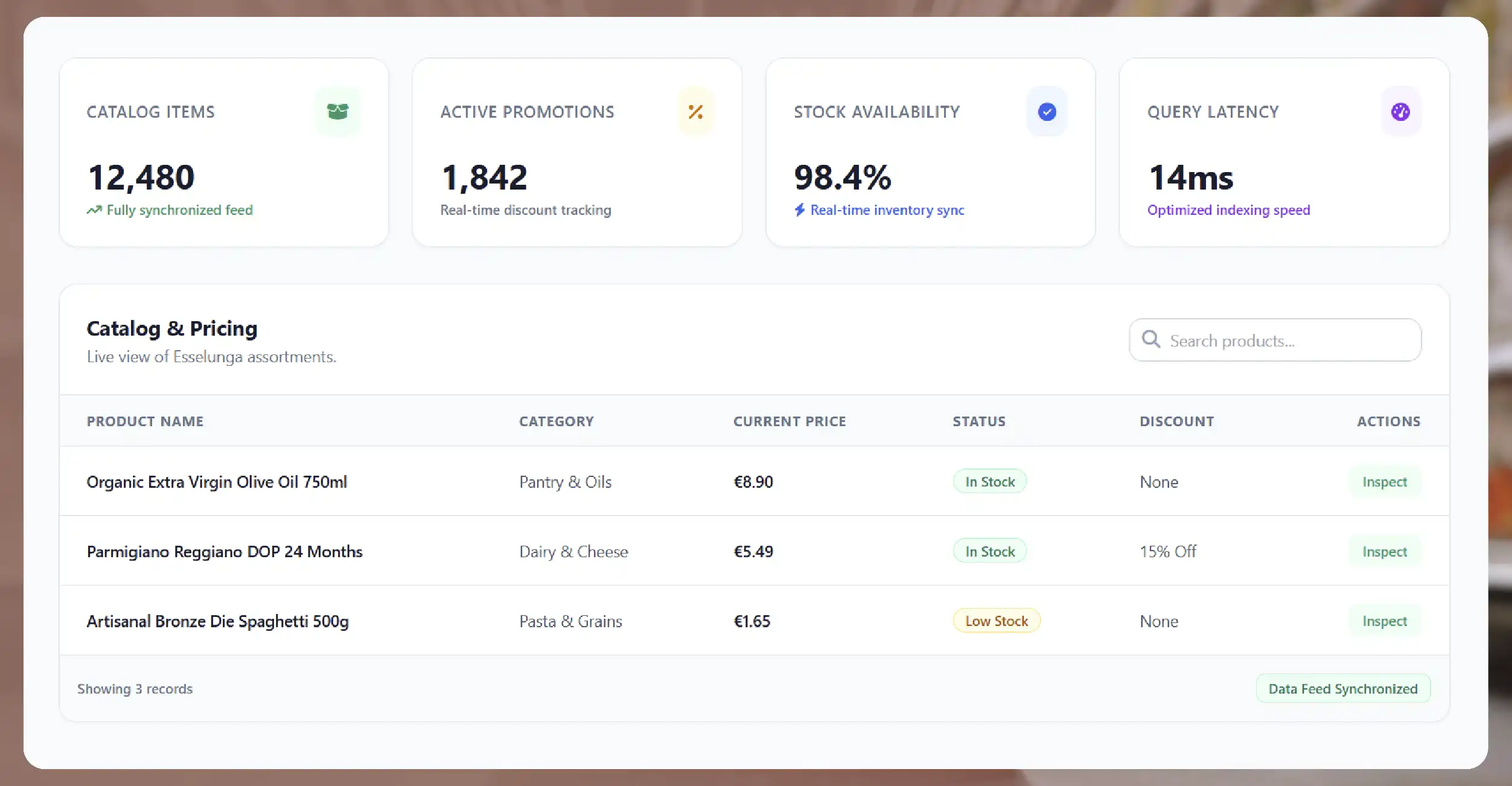
A modern grocery application needs more than static product names and images. Shoppers want to know what a product costs, whether it is available, what category it belongs to, whether it is discounted, and how it compares with alternatives.
Esselunga's broad grocery assortment provides valuable information that can support these requirements. Developers can create applications that transform grocery catalog information into searchable product databases, recommendation engines, pricing tools, and shopping assistants.
The objective is not simply to collect information. It is to turn constantly changing grocery information into structured intelligence that can improve both customer experience and business decision-making.
Creating a Complete Grocery Product Database
The foundation of any grocery shopping application is its product database. When businesses extract Esselunga grocery product data using API, they can organize available product information into structured records that application developers can consume efficiently.
Depending on the accessible and permitted data fields, records may include product name, brand, category, subcategory, product identifier, description, package size, image, price, promotional price, and availability.
Once collected, the information should be normalized. Different products may use different naming conventions, measurement units, or category structures. Standardization makes the resulting database easier to search, compare, analyze, and update.
A clean database also helps developers avoid duplicate records and ensures that changes to products can be tracked systematically.
Tracking Grocery Pricing and Availability
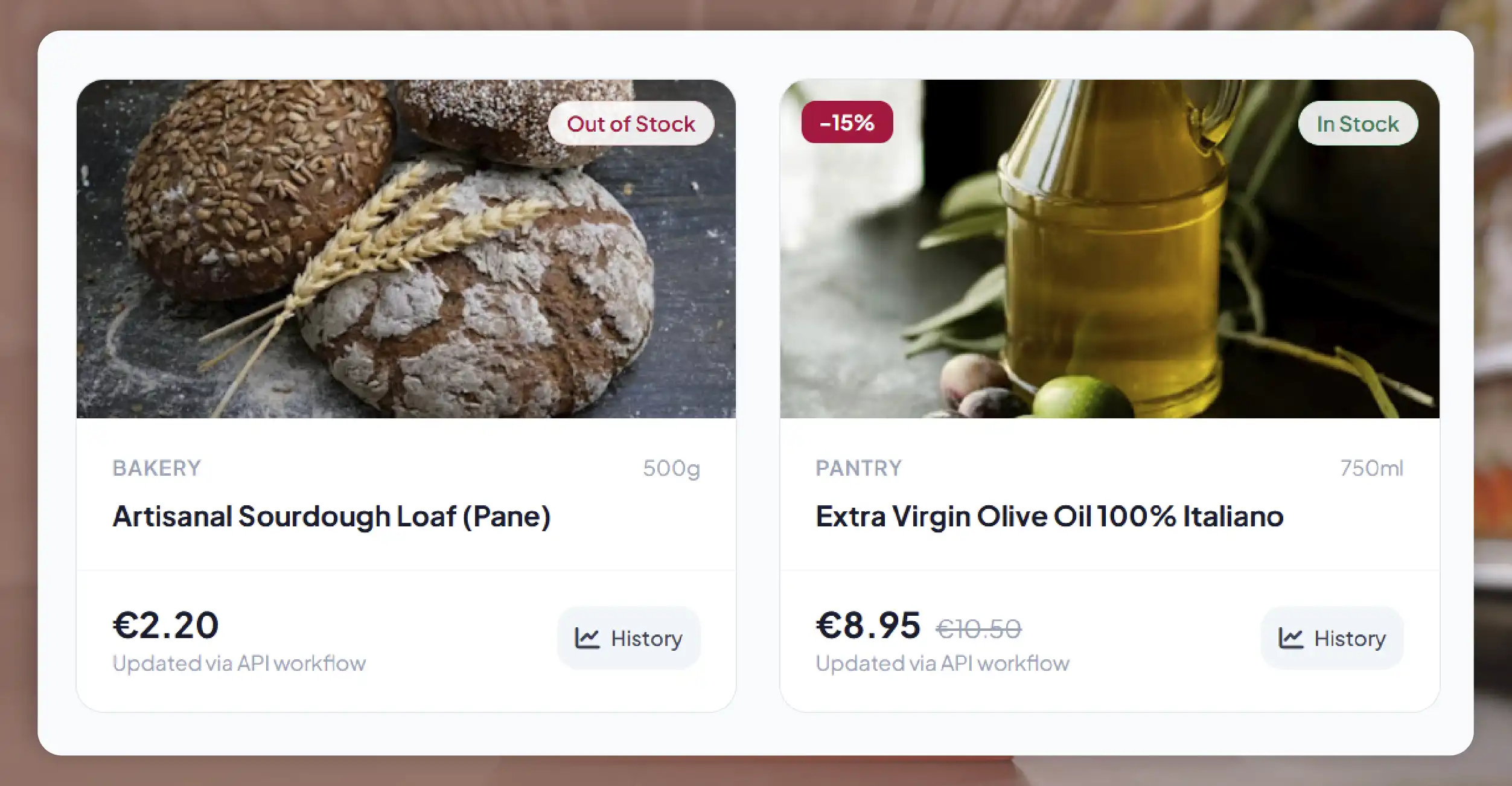
Price and availability are among the most important data points in a grocery application. A customer may find a preferred product through search, but the shopping experience becomes frustrating if its price or availability is outdated.
Businesses looking to Extract Esselunga product pricing and availability API data can create workflows that regularly capture permitted pricing and availability information. These updates can then power product pages, shopping lists, alerts, comparison features, and analytics dashboards.
Historical snapshots add another layer of value. Instead of storing only the latest price, businesses can maintain previous observations to identify price increases, discounts, promotional cycles, and recurring availability changes.
This historical perspective is particularly useful for grocery analytics because prices and inventory conditions can change frequently.
Building a Searchable Esselunga Grocery Catalog
A grocery application should make it easy for customers to find exactly what they need. A shopper searching for pasta, coffee, vegetables, baby products, beverages, or household supplies should be able to quickly filter thousands of products.
With Esselunga grocery catalog data scraping, developers can create structured datasets that support product search, category browsing, brand filtering, price-range selection, promotion filters, and availability-based discovery.
For example, users could filter products by brand, package size, price range, category, or promotional status. A well-organized catalog can also support autocomplete and keyword suggestions.
Product normalization makes these features more powerful because similar products can be grouped even when their descriptions are formatted differently.
Connecting Grocery Data With a Shopping Application
Collecting data is only one part of the process. The next challenge is connecting structured grocery information with the application itself.
A Web Scraping Esselunga API for Grocery Shopping App workflow can be designed around separate data collection, processing, storage, and application layers. This architecture makes the system easier to maintain and scale.
The collection layer obtains permitted data. The processing layer validates and normalizes it. The database stores current and historical information. Finally, an application API delivers the relevant records to the website or mobile application.
This separation prevents the front end from becoming dependent on raw source responses and allows developers to introduce additional retailers or data sources later.
Supporting Personalized Grocery Recommendations
Personalization can make grocery applications substantially more useful. Instead of presenting every shopper with the same products, an application can recommend items based on shopping history, product categories, price preferences, and purchasing patterns.
Businesses can Scrape Grocery Shopping Apps with Esselunga API workflows to create structured product datasets that feed recommendation systems.
For example, if a customer frequently purchases pasta, sauces, cheese, and vegetables, the application can identify complementary products. Similarly, customers who consistently purchase discounted products can receive recommendations focused on promotions.
Product data can therefore become the foundation for personalized shopping lists, frequently purchased product sections, complementary-product recommendations, and customized promotions.
Developing Grocery Price Comparison Features
Price comparison is another powerful application of structured grocery data. Consumers increasingly want to know whether they are receiving good value, particularly when grocery prices fluctuate.
A comparison engine can analyze products by brand, package size, unit price, promotional status, and product type. This is important because comparing two displayed prices without considering package size can produce misleading conclusions.
For example, a 500-gram product priced at €3 cannot be directly compared with a 1-kilogram product priced at €5 without calculating the cost per kilogram.
A properly normalized grocery dataset can make these comparisons more meaningful and support price alerts, deal discovery, and historical pricing dashboards.
Monitoring Promotions and Discounts
Grocery promotions can significantly influence purchasing behavior. Temporary discounts, multi-buy offers, and promotional pricing can change the perceived value of products and influence customer decisions.
Automated grocery data collection can identify changes between regular and promotional prices where such information is available. Applications can then create sections such as "Today's Deals," "Price Drops," "Popular Promotions," or "Products on Offer."
Historical promotion records can also help businesses understand which categories receive frequent discounts and how promotional activity changes over time.
This information can benefit not only shoppers but also brands, retailers, analysts, and market researchers evaluating competitive pricing strategies.
Supporting Stock and Availability Intelligence
A grocery application should ideally provide customers with accurate information about whether products can be purchased. Availability monitoring can reduce the frustration associated with discovering unavailable items after adding them to a basket.
Regular data updates can help identify products that move from available to unavailable and back again. Historical records can reveal recurring patterns by product, category, store, or time period where the underlying data supports such analysis.
Businesses can also use these insights to identify assortment gaps and understand which products may require greater inventory attention.
Building a Scalable Grocery Data Pipeline
A successful grocery application needs a data pipeline capable of handling continuous changes. Product catalogs are not static databases. Names, prices, promotions, images, categories, and availability can change.
A robust pipeline should therefore include automated collection, validation, deduplication, normalization, timestamping, historical storage, error handling, and monitoring.
For larger projects, cloud infrastructure and distributed processing can help manage high-volume datasets. Structured formats such as JSON, CSV, or database tables can make information easier to transfer between systems.
Caching can also improve application performance by preventing unnecessary repeated requests for information that has not changed.
Grocery Data Scraping for Market Intelligence
The value of grocery information extends beyond consumer applications. Businesses can use historical datasets to understand market movements, pricing behavior, assortment changes, and promotional strategies.
Grocery data scraping can support dashboards that track product pricing, availability, promotions, categories, and other grocery indicators over time.
For example, a market intelligence platform could identify categories experiencing frequent price changes. A brand could monitor how its products appear within a grocery assortment. A meal-planning application could use product prices to estimate basket costs.
When structured correctly, the same underlying data can serve multiple business functions.
Ensuring Responsible and Reliable Data Collection
Any grocery data project should be designed around permitted access methods, applicable API documentation, usage restrictions, request limits, authentication requirements, and relevant legal obligations.
Developers should avoid assuming that information visible through a website or application can automatically be collected or redistributed without restrictions.
API credentials should be protected, request volumes should be controlled, and data should be stored securely. Monitoring systems should also detect failed requests, missing fields, schema changes, and unexpected values.
A responsible approach helps create a more sustainable data pipeline while reducing operational and compliance risks.
How iWeb Data Scraping Can Help You?
Scalable Grocery Data Collection
iWeb Data Scraping builds scalable pipelines for permitted grocery information, transforming large product catalogs into structured datasets suitable for applications, analytics platforms, dashboards, and automated intelligence workflows.
Product Data Normalization
Our data processing workflows standardize product names, categories, brands, package sizes, prices, identifiers, and availability fields, helping applications deliver consistent search, comparison, recommendation, and analytics experiences.
Automated Price Monitoring
iWeb Data Scraping supports scheduled price collection, historical tracking, promotion monitoring, and structured reporting, helping businesses identify grocery price changes and evaluate competitive movements across relevant product categories.
Availability Monitoring
Our solutions organize permitted availability signals into historical datasets, enabling businesses to monitor recurring shortages, product availability changes, assortment gaps, and inventory fluctuations across selected grocery categories.
Integration-Ready Data Delivery
iWeb Data Scraping delivers processed grocery datasets through integration-ready workflows, helping developers connect structured product intelligence with mobile applications, websites, dashboards, databases, analytics platforms, and recommendation engines.
Conclusion
Building a successful grocery shopping application requires much more than displaying products on a mobile screen. The real competitive advantage comes from creating a dependable data ecosystem that continuously transforms grocery information into useful customer experiences and actionable business intelligence.
Modern applications can use Stock-out and availability tracking to understand recurring product shortages, identify changing inventory patterns, and improve shopping reliability. At the same time, Market trend and demand intelligence can reveal changing consumer preferences, popular categories, promotional movements, pricing trends, and potential assortment opportunities.
A properly designed scraping API can connect structured grocery intelligence with applications, analytics systems, recommendation engines, price trackers, and monitoring dashboards. When supported by normalization, validation, historical storage, automation, and responsible data-access practices, Esselunga grocery information can become a valuable foundation for digital grocery innovation.
For businesses looking to develop scalable grocery technology, combining API-based data access with Managed web scraping can provide the consistency and flexibility needed to keep product intelligence current. The result is a stronger grocery application, better customer experiences, and richer intelligence for business teams.
FAQs
Depending on accessible and permitted data fields, an application may use product names, categories, brands, descriptions, identifiers, package sizes, images, prices, promotions, and availability information.
Yes. Where current pricing information is accessible and permitted for use, scheduled data collection can support current price displays, historical price tracking, promotional monitoring, and price-change alerts.
Normalization creates consistent product records by standardizing names, categories, brands, package sizes, prices, and identifiers. This improves search, filtering, comparison, recommendations, and analytics accuracy.
Availability information can help customers identify purchasable products while enabling businesses to monitor recurring stock issues, product availability changes, and assortment gaps through historical analysis.
Yes. iWeb Data Scraping can support permitted data collection, extraction, normalization, validation, historical storage, monitoring, and integration-ready grocery datasets for applications, dashboards, and business intelligence systems.