

Introduction
The real estate technology landscape is becoming increasingly data-driven. Renters expect accurate apartment information, property managers need better market visibility, and real estate platforms require continuously updated listings to deliver useful search experiences. This makes structured rental data an important foundation for modern applications.
Build Real Estate Applications with the Apartment List API to create smarter property discovery platforms, rental comparison tools, market intelligence dashboards, and location-based housing applications. With structured apartment information, developers can connect property details, pricing, amenities, availability, and location attributes into applications that help users make faster rental decisions.
Scrape Apartment List API for real estate applications when your project requires organized rental information at scale. Instead of depending on manually collected listings, developers can build automated pipelines that gather relevant apartment information and transform it into application-ready datasets.
Extract real estate application using apartment listing data to support features such as property search, neighborhood comparison, rental price analysis, availability monitoring, and personalized recommendations. When refreshed regularly, this information can become the foundation for a dynamic real estate intelligence ecosystem.
Why Apartment Data Matters for Modern Real Estate Applications?
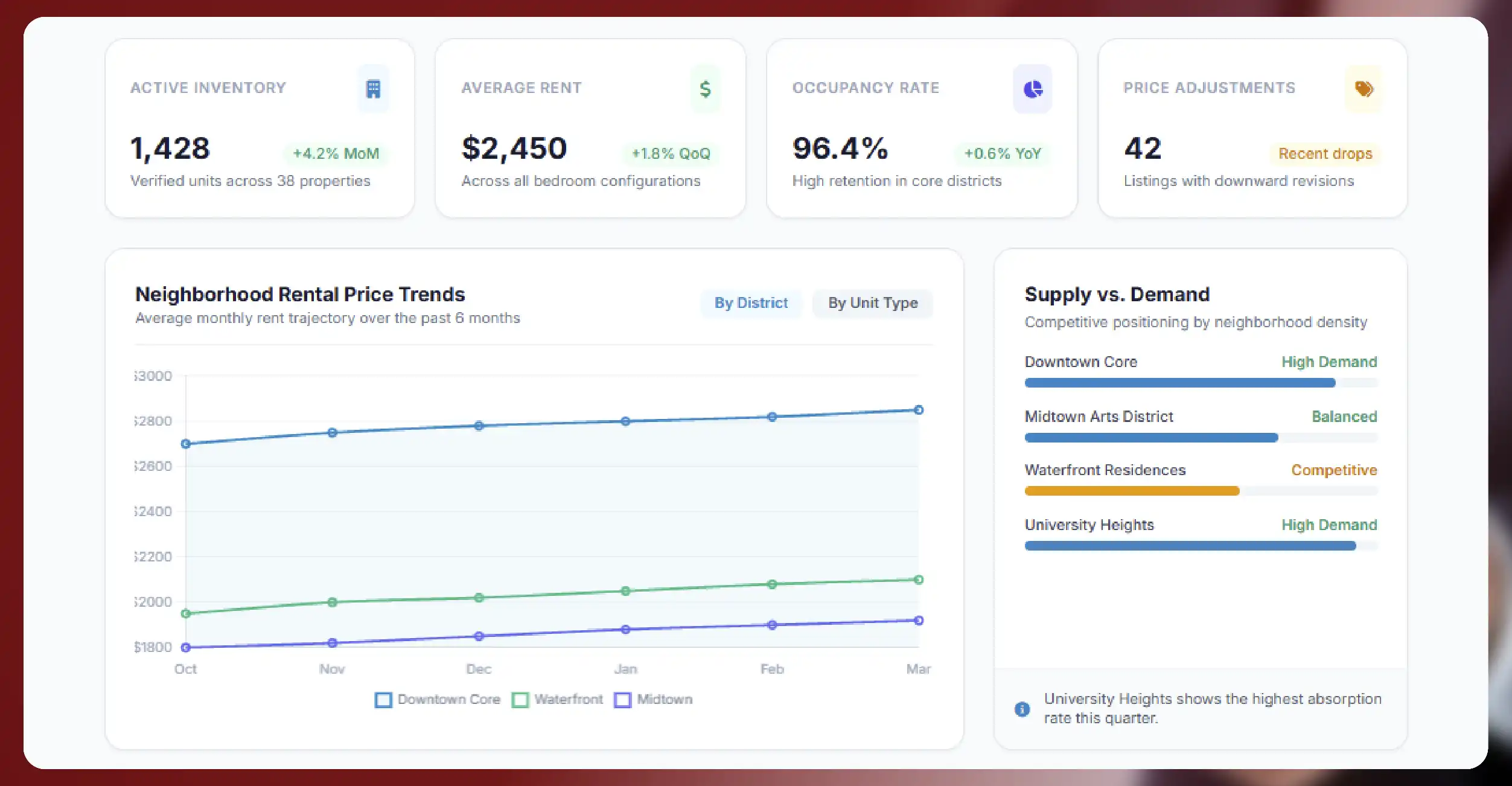
Apartment applications are no longer simple directories containing property names and phone numbers. Users increasingly expect comprehensive information that helps them evaluate properties before contacting a landlord or property manager.
A useful rental application may combine monthly rent, unit type, bedroom and bathroom counts, square footage, amenities, property descriptions, photos, addresses, neighborhood information, and availability. When this information is collected consistently, developers can build powerful search and comparison experiences.
For example, a renter could search for two-bedroom apartments under a specific budget, filter properties according to amenities, compare neighborhoods, and identify listings that recently changed their prices. A property research platform could use the same underlying information to analyze supply, rental trends, and competitive positioning.
Understanding Apartment Data API Integration
Apartment rental data API integration can help connect structured property information with websites, mobile applications, dashboards, and internal analytics systems. The integration layer generally receives apartment information, validates the returned fields, normalizes values, and stores the resulting dataset in a database or cloud environment.
A typical architecture may contain an extraction layer, API processing layer, validation system, storage database, and application interface. This structure allows teams to separate data collection from presentation and analytics.
Developers can also schedule recurring collection processes. For example, a platform monitoring rental markets may collect updated information every few hours or once per day, depending on business requirements and permitted access. Historical snapshots can then be compared to identify price changes, availability movements, or listing additions and removals.
What Data Can Be Collected?
A well-designed apartment data pipeline can organize numerous fields into standardized records. Depending on availability and permitted access, useful attributes may include:
- Property or apartment name
- Listing URL or identifier
- Address and location
- Property type
- Unit type
- Bedroom and bathroom count
- Rent or advertised price
- Square footage
- Availability status
- Available date
- Amenities
- Property description
- Images or image references
- Ratings and reviews where available
- Neighborhood information
- Property management details
- Listing timestamps
The value comes from combining these fields rather than examining individual attributes separately. Rent becomes much more meaningful when paired with unit size, neighborhood, amenities, and availability.
Building a Rental Search Application
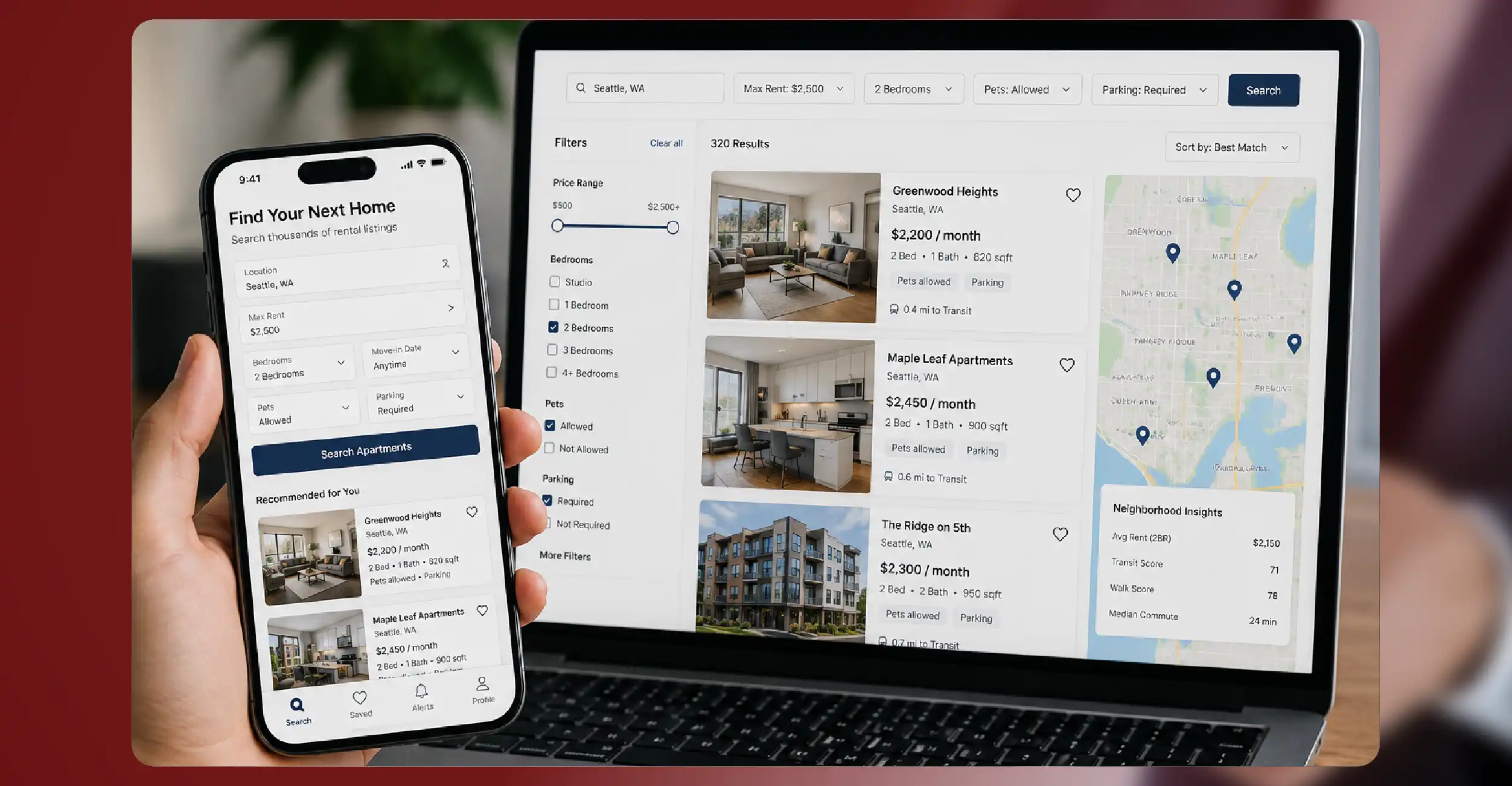
One of the most practical applications is a rental search engine. Developers can ingest apartment records, normalize the data, and expose filters through a web or mobile interface.
A renter might select a city, preferred neighborhood, maximum monthly rent, bedroom count, pet policy, parking requirement, and move-in date. The application can then query the normalized database and return matching properties.
Search functionality can become more sophisticated through ranking algorithms. Properties could be ordered by price, distance, availability, amenities, value score, or historical pricing behavior.
This approach also enables personalized recommendations. If a user repeatedly searches for affordable two-bedroom apartments close to transit, the application can learn those preferences and prioritize relevant listings.
Using Apartment Data for Price Intelligence
Scrape real estate application data API to support rental price intelligence by collecting pricing information over time. A single listing provides a snapshot, but historical records reveal market movement.
Suppose an apartment is advertised at $2,100 in January, $2,025 in February, and $1,950 in March. A historical dataset can identify the downward movement and help analysts investigate whether similar properties experienced the same pattern.
Real estate companies can use this intelligence to benchmark properties against competing listings. Analysts may calculate median rent by neighborhood, average price per square foot, rental differences between unit types, or changes in advertised prices over time.
Such insights can contribute to pricing strategies, investment research, portfolio analysis, and market forecasting.
Monitoring Apartment Availability
Availability is another critical component of rental applications. Property listings can change rapidly as units become occupied, new units are added, or move-in dates shift.
Extract Apartment pricing and availability data API to help applications maintain a more current view of rental inventory. Developers can compare new records with previous snapshots and identify changes.
For example, an application could flag a newly available unit, identify an apartment whose advertised price changed, or remove a listing that is no longer present.
This is especially valuable for rental aggregators where stale information can damage user trust. Automated updates reduce dependence on manual spreadsheet maintenance and create a stronger foundation for real-time or near-real-time experiences.
Location-Based Real Estate Applications
Location is one of the most important dimensions of rental decision-making. Renters frequently care about proximity to workplaces, schools, transportation, shopping centers, restaurants, healthcare facilities, and entertainment.
Apartment data can therefore be connected with geographic information to create map-based experiences. A user could explore available apartments around a selected location and compare rental prices across nearby neighborhoods.
Location-based scoring can also help applications estimate neighborhood attractiveness. Developers might combine apartment listings with external geographic datasets to calculate commute distances, amenity density, neighborhood pricing, or accessibility indicators.
The result is an application that provides more context than a conventional property listing page.
Data Cleaning and Standardization
Raw rental information often requires substantial processing before it becomes useful for analytics. Different records may use inconsistent formats for prices, addresses, room counts, amenities, and availability dates.
A robust pipeline should standardize these values before storing them. For example, monthly rental prices can be converted into numeric fields, bedroom counts can follow a consistent format, and addresses can be separated into standardized geographic components.
Duplicate detection is equally important. The same property may appear across multiple records or change its listing details over time. Unique identifiers, URLs, addresses, and property-level matching techniques can help maintain cleaner datasets.
Validation rules can also identify missing prices, unusual values, malformed records, or unexpected changes in data structure.
Scaling Data Collection for Multiple Markets
A real estate application intended for one neighborhood has very different infrastructure requirements from a platform covering dozens of cities.
At larger scales, data pipelines need efficient scheduling, storage, monitoring, error handling, and processing. Cloud databases and distributed processing systems can help teams manage growing datasets.
Partitioning data by city, state, property, or collection date can make querying more efficient. Historical snapshots can be stored separately from current listing tables, allowing applications to preserve changes without unnecessarily duplicating active records.
Monitoring systems can track collection success rates, missing fields, processing delays, and unexpected changes. This makes the overall pipeline more dependable as the project expands.
Applications of Apartment Listing Data
Apartment data can support many real estate products beyond basic rental search. Property management organizations can benchmark competing properties, while investors can evaluate neighborhood-level rental trends.
Real estate marketplaces can use listing intelligence to improve search and recommendations. Relocation platforms can help users compare housing options in unfamiliar cities. Market research companies can develop rental trend reports based on historical observations.
Other applications include rent comparison engines, neighborhood intelligence platforms, property investment dashboards, housing affordability studies, and rental demand forecasting systems.
The common factor is structured, refreshed data. Once apartment information is organized consistently, the same dataset can support multiple products and analytical workflows.
How iWeb Data Scraping Can Help You?
Automated Apartment Data Collection
iWeb Data Scraping can automate the collection of permitted apartment information, reducing manual research and helping businesses maintain structured property datasets across selected markets.
Customized Data Extraction
Our solutions can be configured around required fields such as property details, pricing, amenities, availability, addresses, and unit information to support specific application and analytics requirements.
Historical Rental Intelligence
Recurring collection can create historical snapshots that allow businesses to identify rental price movements, availability changes, newly added properties, and market-level trends over time.
Scalable Data Delivery
We can organize extracted information into practical formats and delivery workflows, helping development teams integrate refreshed apartment datasets into databases, dashboards, analytics platforms, or applications.
Data Quality and Monitoring
Automated validation, normalization, duplicate handling, and monitoring can improve dataset consistency, making apartment information more reliable for downstream searches, comparisons, reporting, and business intelligence.
Conclusion
Building a successful real estate application depends on more than an attractive interface. The quality, consistency, freshness, and depth of its underlying data determine how useful the final product becomes. Apartment listing information can power rental search engines, price comparison platforms, property intelligence dashboards, neighborhood analysis tools, and investment applications.
By combining structured apartment information with historical collection, geographic analysis, filtering, and intelligent application logic, businesses can transform individual property listings into meaningful market intelligence.
Well-organized Real-estate datasets can help businesses understand rental markets, while Location intelligence adds valuable geographic context to property discovery and analysis. For organizations seeking scalable collection and structured delivery, Web Scraping API Services can provide the technical foundation required to build reliable real estate data workflows.
The key is to design the solution around data quality, responsible collection, scalability, and the application's specific requirements. With the right architecture, apartment listing data can become a powerful resource for creating smarter and more competitive real estate technology products.
FAQs
Depending on available and permitted data, an apartment data API workflow can provide property details, rental prices, unit information, amenities, availability, addresses, descriptions, and other listing attributes.
Yes. Structured apartment records can be compared by location, property type, bedrooms, square footage, amenities, and advertised rent, helping applications provide more meaningful rental comparisons.
The ideal frequency depends on the application's requirements and how quickly listings change. High-change marketplaces may benefit from frequent updates, while research applications may use daily or weekly collection.
Yes. Historical snapshots can help identify rental price changes, listing turnover, availability trends, neighborhood differences, and broader market movements.
Developers should consider permitted access methods, applicable website terms, privacy requirements, data quality, update frequency, scalability, storage architecture, and validation before integrating the information into production applications.