
KEY TAKEAWAYS
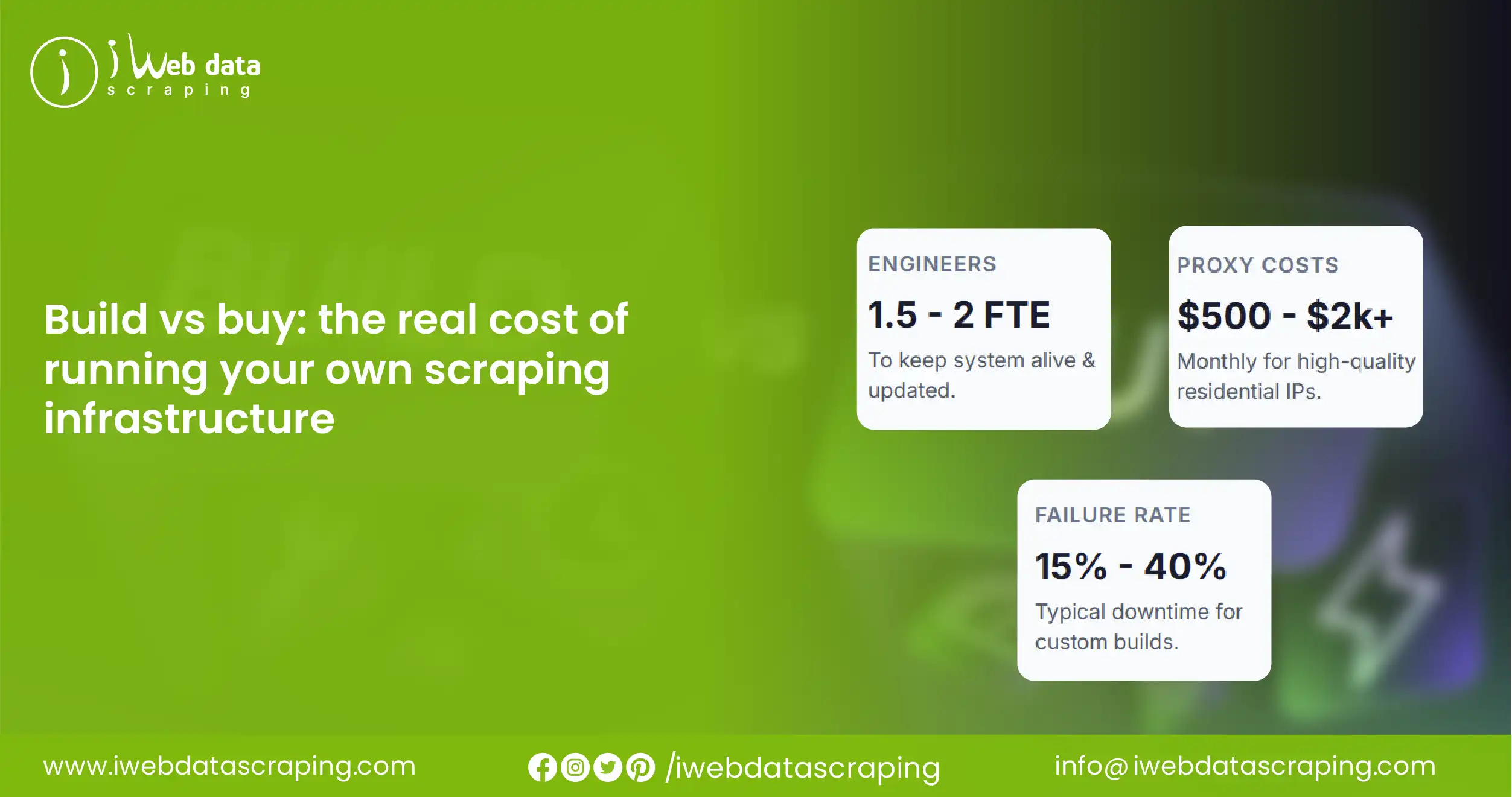
- The scraper is the cheap part. Proxies, anti-bot handling, monitoring and on-call maintenance are 70–80% of the real cost of in-house scraping.
- A typical 3–5 platform in-house setup runs $8K–$15K/month all-in (engineer time + infrastructure) — versus $500–$1,500/month per platform managed.
- The hidden killer isn't cost, it's silent failure: broken parsers that keep delivering wrong data until a decision goes bad.
- Build when scraping is the product. Buy when scraping feeds the product or the decision.
The real question isn't "can we build it?"
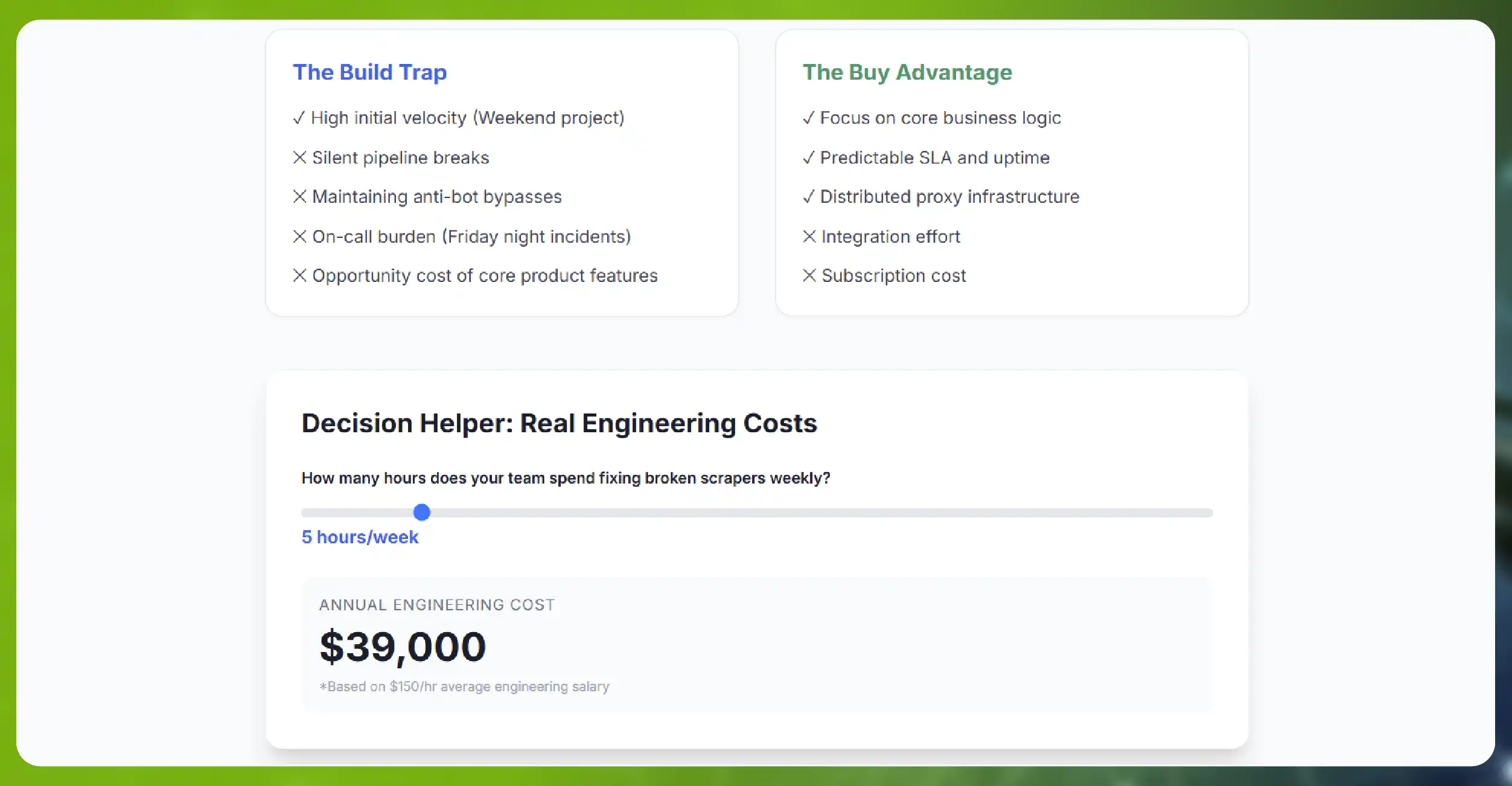
Of course your engineers can build a scraper — a working prototype for one site is a weekend project, and that's precisely the trap. The build-vs-buy decision isn't about whether your team can write extraction code. It's about whether you want to own a 24/7 adversarial operations problem that has nothing to do with your product.
Web scraping at production quality is less like writing software and more like running infrastructure against an opponent: target platforms change layouts, rotate anti-bot vendors, and expand to new cities — each change a silent break in your pipeline. The question that actually decides build vs buy: whose engineer wakes up when Zepto changes its app API on the Friday before your quarterly review?
The line-item cost of building in-house
Here's the budget teams discover after the prototype, based on what clients who switched to us were spending. Assume a modest scope: 3–5 platforms, daily refresh, one geography.
| Line item | In-house (typical) | What it covers |
|---|---|---|
| Engineering time | 0.5–1.0 FTE ≈ $6K–$12K/mo | Parser maintenance, breakage response, schema changes, QA scripts |
| Proxies & unblocking | $300–$2,000/mo | Residential/mobile proxy pools, CAPTCHA solving, fingerprinting tools |
| Infrastructure | $200–$1,000/mo | Headless browser fleets, schedulers, storage, monitoring stack |
| Monitoring & QA | Usually skipped → paid in errors | Field-level accuracy checks, coverage audits, alerting |
| On-call & opportunity cost | Unbudgeted | The roadmap features that engineer isn't shipping |
| Total | $8K–$15K/month | Before the first business insight |
Compare the managed equivalent: our managed feeds for the same scope typically land between $1,500 and $5,000/month total, with monitoring, QA audits and breakage recovery included — because those costs amortize across hundreds of clients hitting the same platforms. The economics aren't subtle; they're structural.
The three costs nobody budgets
1. Silent data corruption
A crashed scraper is the good outcome — someone notices. The expensive failure is the parser that keeps running after a layout change and delivers plausible wrong data: prices from the wrong variant, availability from a cached page, reviews truncated mid-field. One pricing client came to us after re-pricing 200 SKUs off three weeks of silently corrupted competitor data. The scraper had never thrown an error.
2. The anti-bot arms race
Major platforms invest continuously in bot detection — fingerprinting, behavioral analysis, app attestation. Keeping up is a specialist skill your team learns from scratch, on your data's downtime. It's the single largest driver of the maintenance load, and it never plateaus.
3. Key-person risk
In-house scraping knowledge concentrates in one engineer's head: the workarounds, the fragile selectors, the proxy vendor quirks. When they leave, the pipeline becomes a haunted house. Vendors carry this risk across a bench of engineers instead.
Want to benchmark your in-house costs?
Send us your current platform list and refresh schedule — we'll quote the managed equivalent so you can compare line by line.
When building in-house is the right call
Buying isn't always the answer, and pretending otherwise would make this article an ad. Build when:
- Scraping is the product. If you're selling a data tool or aggregator, extraction is core IP — own it.
- The logic can't be specified. Some extraction depends on judgment so entangled with your domain that writing a spec for a vendor costs more than writing the code.
- You already run a data platform team with on-call rotations, monitoring culture and headroom. The marginal cost of one more pipeline is genuinely low for you.
- Volume is trivial and stakes are low. A weekly check of five product pages doesn't need a vendor or a pipeline — a script is fine.
Everyone else — teams whose scraped data feeds pricing decisions, availability alerts, research or AI products — is better served treating web data like electricity: essential, purchased, and someone else's uptime problem.
A 60-second decision framework
| If this sounds like you… | Then |
|---|---|
| "We need competitor prices in the BI tool by Monday, forever" | Buy — managed feed |
| "Our engineers want an API, not a vendor relationship" | Buy — scraping API, keep pipeline ownership |
| "We need this data once, to validate an idea" | Buy — one-time dataset, cheapest option |
| "Extraction logic is our secret sauce and our moat" | Build — it's product, not plumbing |
| "We built it, and it breaks every launch week" | Switch — your schema transfers directly |
The bottom line
In-house scraping is a prototype that quietly becomes a department. The code was never the cost — the adversarial maintenance, the silent failures and the engineer's attention were. Unless extraction is your moat, the arithmetic favors buying the feed and spending your engineers on the product only your company can build.
The cheapest way to test that arithmetic: request a free sample against your current schema, compare it to what your pipeline produced this week, and let the accuracy report argue for us.
Frequently asked questions
Based on our engagements with teams who switched, a production system monitoring 3–5 platforms typically consumes 50–100% of one engineer's time plus $500–$3,000/month in proxies and infrastructure. At loaded engineering costs, that's commonly $8,000–$15,000/month all-in before the first insight is delivered.
Build when scraping IS your product (you're selling a data tool), when you need extraction logic so proprietary it can't be specified to a vendor, or when you already run a data-platform team with on-call capacity. For data that feeds decisions — pricing, availability, research — buying is almost always cheaper.
Target sites change HTML structures, rotate anti-bot systems, A/B test layouts and add new regions without notice. Each change silently breaks parsers. The industry-standard failure mode isn't a crash — it's a feed that keeps delivering, with wrong or missing fields, until someone downstream notices.
Our managed feeds typically start around $500–$1,500/month for a single platform with daily refresh, scaling with platforms, volume and frequency. That includes monitoring, breakage recovery, QA audits and delivery to your warehouse or API — the line items that dominate in-house budgets.
Yes, and many teams do — usually after the second major breakage during a critical week. The switch is straightforward: your field schema and refresh requirements transfer directly into a managed engagement, and a free sample against your existing schema validates parity before you migrate.