
58.6K+
CAR RENTAL PRICE RECORDS PROCESSED

Car Rental Price Data API Enables Accurate Rental Rate Monitoring, Market Benchmarking, Geographic Comparisons, And Insurance Claims Reimbursement Intelligence.
This case study explores a real-world enterprise scenario in which an insurance-claims platform uses automated travel data extraction and pricing intelligence to establish accurate, location-specific rental vehicle replacement costs. The platform required a reliable mechanism to evaluate transportation expenses incurred by policyholders when their insured vehicles became unavailable following accidents, mechanical failures, or covered insurance incidents.
The solution was designed for:
The platform needed a dependable car rental price data API to retrieve standardized rental pricing information from multiple booking sources. It also required car rental rate comparison data to establish consistent benchmarks across vehicle classes, rental providers, locations, and reservation periods.
The primary objective was to replace fragmented price research and manually maintained reference sheets with a centralized pricing intelligence infrastructure. This would enable claims professionals to evaluate rental expenses against comparable market rates while maintaining visibility into the factors influencing transportation costs.
A growing insurance-claims technology platform encountered increasing difficulties validating temporary rental vehicle expenses submitted by policyholders. When an insured vehicle became unavailable following an accident, customers frequently rented replacement vehicles while waiting for repairs, inspections, or settlement approvals. However, rental charges differed considerably depending on location, vehicle category, booking duration, rental provider, and demand conditions.
The organization lacked a centralized pricing reference capable of establishing reasonable rental reimbursement benchmarks. Claims specialists frequently consulted individual rental websites, compared quotations manually, and maintained spreadsheets containing historical prices. These methods created inconsistent assessments and increased the time required to process claims.
To address this challenge, iWeb Data Intelligence implemented an automated rental pricing intelligence pipeline covering US car rental prices by city and multiple vehicle categories. The system collected rental car daily rate data across different booking durations, pickup locations, rental providers, and vehicle specifications.
The solution standardized essential pricing attributes, including daily rental charges, estimated total costs, taxes, additional fees, vehicle categories, rental dates, and availability indicators. Historical observations were retained to support comparisons between the original booking date and subsequent claims assessment dates.
The platform integrated these datasets into its insurance-claims workflow, allowing adjusters to compare submitted rental invoices with comparable market quotations. Automated validation rules highlighted unusual pricing differences and identified records requiring additional investigation.
The client operated an insurance-claims platform processing replacement transportation expenses for customers whose vehicles were temporarily unavailable. Its existing assessment process depended heavily on manual quotation collection, inconsistent pricing references, and individual adjuster judgment. These limitations created operational delays and made it difficult to establish standardized reimbursement benchmarks.
Obtaining Reliable Car Rental Data for Insurance Claims
Rental prices varied significantly according to pickup locations, vehicle categories, reservation periods, provider policies, and seasonal demand. Without comparable market information, adjusters struggled to determine whether submitted rental expenses reflected reasonable local rates.
Tracking Peer-to-Peer Rental Marketplaces
Another challenge involved tracking peer-to-peer rental marketplaces and obtaining comparable Turo price data. These listings introduced additional variations in vehicle specifications, owner-defined pricing, availability, mileage allowances, and delivery charges. The client needed to distinguish comparable vehicle options rather than treating every rental quotation as equivalent.
Lack of Continuous Travel Data Scraping Services
The organization also lacked comprehensive travel data scraping services capable of continuously collecting rental quotations from multiple publicly accessible booking sources. Individual searches were time-consuming and could not provide consistent geographic coverage or historical visibility.
To overcome these challenges, the client required an automated rental pricing intelligence pipeline capable of multi-source collection, vehicle classification, pricing normalization, and API-based delivery.
By implementing an automated rental pricing collection framework, the client replaced disconnected quotation searches with a standardized market intelligence pipeline. The infrastructure continuously collected comparable rental information, organized pricing attributes, and delivered structured records to the insurance-claims platform.
The structured approach improved consistency by ensuring that rental quotations were compared using relevant attributes rather than relying exclusively on headline prices.
| Dimension | Manual Rental Price Tracking | Structured Data Intelligence System |
|---|---|---|
| Data collection | Individual rental website searches | Automated multi-source price collection |
| Geographic coverage | Limited locations | Multiple cities and pickup locations |
| Price comparison | Spreadsheet-based comparison | Standardized provider benchmarking |
| Vehicle matching | Manual category interpretation | Normalized vehicle classifications |
| Daily rates | Individually recorded quotations | Structured daily rental price records |
| Historical analysis | Limited archived information | Timestamped pricing observations |
| Additional charges | Inconsistent fee documentation | Separate fee and tax attributes |
| Claims assessment | Adjuster-dependent evaluation | Benchmark-supported assessment |
| Data updates | Periodic manual refreshes | Scheduled automated collection |
| Reporting | Manually prepared summaries | Integrated analytical dashboards |
| Scalability | Increasing manual workload | Expandable collection infrastructure |
This distinction was important because two apparently similar rental offers could differ substantially in duration, vehicle specifications, mileage restrictions, pickup conditions, and additional charges.
The brand in focus is an emerging insurance technology organization operating a digital claims management platform for automobile insurance providers. Its primary business objective is to simplify claims administration by combining policy information, incident documentation, repair estimates, replacement transportation expenses, and settlement calculations within a unified technology environment.
As its customer base expanded, the organization experienced increasing volumes of claims involving temporary replacement vehicles. Customers frequently submitted rental invoices while their insured automobiles were undergoing repairs or awaiting claim resolution. Assessing these expenses required accurate knowledge of rental market conditions at the relevant location and time.
The organization recognized that a standardized rental pricing reference could improve the consistency of reimbursement assessments. However, building and maintaining such a resource internally would require extensive data collection, technical infrastructure, and continuous monitoring of multiple rental providers.
To address these limitations, the organization partnered with iWeb Data Intelligence to establish an automated rental market data collection framework. The objective was to create a dependable pricing intelligence layer that could support claims evaluation without replacing the adjuster's responsibility for reviewing policy terms, coverage conditions, and supporting documents.
iWeb Data Intelligence developed an end-to-end rental pricing intelligence solution designed to collect information from multiple publicly accessible rental booking sources and transform it into structured datasets.
The approach combined automated extraction, data normalization, validation, historical storage, and API-based delivery. Each component addressed a specific operational requirement of the insurance-claims platform.
Multi-Source Rental Price Collection
The first stage involved collecting rental quotations across selected providers, booking platforms, and eligible peer-to-peer rental marketplaces. Data collection covered different pickup locations, vehicle categories, rental durations, and reservation dates. The pipeline captured available pricing information and associated booking attributes. Collection frequency was configured according to source accessibility, permitted collection methods, and the client's required update intervals.
Vehicle Classification and Standardization
Rental providers frequently described comparable vehicles using different names and category structures. We introduced a standardized classification framework covering economy, compact, intermediate, standard, full-size, SUV, luxury, and specialty vehicle segments. Where available, vehicle make, model, passenger capacity, luggage capacity, transmission type, and fuel category were retained as supporting comparison attributes.
Pricing Normalization
The extracted records were transformed into consistent pricing structures. Daily rental charges, estimated booking totals, taxes, surcharges, additional fees, and optional extras were stored separately wherever the source provided sufficient information. This enabled claims professionals to distinguish the base rental price from the final payable amount and avoid misleading comparisons between incomplete quotations.
Geographic and Temporal Mapping
Every record was associated with its corresponding city, pickup location, rental provider, collection timestamp, and rental period. This helped the platform compare quotations from geographically relevant markets and distinguish current observations from historical pricing information.
Data Validation and Deduplication
Automated validation processes identified incomplete records, duplicate quotations, inconsistent currencies, invalid date ranges, and abnormal pricing values. Records were checked against predefined business rules before entering the final dataset.
API-Based Delivery
The processed dataset was made available through a structured API layer. The client's technology platform could request relevant rental pricing records using supported parameters such as city, pickup location, vehicle category, rental duration, and observation date. The architecture supported standardized data delivery, controlled access, and integration with existing claims management applications.
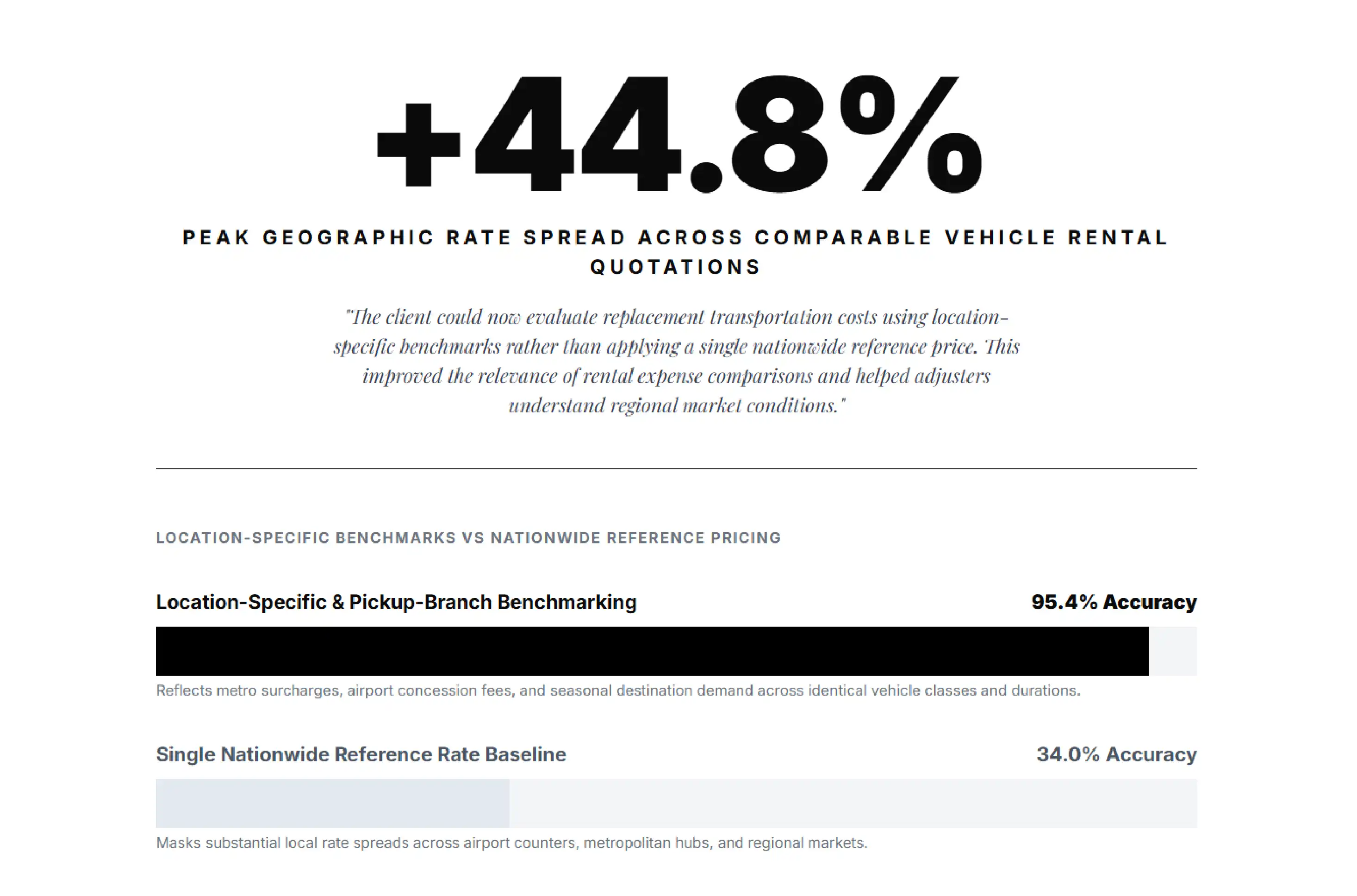
The collected rental quotations demonstrated that vehicle rental expenses differed considerably across cities and pickup locations. Metropolitan areas, airport branches, and popular travel destinations frequently exhibited different pricing patterns even when comparable vehicle categories and rental durations were considered.
The client could now evaluate replacement transportation costs using location-specific benchmarks rather than applying a single nationwide reference price. This improved the relevance of rental expense comparisons and helped adjusters understand regional market conditions.
Geographic segmentation also supported better reporting by identifying markets where rental expenses were consistently higher or lower than broader regional averages.
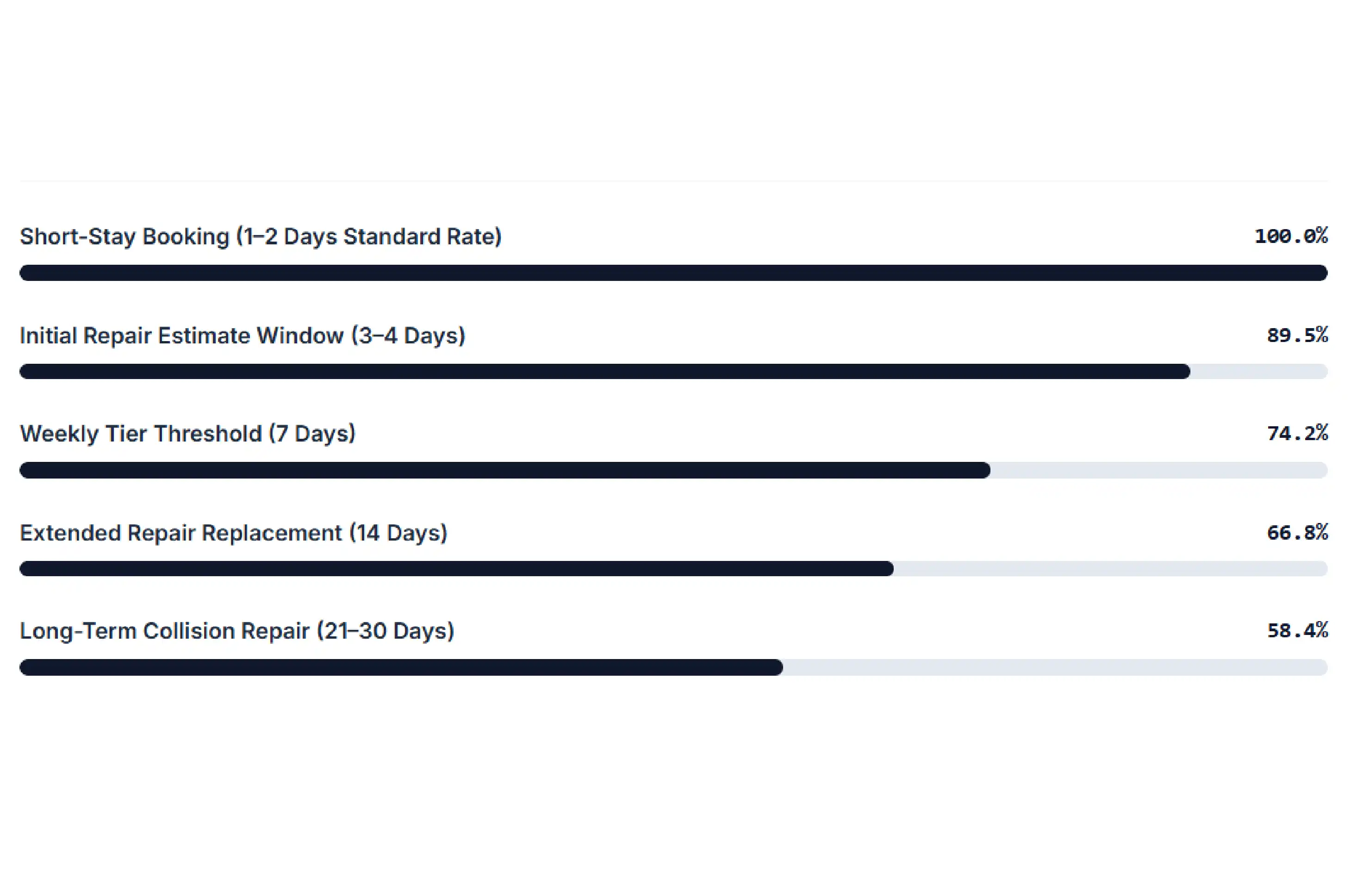
The analysis highlighted meaningful differences between short-duration and extended rental bookings. Daily rates frequently changed according to the total reservation period, promotional conditions, and provider-specific pricing structures.
This finding was particularly relevant to insurance claims because repair timelines could extend beyond initial estimates. A rental quotation for three days could not automatically serve as a reliable benchmark for a replacement vehicle required for two weeks.
The platform therefore incorporated duration-based comparisons to improve the relevance of reimbursement assessments.
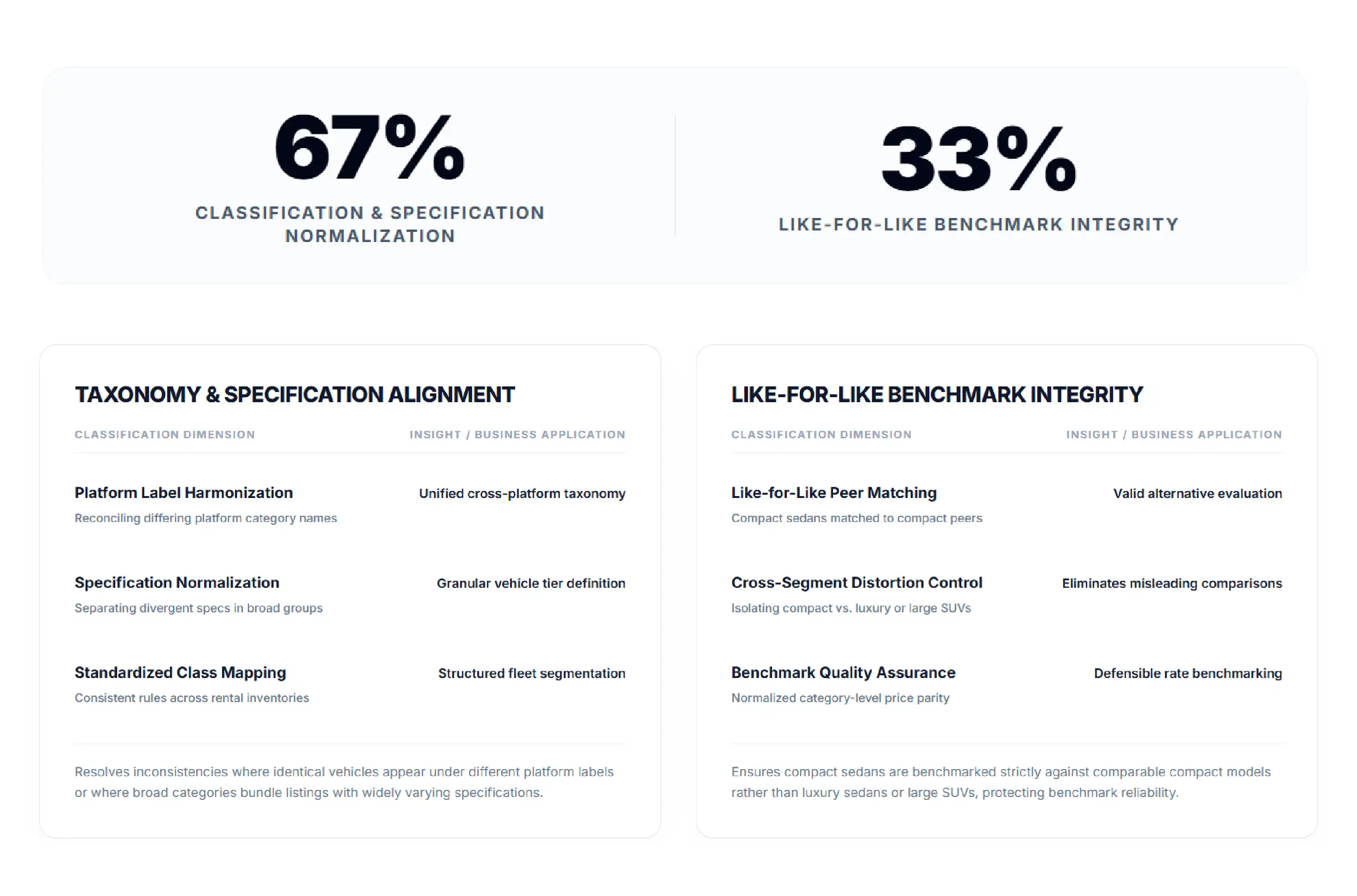
The project identified inconsistencies in how rental platforms categorized vehicles. Similar vehicle types could appear under different labels, while individual listings within one broad category could have significantly different specifications.
The standardized vehicle classification framework helped the client compare more appropriate alternatives. For example, a compact sedan could be evaluated against comparable compact vehicles rather than against luxury sedans or large SUVs.
This improved benchmark quality and reduced the likelihood of misleading comparisons caused by mismatched vehicle categories.
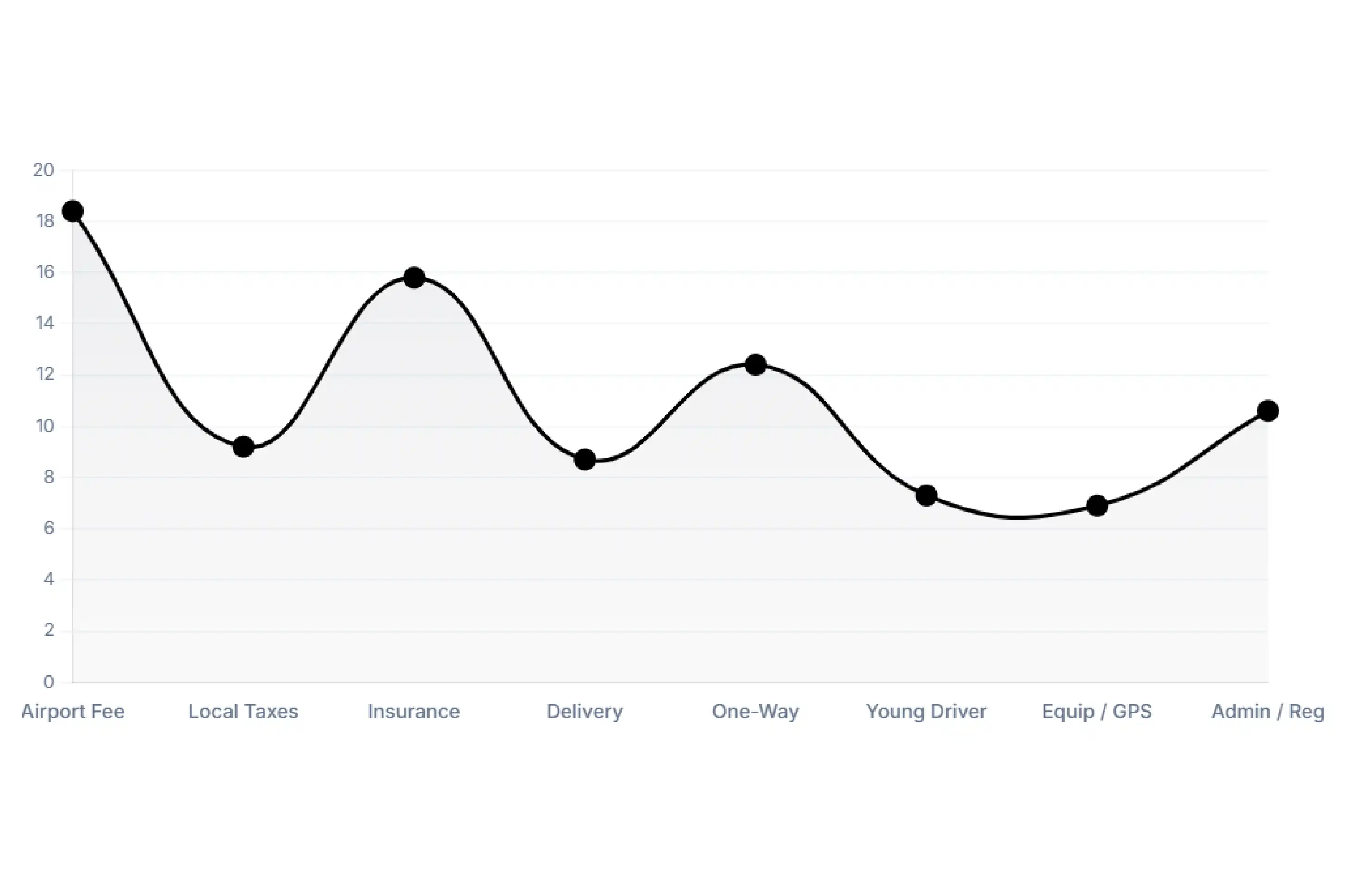
The collected information demonstrated that headline daily rental prices did not always represent the complete booking expense. Taxes, airport fees, optional services, delivery charges, and other additional costs could influence the final amount.
The solution therefore separated available base prices from additional booking components. This helped claims specialists understand the difference between an advertised daily rate and the estimated total rental expense.
Where specific fees were unavailable or excluded from a quotation, the dataset retained appropriate availability indicators instead of assuming that the missing charges were zero.
The following illustrative dataset demonstrates how rental market information can be structured for insurance-claims benchmarking. The figures are sample values created to explain the dataset format and do not represent verified live quotations or actual provider prices.
It includes city, rental provider, vehicle category, daily rate, rental duration, estimated total, and data status.
| City | Rental Provider | Vehicle Category | Daily Rate (USD) | Rental Duration | Estimated Total (USD) | Data Status |
|---|---|---|---|---|---|---|
| New York | Provider A | Economy | 58 | 5 Days | 290 | Available |
| Los Angeles | Provider B | Compact | 64 | 7 Days | 448 | Available |
| Chicago | Provider C | Intermediate | 72 | 5 Days | 360 | Available |
| Miami | Provider D | Standard | 81 | 6 Days | 486 | Available |
| Dallas | Provider E | SUV | 96 | 7 Days | 672 | Available |
| Houston | Provider F | Economy | 54 | 4 Days | 216 | Available |
| San Francisco | Provider G | Premium | 118 | 5 Days | 590 | Available |
| Phoenix | Provider H | Compact | 61 | 8 Days | 488 | Available |
Note: Sample figures are illustrative and do not represent verified live quotations or actual provider prices.
The dataset can be expanded with additional attributes such as pickup branch, drop-off location, booking timestamp, rental start date, rental end date, currency, mileage allowance, vehicle transmission, passenger capacity, taxes, surcharges, and availability status.
After implementing the structured rental pricing intelligence framework, the client established a more consistent approach to replacement vehicle expense evaluation. The following figures represent illustrative project outcome indicators for this case study rather than independently audited financial results.
iWeb Data Intelligence provides structured data collection and analytics solutions designed to transform fragmented online information into reliable business intelligence. Its approach combines automated extraction, data cleaning, standardization, validation, and API-based delivery to support enterprise requirements.
Comprehensive Data Collection
Our collection framework consolidates rental quotations from multiple eligible sources, reducing dependency on individual website searches and creating a more consistent information foundation for insurance analytics and reimbursement benchmarking.
Accurate Data Standardization
We normalize vehicle categories, pricing attributes, rental durations, locations, and available booking information. This creates consistent datasets that can be compared across providers without unnecessary formatting differences or duplicated records.
Scalable Infrastructure
Our data pipelines are designed to accommodate growing information requirements, additional geographic markets, new rental providers, and expanding historical datasets while maintaining structured processing and delivery workflows.
Flexible API Integration
We deliver processed information in formats suitable for existing business applications, reporting systems, analytical environments, and insurance-claims platforms, helping organizations integrate external pricing intelligence into established workflows.
Actionable Market Intelligence
Beyond collecting rental prices, we organize market information into meaningful analytical structures that support geographic benchmarking, vehicle-category comparisons, historical analysis, and improved operational decision-making.
"We are extremely satisfied with the rental pricing intelligence solution delivered by the iWeb Data Intelligence team. Our previous process involved considerable manual effort to identify rental quotations and evaluate replacement vehicle expenses across different locations. The new system has improved the consistency and accessibility of market pricing information within our insurance-claims platform. The structured datasets and API integration have helped our claims specialists access relevant rental benchmarks more efficiently. We particularly appreciate the attention given to vehicle classification, rental duration, geographic coverage, and historical pricing observations. The solution has strengthened our internal assessment processes, improved operational visibility, and reduced the time spent on repetitive market research. The team's technical expertise, data quality processes, and scalable approach have provided a valuable foundation for our continued platform development."
— Head of Claims Technology
The project resulted in a centralized rental pricing intelligence infrastructure that transformed fragmented booking information into structured datasets for insurance-claims assessment. The client gained access to standardized rental quotations across multiple cities, vehicle categories, providers, and booking periods.
Implementation of the web scraping API enabled continuous collection and structured delivery of rental pricing information from eligible online sources. The integration allowed the claims platform to retrieve relevant observations using supported geographic, vehicle, and rental-duration parameters.
The resulting database also improved visibility into dynamic pricing data, helping the organization understand how rental charges changed according to location, booking duration, demand conditions, and market availability. Historical observations provided additional context for evaluating reimbursement requests associated with earlier rental periods.
Furthermore, the platform established a reusable foundation for integrating broader travel datasets into its analytical environment. This created opportunities to extend pricing intelligence beyond rental cars into additional mobility and travel-related categories where relevant.
A car rental price data API provides structured access to rental pricing information collected from supported rental providers and booking sources. It can deliver details such as daily rates, vehicle categories, pickup locations, rental durations, estimated booking totals, and available additional charges. Insurance platforms can use this information to establish rental expense benchmarks and support reimbursement assessments.
Rental pricing information helps claims platforms compare customer-submitted rental invoices against relevant market quotations. By considering location, vehicle category, rental duration, and booking conditions, claims specialists can establish more consistent reference points. This supports faster assessments, improved documentation, and better visibility into unusual rental expenses without automatically determining policy eligibility.
Yes. An automated collection framework can cover selected US metropolitan areas, airport locations, suburban markets, and other supported pickup destinations. The resulting dataset can organize quotations by city, provider, vehicle category, rental period, and collection timestamp, subject to source availability and permitted access.
The collection scope can include eligible peer-to-peer rental marketplaces, including Turo, alongside traditional rental providers where source access and collection conditions permit. Pricing comparisons should account for differences in vehicle specifications, mileage allowances, delivery arrangements, availability, and additional charges before establishing equivalent rental benchmarks.
Yes. iWeb can provide structured datasets and API-based delivery designed for integration with existing insurance applications and analytical systems. Supported integration parameters, response formats, update schedules, and data fields can be aligned with the client's technical requirements and operational workflows.
iWeb Data Intelligence helps insurance technology companies collect, structure, and integrate rental market information through scalable data extraction and API solutions. Transform fragmented rental quotations into actionable pricing intelligence, strengthen claims benchmarking, and support more consistent insurance reimbursement decisions.
Start a projectFields marked * are required. Everything else just helps us scope faster — skip what you don't know yet.