How Does Cross Platform Product Matching - Amazon, Walmart & Target Improve Pricing Intelligence Across Marketplaces?
Introduction
In today’s hyper-competitive eCommerce landscape, brands and retailers are no longer operating in isolated marketplaces. Products are listed across multiple platforms, often with varying titles, descriptions, and pricing strategies. This creates both an opportunity and a challenge—how do businesses accurately identify the same product across different platforms and make data-driven decisions? This is where Cross Platform Product Matching - Amazon, Walmart & Target becomes a critical capability.
Modern businesses rely heavily on data intelligence to stay ahead. By leveraging advanced scraping and matching techniques, companies can Scrape same SKU Data across Amazon, Walmart & Target to build unified product views. Additionally, Cross-platform product matching data scraping enables organizations to normalize product data, eliminate inconsistencies, and create a standardized dataset for analysis.
Understanding Cross-Platform Product Matching
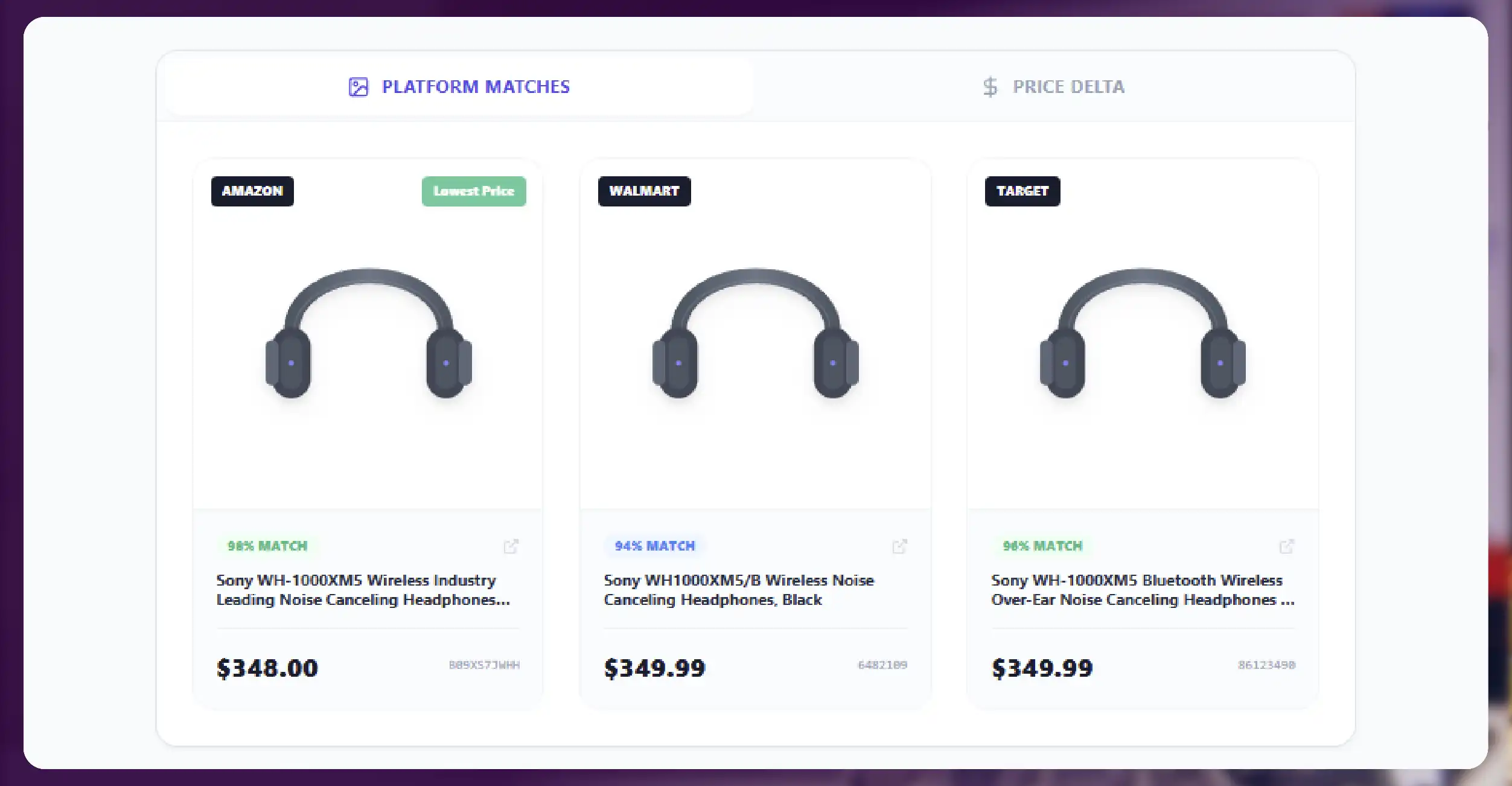
Cross-platform product matching refers to the process of identifying identical or similar products listed across multiple eCommerce platforms. While this sounds straightforward, it is often complex due to inconsistent product titles, missing SKUs, varying descriptions, and different categorization systems.
For example, the same product might be listed with different naming conventions on Amazon, Walmart, and Target. One platform might emphasize brand and specifications, while another focuses on marketing language. This makes it essential to use intelligent algorithms that consider multiple attributes such as:
- Product title similarity
- Brand name
- SKU or UPC codes
- Product specifications
- Images and metadata
The ultimate goal is to accurately Match product listings across Amazon, Walmart & Target and create a unified product identity.
Why Cross-Platform Matching Matters?
Businesses that invest in cross-platform matching gain a significant competitive advantage. Here's why:
1. Competitive Pricing Intelligence
With accurate matching, companies can perform SKU-level price benchmarking across Amazon, Walmart & Target. This allows them to monitor competitor pricing in real time and adjust their strategies accordingly.
2. Improved Catalog Management
Retailers managing thousands of SKUs benefit from cleaner, standardized product data. This reduces duplication and improves operational efficiency.
3. Enhanced Customer Insights
By aggregating product data across platforms, businesses gain deeper insights into customer preferences, reviews, and buying behavior.
4. Better Inventory Planning
Understanding product performance across multiple platforms helps optimize inventory distribution and reduce stockouts or overstock situations.
Key Components of Product Matching Systems
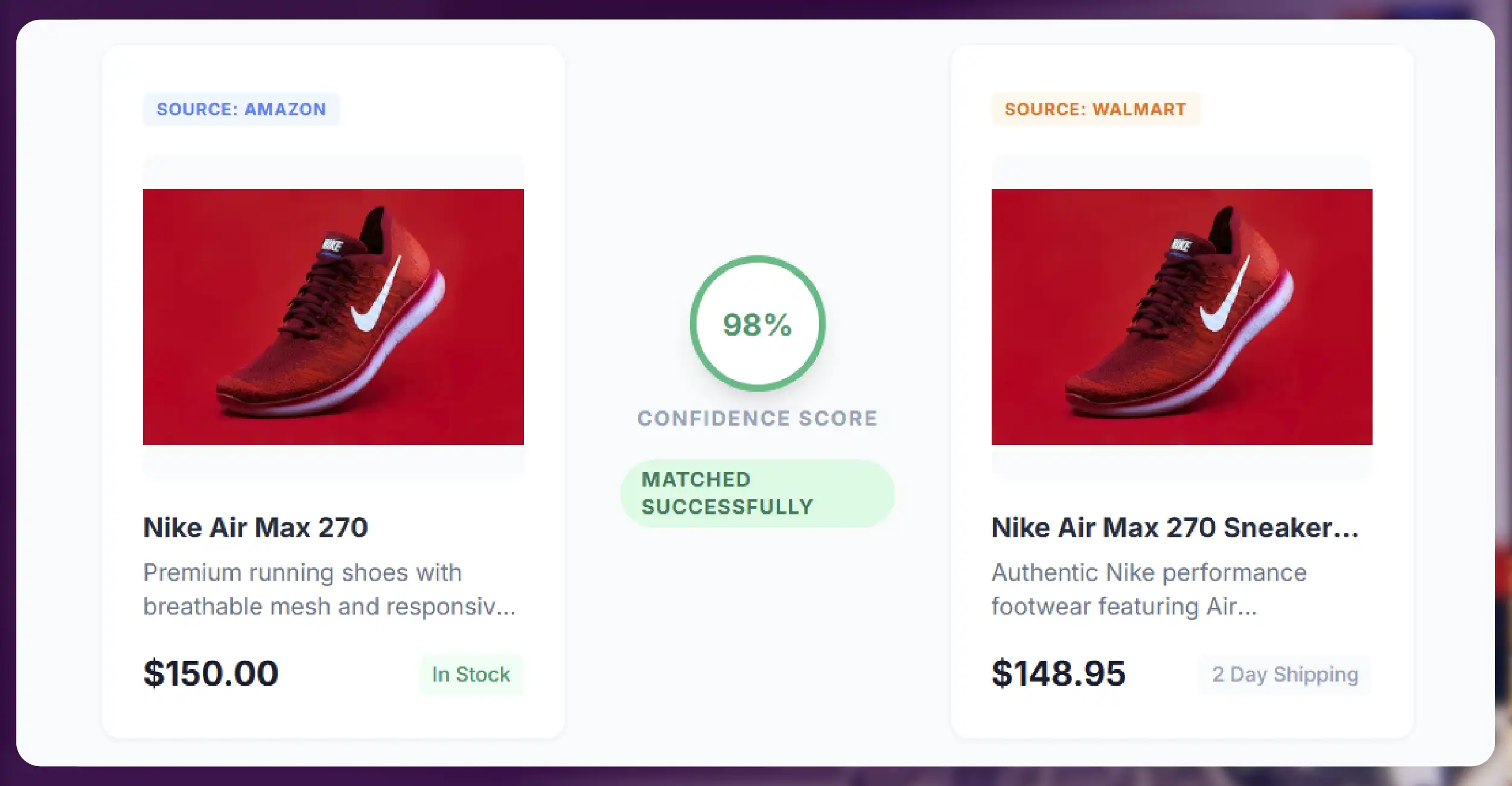
A robust product matching system involves multiple layers of data processing and analysis:
- Data Collection: The foundation lies in collecting product data from multiple platforms. This includes titles, prices, descriptions, images, ratings, and availability.
- Data Normalization: Raw data is often inconsistent. Normalization ensures that attributes like units, formats, and naming conventions are standardized.
- Attribute Matching: Algorithms compare key attributes such as brand, size, color, and specifications to identify potential matches.
- Machine Learning Models: Advanced systems use AI models to improve matching accuracy over time by learning from historical matches and mismatches.
- Validation & Quality Checks: Manual or automated validation ensures that matched products are accurate and reliable.
Role of Automation in Product Matching

Manual matching is not scalable. Automation tools like a Cross-Platform Product Mapping Scraper streamline the process by continuously collecting and aligning product data across platforms.
These tools can:
- Automatically detect matching SKUs
- Identify near-duplicate listings
- Update pricing and availability in real time
- Handle large-scale datasets efficiently
Automation significantly reduces human effort while improving accuracy and speed.
Data Sources for Cross-Platform Matching
To build an effective matching system, businesses rely on diverse datasets:
Amazon Product Data
Using Amazon Product Datasets, companies can access detailed information such as product descriptions, pricing trends, and customer reviews. This data is often extracted using Amazon data extraction Services to ensure consistency and scalability.
Walmart Product Data
Walmart Product Datasets provide insights into pricing strategies, inventory availability, and regional variations. Walmart's structured listings make it easier to map attributes like SKU and UPC.
Target Product Data
Similarly, Target Product Datasets offer valuable data points, including curated product descriptions and brand positioning, which help refine matching accuracy.
Unlock powerful cross-platform insights today—start transforming your product data into competitive advantage now.
Challenges in Cross-Platform Product Matching
Despite advancements, several challenges persist:
1. Inconsistent Product Titles
Different platforms use varying naming conventions, making it difficult to identify identical products.
2. Missing or Incorrect SKUs
Not all listings include SKU or UPC information, which complicates direct matching.
3. Data Duplication
Duplicate listings within the same platform can create confusion and reduce accuracy.
4. Dynamic Pricing
Frequent price changes require real-time updates to maintain accurate benchmarking.
5. Localization Differences
Products may have different specifications or packaging depending on the region.
Advanced Techniques for Accurate Matching
To overcome these challenges, businesses adopt advanced techniques:
- Natural Language Processing (NLP): NLP helps analyze product titles and descriptions to identify similarities beyond exact matches.
- Image Recognition: Visual matching techniques compare product images to detect identical items.
- Fuzzy Matching Algorithms: These algorithms identify approximate matches based on similarity scores.
- AI-Based Classification: Machine learning models classify products into categories and subcategories for better alignment.
Use Cases Across Industries
Cross-platform product matching is not limited to retail giants. It has applications across multiple industries:
Retail & eCommerce
Retailers use matching to monitor competitors, optimize pricing, and improve catalog management.
Consumer Electronics
Brands track product variations and pricing across multiple sellers.
FMCG & Grocery
Companies analyze product availability and pricing across different regions.
Fashion & Apparel
Matching helps identify duplicate listings and maintain brand consistency.
Benefits of Cross-Platform Matching
Implementing a robust product matching system delivers measurable benefits:
- Real-time competitive intelligence
- Increased pricing accuracy
- Improved customer experience
- Better data-driven decision-making
- Scalable operations across multiple platforms
Future Trends in Product Matching
The future of cross-platform product matching is driven by innovation:
- AI-Driven Matching: AI models will become more accurate, reducing dependency on manual validation.
- Real-Time Data Integration: Businesses will increasingly rely on real-time data pipelines for instant insights.
- Enhanced Personalization: Matching data will be used to deliver personalized product recommendations.
- Integration with Analytics Platforms: Product matching will seamlessly integrate with BI tools for advanced analytics.
How iWeb Data Scraping Can Help You?
1. Unified Multi-Platform Data Collection
Our data scraping services gather structured product data from Amazon, Walmart, and Target, ensuring consistent, real-time datasets that enable accurate cross-platform product comparison and analysis.
2. Accurate Product Matching & Normalization
We standardize product attributes like titles, SKUs, and specifications, enabling precise matching across platforms while eliminating duplicates and inconsistencies for reliable, analytics-ready datasets.
3. Real-Time Price & Competitor Monitoring
Our solutions track dynamic pricing changes and competitor strategies across platforms, helping businesses make timely decisions, optimize pricing models, and maintain a competitive advantage in fast-moving markets.
4. Scalable Data Infrastructure & Automation
We deliver automated scraping pipelines designed to handle large-scale data extraction, ensuring continuous updates, minimal manual intervention, and seamless integration with your analytics or business intelligence systems.
5. Actionable Insights & Custom Data Delivery
Our services transform raw data into meaningful insights, delivering customized datasets, dashboards, and reports that support smarter decision-making, demand forecasting, and strategic growth initiatives across eCommerce operations.
Conclusion
Cross-platform product matching is no longer optional—it is a necessity for businesses operating in a multi-channel eCommerce environment. By leveraging advanced technologies and automation tools, companies can unify product data, gain competitive insights, and make smarter decisions.
The integration of datasets such as Ecommerce Product Ratings and Review Dataset enables businesses to understand customer sentiment across platforms. Additionally, adopting eCommerce Data Scraping Services ensures continuous data flow and scalability. Leveraging Web Scraping API Services further enhances automation and real-time data accessibility, making cross-platform matching more efficient and reliable.
Experience top-notch web scraping service
and mobile app scraping solutions with iWeb Data
Scraping. Our skilled team excels in extracting various data sets, including retail store locations and beyond. Connect with us
today to learn how our customized services can address your unique project needs, delivering the
highest efficiency and dependability for all your data requirements.