
52.8K+
PRODUCT LISTINGS MONITORED DAILY

Digital Shelf Monitoring for E-Commerce Enables Real-Time Product Visibility, Competitive Intelligence, Pricing Optimization, and Sustainable Marketplace Growth.
This case study is based on a real-world enterprise scenario where a global consumer brand implemented Digital Shelf Monitoring for E-Commerce to transform fragmented product listing information into structured intelligence across multiple online marketplaces. The objective was to improve product visibility, pricing consistency, inventory availability, and customer experience through continuous monitoring and automated analytics.
It is designed for:
The client's primary challenge was straightforward yet critical. Their products were listed across numerous marketplaces, each displaying different pricing, availability, descriptions, promotional offers, and customer reviews. Manual monitoring was slow, inconsistent, and unable to provide timely insights. The organization required a scalable intelligence platform capable of continuously monitoring digital shelf performance while transforming fragmented marketplace data into structured business intelligence for faster decision-making.
A leading consumer products company sought to improve marketplace visibility and strengthen its online retail performance across major e-commerce platforms. Rapid catalog expansion, changing prices, inconsistent product content, and fluctuating inventory levels made manual monitoring increasingly ineffective.
The organization implemented an enterprise-scale digital shelf monitoring platform capable of continuously collecting marketplace information, normalizing product attributes, and generating actionable business intelligence. Through Digital shelf intelligence for consumer brands, the company established complete visibility into pricing movements, assortment changes, customer sentiment, and product availability.
The automated platform analyzed thousands of product pages every day, collecting structured information related to prices, promotions, inventory, ratings, reviews, search rankings, images, and product specifications. Advanced analytics identified pricing inconsistencies, missing content, unauthorized sellers, and assortment gaps across multiple retail channels.
Using Digital shelf optimization for E-Commerce Brands, category managers gained the ability to compare marketplace performance, monitor competitor activities, optimize product content, and react quickly to changing market conditions. Interactive dashboards enabled faster decision-making while predictive analytics helped forecast pricing trends, inventory risks, and promotional opportunities.
The implementation transformed fragmented marketplace information into a centralized intelligence platform, significantly improving operational efficiency, reducing manual effort, enhancing product visibility, and supporting data-driven e-commerce growth across global digital marketplaces.
Managing digital shelf performance across numerous online marketplaces presented several operational challenges for the client. Product listings varied significantly between retailers, resulting in inconsistent product descriptions, pricing discrepancies, inaccurate specifications, and incomplete product content.
Another major challenge involved Digital shelf monitoring across marketplaces, where thousands of products had to be monitored simultaneously across different retailers, each following unique catalog structures, pricing models, and promotional strategies.
The organization also struggled with Digital shelf price and inventory monitoring, making it difficult to detect stock shortages, sudden price fluctuations, unauthorized discounts, and inventory inconsistencies before they negatively affected customer experience and sales performance.
Product ratings and customer reviews increased rapidly across marketplaces, yet existing reporting systems failed to consolidate customer feedback into actionable insights. Marketing and merchandising teams therefore lacked timely visibility into customer sentiment and recurring product issues.
Frequent promotional campaigns created additional complexity. Flash sales, seasonal discounts, bundled offers, and dynamic pricing changed throughout the day, making manual tracking nearly impossible.
The company also required the capability to Extract digital shelf Data API outputs into centralized analytical systems for downstream reporting, forecasting, competitive benchmarking, and executive dashboards.
As marketplace expansion accelerated globally, manual monitoring became increasingly expensive, slow, and susceptible to errors. The client required an automated solution capable of continuously monitoring digital shelf activity while delivering structured intelligence at enterprise scale.
By implementing an automated digital shelf monitoring framework, the client replaced fragmented manual product tracking with a centralized intelligence platform capable of continuously monitoring marketplace performance across thousands of products and retailers.
| Dimension | Manual Monitoring | Automated Digital Shelf Intelligence |
|---|---|---|
| Product Monitoring | Individual product checks | Continuous automated marketplace monitoring |
| Price Updates | Periodic manual verification | Real-time automated price tracking |
| Inventory Visibility | Limited stock observations | Continuous inventory monitoring |
| Product Content | Manual comparison | Automated content validation |
| Competitor Analysis | Time-consuming research | Continuous competitor benchmarking |
| Customer Reviews | Manual review analysis | Automated sentiment classification |
| Reporting | Spreadsheet-based reporting | Interactive real-time dashboards |
| Business Scalability | Limited marketplace coverage | Enterprise-scale marketplace intelligence |
The organization featured in this case study is a rapidly expanding consumer goods enterprise selling products across multiple global e-commerce marketplaces. Its extensive digital catalog spans thousands of products distributed through leading online retailers, marketplaces, and omnichannel commerce platforms.
As digital commerce continued to grow, maintaining accurate and consistent product information became increasingly challenging. Every marketplace displayed products differently, often resulting in inconsistent pricing, incomplete descriptions, outdated images, missing specifications, and varying promotional information.
The company's merchandising, pricing, marketing, and analytics teams relied heavily on marketplace data to guide strategic decisions. However, fragmented information, delayed reporting, and manual monitoring prevented teams from responding quickly to market changes.
To overcome these challenges, the organization implemented a comprehensive digital shelf intelligence platform capable of continuously collecting, structuring, and analyzing marketplace data from multiple online retailers.
The new intelligence framework enabled complete visibility into pricing trends, inventory movement, customer feedback, competitive positioning, search visibility, and product performance. As a result, the organization transitioned from reactive marketplace management to proactive digital shelf optimization, allowing faster decisions, improved operational efficiency, and stronger competitive positioning across the evolving e-commerce landscape.
We designed and implemented an enterprise-grade digital shelf monitoring platform that continuously collected, standardized, and analyzed product information across leading e-commerce marketplaces. The solution eliminated manual monitoring by automating marketplace intelligence, enabling near real-time visibility into pricing, inventory, product content, promotions, ratings, and customer reviews.
Using eCommerce Data Scraping Services, our platform continuously captured structured marketplace data from thousands of product listings while maintaining data consistency across multiple retail channels. Automated validation pipelines cleaned duplicate records, standardized product attributes, and normalized pricing, availability, seller information, and promotional metadata before storing them within a centralized analytics repository.
The intelligence engine also integrated the Ecommerce Product Ratings and Review Dataset, enabling businesses to analyze customer sentiment, identify recurring product issues, compare review trends across marketplaces, and measure brand perception at scale. Natural language processing models classified review sentiment while identifying emerging customer concerns and product improvement opportunities.
To provide a complete marketplace intelligence framework, we implemented Digital Shelf Analytics Solutions, allowing category managers and digital commerce teams to compare competitor pricing, monitor assortment changes, measure search visibility, evaluate Buy Box ownership, detect unauthorized sellers, and optimize digital shelf performance through interactive dashboards and automated alerts.
The final solution unified pricing intelligence, product availability, content compliance, ratings, reviews, promotions, and competitive benchmarking into one scalable analytics ecosystem, dramatically reducing manual effort while improving business responsiveness.
The implementation provided the client with uninterrupted visibility into product performance across multiple online marketplaces. Instead of manually checking product listings, the automated platform continuously monitored pricing changes, stock availability, promotional campaigns, product rankings, and content quality throughout the day.
Business users gained a centralized dashboard displaying live marketplace performance, allowing merchandising teams to detect pricing inconsistencies, missing product information, and stock shortages before they affected customer experience or revenue generation.
Real-time monitoring significantly reduced reporting delays and improved operational responsiveness across digital commerce teams.
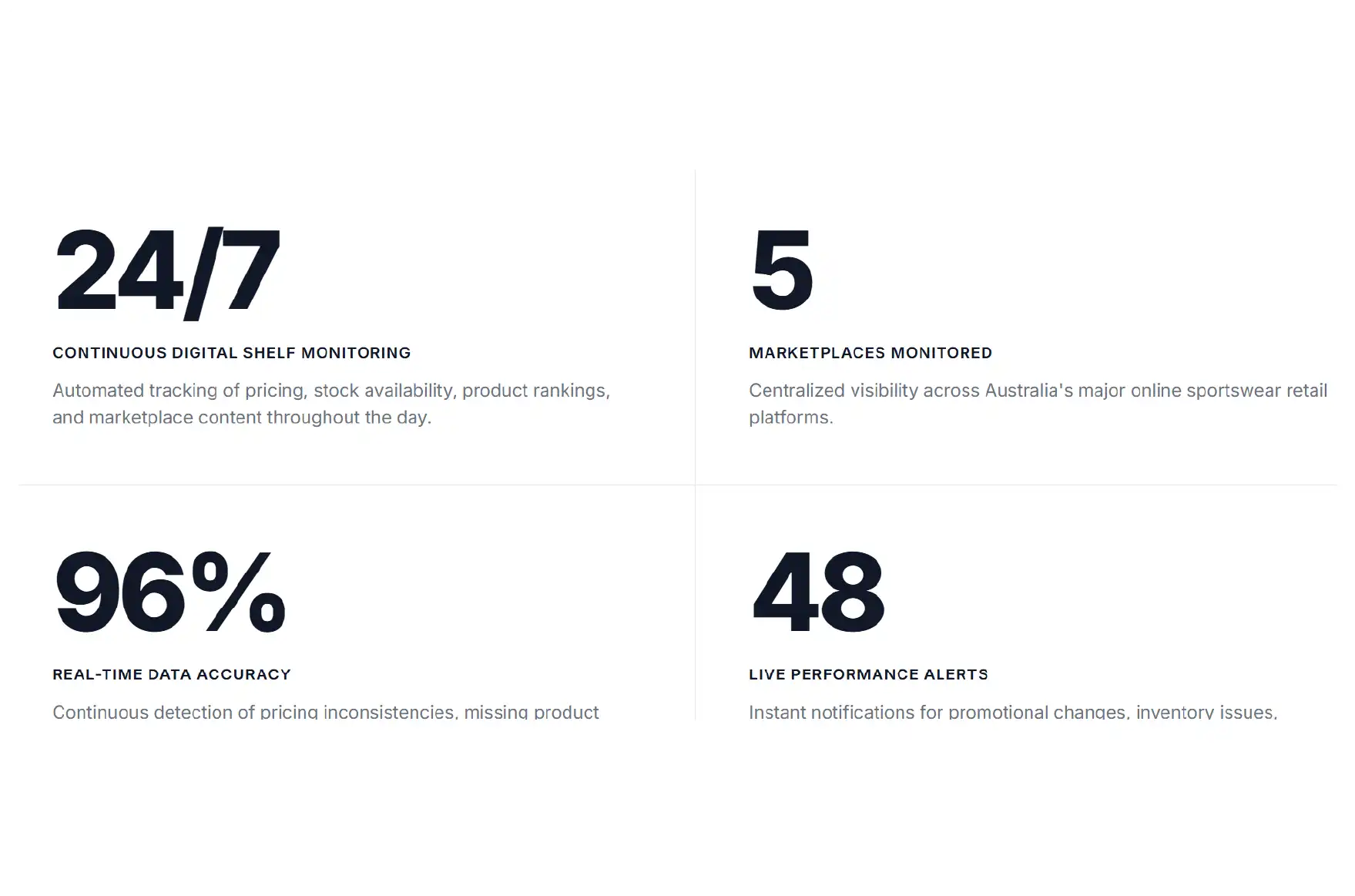
Continuous marketplace monitoring enabled the client to identify pricing fluctuations, promotional changes, and inventory shortages almost immediately after they occurred.
Instead of discovering pricing inconsistencies days later, automated alerts notified pricing managers whenever competitors adjusted prices, retailers launched promotions, or products became unavailable.
This proactive visibility allowed pricing teams to respond quickly, maintain competitive positioning, reduce lost sales opportunities, and improve promotional planning across multiple retail channels.
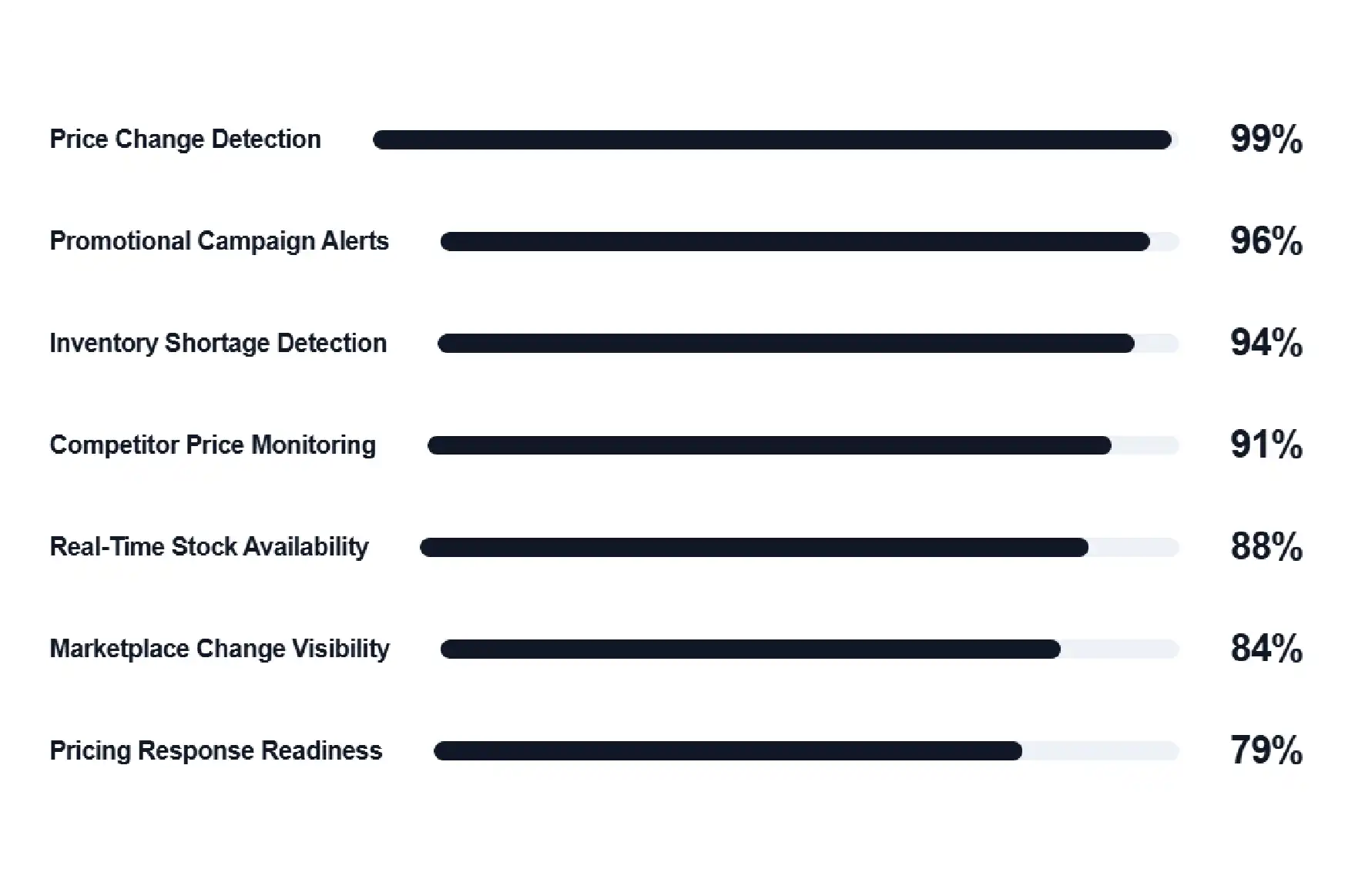
Automated product content validation significantly improved catalog consistency across marketplaces.
The platform continuously compared titles, descriptions, images, specifications, bullet points, and product attributes against predefined quality standards. Missing information, duplicate content, incorrect specifications, and inconsistent branding were automatically identified and prioritized for correction.
As product content quality improved, customers experienced more accurate product information, leading to higher engagement, improved search visibility, and increased conversion rates.
Product Intelligence Metrics
| Metric | Insight Captured | Business Impact |
|---|---|---|
| Price Consistency | Marketplace price comparison | Reduced pricing conflicts |
| Inventory Availability | Stock status monitoring | Faster replenishment decisions |
| Content Accuracy | Product information validation | Improved customer experience |
| Customer Ratings | Average rating trends | Better reputation management |
| Review Sentiment | Positive, neutral, negative feedback | Product improvement opportunities |
| Search Visibility | Marketplace ranking performance | Increased product discoverability |
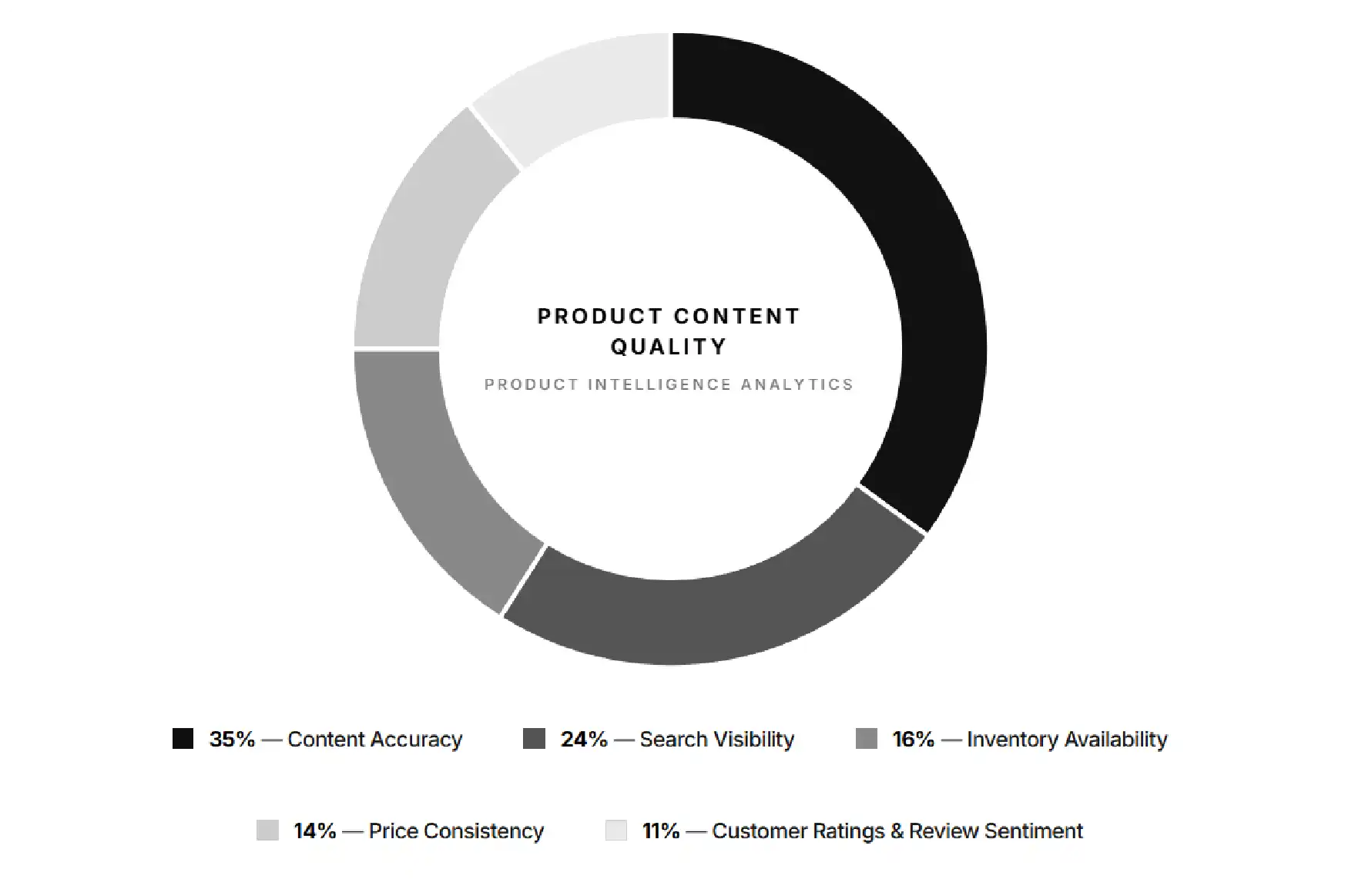
The digital shelf intelligence platform enabled continuous monitoring across hundreds of brands, thousands of SKUs, and multiple online marketplaces simultaneously.
Unlike manual processes, the automated system processed large datasets efficiently while maintaining high accuracy and consistency. Category managers could compare competitor pricing, monitor assortment expansion, identify new product launches, evaluate promotional strategies, and benchmark marketplace performance from a single centralized dashboard.
The scalable architecture ensured that growing product catalogs and expanding marketplace coverage did not impact reporting speed or analytical accuracy, providing executives with enterprise-wide digital commerce intelligence.
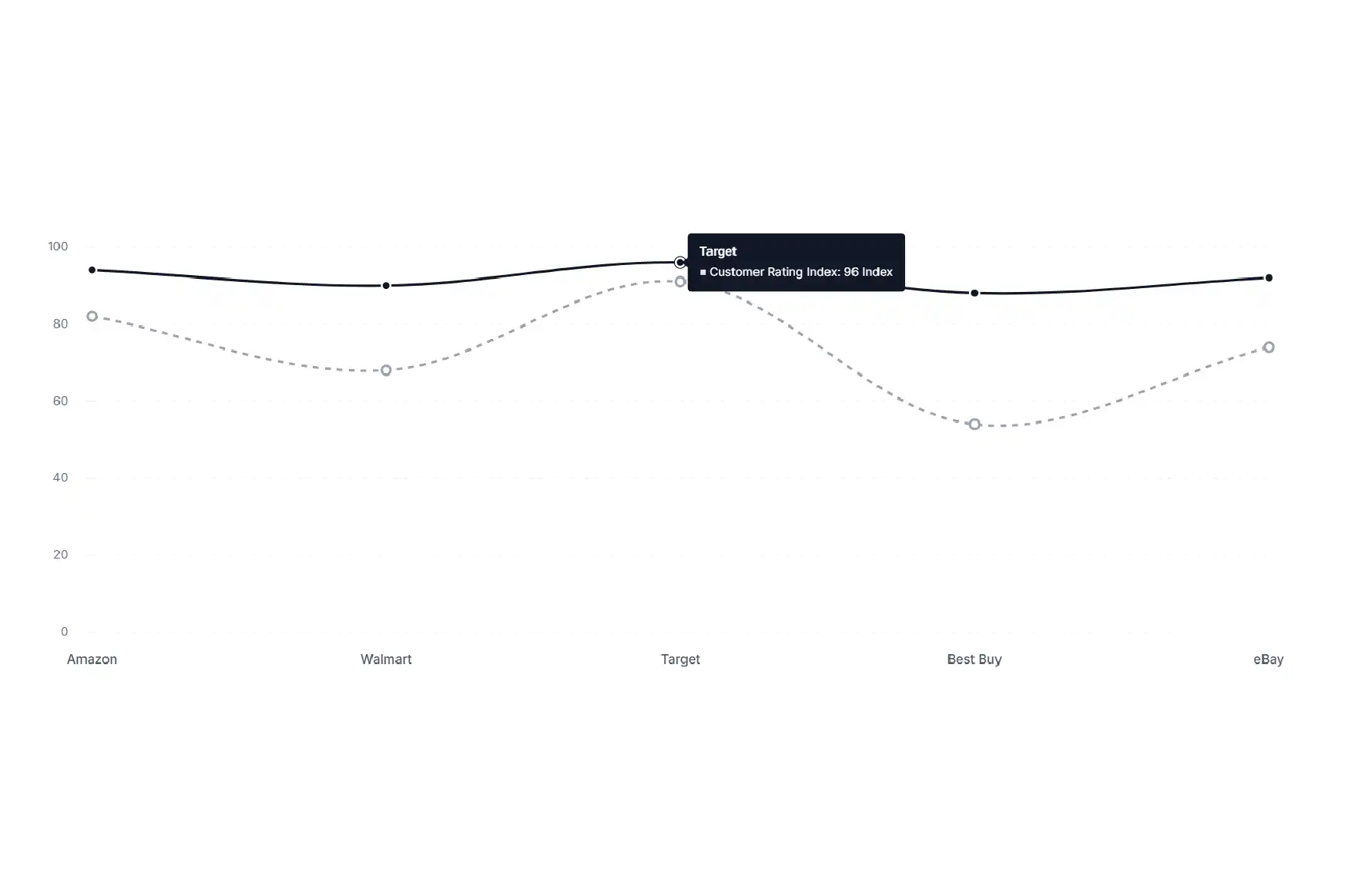
The following dataset illustrates marketplace performance across selected products, highlighting differences in pricing, availability, customer sentiment, ratings, and search visibility. It demonstrates how automated digital shelf monitoring converts raw marketplace information into structured business intelligence.
| Product | Marketplace | Price | Availability | Rating | Reviews | Search Rank |
|---|---|---|---|---|---|---|
| Wireless Earbuds | Amazon | $79 | In Stock | 4.7 | 8,420 | #3 |
| Bluetooth Speaker | Walmart | $95 | Low Stock | 4.5 | 5,680 | #6 |
| Smart Watch | Target | $199 | In Stock | 4.8 | 11,350 | #2 |
| Gaming Mouse | Best Buy | $49 | Out of Stock | 4.4 | 3,290 | #8 |
| Laptop Backpack | eBay | $39 | In Stock | 4.6 | 4,980 | #5 |
Following implementation of the digital shelf monitoring platform, the client achieved measurable improvements across marketplace operations, pricing strategy, merchandising efficiency, and customer engagement.
Our digital shelf intelligence framework enables organizations to centralize product information from multiple online marketplaces into a unified analytics platform. By consolidating pricing, product content, inventory availability, customer ratings, reviews, promotions, and competitive data, businesses eliminate fragmented reporting and gain a single source of truth for marketplace performance.
The platform continuously monitors digital commerce activity, helping brands respond quickly to pricing fluctuations, stock shortages, competitor launches, promotional campaigns, and changing customer behavior. This real-time visibility allows merchandising, marketing, and pricing teams to make informed decisions while improving operational responsiveness across global e-commerce ecosystems.
Advanced validation and cleansing pipelines ensure data accuracy by removing duplicate records, standardizing product attributes, validating catalog information, and detecting inconsistencies before they impact reporting. This creates reliable datasets that support forecasting, assortment planning, pricing optimization, and executive decision-making with greater confidence.
Built on a highly scalable architecture, the solution efficiently processes millions of marketplace records while maintaining high performance and analytical accuracy. Whether monitoring hundreds or thousands of products across numerous retailers, the platform delivers consistent intelligence without compromising speed or reliability.
Ultimately, our approach transforms raw marketplace information into structured business intelligence, empowering organizations to optimize product visibility, strengthen competitive positioning, improve customer experience, and drive sustainable digital commerce growth.
"The digital shelf monitoring solution has completely transformed the way we manage our online marketplace operations. We now have continuous visibility into pricing, inventory, product content, customer reviews, and competitor activities across every major marketplace we operate in. Automated dashboards have replaced time-consuming manual reporting, enabling our teams to make faster and more confident decisions. The quality of the data, speed of delivery, and scalability of the platform have exceeded our expectations while significantly improving operational efficiency and marketplace performance."
— Vice President, Digital Commerce Strategy
The project successfully delivered a fully automated enterprise digital shelf intelligence platform capable of continuously monitoring product listings, pricing, promotions, inventory, ratings, reviews, and competitor activities across multiple global e-commerce marketplaces.
Implementation of Price Monitoring Services enabled continuous tracking of competitor pricing, promotional movements, discount strategies, and product availability. This helped pricing teams respond more quickly to market changes while maintaining pricing consistency and protecting profitability.
The platform also integrated Web Scraping API Services to automate high-frequency collection of marketplace data from multiple retail websites. Structured datasets were continuously updated and delivered into centralized business intelligence systems, providing accurate and reliable information for reporting, forecasting, and strategic planning.
To support long-term scalability, the organization deployed enterprise-grade Web Scraping Services, allowing the infrastructure to process growing volumes of marketplace data without compromising performance or analytical accuracy. Automated extraction pipelines eliminated manual monitoring while ensuring consistent, high-quality datasets across every monitored retailer.
As a result, the organization achieved faster decision-making, improved product visibility, stronger pricing governance, enhanced customer experience, and more effective competitive benchmarking. Digital commerce teams gained real-time access to marketplace intelligence, enabling proactive optimization of product listings, promotional strategies, inventory planning, and assortment decisions.
Overall, the project established a scalable foundation for data-driven e-commerce operations, delivering measurable improvements in operational efficiency, marketplace performance, and return on investment while positioning the client for sustained growth in an increasingly competitive digital retail landscape.
Digital shelf monitoring is the continuous process of tracking product listings, prices, inventory, promotions, ratings, reviews, and product content across online marketplaces. It helps brands maintain accurate listings, improve visibility, monitor competitors, and optimize overall marketplace performance.
Automated monitoring eliminates manual product tracking by continuously collecting marketplace data in real time. Businesses can quickly identify pricing changes, stock shortages, content inconsistencies, customer feedback trends, and competitor activities, enabling faster and more informed business decisions.
A digital shelf intelligence platform can monitor product titles, descriptions, specifications, images, prices, discounts, inventory availability, Buy Box ownership, search rankings, seller information, customer ratings, product reviews, promotional campaigns, and assortment changes across multiple online retailers.
Yes. The platform is designed to process millions of marketplace records across hundreds of retailers and thousands of products while maintaining high performance, data accuracy, and reporting reliability. It easily scales as product catalogs and marketplace coverage continue to grow.
Digital shelf intelligence is valuable for consumer packaged goods (CPG), retail, electronics, fashion, beauty, grocery, healthcare, home furnishings, automotive, and any industry that sells products through e-commerce marketplaces. It supports pricing optimization, competitive intelligence, catalog management, customer experience improvement, and data-driven digital commerce strategies.
Partner with iWeb Data Scraping to gain real-time marketplace intelligence, automate product monitoring, and transform e-commerce data into actionable insights that drive growth and competitive advantage.
Start a project