

Introduction
The healthcare industry depends on accurate, accessible, and regularly updated provider information. Patients want to find qualified doctors, compare medical specialties, identify nearby clinics, and access hospital services without spending hours searching across multiple websites. Healthcare businesses, insurance companies, medical technology providers, and online healthcare platforms also need reliable provider information to improve their services and make informed business decisions.
However, doctor information is distributed across numerous public sources, including hospital websites, medical association directories, government databases, clinic portals, healthcare marketplaces, and professional registration platforms. Collecting this information manually is time-consuming, particularly when businesses need to monitor thousands of healthcare professionals across multiple locations.
This is where web scraping doctor data becomes valuable. Automated extraction technologies collect publicly available information from different online sources and organize it into structured, searchable databases. These databases make it easier to identify healthcare professionals, track practice locations, and maintain comprehensive provider directories.
By using doctor directory data, businesses can develop centralized information systems containing physician profiles, qualifications, specialties, clinic addresses, contact details, and affiliated healthcare facilities. With appropriate source permissions, privacy safeguards, and validation procedures, web scraping can transform scattered public information into useful healthcare intelligence.
1. Understanding Web Scraping for Healthcare Provider Directories
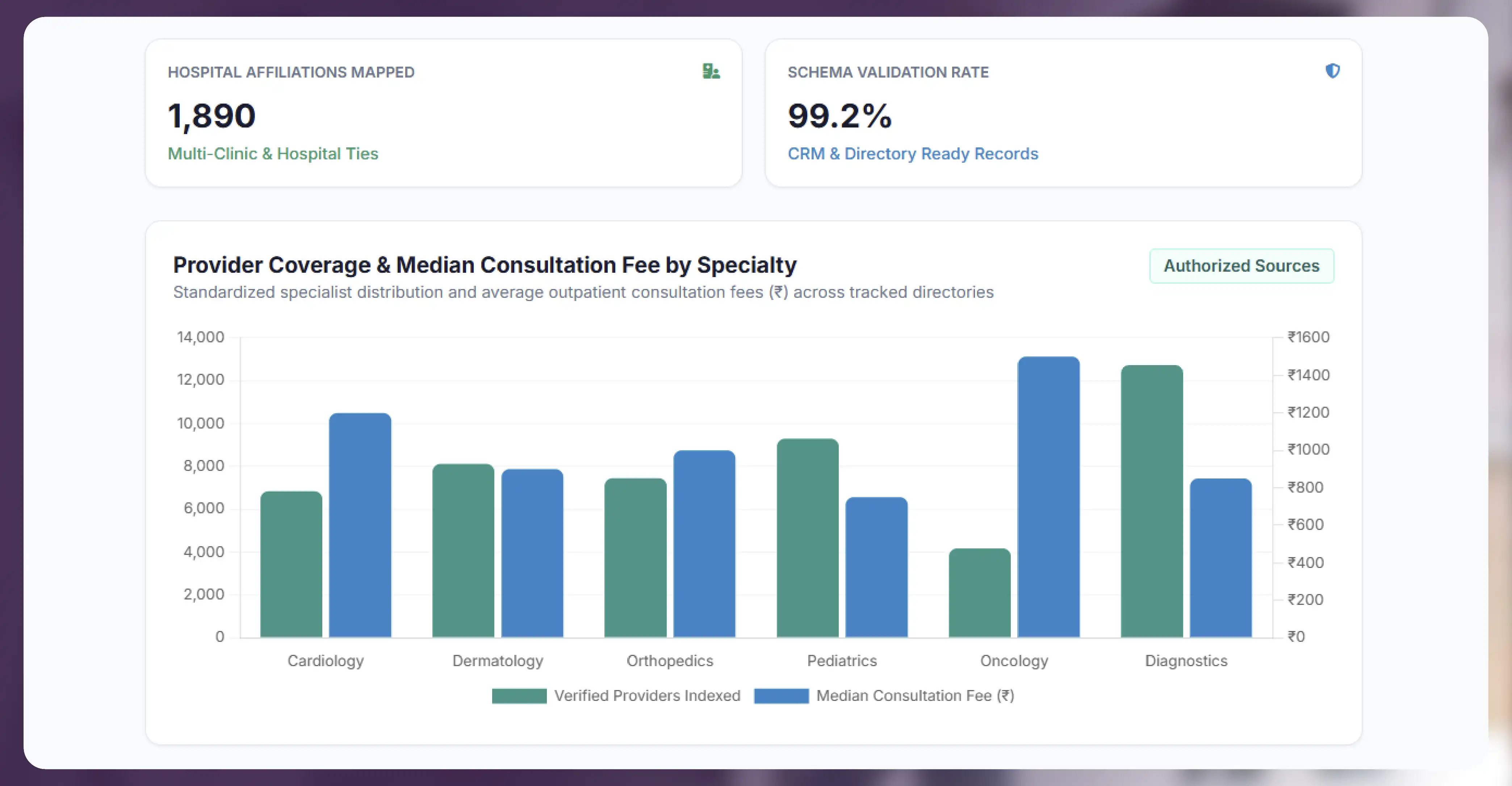
Healthcare provider directories are organized databases containing information about doctors, specialists, medical practitioners, clinics, hospitals, and other healthcare facilities. They help patients discover suitable providers while enabling businesses to understand healthcare service availability across different markets.
Traditionally, these directories were developed through manual research, individual provider submissions, and partnerships with healthcare organizations. Although these methods remain useful, they can create information gaps when providers change locations, update their specialties, modify contact details, or discontinue services.
Automated healthcare provider data scraping helps address these challenges by collecting publicly accessible information from authorized online sources. Depending on the website and applicable permissions, extraction systems can capture provider names, professional qualifications, specialties, practice locations, facility affiliations, and publicly listed contact information.
The collected information can then be standardized, validated, categorized, and transferred into databases, spreadsheets, CRM systems, or healthcare directory platforms.
2. Important Public Sources for Doctor and Healthcare Data

The quality of a provider directory depends heavily on the sources used to build it. Combining multiple credible sources improves coverage and makes verification easier.
Government Healthcare Databases
Government databases are important starting points for building structured healthcare directories. In the United States, the National Plan and Provider Enumeration System (NPPES), maintained by CMS, provides publicly accessible National Provider Identifier information.
Its downloadable files and NPI Registry support research into provider names, organization details, taxonomy classifications, and practice addresses. However, an NPI record does not independently establish an active license, current practice status, or clinical quality.
Other useful resources include CMS Care Compare, which provides information about participating hospitals, clinicians, and healthcare facilities through different datasets and comparison tools.
Hospital and Clinic Websites
Hospital websites frequently publish detailed information about their medical teams, departments, specialties, appointment channels, and facility locations.
Scraping permitted public pages can help businesses collect:
- Doctor names and professional designations.
- Medical specialties and sub-specialties.
- Hospital and clinic affiliations.
- Department information.
- Practice addresses and locations.
- Public appointment contact details.
- Consultation availability, where published.
Medical Associations and Professional Directories
Medical associations and professional organizations may maintain directories containing registered members, specialist information, and professional credentials.
These sources can help identify practitioners within particular medical disciplines. However, businesses should review membership-directory restrictions, licensing requirements, and website terms before collecting or reusing information.
Public Health Portals and Registration Platforms
State medical councils, national healthcare authorities, and official registration platforms can provide additional professional information. Their usefulness varies by jurisdiction, data availability, and publication policies.
Cross-referencing these sources helps identify inconsistencies between provider profiles and official registration records.
3. What Information Should a Doctor Directory Include?
A useful healthcare directory should contain more than basic names and telephone numbers. Businesses should define a consistent data structure before beginning extraction.
Important information fields include:
| Data Category | Information to Collect |
|---|---|
| Provider Identity | Doctor name, professional title, unique provider ID |
| Professional Details | Qualifications, certifications, registration details |
| Specialization | Primary specialty, sub-specialty, medical discipline |
| Practice Information | Clinic name, hospital affiliation, department |
| Location | Street address, city, state, postal code |
| Contact Information | Public phone number, official email, website |
| Appointment Details | Public booking link, consultation timings |
| Facility Information | Hospital name, facility type, available departments |
| Source Information | Original URL, collection date, verification status |
Collecting physician listings data in a standardized format allows businesses to create searchable profiles and filter doctors according to specialty, geography, qualifications, and healthcare affiliations.
For example, a healthcare platform could identify all publicly listed cardiologists in Mumbai, compare their practice locations, and organize the results by hospital affiliation. An insurance company could use similar information to review provider network coverage.
The objective is to create a reliable directory rather than simply accumulate large volumes of unverified records.
4. How the Web Scraping Process Works?
Building a healthcare provider directory requires a structured extraction and data-processing workflow. A well-designed system typically follows these stages.
Step 1: Identify Relevant Sources
The first stage involves identifying government databases, hospital websites, medical association portals, clinic directories, and other authorized public sources.
Businesses should evaluate source credibility, data availability, access restrictions, and update frequency before selecting websites for collection.
Step 2: Extract Publicly Available Information
Automated scraping systems collect relevant information from permitted webpages and downloadable datasets.
Depending on source structure, extraction methods may include HTML parsing, structured data extraction, API integration, and document processing. JavaScript-rendered websites may require additional browser-based extraction techniques.
Step 3: Organize and Standardize Records
Different sources frequently use different formats. One website may display a specialty as ENT, while another uses otolaryngology.
Data standardization maps these variations into consistent categories. Address formats, professional titles, specialty labels, and telephone formats can also be normalized.
Step 4: Remove Duplicate Records
The same doctor may appear on several hospital websites, medical directories, and professional registration platforms.
Duplicate detection can use combinations of provider identifiers, names, registration numbers, addresses, and affiliated organizations. Matching systems should preserve multiple legitimate practice locations instead of incorrectly treating them as duplicate profiles.
Step 5: Validate and Enrich Information
Collected information should be cross-checked against authoritative sources wherever possible.
For example, a provider's registration information can be checked against the relevant medical regulator, while hospital affiliations can be compared with official facility directories.
Missing information should remain marked as unavailable rather than being automatically assumed.
Step 6: Schedule Regular Updates
Healthcare information changes frequently. Doctors relocate, clinics open new branches, hospitals update departments, and practitioners modify their professional profiles.
Automated monitoring can identify changes and trigger revalidation. Monthly or weekly refresh schedules may work for some datasets, while frequently changing appointment information may require more regular checks.
5. Clinic and Hospital Data Extraction for Location-Based Directories
A comprehensive provider directory should cover healthcare facilities alongside individual practitioners.
Clinic and hospital data extraction helps businesses build facility-level databases containing information about healthcare organizations and their service locations.
Useful fields include:
- Hospital and clinic names.
- Facility categories and ownership information, where publicly available.
- Branch locations and addresses.
- Medical departments and specialties.
- Public contact information.
- Published operating hours.
- Emergency service information, where listed.
- Official websites and appointment portals.
- Publicly disclosed accreditation information.
This information supports location-based healthcare discovery.
For example, a patient-facing platform could identify hospitals offering oncology, orthopaedics, dermatology, and maternity services across different cities.
Healthcare businesses could also use facility-level datasets to understand which locations have particular specialties and where additional service coverage may be needed.
An important distinction is that a listed facility or advertised service should not automatically be interpreted as proof of current service availability. Information should be verified with the relevant provider before being presented as confirmed.
6. Business Applications of Healthcare Provider Directories
Structured healthcare directories create opportunities across multiple industries.
Healthcare Aggregators and Discovery Platforms
Online healthcare platforms can use provider databases to develop searchable doctor profiles. Patients can filter professionals by location, specialty, qualifications, and affiliated facilities.
Regular updates also help platforms identify outdated listings and improve directory completeness.
Insurance Companies and TPA Networks
Insurance companies can analyze public provider information to understand the geographic distribution of hospitals, clinics, and medical specialists.
When combined with their authorized internal network records, public information can help identify potential coverage gaps and opportunities for provider-network expansion.
Pharmaceutical and Medical Device Companies
Pharmaceutical companies can use appropriately sourced professional directory information for territory planning and understanding the distribution of medical specialties.
Medical device businesses can identify hospitals and healthcare facilities that publicly list relevant departments, supporting market research and account segmentation.
Such datasets should not be used to infer individual prescribing behaviour or obtain confidential patient information.
Healthcare Recruitment Platforms
Recruitment companies can use public professional information to identify potential candidates by specialty, qualifications, and geographic location.
Provider directories can also help recruitment platforms understand regional concentrations of different medical professionals.
Healthcare Market Research Companies
Market research organizations can combine provider and facility information with publicly available demographic and healthcare infrastructure datasets.
This helps analyze specialist distribution, facility density, geographic coverage, and potential market opportunities.
7. Data Quality Challenges and How to Address Them
Building healthcare directories involves several challenges that can affect accuracy and usability.
| Challenge | Recommended Solution |
|---|---|
| Duplicate doctor profiles | Use identifier-based matching and record linkage |
| Outdated addresses | Schedule periodic source verification |
| Inconsistent specialties | Apply standardized taxonomy classifications |
| Missing contact details | Retain null values and track completeness |
| Conflicting qualifications | Prioritize authoritative registration sources |
| Multiple practice locations | Maintain separate location records |
| Incorrect facility affiliations | Cross-check official hospital profiles |
| Website structure changes | Monitor extraction performance and update parsers |
One particularly important issue is distinguishing professional registration from actual practice status.
For example, CMS clearly states that obtaining an NPI does not establish that a healthcare provider is licensed or credentialed. Consequently, businesses should not treat an NPI record as independent proof of professional eligibility.
Similarly, an outdated hospital profile should not automatically be considered evidence of an active affiliation.
A reliable directory therefore needs source-level traceability, verification timestamps, confidence indicators, and clearly defined update procedures.
8. Compliance, Privacy, and Responsible Data Collection
Healthcare provider information requires careful handling, even when collected from publicly accessible websites.
Public availability does not automatically mean unrestricted collection, redistribution, or commercial reuse.
Businesses should consider the following practices:
- Review website terms of service and applicable data-use restrictions.
- Follow robots.txt instructions and relevant access policies.
- Respect rate limits and avoid excessive server requests.
- Use official APIs and bulk downloads where available.
- Avoid authentication bypasses and restricted databases.
- Collect only information necessary for the intended business purpose.
- Avoid patient records, medical histories, and confidential clinical information.
- Maintain appropriate security, access controls, and data-retention policies.
- Review applicable privacy and data-protection requirements in each operating jurisdiction.
In the United States, HIPAA obligations depend on the organization's role and the nature of the information handled. Public professional directory information should not be confused with protected health information obtained through patient-care or covered-entity systems.
In India, businesses should also assess applicable requirements under the Digital Personal Data Protection Act and other relevant laws, particularly when personal contact details or information connected to identifiable individuals are processed.
Responsible collection is essential for building sustainable healthcare data products.
9. Emerging Trends in Healthcare Directory Data Collection
Healthcare directories are becoming more sophisticated as data engineering, automation, and healthcare interoperability improve.
- AI-powered data validation: Machine learning can identify inconsistent provider names, classify medical specialties, and flag potentially duplicated profiles. Human verification remains important for consequential credential information.
- API-first data integration: Businesses are increasingly combining authorized APIs, downloadable government datasets, and permitted website extraction instead of depending exclusively on HTML scraping.
- Healthcare interoperability: Standardized formats such as FHIR can support the exchange of healthcare information between compatible systems. Directory-related implementations may use healthcare practitioner and organization resources, subject to the capabilities and requirements of participating systems.
- Geospatial provider mapping: Address normalization and geographic mapping help businesses understand provider distribution across cities, districts, and underserved areas.
- Automated change detection: Scheduled monitoring can identify changes in doctor profiles, facility addresses, published specialties, and contact information, helping businesses maintain fresher directories.
- Source-level data provenance: Recording where each field originated, when it was collected, and when it was last verified makes healthcare databases easier to audit and maintain.
These developments are shifting healthcare directories from static contact lists into continuously maintained information resources.
10. How iWeb Data Scraping Can Help You?
iWeb Data Scraping helps businesses build accurate and scalable healthcare provider directories from authorized public sources.
1. Comprehensive Provider Discovery
iWeb Data Scraping collects publicly available doctor profiles from authorized sources, helping businesses build centralized directories covering specialties, qualifications, professional details, and practice locations across multiple healthcare markets.
2. Accurate Data Standardization
Our data processing solutions normalize provider names, specialties, addresses, and facility information, making healthcare directories consistent, searchable, easier to manage, and suitable for business intelligence applications.
3. Multi-Source Data Collection
iWeb combines information from permitted government portals, hospital websites, clinic directories, and professional platforms, expanding provider coverage while maintaining source references and traceability for collected records.
4. Continuous Directory Updates
Automated monitoring identifies changes in published provider information, helping businesses refresh contact details, practice locations, hospital affiliations, and specialties through scheduled collection and verification workflows.
5. Flexible Data Delivery
iWeb provides structured healthcare datasets through customized formats, APIs, and database integrations, enabling healthcare platforms, insurers, researchers, and businesses to incorporate provider intelligence into existing systems.
Conclusion
Building a comprehensive healthcare directory requires more than collecting doctor names and contact information. Businesses need structured, validated, and regularly refreshed records that connect medical professionals with their specialties, practice locations, and affiliated healthcare facilities.
A well-designed healthcare market data strategy enables healthcare platforms, insurance providers, pharmaceutical companies, and market research organizations to understand provider distribution, identify service coverage opportunities, and improve business planning.
With web scraping doctor data, businesses can transform information scattered across public healthcare sources into organized datasets that support provider discovery, competitive research, geographic analysis, and healthcare directory development.
iWeb Data Scraping helps businesses collect, standardize, validate, and maintain publicly available healthcare information through customized data extraction solutions. By combining responsible collection practices with automated data processing, organizations can build scalable healthcare intelligence systems and make more informed decisions.
Frequently Asked Questions (FAQs)
Web scraping doctor data is the automated process of collecting publicly accessible healthcare provider information from permitted websites, government databases, hospital directories, and professional platforms to build structured doctor databases.
Businesses can collect publicly listed doctor names, specialties, qualifications, registration details, practice addresses, hospital affiliations, clinic information, official websites, and published appointment contact details, subject to applicable permissions and restrictions.
Useful sources include CMS NPPES, the CMS Provider Data Catalog, medical council registries, hospital websites, clinic directories, medical associations, and authorized healthcare information platforms.
Update frequency depends on source availability and business requirements. Weekly or monthly updates may suit professional profiles, while frequently changing practice details may require more frequent monitoring and verification.
iWeb Data Scraping provides customized extraction, data cleaning, deduplication, standardization, validation, and structured data delivery to help businesses develop scalable healthcare provider directories from authorized public sources.