
52.6K+
TOTAL PROPERTY LISTINGS PROCESSED

Extract NoBroker Property Data for Real Estate Market Intelligence and Demand Analysis
This case study is based on a real-world enterprise scenario where a real estate intelligence and analytics team leverages large-scale property marketplace data extraction through advanced methods to transform online housing listings into structured business intelligence for pricing analysis, demand forecasting, property research, and buyer behavior tracking.
It is designed for:
The client’s primary objective was to convert continuously changing property marketplace information into a centralized intelligence system. Through structured extraction techniques, they aimed to monitor listings, understand buyer demand, and analyze market movements more effectively.
By implementing solutions to Extract NoBroker property data, the organization gained access to structured information covering property details, locations, pricing trends, amenities, and listing performance indicators. The extracted insights enabled deeper market understanding and improved property research workflows.
The increasing complexity of housing markets created a requirement for accurate pricing intelligence. With NoBroker property price data scraping, the client was able to analyze property rates, compare locality-wise variations, and identify pricing opportunities across different regions.
The overall objective was to replace manual property tracking with an automated real estate intelligence framework capable of delivering faster insights and supporting better investment and marketing decisions.
A recent real estate analytics initiative explored how businesses can leverage online property marketplace intelligence to improve housing market analysis and decision-making. The client implemented advanced data extraction pipelines to capture property listings, pricing information, and demand signals from digital real estate platforms.
The project enabled analysts to understand buyer preferences and market movements by processing large volumes of property information. Using structured datasets, teams analyzed location trends, property categories, price variations, and availability patterns across multiple cities.
The implementation helped organizations perform Homebuyer demand analytics From NoBroker by identifying popular locations, frequently searched property types, and changing buyer interest patterns. These insights supported more effective property marketing strategies and demand forecasting.
The system was also designed to Scrape NoBroker Property Sale Listings Data, enabling continuous monitoring of residential sale properties, pricing updates, locality performance, and inventory movement.
Through automated pipelines, the client achieved reliable NoBroker Property availability Data Extraction to track active listings, understand supply conditions, and identify areas with increasing or declining property availability.
The extracted real estate intelligence was transformed into dashboards and analytical reports, allowing stakeholders to make faster decisions regarding property investments, pricing strategies, and market expansion opportunities.
Overall, the case study demonstrated how real estate data extraction solutions can convert scattered online property information into actionable market intelligence for modern housing businesses.
The client operated in a highly competitive real estate environment where property listings, prices, and buyer preferences changed frequently. Traditional methods of collecting property information were slow, inconsistent, and unable to provide accurate real-time market visibility.
One of the major challenges was understanding regional housing demand patterns. Without automated insights, it was difficult to perform City-wise housing demand tracking From NoBroker and identify which locations were experiencing increased buyer interest, higher property searches, or changing investment potential.
The client also faced difficulties in monitoring large volumes of property inventory across different locations. Manual research methods limited their ability to Track housing demand across Indian cities From NoBroker, making it challenging to compare market opportunities and predict future housing trends.
Another significant challenge was the lack of structured property intelligence from online marketplaces. Raw listing information needed to be collected, cleaned, categorized, and converted into usable datasets for analytics.
The organization required accurate nobroker.in Real Estate Data Scraping capabilities to gather property details such as location, price, configuration, availability status, amenities, and listing information.
Additional challenges included:
To overcome these limitations, the client needed a scalable real estate intelligence solution capable of collecting, processing, and analyzing property marketplace data continuously while maintaining accuracy and consistency.
By adopting an automated approach to extract and analyze property marketplace information, the client replaced manual property research workflows with a structured intelligence pipeline. The system continuously captured property listings, pricing movements, locality trends, and availability signals, enabling faster market analysis and improved real estate decision-making.
| City | Property Type | Monthly Rent Range | Demand Score | Availability | Top Demand Signal |
|---|---|---|---|---|---|
| Sofia | 2 BHK Apartment | €600 - €950/month | 9.1/10 | High | Urban Rental Demand |
| Plovdiv | 1 BHK Apartment | €350 - €650/month | 8.5/10 | Medium | Student Housing Demand |
| Varna | Apartment | €500 - €850/month | 8.7/10 | High | Coastal Rental Market |
| Burgas | Residential Flat | €450 - €750/month | 8.2/10 | Medium | Family Rental Demand |
| Ruse | Apartment | €300 - €550/month | 7.9/10 | High | Affordable Housing Segment |
The brand in focus is a growing real estate intelligence organization operating in India’s dynamic residential property ecosystem. The company focuses on collecting, organizing, and analyzing property marketplace information to understand housing trends, buyer preferences, pricing movements, and availability patterns.
As the real estate market expanded across metropolitan and emerging cities, the organization faced increasing challenges in tracking thousands of property listings, changing prices, and shifting buyer requirements. Traditional methods were unable to provide complete visibility into market movements, resulting in slower insights and delayed business decisions.
To overcome these limitations, the company implemented an automated property intelligence framework powered by advanced data extraction and analytics technologies. The solution enabled continuous monitoring of residential listings, locality trends, and property performance indicators.
By transforming raw marketplace information into structured intelligence, the organization improved its ability to identify demand hotspots, compare pricing strategies, and understand housing market opportunities.
The platform helped stakeholders analyze property supply-demand relationships, evaluate location performance, and create data-backed strategies for real estate expansion, marketing campaigns, and customer engagement.
We delivered an end-to-end property intelligence solution that transformed unstructured marketplace information into structured analytical datasets using automated extraction pipelines, data processing frameworks, and scalable cloud infrastructure.
The system collected property information including location details, pricing, configurations, amenities, availability status, and listing attributes. The collected information was cleaned, standardized, and enriched to support advanced market analysis.
Using automated workflows, the solution enabled continuous monitoring of property listings, locality-level trends, and demand indicators. This helped the client identify pricing changes, emerging locations, and buyer preference patterns with improved accuracy.
The implementation generated comprehensive Real Estate Property Datasets containing structured property attributes, historical pricing signals, and market-level indicators required for analytics and forecasting.
Through advanced Real Estate Property Data Extraction, the system created a reliable data foundation for market intelligence dashboards, competitive analysis, and investment research.
The solution also integrated automated validation processes to remove duplicate listings, improve data consistency, and ensure high-quality information for decision-making.
Overall, the approach helped the client move from manual property research to a scalable real estate intelligence ecosystem capable of supporting continuous market analysis.
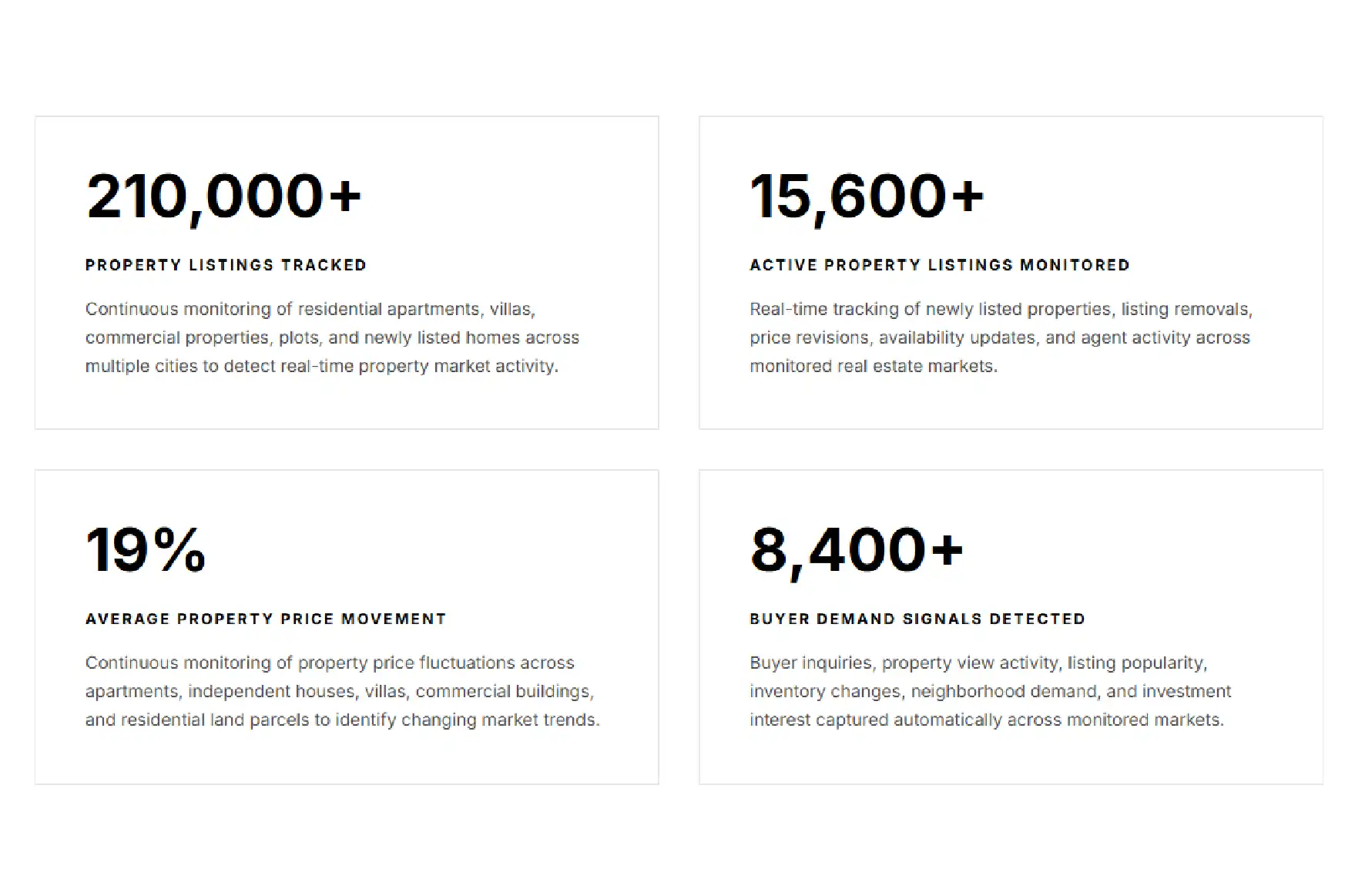
The implementation of continuous property data extraction enabled the client to gain real-time visibility into housing market activity across multiple locations. Instead of manually checking listings, the system monitored property additions, removals, price updates, and availability changes automatically.
This allowed the organization to understand market movements faster and identify areas experiencing increased buyer interest. Real-time property intelligence helped teams adjust pricing strategies, improve customer targeting, and respond quickly to changing market conditions.
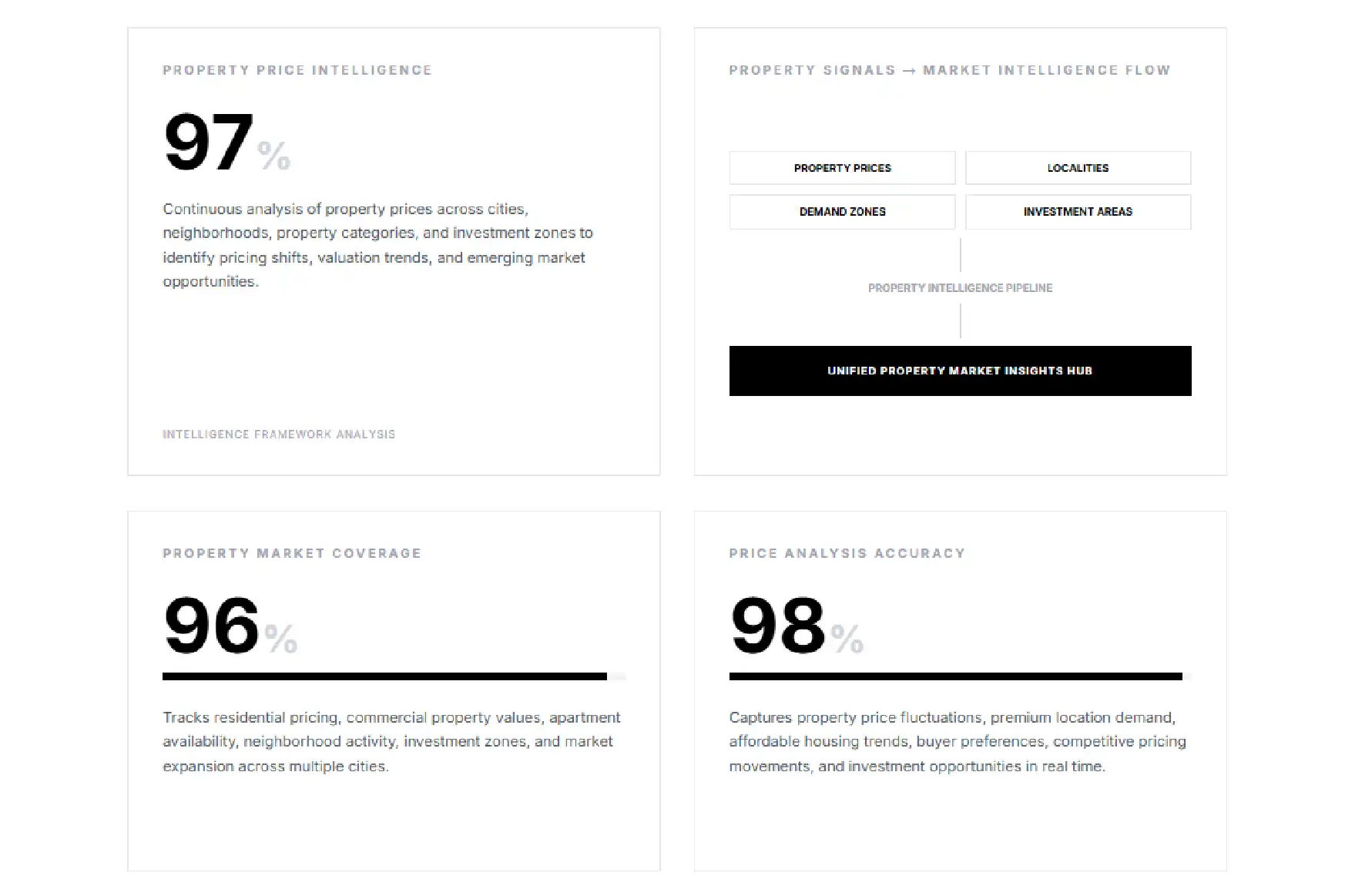
The structured data pipeline enabled accurate comparison of property prices across different cities, localities, and property categories. By analyzing pricing patterns, the client identified premium areas, affordable segments, and emerging investment opportunities.
The system helped stakeholders track price fluctuations and understand competitive positioning, allowing them to create better pricing strategies and improve market forecasting capabilities.
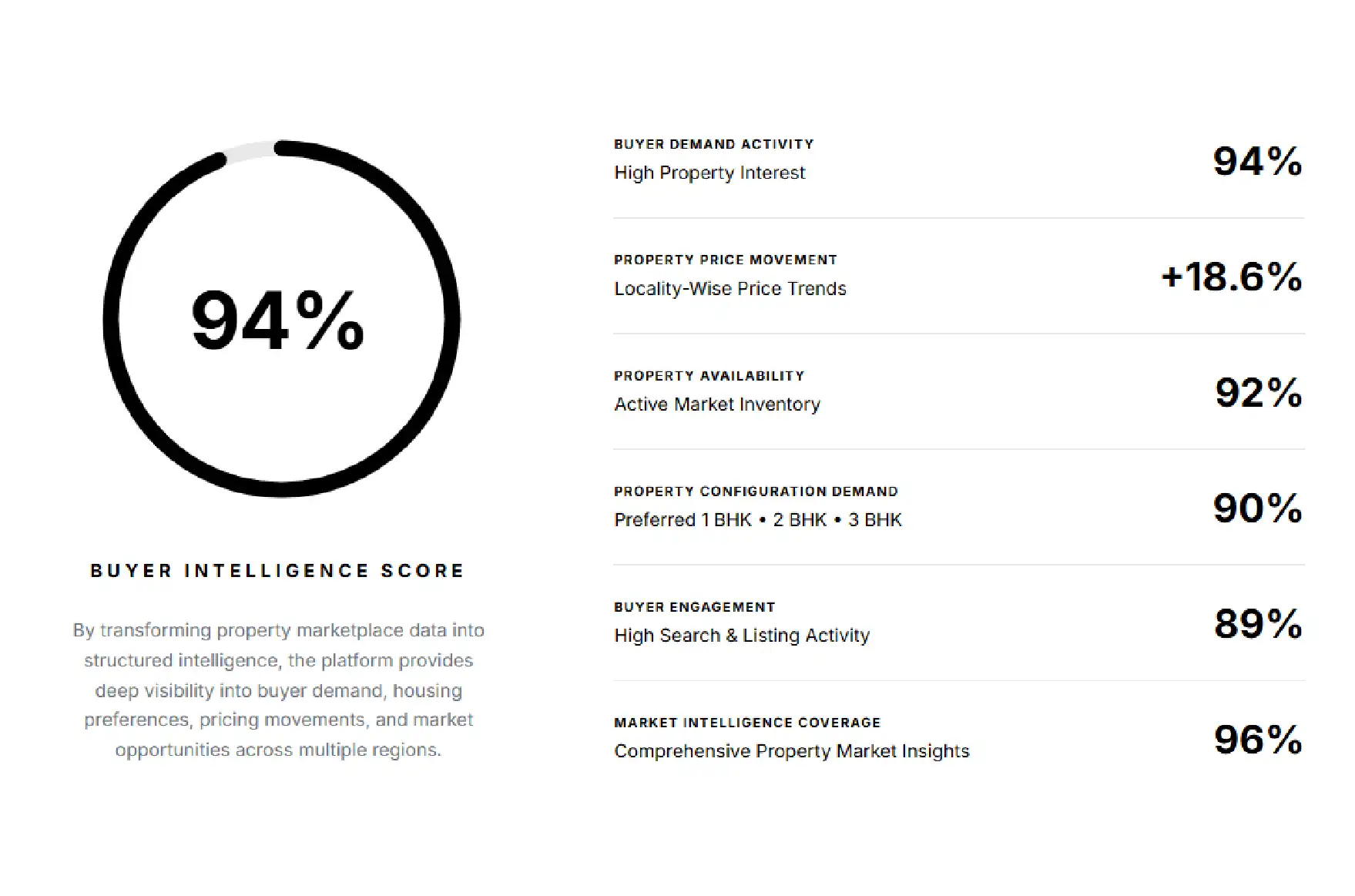
By converting property marketplace information into structured datasets, the solution enabled deeper analysis of buyer behavior and housing preferences.
The analytics system identified:
| Metric | Insight Captured | Business Impact |
|---|---|---|
| Search & Listing Activity | Buyer interest by location and property type | Better demand forecasting |
| Price Movement | Locality-wise property price changes | Improved pricing decisions |
| Availability Trends | Active vs unavailable properties | Inventory planning optimization |
| Property Configuration | Demand for BHK types and categories | Better customer targeting |
Key Observation:
The structured insights allowed the client to understand buyer expectations, optimize property recommendations, and improve overall market responsiveness.
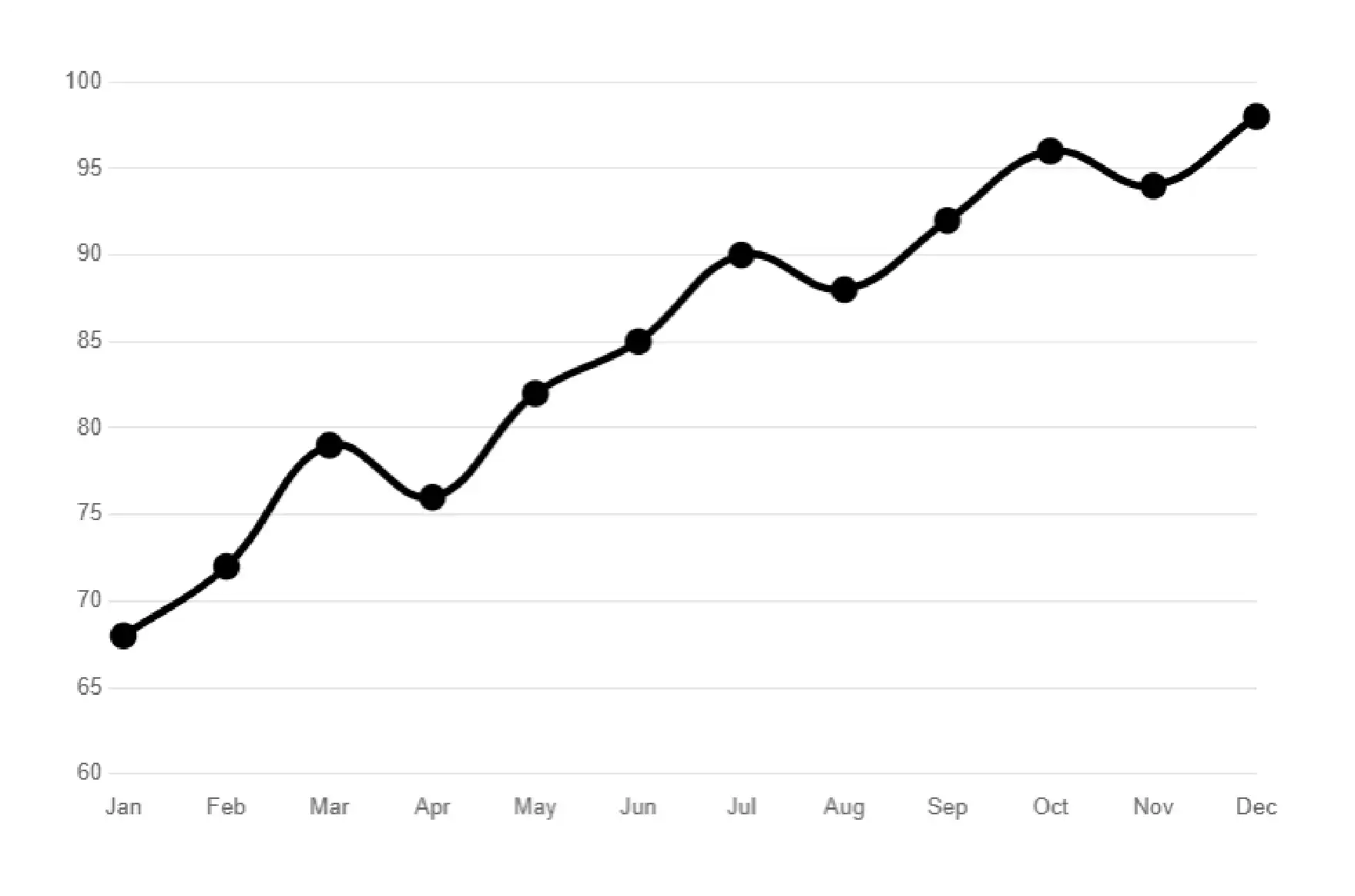
The automated system enabled large-scale monitoring of residential property markets across multiple cities simultaneously. Unlike manual research methods, the platform continuously processed high-volume property information while maintaining accuracy and consistency.
The scalable framework allowed the organization to analyze regional housing trends, compare city-level opportunities, and identify changing demand patterns faster.
This improved strategic planning by providing a complete view of property ecosystems across different markets.
The dataset snapshot represents property marketplace performance across different cities and residential categories. It highlights how pricing, availability, demand intensity, and location-wise engagement vary across markets. The analysis helped the client identify high-demand regions, popular property configurations, and pricing opportunities.
| City | Property Type | Avg Price Range | Demand Score | Availability | Top Demand Signal |
|---|---|---|---|---|---|
| Bangalore | Apartment | ₹85L – ₹1.6Cr | 9.2/10 | High | IT Corridor Housing |
| Mumbai | Flat | ₹1.2Cr – ₹2.8Cr | 8.7/10 | Medium | Premium Localities |
| Delhi NCR | Apartment | ₹65L – ₹1.5Cr | 8.4/10 | High | Family Housing Demand |
| Pune | Residential Flat | ₹55L – ₹1.1Cr | 8.9/10 | High | Affordable Premium Homes |
| Hyderabad | Apartment | ₹60L – ₹1.3Cr | 8.6/10 | Medium | New Development Areas |
Key Observation:
The dataset revealed strong variations in housing demand and pricing across cities. High-demand locations showed increased listing activity, stronger buyer interest, and faster inventory movement, enabling better market forecasting.
After implementing structured real estate intelligence through automated property data extraction, the client achieved significant improvements in market visibility, pricing analysis, demand forecasting, and operational efficiency.
Our real estate data intelligence approach enables businesses to collect, organize, and analyze large-scale property marketplace information through automated extraction frameworks. The solution eliminates fragmented research processes by consolidating property listings, pricing information, availability details, and market signals into a unified intelligence system.
The platform supports continuous market monitoring by tracking property movements, price changes, and location-wise demand patterns. This allows real estate businesses to identify emerging opportunities, evaluate competition, and respond quickly to changing buyer behavior.
Advanced data cleaning and validation methods remove duplicate listings, outdated records, and inconsistent information, ensuring that analytics teams work with accurate and reliable property datasets.
The system is designed for scalability, allowing organizations to process increasing volumes of property information across multiple cities while maintaining speed, accuracy, and performance.
By transforming raw property data into actionable insights, businesses gain stronger forecasting capabilities, improved market understanding, and better strategic planning support for real estate growth.
We are extremely satisfied with the real estate intelligence solution delivered by the team. The project helped us automate property data collection and transform scattered marketplace information into structured insights. Their approach improved our understanding of pricing trends, housing demand, and property availability across different markets.
The accuracy and speed of the system significantly reduced our manual research efforts and enabled our teams to make faster, data-backed decisions. The dashboards and analytical reports provided valuable visibility into market movements and customer preferences.
We now have a stronger foundation for property analysis, demand forecasting, and strategic planning. The solution has improved our operational efficiency and helped us respond more effectively to changing real estate trends.
— Head of Real Estate Analytics
The final outcome of the project was a scalable real estate intelligence platform that transformed raw property marketplace information into structured business insights. The client achieved faster decision-making capabilities with improved visibility into property pricing, availability trends, buyer demand, and market opportunities.
Implementation of Web Scraping API Services enabled continuous and reliable extraction of property information from multiple online sources while maintaining data consistency and accuracy.
The automated framework eliminated manual data collection challenges and improved operational efficiency by delivering continuously updated property datasets for analysis and reporting.
Deployment of Web Scraping Services further strengthened the infrastructure by enabling scalable data processing, supporting large volumes of property information without reducing performance.
As a result, the organization gained improved market forecasting capabilities, enhanced property research workflows, and stronger competitive positioning within the real estate industry.
Overall, the solution created a future-ready data ecosystem that supports smarter investment decisions, customer targeting, and long-term real estate growth.
Transform property data into actionable market intelligence with automated scraping solutions for faster decisions and growth.
Start a projectNoBroker property data scraping helps businesses collect structured information about property listings, prices, locations, configurations, availability, and market trends. This information supports real estate analytics, demand forecasting, and competitive research.
Property data extraction converts scattered online listings into organized datasets. Businesses can analyze pricing patterns, buyer demand, locality performance, and inventory trends to make faster and more accurate decisions.
Yes, automated systems can continuously monitor property listings and availability updates. This helps businesses identify new inventory, changing market conditions, and emerging housing opportunities.
Yes, the framework is designed to process large-scale property information across multiple cities and locations. It enables city-wise comparison, demand tracking, and market analysis at scale.
Real estate companies, property consultants, investment firms, developers, and analytics teams benefit from property data scraping by gaining better market intelligence and customer insights.