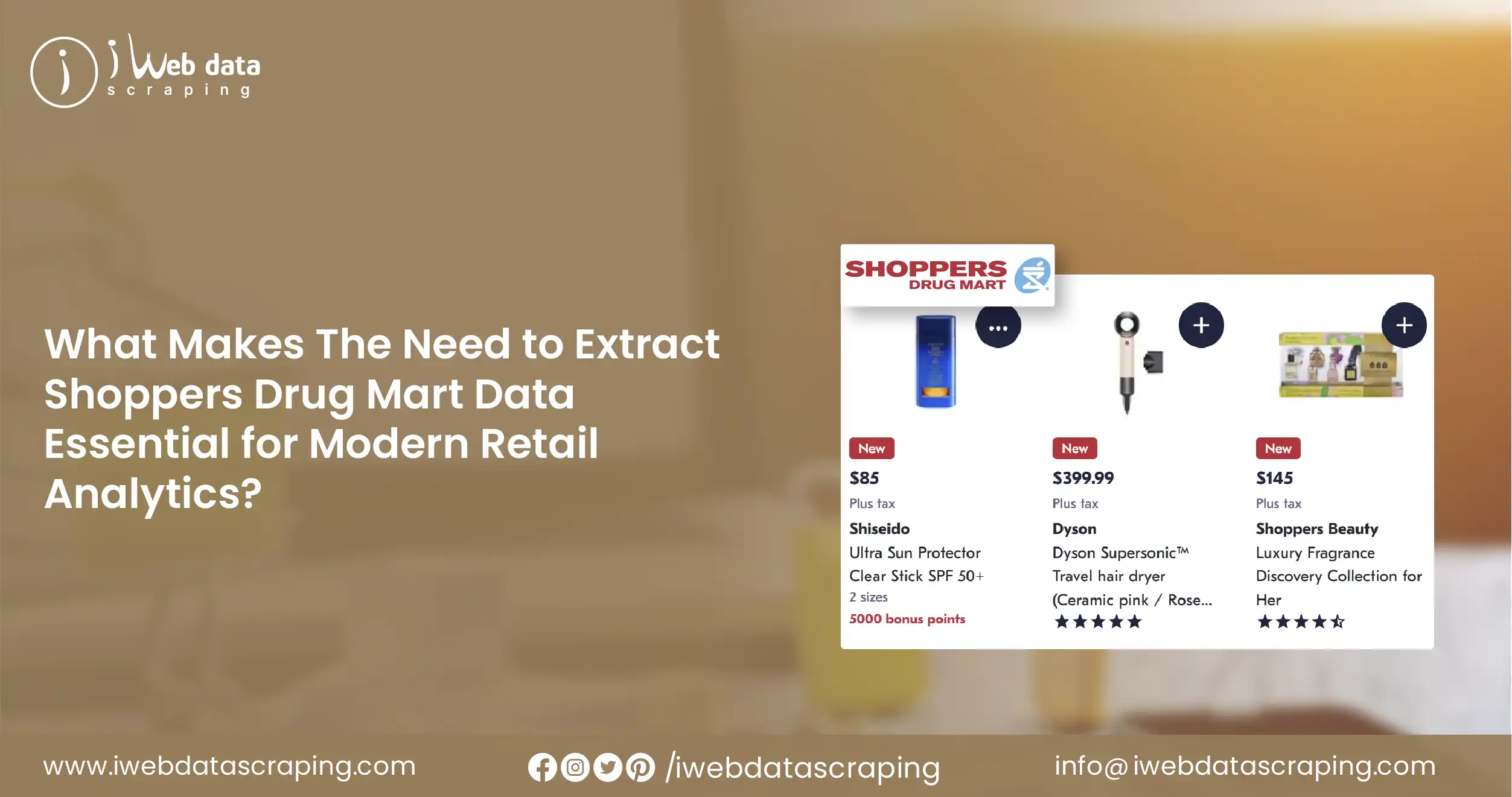
What Makes The Need to Extract Shoppers Drug Mart Data Essential for Modern Retail Analytics?
Introduction
The retail pharmacy and personal care market has evolved rapidly with growing
customer demand for convenience, transparency, and competitive pricing. Businesses today rely
heavily on structured retail intelligence to understand product availability, pricing changes,
customer preferences, and promotional strategies. This is where the need to Extract Shoppers
Drug Mart Data becomes a valuable strategy for brands, researchers, eCommerce sellers, and
market analysts seeking actionable insights from one of Canada’s leading pharmacy retail chains.
Modern retailers and analytics firms increasingly depend on Shopper's Drug Mart
Pricing Data Scraping to monitor product pricing trends across healthcare, cosmetics, household
essentials, supplements, and wellness categories. By collecting structured product-level
information from online listings, businesses can improve pricing decisions and identify
profitable opportunities faster than competitors.
Organizations also leverage Shoppers Drug Mart store level analytics to evaluate
regional demand, product assortment variations, stock availability, and promotional
effectiveness across multiple locations. These insights help businesses optimize supply chain
planning, product launches, and customer engagement strategies in highly competitive retail
markets.
Understanding the Importance of Shoppers Drug Mart Data Extraction
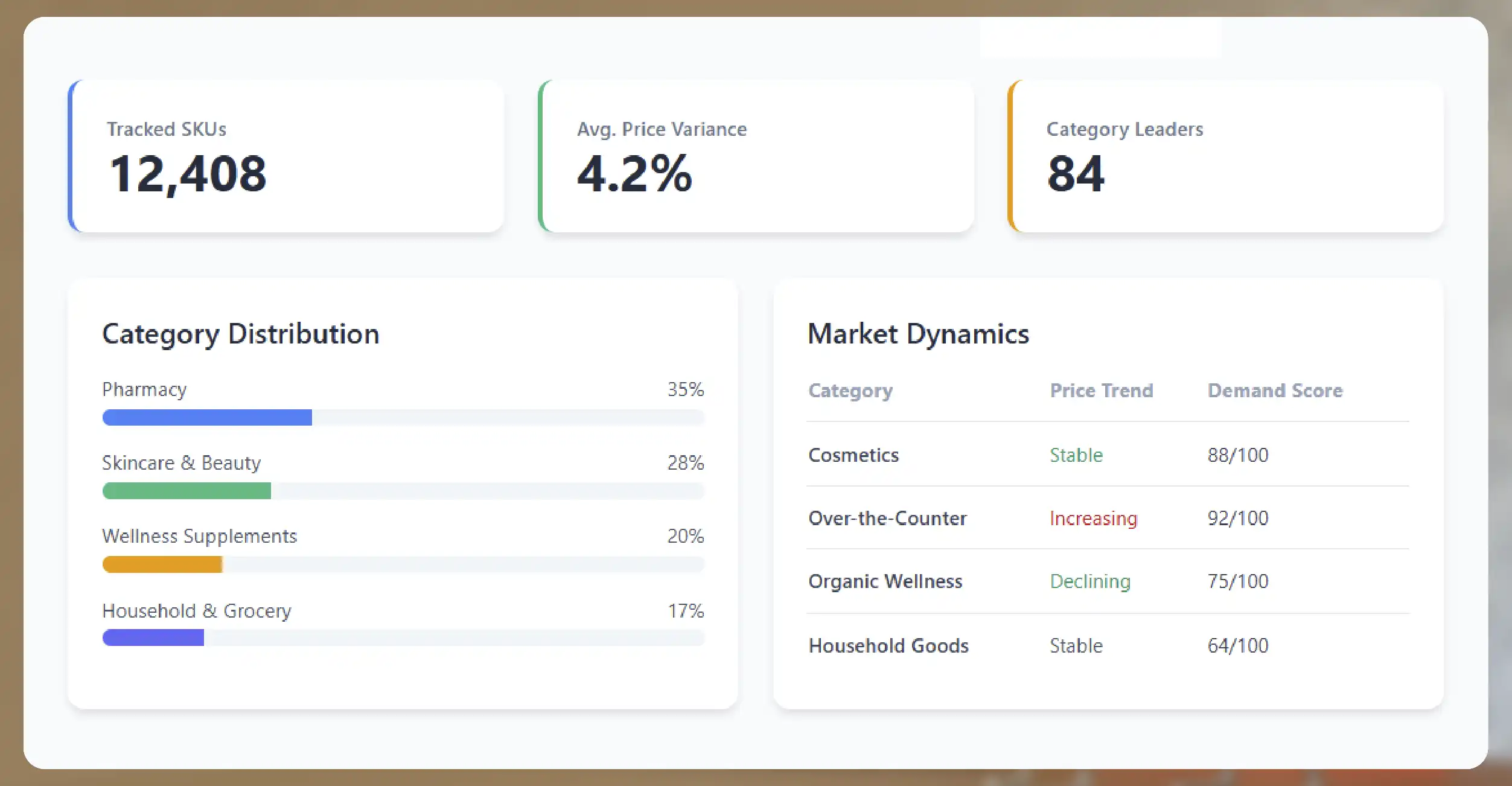
Shoppers Drug Mart operates across multiple retail categories, including pharmacy
products, skincare, cosmetics, groceries, wellness supplements, household items, and beauty
products. With thousands of products available online and in-store, extracting structured data
from these platforms provides enormous business value.
Retail intelligence teams use extracted datasets to analyze product titles,
descriptions, brand positioning, SKU-level pricing, inventory updates, discounts, customer
ratings, and review patterns. Such data enables organizations to understand purchasing trends
and identify products that perform well in specific categories or geographic regions.
For eCommerce businesses, competitor tracking has become essential for maintaining
pricing competitiveness. Brands selling similar products can continuously monitor price
fluctuations, promotional campaigns, and seasonal discounts. This helps improve margin
strategies while maintaining competitive positioning in the marketplace.
Another significant advantage of retail data extraction is product assortment
analysis. Businesses can identify which products are newly launched, discontinued, or promoted
aggressively. These insights support better merchandising decisions and market forecasting.
Healthcare and pharmaceutical analytics firms also use extracted retail datasets to
monitor wellness product demand, over-the-counter medicine trends, and customer behavior
patterns. These datasets become valuable for market research and product development
initiatives.
Key Data Points Businesses Can Extract
Retail data extraction from Shoppers Drug Mart platforms includes a wide range of
structured information useful for analytics and strategic planning. Businesses commonly collect
product names, product categories, SKUs, product descriptions, specifications, pricing details,
promotional discounts, and availability status.
In addition to product information, companies also analyze customer-generated
content such as ratings, reviews, review counts, and customer sentiment. These insights help
brands understand consumer satisfaction levels and product perception within the market.
Advanced extraction solutions can also collect seller information, delivery
availability, shipping timelines, coupon offers, and bundle promotions. Such detailed datasets
support dynamic pricing models and inventory optimization.
Businesses involved in retail benchmarking often combine extracted datasets with
external market intelligence to evaluate pricing gaps and category performance across
competitors. This approach helps create data-driven pricing strategies and improve overall
operational efficiency.
Benefits of Shoppers Drug Mart Data Scraping for Businesses
The growing digital retail ecosystem has increased the demand for automated retail
monitoring solutions. Businesses benefit from retail data extraction in several important ways.
One major advantage is real-time market visibility. Automated scraping systems
continuously collect fresh product and pricing information, allowing organizations to respond
quickly to market fluctuations. This reduces manual research efforts while improving
decision-making speed.
Another major benefit is competitor monitoring. Businesses can track how rival
brands adjust pricing, launch promotions, or manage inventory levels. These insights help
organizations remain competitive in rapidly changing markets.
Retail data extraction also supports assortment optimization. By analyzing popular
products, seasonal demand patterns, and customer feedback, businesses can refine their product
portfolios and improve conversion rates.
Customer sentiment analysis is another valuable application. Reviews and ratings
provide direct insights into customer experiences, helping brands identify recurring issues,
product strengths, and emerging consumer preferences.
Additionally, extracted retail data can support predictive analytics models used for
demand forecasting, revenue optimization, and inventory planning. Organizations can better
prepare for seasonal demand spikes and avoid stock shortages.
Role of Automation in Retail Data Collection
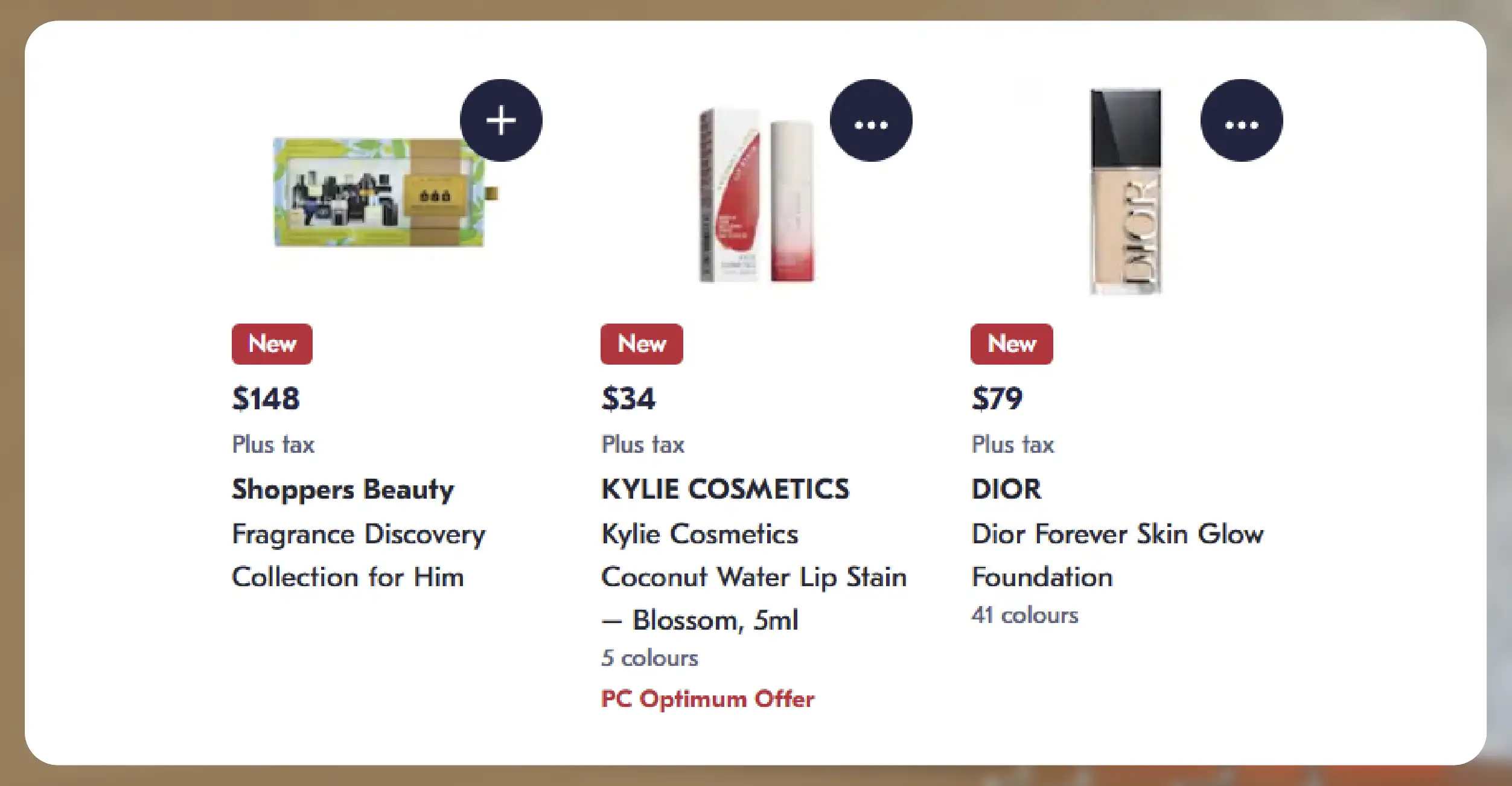
Manual collection of retail information is time-consuming and inefficient,
especially when dealing with thousands of products across multiple categories. Automated
extraction technologies solve this challenge by collecting structured data at scale with high
accuracy and speed.
Modern scraping systems use intelligent crawlers, APIs, and AI-driven extraction
tools to gather data from retail websites efficiently. These tools can navigate category pages,
capture product details, monitor price changes, and update datasets in real time.
Automation also ensures consistency in data formatting and improves data
reliability. Businesses can integrate extracted information directly into dashboards, analytics
platforms, or business intelligence systems for deeper analysis.
Large enterprises often combine automated retail extraction with machine learning
algorithms to identify trends, detect anomalies, and generate predictive insights. This helps
improve operational agility and strategic planning.
Use Cases Across Different Industries
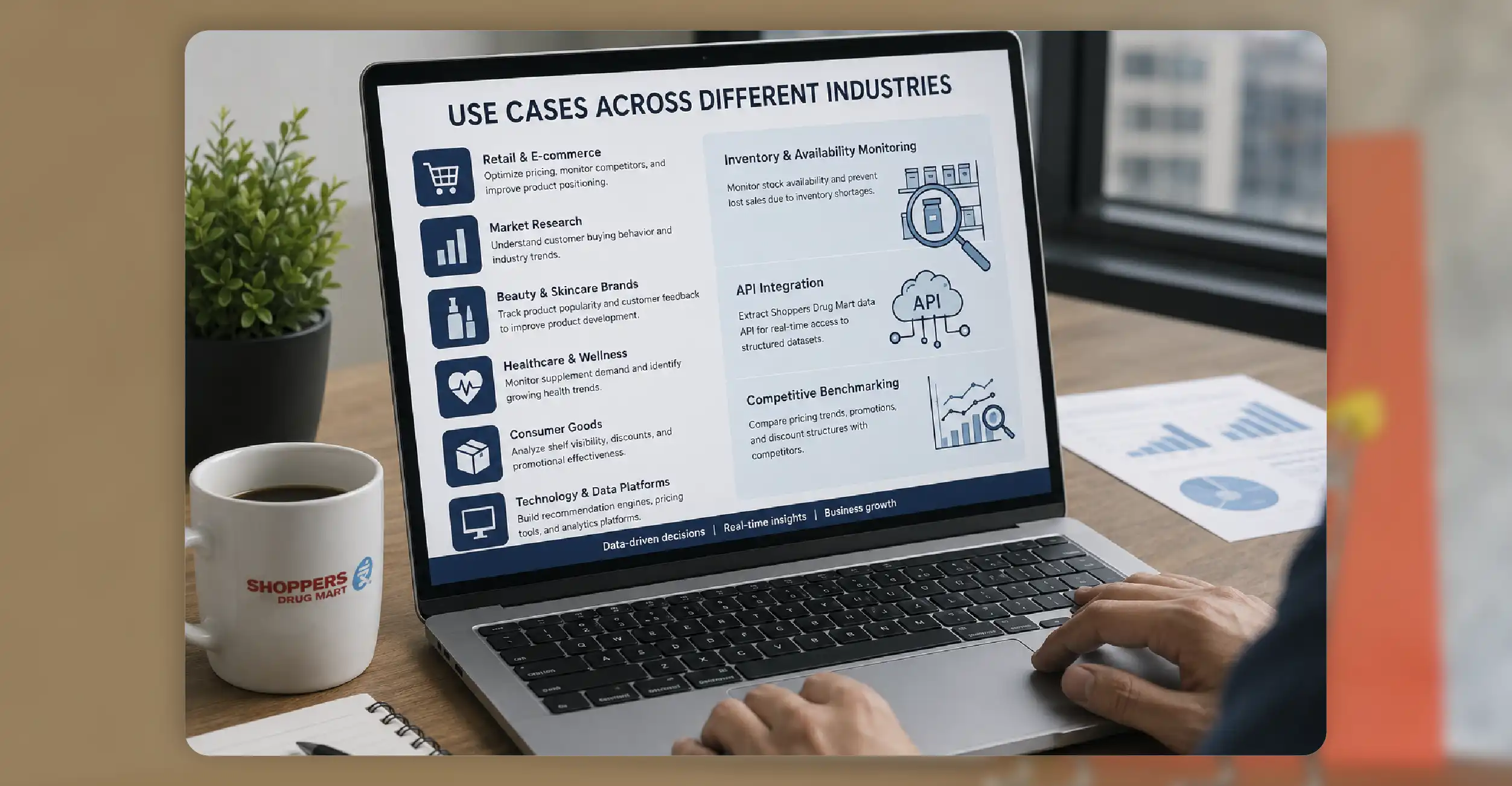
Retail data extraction from pharmacy and wellness platforms supports various
industries and business functions. eCommerce retailers use the data to optimize pricing, monitor
competitors, and improve product positioning.
Market research firms analyze extracted datasets to understand customer buying
behavior and industry trends. Beauty and skincare brands track product popularity and customer
feedback to improve product development strategies.
Healthcare organizations monitor wellness and supplement demand patterns to identify
growing health trends. Consumer packaged goods companies analyze shelf visibility, discount
strategies, and promotional effectiveness across product categories.
Technology companies also utilize retail datasets to build recommendation engines,
pricing intelligence tools, and analytics platforms for retailers and brands.
Businesses engaged in digital commerce increasingly rely on Shoppers Drug Mart
inventory scraping to monitor stock availability and prevent lost sales opportunities caused by
inventory shortages or supply chain disruptions.
Many enterprises also prefer scalable solutions that support automated integration
through method to Extract Shoppers Drug Mart data API frameworks for real-time access to
structured datasets across multiple business applications.
Competitive benchmarking has become another important application area, where
organizations use Shoppers Drug Mart competitor pricing analytics to compare pricing trends,
promotional campaigns, and discount structures against rival retailers.
Unlock actionable retail intelligence today with advanced
Shoppers Drug Mart data scraping solutions for businesses.
Advanced Retail Intelligence and Analytics
Retail analytics has evolved beyond simple pricing comparisons. Modern businesses
require deep insights into customer engagement, market behavior, and product performance across
digital platforms.
Advanced retail intelligence combines extracted product data with machine learning
and AI technologies to generate actionable recommendations. Businesses can identify
top-performing products, forecast future demand, and optimize marketing strategies more
effectively.
Analytics dashboards built on extracted retail datasets provide real-time visibility
into product movements, competitor activities, and category-level trends. These dashboards help
decision-makers respond quickly to changing market conditions.
Companies also analyze review sentiment and customer feedback to improve customer
experience and enhance brand loyalty. Understanding customer concerns helps businesses make
better product improvements and marketing decisions.
Organizations offering Shoppers
Drug Mart data extraction Services help businesses
automate large-scale retail intelligence collection while ensuring data quality, scalability,
and operational efficiency.
Retailers and analytics firms frequently combine these solutions with broader
eCommerce Data Scraping Services to monitor
multiple online marketplaces, pharmacies, and
grocery platforms from a unified intelligence system.
Customer behavior analysis also benefits from structured datasets such as Ecommerce
Product Ratings and Review Dataset, enabling businesses to evaluate consumer
satisfaction,
sentiment trends, and product popularity more accurately.
Challenges in Retail Data Extraction
While retail data extraction offers enormous benefits, businesses also face
technical and operational challenges. Retail websites frequently update layouts, pricing
structures, and anti-bot mechanisms, making extraction more complex.
Dynamic content rendering, CAPTCHA systems, and rate limitations require advanced
scraping technologies and adaptive infrastructure. Businesses must use scalable and compliant
solutions to ensure reliable data collection.
Data normalization is another important challenge. Extracted information often comes
in different formats, requiring cleaning, validation, and structuring before analytics can be
performed effectively.
Compliance and ethical considerations also play a major role. Organizations must
ensure their extraction practices align with applicable laws, platform policies, and responsible
data usage standards.
Despite these challenges, advanced scraping technologies and AI-driven automation
continue to improve the efficiency and scalability of retail intelligence operations.
Future of Retail Data Intelligence
The future of retail analytics will rely heavily on real-time intelligence and
AI-powered automation. Businesses are increasingly adopting predictive analytics models that use
extracted retail data to forecast demand, optimize pricing, and personalize customer
experiences.
As eCommerce competition grows, companies will continue investing in scalable retail
intelligence solutions capable of monitoring multiple retailers simultaneously. Real-time
visibility into market changes will become essential for maintaining competitiveness.
AI-driven analytics platforms will further enhance the value of extracted retail
datasets by identifying hidden trends, customer preferences, and emerging opportunities
automatically.
Cloud-based data pipelines and integrated analytics ecosystems will also simplify
the process of transforming raw retail data into actionable business intelligence.
How iWeb Data Scraping Can Help You?
Real-Time Market Visibility
Our data scraping services help businesses monitor live product pricing, inventory
updates, promotional campaigns, and changing customer demand patterns across multiple retail and
eCommerce platforms efficiently.
Competitor Price Intelligence
We provide accurate competitor monitoring solutions that allow brands to compare
pricing strategies, discounts, and product positioning to maintain a strong competitive market
advantage.
Automated Large-Scale Data Collection
Our advanced scraping systems automate large-scale data extraction processes,
reducing manual efforts while ensuring faster, structured, and highly accurate business
intelligence delivery.
Customer Behavior and Sentiment Analysis
We extract ratings, reviews, and customer feedback data that help businesses
understand consumer preferences, improve products, and enhance customer satisfaction strategies
effectively.
Scalable Analytics and Business Growth
Our scalable data scraping services support business expansion by delivering
actionable insights for pricing optimization, inventory management, trend forecasting, and
smarter decision-making processes.
Conclusion
In this evolving ecosystem, businesses leveraging advanced eCommerce Data
Intelligence solutions will gain a significant advantage through faster decision-making,
improved pricing strategies, and better customer insights.
Scalable integration frameworks supported by modern Web Scraping API Services will continue enabling seamless
access to structured retail datasets across enterprise analytics environments.
Organizations adopting enterprise-grade Web
Scraping Services will be better positioned to monitor market dynamics, optimize
operations, and maintain a strong competitive edge in digital commerce.
Experience top-notch web scraping service
and mobile app scraping solutions with iWeb Data
Scraping. Our skilled team excels in extracting various data sets, including retail store locations and beyond. Connect with us
today to learn how our customized services can address your unique project needs, delivering the
highest efficiency and dependability for all your data requirements.