
125K+
FASHION PRODUCT RECORDS PROCESSED

Fashion Product Data Extraction Enables Accurate Catalogues, Smarter AI Recommendations, Competitive Insights, And Personalized Shopping Experiences Across E-Commerce Platforms.
This case study is based on a real-world enterprise scenario where a digital intelligence and analytics team leverages large-scale fashion product data extraction methods to transform unstructured e-commerce catalogues into structured business intelligence for AI recommendations, product discovery, competitive analysis, and customer behavior tracking.
It is designed for:
The client's core challenge was simple: fashion product information is generated continuously across e-commerce platforms but remains fragmented, inconsistent, and difficult to interpret at scale. Their objective was to convert product listings, images, attributes, pricing information, and catalogue updates into a unified intelligence layer that supports AI-powered recommendations and improves product discovery across digital fashion ecosystems.
A recent case study explored how modern fashion technology and e-commerce teams leveraged large-scale product information ecosystems to generate actionable insights. Teams implemented advanced fashion product data extraction pipelines to capture apparel information across multiple online marketplaces effectively.
Analysts benefited from a structured fashion image dataset India to evaluate product appearance, visual attributes, category classifications, and consumer preferences across different apparel segments. Data engineers processed extensive product information, filtering inconsistencies and ensuring accurate product categorization and catalogue standardization efficiently.
This initiative helped enterprises collect and analyze fashion catalogue data for AI, enabling machine learning models to understand product characteristics, identify fashion trends, and support personalized recommendation systems. AI models then analyzed extracted datasets, identifying similar products, customer preferences, and emerging fashion patterns.
Insights were visualized in dashboards, enabling stakeholders to optimize product positioning, catalogue strategies, and recommendation performance rapidly. Businesses improved product discovery through data-driven personalization and better understanding of customer preferences.
The implementation also supported product similarity analysis, visual attribute recognition, and intelligent fashion classification across multiple product categories. Ultimately, the study demonstrated how scalable data extraction systems can transform fragmented fashion product information into structured, actionable business intelligence for AI-driven applications.
The client faced significant difficulties in managing and interpreting large volumes of unstructured fashion product information from rapidly growing online marketplaces. Traditional analytics tools were unable to provide timely insights, leading to delayed decision-making and missed market opportunities. Lack of visibility into product attributes and customer preferences made it harder to optimize recommendations effectively.
Absence of Structured Product Information
Another major challenge was the absence of structured product information and a reliable apparel product data API, which limited the ability to collect consistent fashion attributes, product descriptions, images, sizes, colors, brands, and pricing information across different e-commerce platforms.
Fragmented Data Sources
The client also struggled with fragmented data sources, making it difficult to achieve consistent monitoring of product catalogues, customer preferences, and fashion trends across multiple marketplaces.
Limited Recommendation Engine Data
Additionally, they lacked organized fashion recommendation engine data, restricting their ability to identify customer preferences, match similar products, and generate relevant personalized recommendations based on product attributes and visual similarities.
Inefficient Manual Tracking
Manual tracking methods proved inefficient, time-consuming, and prone to errors, especially when dealing with high-frequency product updates and extensive catalogue information.
To address these issues, they required scalable systems capable of handling continuous data streams and transforming raw information into structured datasets suitable for advanced analytics. They also needed reliable AI and LLM training data to support machine learning applications, improve product understanding, and develop intelligent recommendation capabilities. They ultimately needed advanced Fashion Data Scraping Services to unify data collection, improve accuracy, and enable faster strategic decision-making across fashion technology and e-commerce operations.
By adopting a structured fashion product data extraction pipeline, the client replaced fragmented manual catalogue monitoring with an automated intelligence system that continuously captures product listings, images, attributes, pricing information, and catalogue movements across fashion e-commerce ecosystems, enabling faster insights, higher accuracy, and improved recommendation capabilities.
| Dimension | Manual Fashion Product Tracking | Client Data Scraping System |
|---|---|---|
| Data collection | Individual marketplace browsing and selective product monitoring | Automated multi-platform product ingestion |
| Insight speed | Slow, dependent on manual review cycles | Continuous product data collection and updates |
| Data structuring | Inconsistent product descriptions and attributes | Standardized datasets with normalized product fields |
| Product identification | Manual identification of similar apparel | Automated product matching and classification |
| Image analysis | Individual image inspection | Structured image datasets for visual analysis |
| Catalogue monitoring | Periodic checks of selected listings | Scalable monitoring across multiple product categories |
| Recommendation support | Limited product similarity insights | Structured inputs for AI recommendation engines |
The structured approach provided a consistent foundation for AI recommendation development while reducing repetitive catalogue management activities.
The brand in focus is a rapidly growing fashion intelligence and e-commerce analytics organization operating within a complex online retail ecosystem. It specializes in extracting, structuring, and analyzing high-volume product information from fashion marketplaces to understand product trends, catalogue movements, pricing patterns, and customer preferences across multiple apparel categories.
As its monitoring scope expanded, the organization struggled with increasing product volumes, inconsistent catalogue structures, and the challenge of interpreting large-scale fashion information across multiple platforms. To overcome this, it adopted a structured intelligence framework powered by automated fashion product data extraction pipelines.
Operating in a fast-moving environment where fashion trends, seasonal collections, and product availability change frequently, the brand depends on real-time visibility into product attributes, pricing movements, and catalogue performance. This shift has enabled the organization to move from reactive manual tracking to proactive, data-driven fashion intelligence generation, significantly improving its ability to identify opportunities, understand product relationships, and optimize AI-powered recommendations across its e-commerce operations.
We delivered an end-to-end analytics solution that transformed raw fashion product listings into structured business intelligence using automated data extraction pipelines, advanced parsing, image processing, and scalable cloud infrastructure.
The system collected product information, cleaned inconsistent records, removed duplicates, and enriched listings with metadata such as brand, category, color, size, material, price, product descriptions, and image references to improve analytical accuracy.
It also enabled cross-platform catalogue monitoring, product classification, attribute standardization, and visual similarity analysis to help the client identify high-performing products and fashion behavior patterns quickly.
The platform integrated Social Media Data Intelligence Services to unify relevant digital engagement insights with fashion product performance signals. Using advanced pipelines, we implemented Digital Shelf Analytics Solutions to map product visibility, catalogue performance, and competitive positioning across datasets. This helped compare product effectiveness, detect catalogue anomalies, and optimize product assortment strategies.
The final layer applied Social Media Data Extraction Services for continuous digital data ingestion and real-time updates, where relevant to the client's wider intelligence ecosystem. Overall, the solution delivered scalable fashion product insights and reduced manual catalogue management efforts.
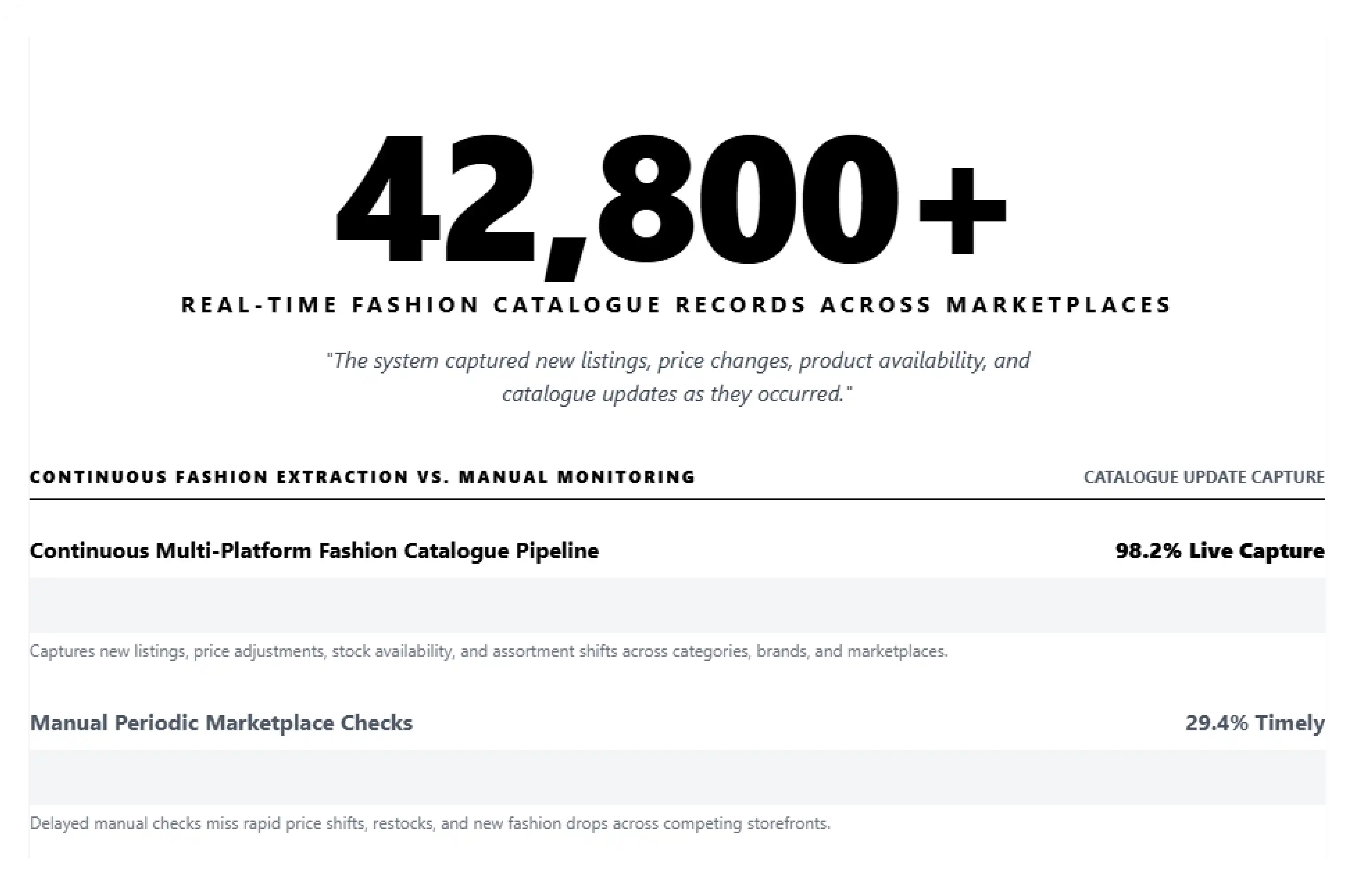
The implementation of continuous product data extraction from fashion marketplaces enabled the client to gain real-time visibility into product catalogues across multiple platforms. Instead of relying on manual monitoring, the system captured new listings, price changes, product availability, and catalogue updates as they occurred.
This allowed the business to understand how fashion assortments evolved across different categories, brands, and marketplaces. As a result, product intelligence strategies became more responsive, reducing the lag between catalogue changes and business decisions.
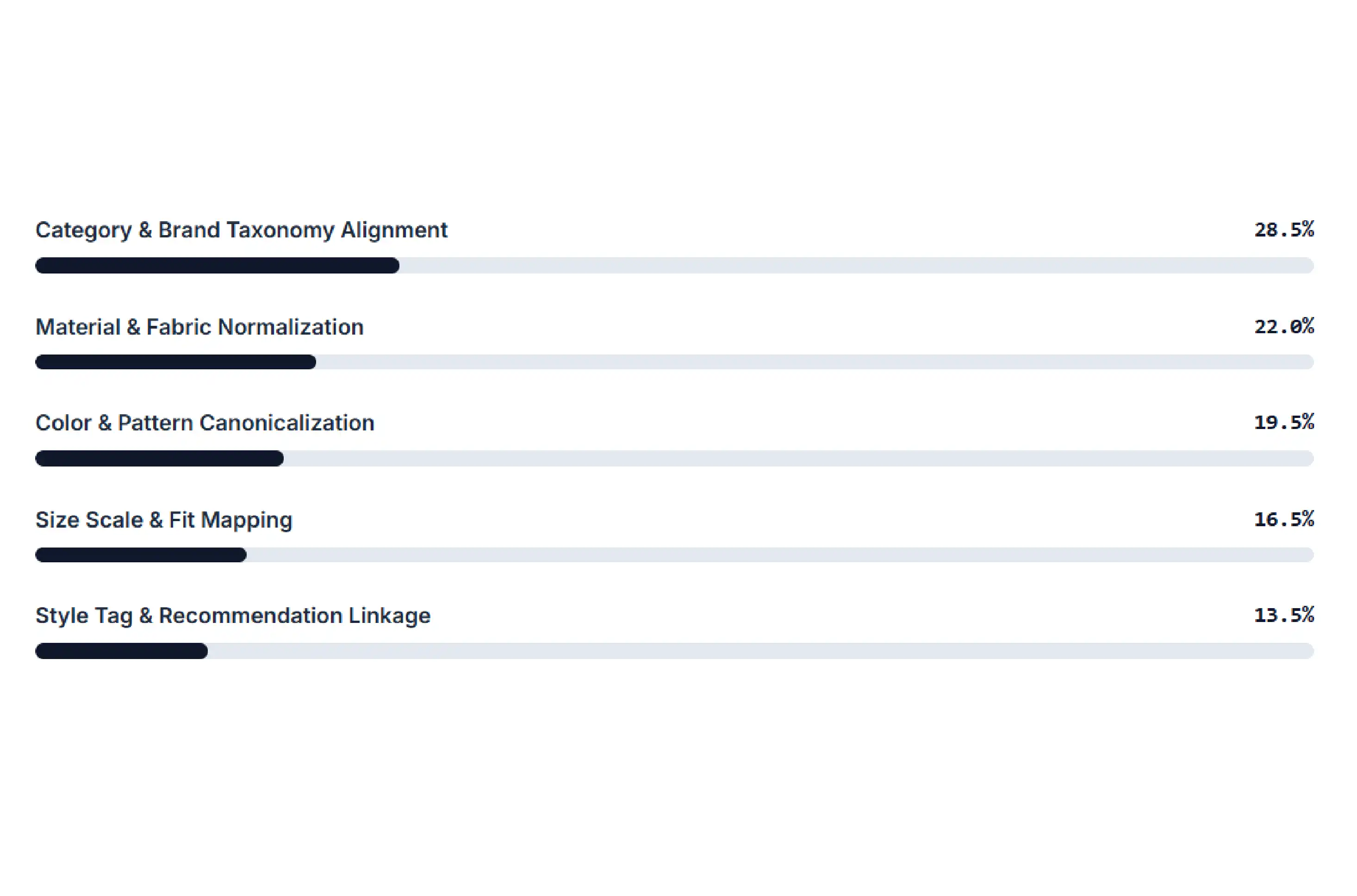
The scraping pipeline enabled automated identification and classification of fashion products using structured attributes such as category, brand, color, size, material, pattern, and style.
By standardizing inconsistent product information across marketplaces, the system created comparable records for analytics and recommendation applications. This allowed teams to identify related apparel products, understand category distribution, and improve product matching accuracy across different fashion platforms.
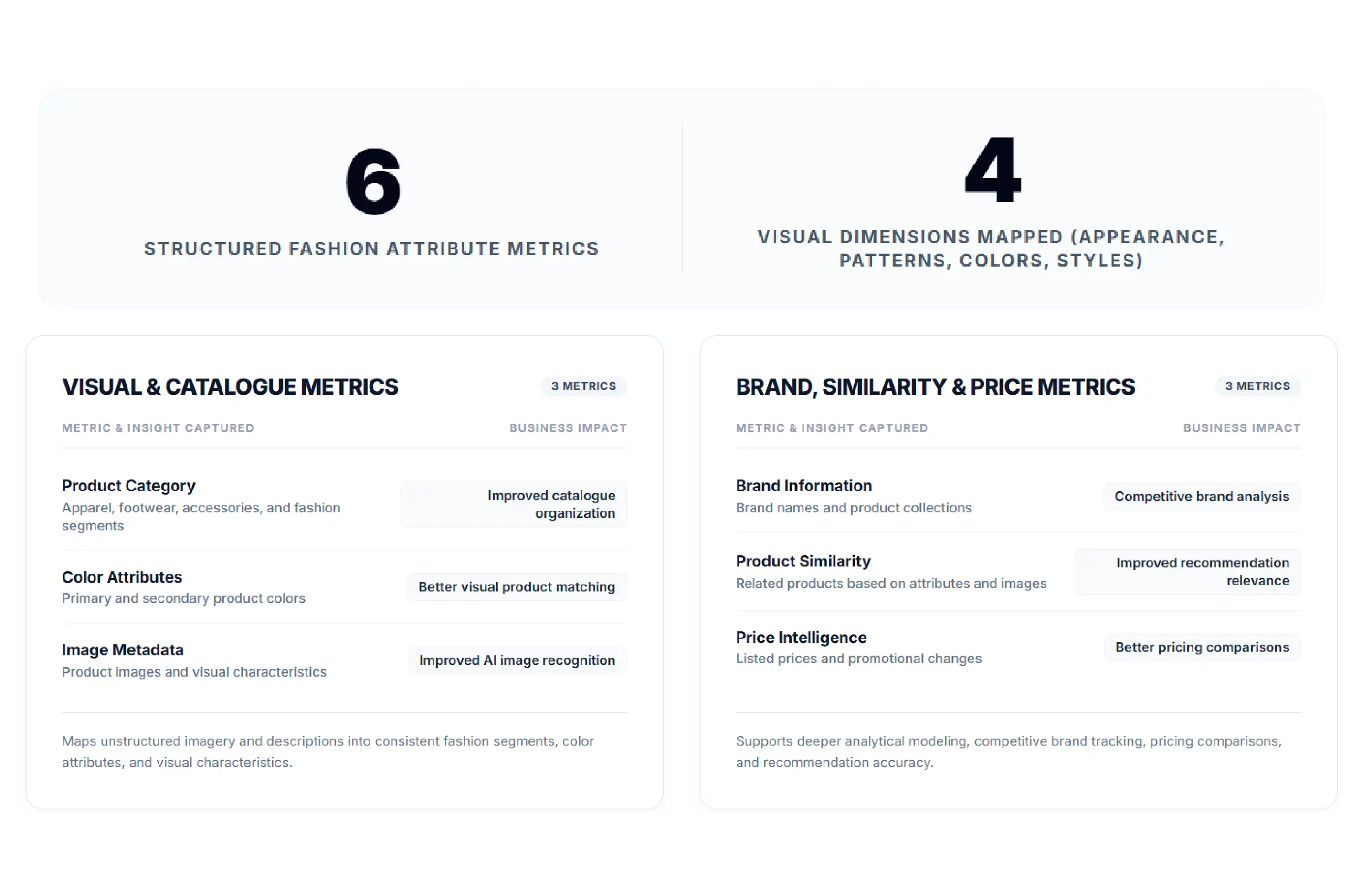
By converting unstructured product images and descriptions into organized datasets, the system enabled consistent product classification and visual attribute mapping across fashion categories.
This helped identify how different apparel products compared based on their appearance, patterns, colors, and styles. The structured output supported deeper analytical modeling and improved recommendation decision-making accuracy.
Key metrics included product category for catalogue organization, color attributes for visual product matching, brand information for competitive brand analysis, product similarity for recommendation relevance, price intelligence for pricing comparisons, and image metadata for AI image recognition.
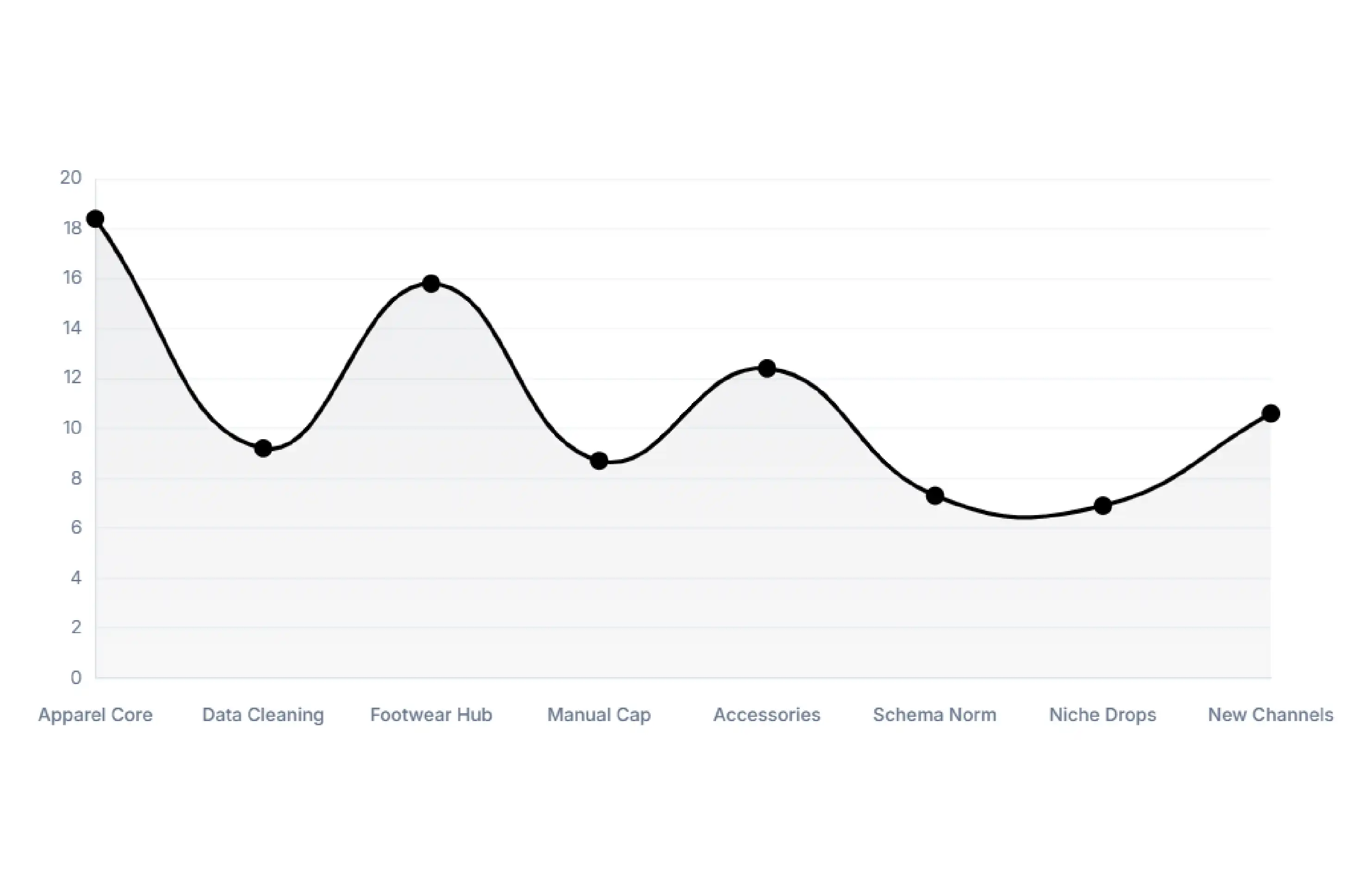
The automated system enabled large-scale monitoring across multiple fashion marketplaces simultaneously. Unlike manual tracking, which was limited in scope, the pipeline ensured consistent ingestion, cleaning, and analysis of high-volume product information.
This scalability allowed the organization to maintain continuous visibility across diverse fashion categories and expanding digital retail ecosystems, improving strategic agility and competitive awareness.
The dataset snapshot shows fashion product performance across different apparel categories and brands. It highlights how product pricing, colors, ratings, and image availability vary across listings, with women's dresses and men's casual wear showing different catalogue characteristics. The structured dataset also provides product attributes that can support visual matching and AI recommendation applications.
| Product Name | Category | Brand | Price (INR) | Color | Rating | Image Status |
|---|---|---|---|---|---|---|
| Floral Summer Dress | Women's Clothing | Brand A | 1,499 | Pink | 4.4 | Available |
| Casual Cotton Shirt | Men's Clothing | Brand B | 999 | Blue | 4.2 | Available |
| Running Sneakers | Footwear | Brand C | 2,499 | White | 4.5 | Available |
| Printed Ethnic Kurta | Ethnic Wear | Brand D | 1,299 | Yellow | 4.3 | Available |
| Everyday Handbag | Accessories | Brand E | 1,799 | Black | 4.1 | Available |
Note: Illustrative sample dataset; values are not live marketplace listings.
The structured dataset enables teams to compare product names, categories, brands, prices, colors, ratings, and image availability for AI recommendation and catalogue intelligence applications.
After implementing structured fashion product data intelligence through continuous extraction of product catalogues and images, the client achieved significant improvements in product understanding, recommendation readiness, catalogue visibility, and competitive analysis, driven by always-on visibility into product attributes, pricing movements, and assortment changes across fashion marketplaces.
Our approach enables unified data collection across multiple fashion e-commerce platforms by consolidating product information into a single structured format, removing fragmentation, reducing manual effort, and ensuring consistent datasets for reliable analysis, reporting, and strategic planning without missing critical product attributes from any source.
Real-Time Catalogue Monitoring
It also supports real-time catalogue monitoring by continuously tracking evolving product listings, allowing businesses to stay updated with fast-changing fashion trends and respond quickly to shifts in customer preferences, competitor assortments, and emerging market opportunities.
Enhanced Data Accuracy and Cleaning
In addition, the system enhances data accuracy and cleaning by removing duplicates, irrelevant entries, and inconsistencies from raw product datasets, ensuring only high-quality and reliable information is used for forecasting, recommendation development, and long-term analytical insights without distortion.
Scalable Insight Generation
It is also designed for scalable insight generation, allowing seamless processing of increasing product volumes while maintaining performance stability, even as catalogue complexity grows across large-scale fashion ecosystems.
Smarter Business Decision Support
Finally, it delivers smarter business decision support by transforming raw product information into structured insights that help organizations better understand catalogue performance, product relationships, and customer preferences. These capabilities enable more confident, evidence-based decision-making, improved product discovery, and stronger AI-driven fashion recommendation strategies.
"We are extremely satisfied with the fashion product data intelligence solution delivered by the team. The project helped us streamline large-scale product data collection and convert unstructured catalogue information into clear, actionable insights. Their approach significantly improved our understanding of fashion trends, product attributes, and marketplace movements. The accuracy, speed, and reliability of the system exceeded our expectations and reduced our manual catalogue analysis efforts drastically. The structured product datasets and reporting tools have enhanced our recommendation development process and improved product discovery capabilities. We now operate with better catalogue visibility, faster insights, and stronger competitive positioning across our digital fashion initiatives."
— Head of Digital Strategy
The final outcome of the project was a fully automated and scalable data intelligence system that transformed raw digital signals and fashion product information into structured business insights. The client achieved significantly faster decision-making capabilities with improved visibility into product attributes, fashion trends, catalogue movements, and competitive performance. Operational efficiency improved as manual data collection was eliminated and replaced with automated pipelines, reducing errors and saving valuable time.
Implementation of Web Scraping API Services enabled seamless and continuous data extraction from multiple online sources with high accuracy and reliability. The integration of fashion data scraping capabilities further helped organize product listings, apparel attributes, images, descriptions, pricing information, and catalogue updates across different fashion platforms.
The solution also enabled the organization to build and maintain structured ecommerce product datasets, supporting product comparison, catalogue analysis, competitive intelligence, and AI-powered product discovery applications. Furthermore, advanced product data enrichment processes improved the completeness and consistency of extracted information by standardizing product attributes, categorizing fashion items, matching related listings, and enriching records with additional metadata.
As a result, the organization gained improved forecasting ability, better recommendation optimization, and stronger competitive positioning in a rapidly evolving digital landscape. The solution also enhanced data consistency across reporting systems and supported advanced analytics and AI-driven use cases. Deployment of Web Scraping Services further ensured scalable infrastructure support, allowing the system to handle growing data volumes without performance degradation.
Overall, the project delivered measurable operational value, improved product intelligence, and a strong foundation for future AI-driven fashion commerce growth.
Our solutions are designed to collect, clean, and structure large volumes of fashion product information from multiple e-commerce platforms. This helps businesses gain actionable insights, monitor catalogue changes, analyze product attributes, and develop AI-powered recommendation systems using accurate and organized information.
We use advanced validation techniques, deduplication processes, attribute standardization, and automated cleaning pipelines. This ensures that collected product information is consistent, reliable, and suitable for analytics, catalogue management, recommendation development, and strategic business decision-making.
Yes, our infrastructure can collect permitted product images and associated attributes such as category, brand, color, size, material, and descriptions. These structured records can support visual recognition, product similarity analysis, and AI-powered recommendation workflows.
Absolutely. Our architecture is designed to scale efficiently with increasing product volumes. Whether handling thousands or millions of product records, the system maintains processing performance, data consistency, and operational stability without compromising analytical quality.
Our solutions are widely used in fashion retail, e-commerce, apparel manufacturing, online marketplaces, fashion technology, and AI development. Any business that relies on product intelligence, competitive analysis, catalogue optimization, or personalized shopping experiences can benefit significantly from our expertise.
Our advanced fashion data extraction and analytics solutions help you transform unstructured product catalogues into structured intelligence, enabling better product discovery, accurate recommendations, improved catalogue management, and smarter e-commerce decisions at scale.
Start a projectFields marked * are required. Everything else just helps us scope faster — skip what you don't know yet.