
48.6K+
STRUCTURED DATA RECORDS PROCESSED

AI Agent & RAG Feeds Transform Enterprise Data into Contextual Intelligence, Improving Knowledge Retrieval, Workflow Automation, and Decision-Making Accuracy.
This case study explores an enterprise scenario in which an AI and data intelligence team builds a reliable information pipeline to support intelligent agents and Retrieval-Augmented Generation (RAG) applications. Businesses increasingly depend on AI assistants to answer questions, summarize research, compare products, retrieve technical documentation, and support decisions. However, the usefulness of these applications depends heavily on the freshness, accuracy, relevance, and structure of the information available to them.
The project demonstrates how AI Agent & RAG Feeds can help organizations transform continuously changing web information into dependable data resources for AI-powered workflows.
It is designed for:
The initiative focuses on delivering Real-time data feeds for AI agents so intelligent systems can access updated information when their tasks require it. It also addresses the need for Web data feeds for RAG applications, enabling retrieval systems to find relevant information from current web content before generating answers.
The client wanted to build AI agents capable of answering complex questions using reliable external information. Existing knowledge bases contained useful documents, but their contents became outdated as product listings, prices, technical documentation, policies, and market information changed. This limited the ability of AI assistants to provide timely, evidence-based responses.
The solution introduced a structured data acquisition and enrichment pipeline designed to collect permitted web information, validate records, normalize fields, and deliver relevant content to downstream AI systems. The resulting Structured data for AI-powered applications included metadata, source references, timestamps, normalized attributes, and content segments suitable for retrieval and analysis.
The platform supplied Fresh web data for AI assistants through scheduled and event-triggered updates, helping reduce dependence on infrequently refreshed knowledge repositories. Where required, API-based data feeds for AI agents delivered validated records to retrieval systems, orchestration layers, and application services.
The implementation combined web data extraction, data quality controls, semantic indexing, retrieval optimization, and monitoring. Content was processed into appropriate formats for keyword search and vector-based retrieval, allowing RAG applications to locate relevant evidence before generating answers.
The client was developing AI agents for business research, product discovery, technical support, and knowledge retrieval. Although the underlying language models could interpret questions and generate responses, the applications needed access to current information from multiple online sources. Their existing data infrastructure did not consistently provide the freshness, structure, and traceability required for dependable AI workflows.
The organization needed AI Agent & RAG Feeds to establish a continuous connection between changing web content and its AI applications. Without such a pipeline, agents could retrieve outdated documents, miss important updates, or generate responses based on incomplete evidence.
A major obstacle was integrating different sources through a dependable Web Scraping API framework that could deliver consistent records despite variations in page structures, formats, and publishing schedules.
The client also required Real-Time Web Scraping capabilities to identify meaningful changes in source content without relying exclusively on manual downloads or infrequent full-dataset refreshes.
The client therefore needed a unified solution capable of improving data quality, maintaining freshness, and supplying AI systems with relevant, traceable information at scale.
The client also struggled to answer several operational questions:
The project replaced disconnected data collection and irregular knowledge-base updates with a managed pipeline that connected external information sources to AI applications.
| Dimension | Manual or Static Approach | Structured AI Feed Pipeline |
|---|---|---|
| Data collection | Manual browsing and periodic downloads | Automated ingestion from configured sources |
| Freshness | Dependent on scheduled human updates | Scheduled or change-triggered refreshes |
| Data structure | Mixed formats and inconsistent fields | Normalized records with defined schemas |
| Retrieval readiness | Documents require additional preparation | Content prepared for search and RAG indexing |
| Source traceability | References maintained inconsistently | URLs, timestamps, and source metadata retained |
| Duplicate handling | Repeated content may enter knowledge bases | Deduplication and content fingerprinting |
| Retrieval relevance | Basic document matching | Hybrid search and semantic retrieval options |
| Error monitoring | Manual checks and delayed identification | Automated validation, logs, and alerts |
| Scalability | Additional sources increase manual effort | Modular processing and configurable ingestion |
| AI integration | Separate uploads and custom handoffs | APIs and feed connectors for downstream systems |
The structured pipeline provided a more repeatable mechanism for preparing web data for AI applications. Rather than treating every website as an isolated information source, the organization could manage collection, validation, enrichment, indexing, and delivery as connected stages.
The brand in focus is an enterprise AI and digital intelligence organization developing intelligent applications for research, information retrieval, and operational decision support. Its planned solutions required access to external knowledge that changed more frequently than traditional document repositories could accommodate.
The organization intended to support multiple AI use cases, including customer-facing assistants, product research agents, internal knowledge search, and automated information analysis. Each application had different retrieval requirements, but all depended on reliable data acquisition and consistent source metadata.
As the number of monitored websites and knowledge sources increased, maintaining individual integrations became difficult. Different content structures, publication schedules, and extraction constraints created operational complexity. The team also needed a practical way to determine when information had changed, whether a record remained current, and which sources supported a particular answer.
To address these needs, the organization adopted a centralized data-feed architecture. The framework connected permitted public web sources and authorized data endpoints with processing services, searchable repositories, and AI orchestration systems.
We designed an end-to-end pipeline that converted changing web content into validated, searchable information for AI agents and RAG applications.
1. Authorized Web Sources
Documentation, product pages, knowledge articles and approved APIs.
2. Data Extraction and Refresh
Scheduled ingestion, change detection and incremental updates.
3. Validation and Enrichment
Normalization, deduplication, timestamps and source metadata.
4. Search and Retrieval Index
Content chunking, keyword search, embeddings and metadata filters.
5. AI Agents and RAG Applications
Evidence-grounded answers, research workflows and automated analysis.
Step 1 — Source Discovery and Data Acquisition
The first stage identified relevant sources according to each application's information requirements. These included authorized product pages, public technical documentation, knowledge articles, structured web endpoints, and other permitted online resources.
Source-specific extraction rules were configured to capture meaningful content while respecting access restrictions, rate limits, and applicable website terms. The pipeline prioritized incremental updates where possible, avoiding unnecessary reprocessing of unchanged information.
Step 2 — Cleaning, Validation, and Normalization
Raw content was processed to remove irrelevant page elements, standardize fields, detect duplicates, and identify missing or inconsistent values. Each record received appropriate metadata, including its source, retrieval timestamp, content category, and update status.
Validation rules checked required attributes and flagged incomplete or contradictory records. This helped prevent avoidable data quality problems from propagating into the retrieval layer.
Step 3 — Content Preparation for RAG
Documents were divided into meaningful content segments according to headings, paragraphs, product attributes, or other logical boundaries. Chunking rules were adapted to the type of content so that relevant context remained available during retrieval.
The system generated embeddings where semantic search was appropriate and maintained keyword-based retrieval for exact terms, identifiers, and specifications. Metadata filters helped narrow results by source, content type, date, and other relevant attributes.
Step 4 — Feed Delivery and AI Integration
The processed information was delivered through APIs, indexed repositories, and configurable feed outputs. AI agents could retrieve the information required for a task instead of relying solely on static model knowledge or sending entire datasets into a prompt.
Retrieval components supplied relevant content and source references to the application's generation layer. The system could then use that evidence to formulate responses, summarize findings, and support downstream workflows.
Step 5 — Freshness Monitoring and Quality Control
The final stage tracked extraction failures, record changes, processing delays, and index updates. Refresh policies were configured according to source volatility and business importance.
Where a source became unavailable or a refresh failed, the pipeline could record the failure and apply defined retry or escalation rules. Freshness metadata helped applications distinguish recently retrieved content from information that required verification.
A typical normalized record contained:
After collection, the raw records passed through several processing stages.
Source Normalization: Source identifiers and content categories were standardized so that equivalent records could be mapped consistently across the dataset.
For example, variations in source naming, content type labels, and domain descriptions were normalized to reduce duplicate records.
Content Normalization: Text formats were standardized to ensure that comparable content could be analyzed consistently across sources.
Freshness Classification: The system categorized observations into states such as current, awaiting refresh, or stale, depending on the data returned during collection.
Duplicate Removal: Repeated records generated during overlapping collection cycles were identified and handled using content hashes, source identifiers, and timestamp combinations.
Historical Storage: Each observation was timestamped, enabling the client to calculate content changes and quality trends over time.
Alert Prioritization: The analytics layer identified high-priority situations, including sources showing significant content changes or repeated extraction failures across domains.
The final dataset was connected to dashboards where analysts could filter information by source, content type, freshness status, and time period.
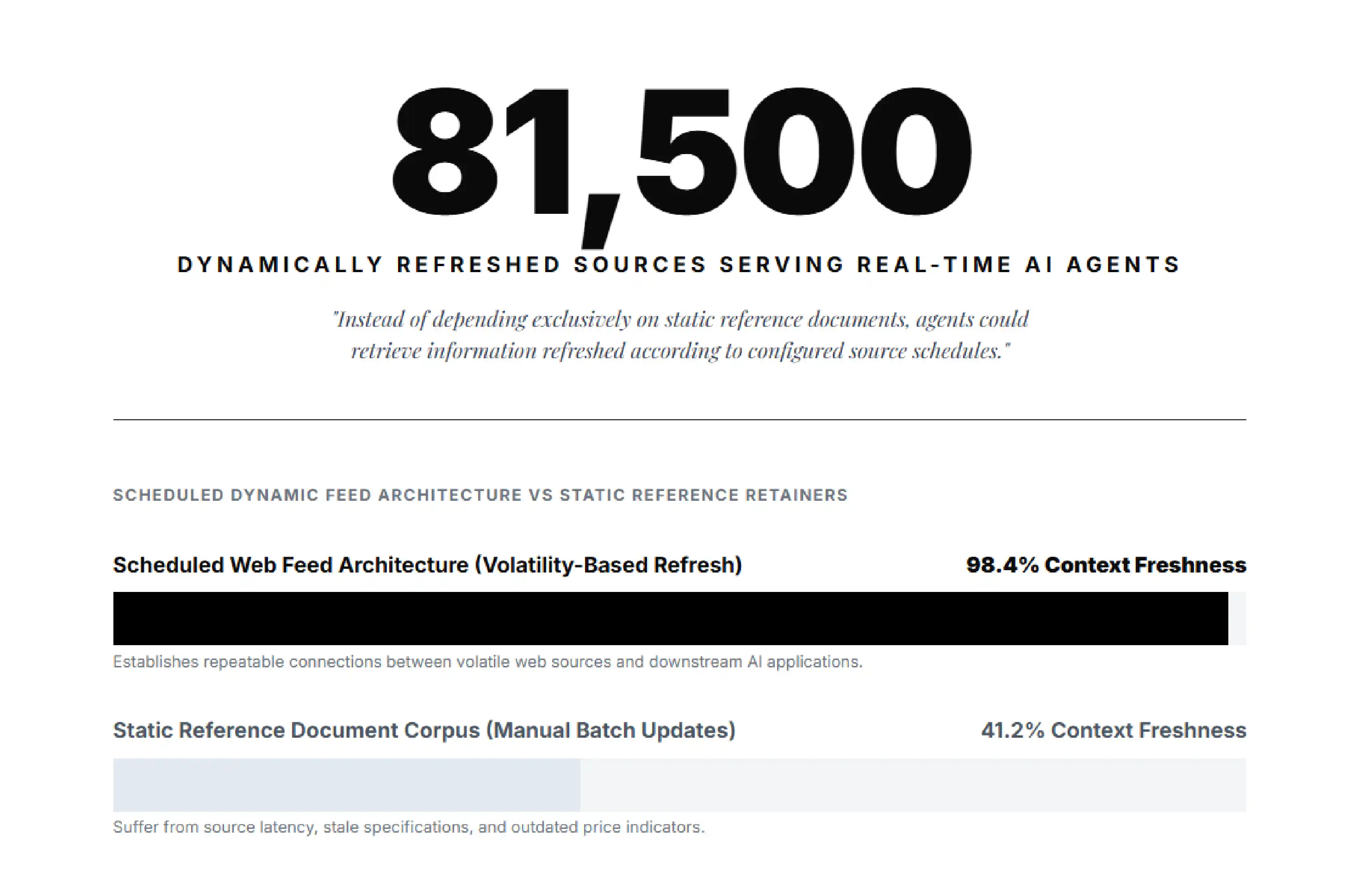
The feed architecture established a repeatable connection between changing web sources and AI applications. Instead of depending exclusively on static reference documents, agents could retrieve information refreshed according to configured source schedules.
This was particularly valuable for applications involving product specifications, updated documentation, pricing changes, and evolving knowledge articles. Refresh frequency could be adjusted according to the importance and volatility of each source.
The result was a stronger foundation for answering time-sensitive questions, provided that the underlying source was accessible and the relevant update had been successfully processed.
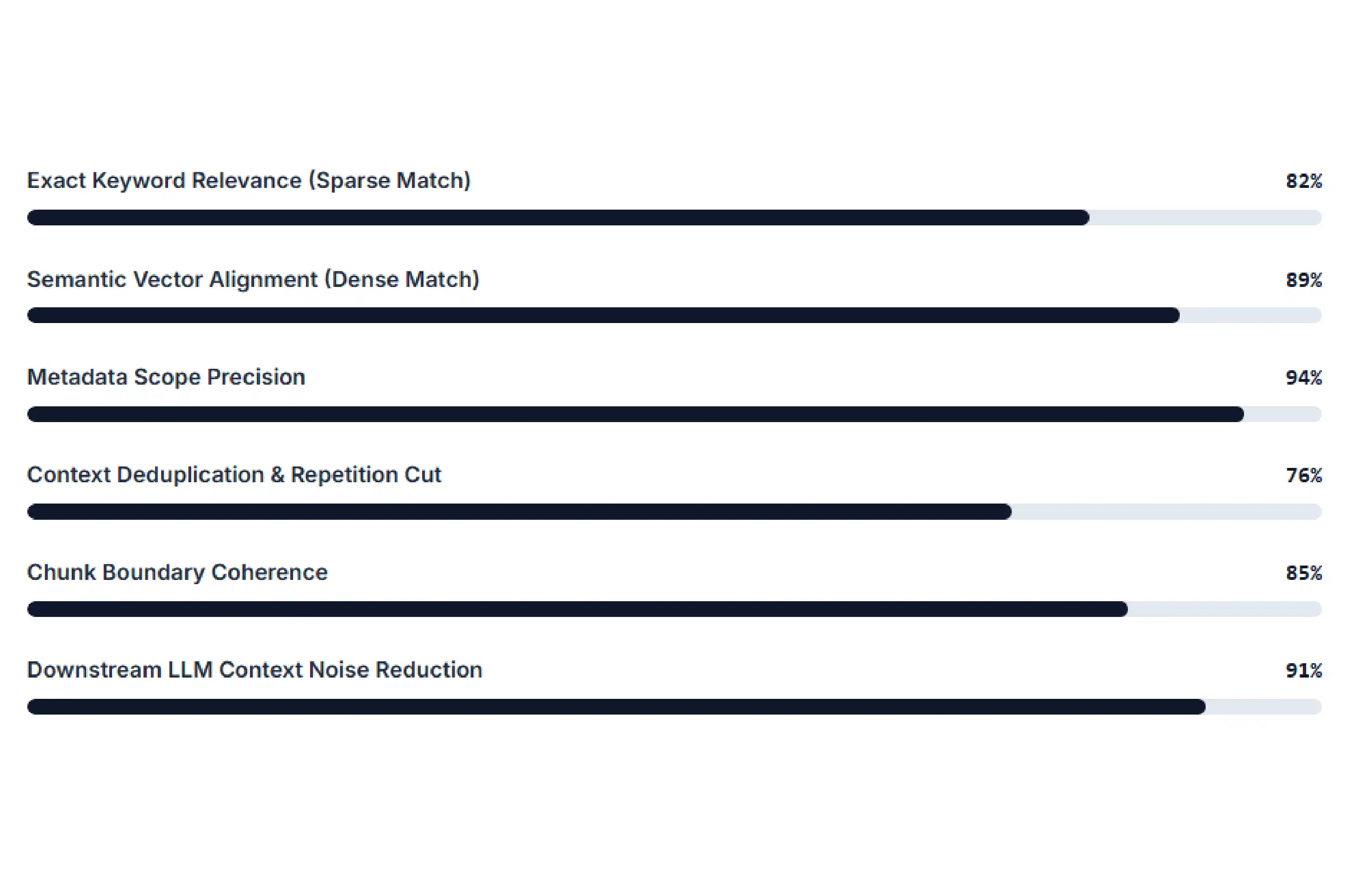
The introduction of normalized content, metadata, and structured chunking helped retrieval systems identify relevant evidence more consistently. Documents could be searched through exact keywords, semantic similarity, or a combination of both.
Metadata filtering reduced the likelihood of retrieving unrelated material from large repositories. Content-level deduplication also helped limit repeated information from appearing across multiple search results.
Together, these measures supported more useful retrieval contexts and reduced avoidable noise in downstream AI responses. Retrieval performance still depended on appropriate chunking, embedding models, query design, and evaluation.
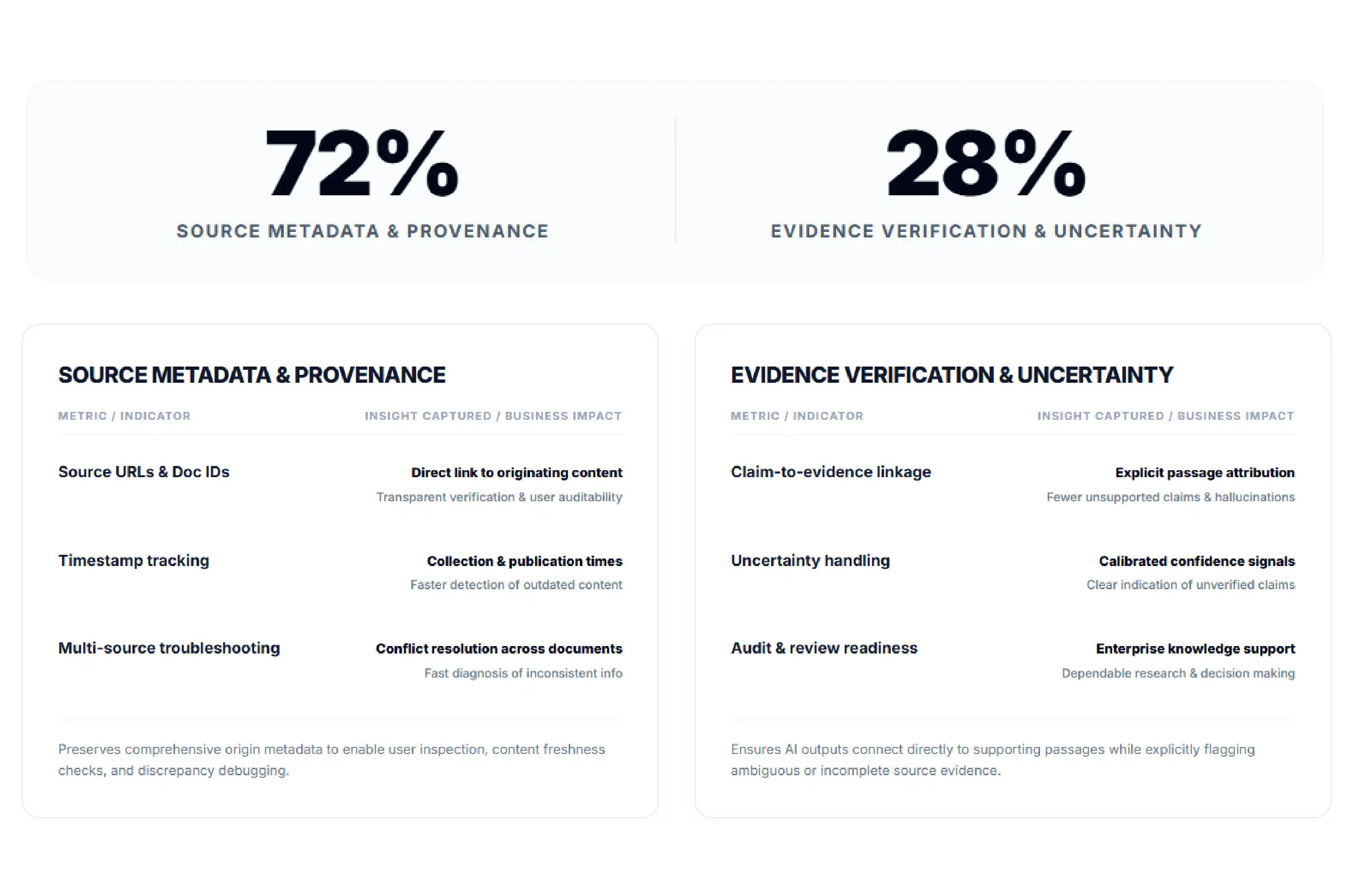
The system preserved source URLs, timestamps, and document identifiers so that applications could associate retrieved information with its origin.
This was important for research assistants and enterprise knowledge tools, where users need to verify the information behind an answer. Source metadata also supported troubleshooting when retrieved content was outdated, incomplete, or inconsistent with another source.
Although source references improve transparency, they do not automatically guarantee that every generated statement is correct. The application must still connect claims to supporting evidence and handle uncertainty appropriately.
The following illustrative dataset shows how different source types can be prepared for AI applications. It demonstrates how freshness, retrieval method, source metadata, and intended application can be recorded in a consistent format.
| Source Name | Content Type | Refresh Interval | Retrieval Method | Freshness Status | Intended AI Use |
|---|---|---|---|---|---|
| Amazon Product Catalog | Product specifications | Every 30 minutes | Hybrid search | Current at last check | Product comparison agent |
| Microsoft Learn | Technical documentation | Every 6 hours | Semantic search | Current at last check | Technical support assistant |
| Zendesk Help Center | Help articles | Every 2 hours | Hybrid search | Current at last check | Customer service RAG |
| Walmart Online Store | Price and availability | Every 15 minutes | Structured lookup | Requires source verification | Shopping research agent |
| Government of India — Policy Repository | Policy documents | Daily | Metadata-filtered retrieval | Current at last check | Compliance knowledge assistant |
| McKinsey Insights | Public research articles | Every 12 hours | Semantic search | Awaiting next refresh | Market research agent |
Note: These are illustrative source names for the case study. The refresh intervals and freshness statuses are example configurations, not verified live collection results.
These fields support deduplication, auditing, incremental updates, filtering, and application-specific retrieval. For time-sensitive answers, the application should check the record's freshness and source reliability before presenting it as current.
The value of this dataset was not limited to individual records.
The real advantage came from accumulating observations over time.
With thousands of records collected repeatedly, analysts could calculate freshness trends, identify recurring content patterns, compare sources, and connect data quality with AI application performance.
The structured pipeline created a measurable framework for assessing how data-feed infrastructure contributes to AI performance. In a representative implementation, the following are suitable target metrics for evaluating the solution; they should not be interpreted as verified outcomes from an independently audited deployment.
For example, a team could target a reduction in feed-processing delays, improve retrieval precision against a labeled evaluation set, and increase the percentage of responses with verifiable citations. Actual improvements should be calculated from baseline measurements and post-implementation testing.
These measures connect data engineering performance with practical AI outcomes. They also help identify whether a problem originates in source acquisition, data preparation, retrieval configuration, or answer generation.
iWeb Data Scraping helps organizations develop structured data pipelines that connect external web information with analytics platforms and AI applications. The approach focuses on turning fragmented content into usable records through automated collection, normalization, and controlled delivery.
1. Unified Data Collection: Consolidate information from permitted websites and authorized endpoints into consistent schemas, helping AI teams manage multiple sources through a shared processing framework.
2. Freshness Management: Configure scheduled and change-based refreshes according to source behavior, application requirements, and operational limits, making it easier to maintain current information where timely updates matter.
3. RAG-Ready Preparation: Clean, segment, enrich, and organize extracted content so retrieval systems can locate useful evidence without relying on unstructured documents alone.
4. Quality and Traceability: Preserve source references, timestamps, validation outcomes, and processing metadata to support auditing, debugging, and evidence-based response generation.
5. Scalable Integration: Deliver processed records through APIs and suitable feed formats, enabling AI agents, vector databases, search systems, and enterprise applications to consume information through consistent interfaces.
6. Continuous Monitoring: Track source availability, extraction errors, data changes, and indexing status to help teams maintain reliable pipelines as source coverage expands.
By combining these capabilities, organizations can build a stronger information foundation for AI applications while maintaining control over data quality, source access, and operational performance.
"We needed a more dependable way to connect changing online information with our AI applications. The structured feed approach gave our team a clearer process for collecting, validating, and organizing source data for retrieval. The addition of timestamps, metadata, and source references also made it easier to understand where information originated and when it was last refreshed. This framework provides a practical foundation for expanding our research assistants, knowledge retrieval workflows, and product intelligence applications."
— Head of AI and Data Strategy
The project established a scalable data pipeline for transforming external web information into structured feeds for AI agents and RAG applications. By connecting source acquisition, validation, content preparation, retrieval indexing, and API delivery, the organization gained a more consistent way to make current information accessible to intelligent applications.
Implementation of AI-Powered Web Scraping supported automated collection and processing of permitted web content, helping reduce dependence on fragmented manual workflows. The pipeline also established controls for data validation, deduplication, metadata management, and freshness monitoring.
The architecture created a reusable foundation for multiple AI use cases, including research assistants, enterprise knowledge search, customer support automation, technical documentation retrieval, and product discovery.
The addition of Product Data Scraping for AI Apps enabled product-related records to be organized around attributes such as identifiers, descriptions, specifications, pricing, and availability where those fields were available from authorized sources. This structure can support comparison agents, shopping assistants, and product recommendation workflows.
The final outcome was a practical framework for connecting changing web information with AI reasoning systems. Its long-term value depends on source quality, appropriate refresh schedules, retrieval evaluation, secure access controls, and continuous monitoring. With these elements in place, businesses can develop AI applications that are better equipped to retrieve relevant evidence, explain their sources, and respond to changing information needs.
The company could now answer critical operational questions faster:
This shift from periodic reporting to continuous data intelligence strengthened the organization's ability to manage the rapidly evolving AI development environment.
Most importantly, the project demonstrated that data visibility is not simply a collection metric. In a competitive AI environment, data quality intelligence is part of the application foundation and directly influences the opportunity to build reliable, trustworthy systems.
AI Agent and RAG Feeds are structured data pipelines that supply external or internal information to AI agents and retrieval-augmented generation applications. They collect, validate, organize, and deliver information so AI systems can retrieve relevant evidence when answering questions or completing tasks.
Data feeds help keep searchable knowledge repositories aligned with updated source content. Cleaning, chunking, metadata enrichment, and indexing improve information organization, while source references and timestamps support traceability. The quality of generated answers still depends on retrieval performance and the language model.
Yes, AI agents can access recently retrieved web information through APIs, search services, and automated data feeds. The actual freshness depends on source availability, update schedules, extraction limits, and processing delays. Applications should verify timestamps before presenting information as current.
Feeds can include product specifications, prices, availability, technical documentation, public knowledge articles, company information, and other permitted web content. The exact fields depend on the source and the application's requirements.
Accuracy can be improved through schema validation, duplicate detection, field-level checks, source attribution, and automated monitoring. Teams should also test retrieval quality, verify important claims against source material, and handle conflicting or incomplete information transparently.
Our advanced data scraping and AI feed solutions help you transform dynamic web content into structured, RAG-ready intelligence, enabling more accurate AI responses, faster information retrieval, and smarter automated decisions at scale.
Start a projectFields marked * are required. Everything else just helps us scope faster — skip what you don't know yet.