
52.4K+
LIVE MATCH UPDATES PROCESSED

Scrape Live Scores Using Flashscore API to Track Match Results, Analyze Player Statistics, and Identify Real-Time Sports Trends Across Competitions.
This case study explores how a sports intelligence and analytics team can transform live match information into structured business intelligence by implementing a scalable method to Scrape Live Scores Using Flashscore API. The solution focuses on monitoring match results, player statistics, competition standings, and emerging sports trends to support faster decisions across sports analytics, digital media, and fan engagement operations.
It is designed for:
Organizations can also use Flashscore API for live match results and player stats to organize authorized sports data into consistent formats for analysis, reporting, and application development.
Illustrative case study metrics for a representative enterprise scenario, not independently verified Flashscore performance figures.
A representative sports analytics project examined how an enterprise could improve real-time competition monitoring by building automated data collection and processing pipelines around Flashscore-related sports information. The objective was to transform fragmented match updates into structured datasets that could support live reporting, historical comparisons, player evaluation, and sports trend discovery.
The proposed solution enabled teams to Extract real-time sports scores and match statistics from permitted sources or authorized interfaces, depending on access rights and data availability. Collected records included fixture identifiers, competition names, match times, scores, match status, team information, and available player-level performance indicators.
Through Flashscore live score scraping for sports analytics, the team established a standardized workflow for collecting, validating, and organizing sports information. Automated monitoring reduced dependence on manual score checking and created a consistent foundation for tracking match developments across multiple competitions.
The processing pipeline normalized team names, aligned timestamps, handled postponed and abandoned fixtures, and detected score changes. Where supported by the source, player statistics and match events were linked to the appropriate fixtures, reducing fragmentation between match-level and individual-performance datasets.
The client operated in a competitive sports information environment where match results and statistics changed throughout the day. Existing manual workflows required analysts to check individual fixtures, update spreadsheets, and reconcile information from different sources. This created delays and increased the possibility of inconsistent records.
One major challenge involved building dependable Flashscore API for player performance analysis workflows. Player appearances, goals, assists, cards, substitutions, and other statistics vary by sport and competition. Incomplete event coverage or inconsistent player identifiers could undermine comparisons across matches and seasons.
Another difficulty was the complexity of Flashscore scraping Data API integration. Access to sports information depends on the source's available interfaces, permitted usage, licensing, and technical restrictions. The client needed a collection architecture that respected access conditions instead of assuming an unrestricted public API existed.
The team also required Sports and fitness data scraping capabilities that could accommodate multiple sports, competition formats, and statistical definitions. Football, tennis, basketball, and other sports expose different events, scoring structures, and player-performance measures, making a universal data model difficult to implement without sport-specific rules.
The client also struggled to answer several operational questions:
By replacing fragmented manual monitoring with an automated data intelligence workflow, the client could consolidate permitted match information, process event updates, and distribute validated records to analytics systems.
| Dimension | Manual Sports Tracking | Structured Data Pipeline |
|---|---|---|
| Data collection | Individual fixture checks | Automated collection from authorized sources |
| Update frequency | Dependent on analyst availability | Scheduled or event-driven updates, subject to source capabilities |
| Score monitoring | Manual comparison of changing scores | Automated detection of score changes |
| Player statistics | Separate spreadsheets and reports | Standardized player and match records |
| Data consistency | Different formats and naming conventions | Normalized identifiers, timestamps, and fields |
| Trend identification | Retrospective analysis | Faster identification of emerging patterns |
| Quality assurance | Manual error checking | Automated validation and anomaly detection |
| Historical analysis | Scattered files and snapshots | Centralized, versioned historical datasets |
| Operational reach | Limited by analyst capacity | Scalable processing across supported competitions |
| Reporting | Repeated manual preparation | Reusable dashboards and automated reporting |
The automated approach does not eliminate the need for human oversight. Instead, it reduces repetitive work and creates consistent validation procedures, allowing analysts to focus on interpretation rather than continuously checking individual scoreboards.
The brand in this representative scenario is a sports intelligence and digital analytics organization serving media publishers, sports application developers, performance analysts, and data-driven businesses. Its operations depend on accurate match information, timely score changes, and structured statistics that can be analyzed across competitions.
As its coverage expanded, the organization faced increasing volumes of live fixtures and increasingly complex data requirements. Analysts needed to compare team performance, understand individual contributions, track tournament progress, and prepare reports without repeatedly reconciling information from disconnected sources.
The organization sought a unified data framework that could handle live match monitoring and historical analysis while accommodating differences between sports. It also needed clear data provenance, source timestamps, validation rules, and mechanisms for identifying unavailable or delayed information.
The implementation follows a modular architecture that separates source access, data collection, transformation, validation, storage, and reporting. This allows the organization to adjust its collection strategy as source permissions, competition coverage, and analytical requirements evolve.
1. Authorized Source Integration
The first stage identifies available data access methods, including licensed sports feeds, approved APIs, and permitted website access. Where a Flashscore-specific API is unavailable or does not provide the required fields, the architecture can use an authorized alternative rather than assume an unrestricted endpoint exists.
The integration layer records source identifiers, retrieval timestamps, competition details, and the collection method. These details help analysts trace discrepancies and understand when information was last refreshed.
2. Live Match Data Collection
The collection service gathers supported fixture information, including match identifiers, teams or participants, scheduled start times, competition names, scores, and current match status. Where available and permitted, it also captures event timelines, player statistics, and relevant match-level metrics.
Collection frequency is configured around source limits and business requirements. A high-priority live fixture may require more frequent refreshes than a completed historical match, but actual update speed depends on the source and access method.
3. Data Normalization and Cleaning
The transformation layer standardizes competition names, team labels, player identifiers, time zones, and score formats. It also removes duplicate records, validates required fields, and associates match events with their correct fixtures.
This stage distinguishes a missing value from a genuine zero. For example, an unavailable shots-on-target statistic must not automatically be interpreted as zero shots on target. Such distinctions improve reporting reliability and prevent misleading comparisons.
4. Mobile and Web Application Integration
The solution supports Mobile app scraping workflows where permitted mobile-accessible information is relevant, while keeping app integration distinct from unauthorized access to private endpoints or protected application data. For production use, official APIs or licensed feeds are preferable whenever available.
The system can distribute validated records to mobile applications, websites, internal dashboards, and notification services through documented interfaces. Developers can build live scorecards, match timelines, competition tables, and player profiles using a consistent data model.
5. API Delivery and Analytics
The delivery layer uses Web Scraping API Services as part of the broader data integration architecture, where permitted collection and API-based delivery are required. It exposes normalized records to downstream applications, reporting systems, and analytical models.
Dashboards can display current scores, match status, player performance, recent results, and emerging statistical patterns. Historical snapshots support trend comparisons, while monitoring rules identify stale data, unexpected score changes, and processing failures.
A typical normalized record contained:
After collection, the raw records passed through several processing stages.
Team and Player Normalization: Team names and player identifiers were standardized so that equivalent participants could be mapped consistently across fixtures.
For example, variations in team naming, abbreviations, and competition labels were normalized to reduce duplicate records.
Event Normalization: Match events and statistics were standardized so that comparable records could be analyzed consistently across competitions.
Status Classification: The system categorized observations into states such as scheduled, live, half-time, finished, postponed, or abandoned, depending on the data returned during collection.
Duplicate Removal: Repeated records generated during overlapping collection cycles were identified and handled using match identifier, timestamp, and event combinations.
Historical Storage: Each observation was timestamped, enabling the client to calculate score movements and performance trends over time.
Alert Prioritization: The analytics layer identified high-priority situations, including matches showing significant score changes or repeated data quality issues across competitions.
The final dataset was connected to dashboards where analysts could filter information by competition, team, player, status, and time period.
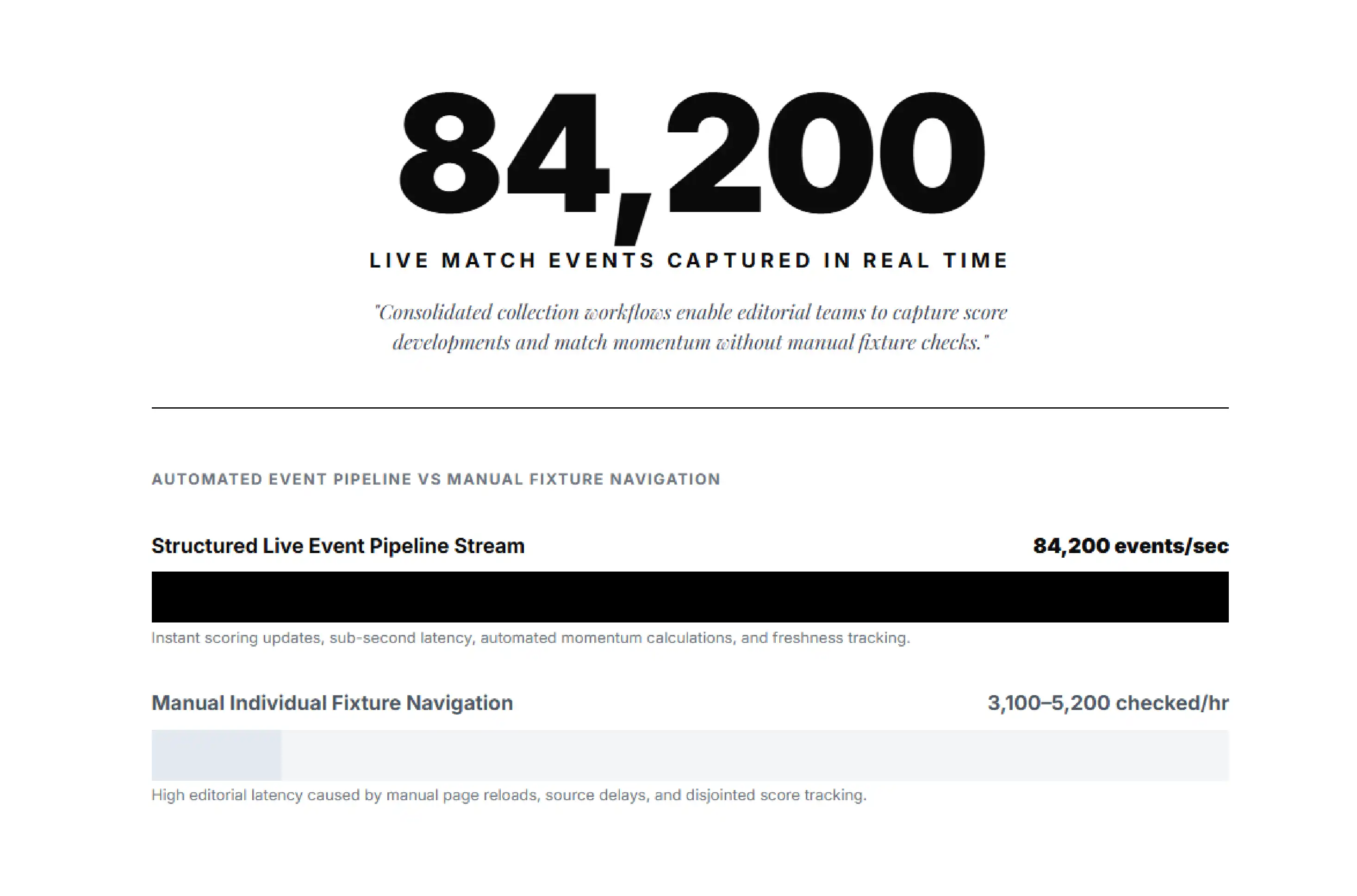
A structured collection workflow allows analysts to monitor score changes and match status without repeatedly navigating individual fixtures. Goals, set changes, substitutions, cards, and other supported events can be associated with the appropriate match record.
This consolidated view helps editorial teams prepare timely updates and enables analysts to examine how match momentum develops. Data freshness indicators are essential because collection intervals and source delays can affect how closely dashboards reflect events on the field.
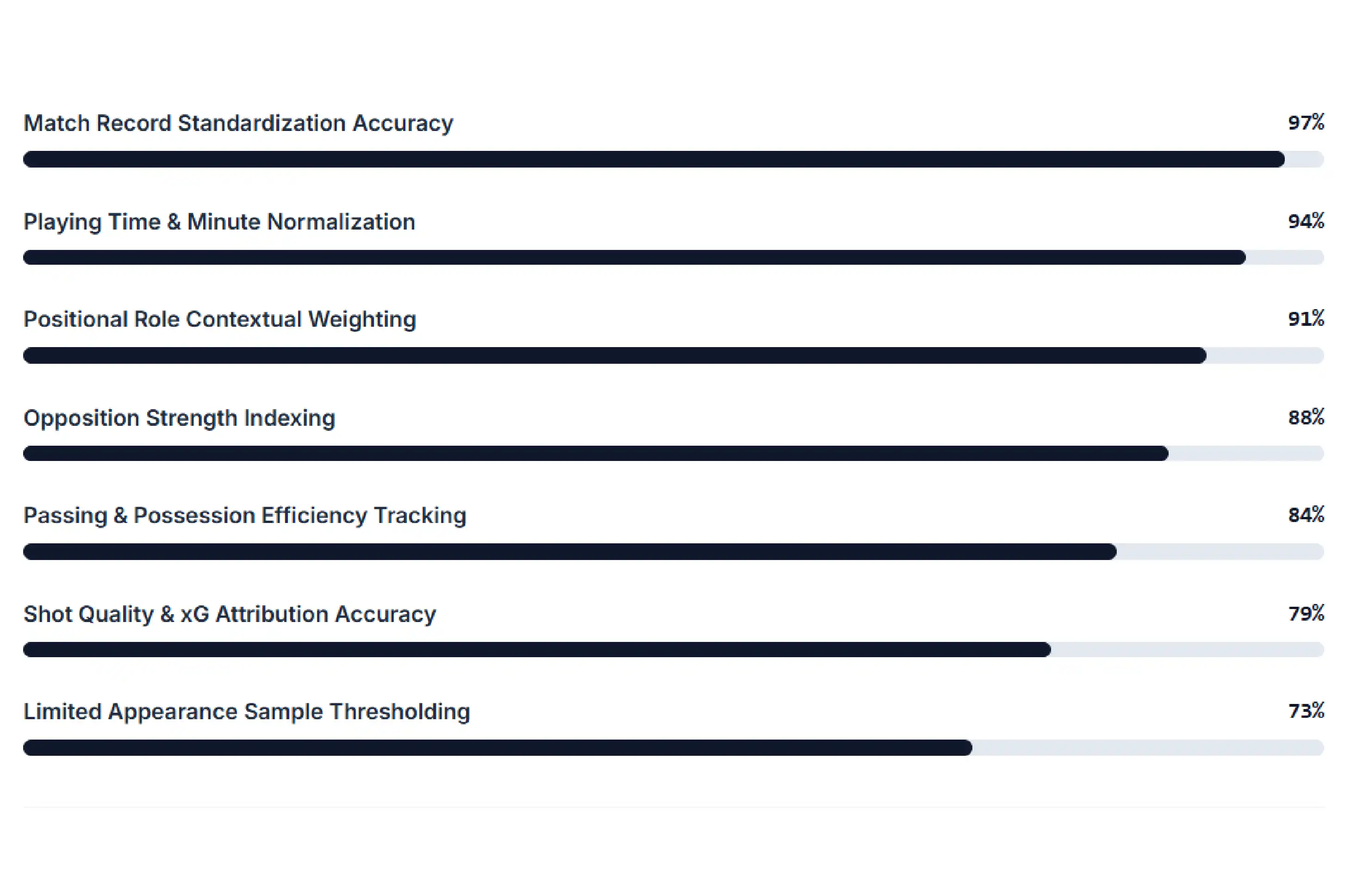
Standardized match records make it easier to compare player contributions and team performance across fixtures. Depending on the sport and available fields, analysts can examine goals, assists, shots, possession, passing statistics, serve performance, or other relevant indicators.
Player identifiers and competition context are particularly important. A player with limited appearances should not automatically be compared with a regular starter without accounting for playing time, role, opposition, and the number of matches observed.
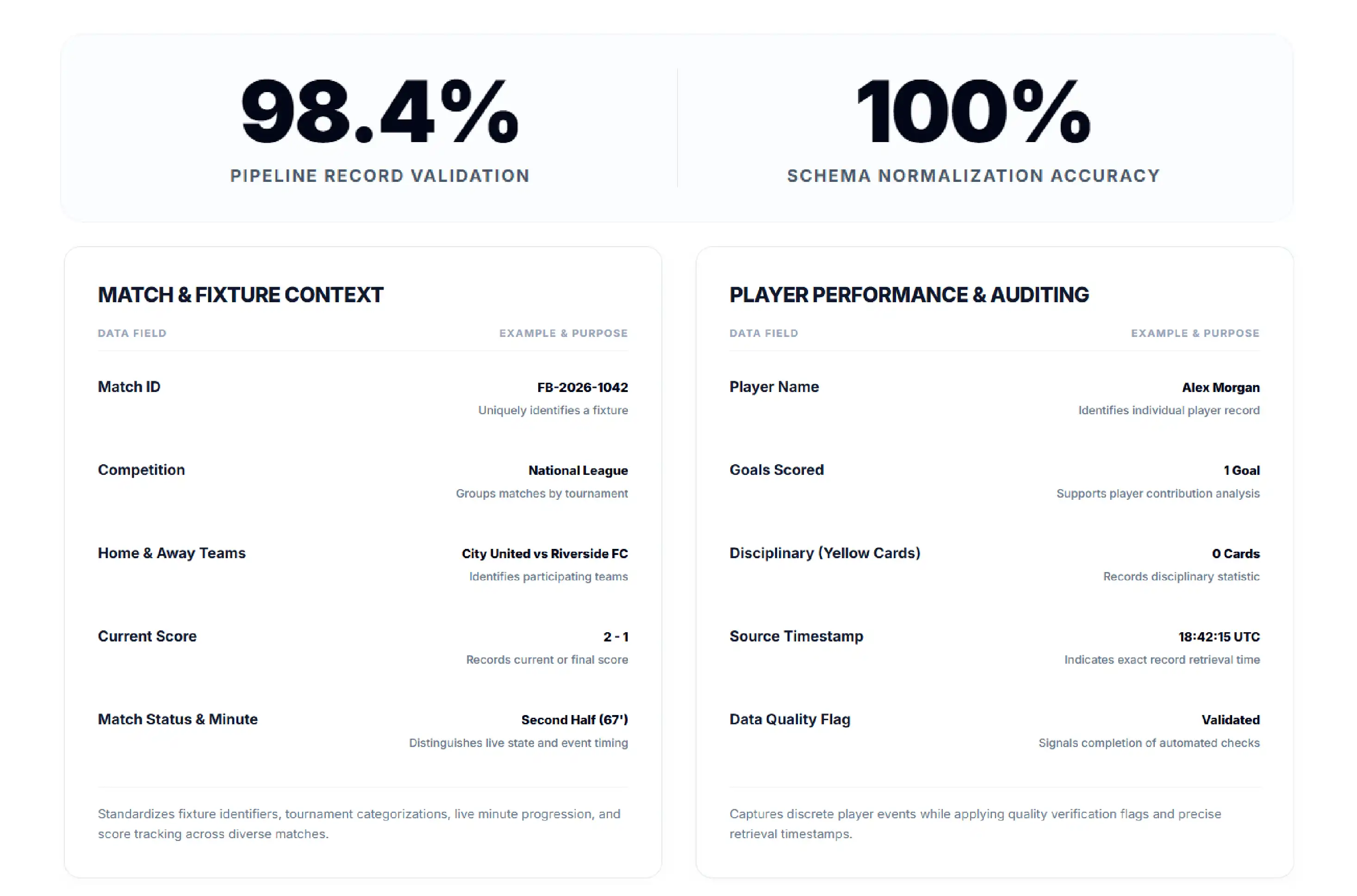
The pipeline converts changing match updates into organized records that can support analysis and reporting. A representative dataset may contain the following fields:
| Data Field | Example | Analytical Purpose |
|---|---|---|
| Match ID | FB-2026-1042 | Uniquely identifies a fixture |
| Competition | National League | Groups matches by tournament |
| Home Team | City United | Identifies a participating team |
| Away Team | Riverside FC | Identifies the opponent |
| Home Score | 2 | Records the current or final score |
| Away Score | 1 | Records the opposing score |
| Match Status | Second Half | Distinguishes live from completed fixtures |
| Match Minute | 67 | Provides event timing where available |
| Player Name | Alex Morgan | Identifies a player record |
| Goals | 1 | Supports player contribution analysis |
| Yellow Cards | 0 | Records a supported disciplinary statistic |
| Source Timestamp | 18:42:15 UTC | Indicates when the record was retrieved |
| Data Quality Flag | Validated | Signals completion of configured checks |
The values are illustrative examples, not a live Flashscore feed. In a production system, field availability and definitions must be confirmed against the authorized source.
The following sample illustrates how structured match data can support live monitoring and performance analysis. The records are fictional and do not represent current or historical Flashscore results.
| Competition | Match | Score | Status | Player/Event Insight | Trend Signal |
|---|---|---|---|---|---|
| Premier League | City United vs Riverside FC | 2–1 | 67' | One recorded goal contribution | Late-match activity |
| Continental Cup | Northbridge vs Lakeside | 1–1 | 72' | Equalizing goal recorded | Competitive fixture |
| National League | Eastport vs Hilltown | 3–0 | Finished | Three team goals | High scoring |
| International Series | Falcons vs Tigers | 148–139 | Finished | Team scoring totals | High-scoring contest |
| Tennis Championship | Player A vs Player B | 1–0 sets | In progress | First set completed | Match momentum |
| Regional Cup | Harbor FC vs Valley FC | 0–0 | Half-time | No goals recorded | Second-half monitoring |
A practical analytics dashboard would separate sports-specific records rather than compare unlike measures directly. Football scores, basketball points, and tennis sets require different statistical models and interpretation rules.
The system could also provide filters for competition, team, player, match status, and date. Analysts could review recent fixtures, compare results across selected periods, and investigate whether a live trend persists in historical data.
For this representative enterprise scenario, the expected operational benefits come from reducing manual collection, standardizing match information, and making validated records accessible to analytics teams. The figures below are illustrative targets for evaluating a deployment, not independently measured client outcomes.
Actual benefits depend on data licensing, competition coverage, collection frequency, source reliability, and the quality of the organization's existing workflows. Performance should be measured against a documented baseline after deployment.
iWeb Data Intelligence can help organizations design data collection and integration workflows that transform permitted sports information into consistent, analytics-ready datasets. The approach combines source assessment, automated processing, data quality checks, and structured delivery to support reliable sports intelligence.
Unified Data Collection: Consolidate authorized match information into a standardized format, reducing fragmentation across competitions, teams, and statistical sources.
Real-Time Monitoring: Configure collection schedules and update checks around source capabilities, enabling faster visibility into changing match conditions and available statistics.
Data Quality Management: Apply normalization, duplicate detection, timestamp validation, and missing-value checks to improve the consistency of sports reporting.
Scalable Analytics: Organize match and player records for historical comparisons, dashboards, performance analysis, and appropriately validated predictive models.
Business Decision Support: Deliver structured information to media teams, application developers, analysts, and other stakeholders through reusable datasets and integration services.
By combining these capabilities with responsible source access and clear data provenance, businesses can establish a foundation for sports intelligence that scales with their analytical requirements.
"We needed a more organized approach to monitoring sports results and interpreting match-level information across multiple competitions. The proposed data intelligence framework helped us understand how authorized source integration, consistent data structures, and automated quality checks can reduce repetitive work and improve reporting workflows. The standardized approach also gives our analysts a clearer path toward comparing team results, evaluating player contributions, and identifying emerging sports trends. We particularly value the emphasis on data freshness, validation, and traceability, which helps our team understand the reliability and limitations of each record. This framework provides a practical foundation for developing more responsive sports dashboards and analytical applications as our coverage requirements grow."
— Head of Sports Data Analytics
The project established a practical blueprint for transforming live sports information into structured business intelligence. By combining authorized source integration, automated collection, data normalization, and validation, the organization can reduce reliance on fragmented manual tracking and build more consistent reporting workflows.
The framework supports the monitoring of match results, fixture status, supported player statistics, and competition-level developments. Centralized records also make it easier to compare historical performance, investigate trends, and distribute information to dashboards and downstream applications.
Implementing method to Scrape Live Scores from Flashscore API workflows requires careful assessment of the available interfaces, licensing terms, and technical restrictions. Where a public or authorized Flashscore API does not provide the required access, an appropriately licensed sports data provider or another permitted integration method should be considered.
The company could now answer critical operational questions faster:
This shift from periodic reporting to continuous sports intelligence strengthened the organization's ability to manage the rapidly evolving sports data environment.
Most importantly, the project demonstrated that live score visibility is not simply a results metric. In a competitive sports media environment, match intelligence is part of the viewer experience and directly influences the opportunity to convert engagement into loyalty.
Flashscore live score scraping refers to collecting permitted match information from available Flashscore interfaces or authorized integrations and organizing it into structured records. Depending on source access, records may include scores, fixtures, match status, results, and available statistics.
A generally available public API should not be assumed. API availability, access conditions, and permitted usage must be confirmed with the provider. Businesses may need a licensed sports data feed or another authorized integration when direct API access is unavailable.
Depending on the sport and source, datasets may include scores, match timelines, player appearances, goals, assists, cards, possession, shots, standings, or other performance indicators. Not every competition provides every statistic.
They can use stable match identifiers, source timestamps, schema validation, duplicate detection, event reconciliation, and freshness monitoring. Systems should distinguish missing values from genuine zero values and flag records that cannot be validated confidently.
Structured sports data can help organizations monitor competitions, compare team and player performance, prepare timely sports content, build dashboards, and investigate emerging statistical trends. Any predictive analysis should account for data quality, sample size, and the limitations of available records.
iWeb Data Intelligence can help you develop scalable data collection and analytics workflows that organize permitted sports information into structured datasets, improve match monitoring, and support informed decisions across sports media, digital applications, and performance analytics.
Start a projectFields marked * are required. Everything else just helps us scope faster — skip what you don't know yet.