
58.6K+
SKU RECORDS PROCESSED

Scrape SKU-based Data Collection from Flipkart Minutes to Track Real-Time Inventory, Pricing, Availability, and Product Intelligence Across Markets
This case study presents a real-world enterprise scenario where a retail intelligence organization implemented automated method to Scrape SKU-based Data Collection from Flipkart Minutes to transform rapidly changing quick-commerce product information into structured business intelligence. The solution enabled continuous monitoring of product catalogs, pricing movements, inventory fluctuations, and consumer demand signals across a fast-growing grocery delivery ecosystem.
The project was designed for:
The client operated in a market where quick-commerce platforms were expanding rapidly, but SKU-level visibility remained limited. Grocery categories changed multiple times throughout the day due to demand spikes, promotional campaigns, and local inventory movements. Traditional market monitoring methods failed to capture these rapid changes.
The primary objective was to create a structured intelligence framework that could capture product-level information, identify market gaps, analyze availability trends, and provide actionable insights for pricing, assortment planning, and competitive positioning.
The organization needed a reliable solution capable of continuously monitoring thousands of grocery products while maintaining historical visibility into how prices, stock levels, and product availability evolved over time.
The quick-commerce sector experienced significant transformation as consumers shifted toward instant grocery delivery models. Platforms like Flipkart Minutes created highly dynamic marketplaces where product availability, discounts, and pricing could change within hours. Businesses required deeper visibility into these changes to understand customer demand and competitor movements.
Through Flipkart Minutes SKU-level product data scraping, the client developed a structured dataset containing product names, categories, SKU identifiers, prices, discounts, stock indicators, ratings, and availability patterns. The system continuously monitored product-level changes and converted fragmented marketplace information into actionable retail intelligence.
The implemented pipeline helped businesses Extract Flipkart Minutes product catalog and pricing data while analyzing pricing movements, category expansion, and inventory consistency. Machine learning models processed historical records to identify demand patterns, detect market opportunities, and forecast potential stock issues.
The intelligence framework provided visibility into:
The project demonstrated how automated retail data collection can help brands move from reactive decision-making toward predictive commerce strategies.
The client faced multiple challenges while attempting to understand the fast-changing quick-commerce grocery ecosystem. Unlike traditional e-commerce platforms where product information remains relatively stable, instant delivery platforms experience continuous changes in inventory, pricing, and product visibility.
One major challenge was the inability to track thousands of grocery SKUs simultaneously. Manual monitoring methods could only capture limited products and failed to provide complete visibility into marketplace changes.
The client struggled with inconsistent product availability information because grocery inventory changed based on local demand, warehouse capacity, delivery zones, and customer purchasing behavior.
Another challenge involved understanding pricing volatility. Promotional campaigns, competitor movements, and demand fluctuations caused frequent price changes that were difficult to track without automated systems.
The absence of structured Flipkart Minutes inventory and availability tracking prevented the client from measuring stock reliability, identifying frequently unavailable products, and comparing performance across categories.
Additionally, brands lacked access to accurate product availability data from Flipkart Minutes, limiting their ability to optimize product distribution strategies and identify areas where competitors gained visibility advantages.
The client also faced challenges related to:
To overcome these limitations, the organization required an automated data intelligence system capable of collecting, processing, and analyzing large-scale grocery marketplace information continuously.
The rapid expansion of instant grocery delivery created a major information gap between marketplace activity and business decision-making. While consumers received faster deliveries, brands and retailers struggled to understand what happened behind the digital storefront.
Traditional retail intelligence systems focused mainly on monthly sales reports and consumer surveys. However, quick-commerce markets required hourly and daily monitoring because product availability changed significantly based on demand intensity.
A major market gap existed around SKU-level visibility. Businesses knew overall category performance but lacked detailed insights into individual products, including when products disappeared, how long they remained unavailable, and whether competitors gained market share during stock shortages.
The client required SKU-based grocery product analytics to understand product-level movements across different categories, including packaged foods, beverages, personal care, household essentials, and fresh grocery segments.
The solution also focused on implementing flipkart minutes data extraction api capabilities to ensure continuous data collection and structured information delivery for analytics platforms.
The market intelligence framework analyzed:
| Intelligence Area | Data Captured | Business Application |
|---|---|---|
| SKU Monitoring | Product ID, name, category, pricing | Product performance tracking |
| Availability Analysis | Stock status and visibility | Inventory optimization |
| Pricing Intelligence | Discounts and price changes | Competitive pricing strategy |
| Category Growth | New product additions | Market expansion planning |
| Demand Signals | Product movement patterns | Forecasting models |
This approach helped close the visibility gap between marketplace activity and strategic retail planning.
By adopting automated Grocery data scraping, the client replaced manual marketplace observation with a scalable intelligence pipeline capable of monitoring thousands of grocery products continuously.
| Dimension | Manual Tracking Approach | Client Data Intelligence System |
|---|---|---|
| Data Collection | Limited product observation | Automated SKU-level extraction |
| Monitoring Frequency | Occasional manual checks | Continuous marketplace monitoring |
| Data Accuracy | Human errors and missing records | Automated validation processes |
| Inventory Visibility | Limited stock understanding | Real-time availability insights |
| Market Analysis | Historical assumptions | Dynamic trend identification |
| Scalability | Difficult across categories | Supports large SKU volumes |
The structured system improved efficiency by collecting product-level information automatically and organizing it into analytical datasets.
Using Managed web scraping, the client established a reliable collection framework that handled frequent marketplace changes, dynamic content structures, and large-scale product updates.
The pipeline supported:
The brand in focus is a retail intelligence organization helping consumer businesses understand digital marketplace performance through advanced analytics. The company specializes in transforming online commerce signals into actionable insights for pricing optimization, assortment planning, and demand forecasting.
As quick-commerce platforms expanded, the organization identified a growing requirement for detailed marketplace intelligence. Brands wanted to understand not only what products were available but also how quickly inventory changed, where demand increased, and which products gained stronger visibility.
The company operated in a highly competitive environment where small changes in product availability could influence consumer purchasing decisions. A competitor gaining temporary visibility due to another brand's stock shortage could directly impact sales performance.
To address these challenges, the organization adopted a data-driven framework focused on continuous product monitoring and SKU-level analysis.
The implementation provided deeper visibility into:
This transformation enabled the organization to shift from delayed market reporting toward proactive retail intelligence.
We delivered an end-to-end data extraction and analytics framework designed to capture, process, and analyze Flipkart Minutes marketplace information at scale.
The system collected structured product information including SKU identifiers, product names, categories, pricing details, discounts, availability status, and marketplace changes.
Advanced processing pipelines cleaned duplicate records, standardized product attributes, and created historical datasets for trend analysis.
The solution enabled Stock-out and availability tracking by monitoring product visibility changes and identifying repeated inventory gaps across categories.
It also supported Market trend and demand intelligence through historical analysis of product movement, pricing changes, and consumer interest signals.
The architecture included:
The platform continuously converted marketplace activity into structured insights that supported faster retail decisions.
The implementation provided the client with complete visibility into thousands of grocery products across multiple categories. Previously, businesses relied on limited observations that failed to capture daily marketplace fluctuations.
The automated system tracked SKU-level movements and identified changes in pricing, product availability, and category expansion.
This allowed teams to understand:
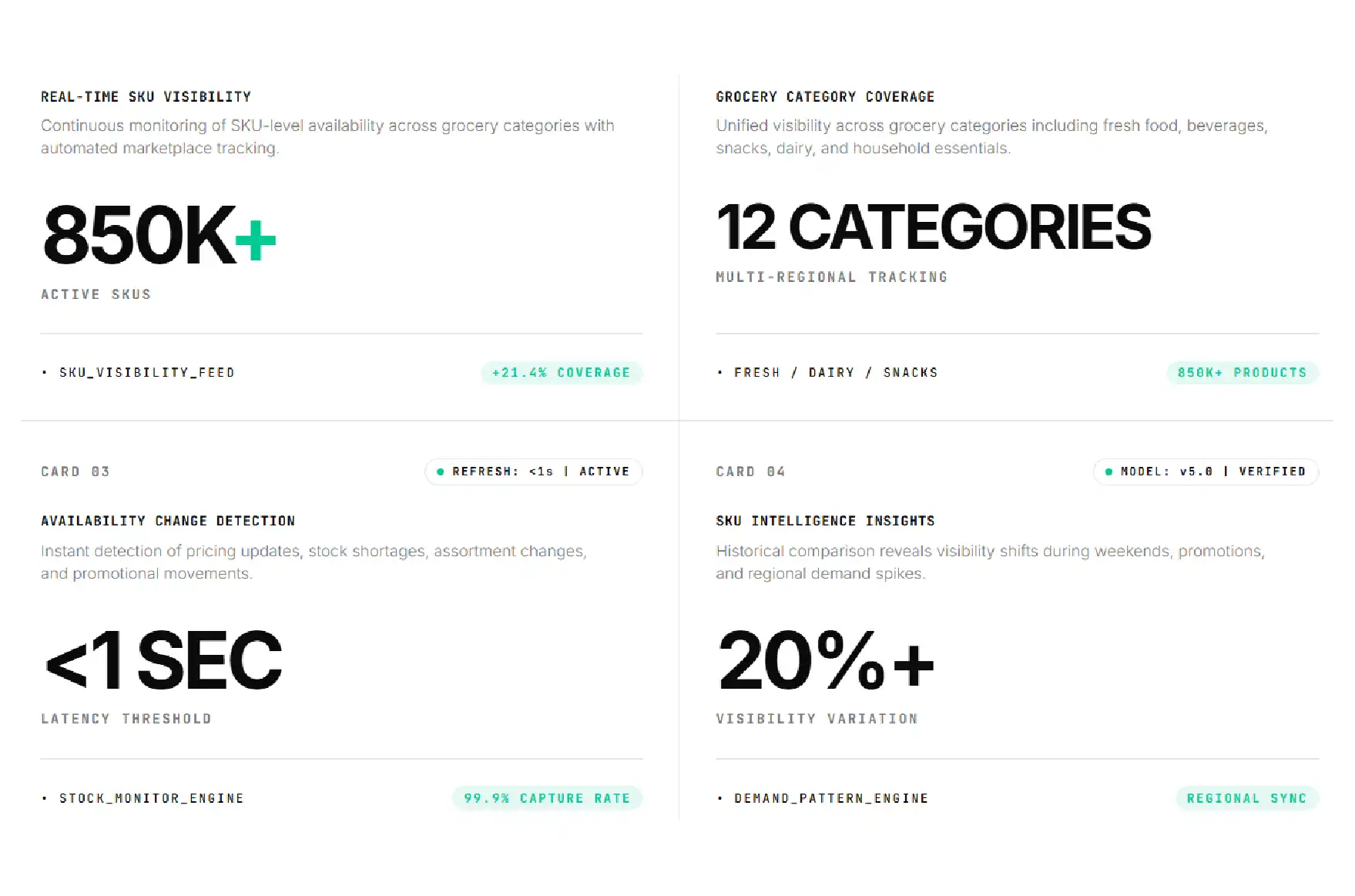
The analysis revealed that availability patterns changed significantly during weekends, promotional periods, and high-demand events.
Historical comparison showed that certain grocery categories experienced more than 20% variation in SKU visibility depending on regional demand conditions.
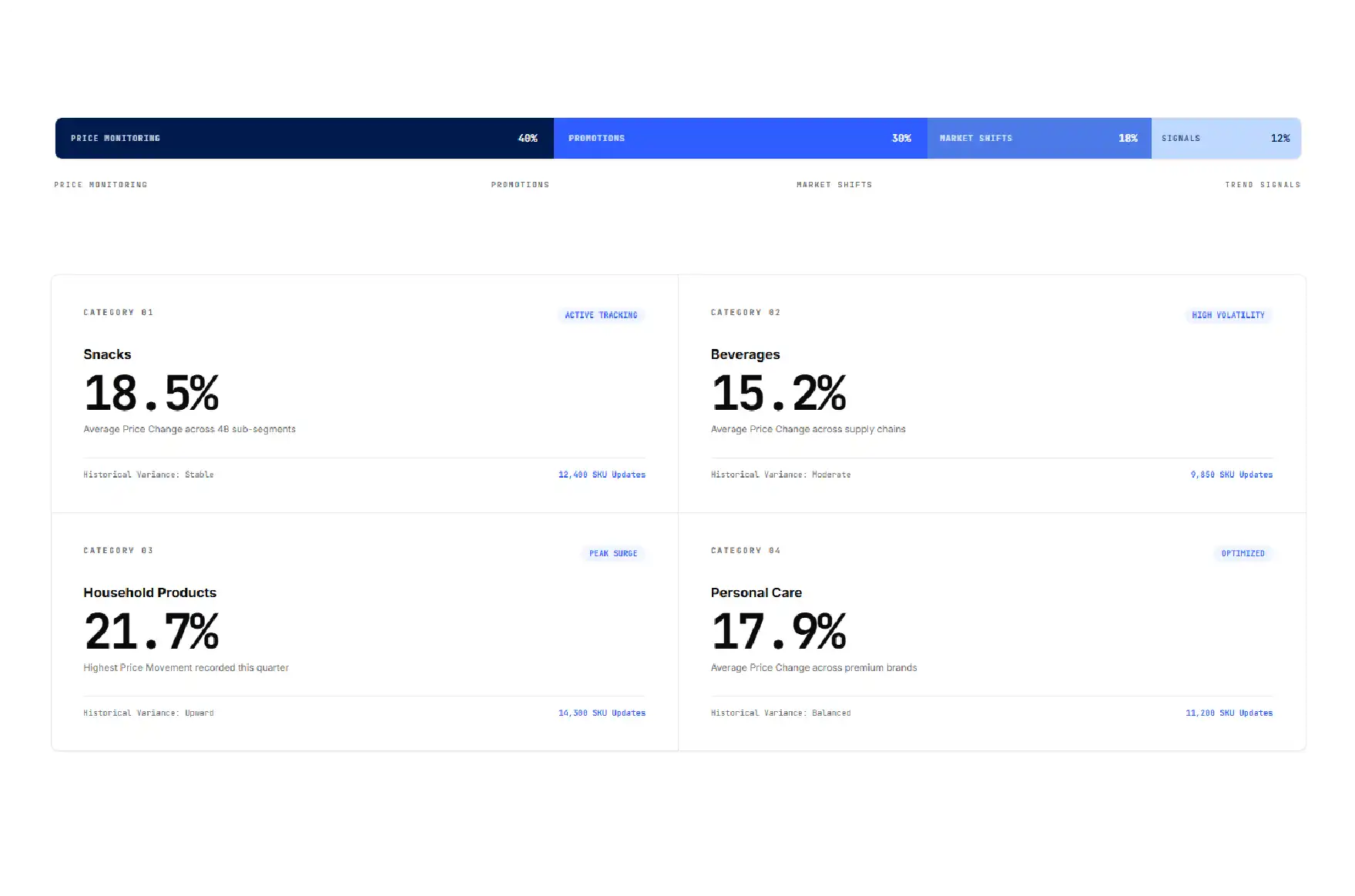
The system analyzed pricing changes over time to identify competitive movements and promotional strategies.
Before implementation, brands lacked historical pricing visibility and could not determine whether price changes were temporary promotions or long-term market adjustments.
The dataset captured:
| Category | Average Price Changes Tracked | Monthly SKU Movement |
|---|---|---|
| Snacks | 18.5% | 12,400 SKU updates |
| Beverages | 15.2% | 9,850 SKU updates |
| Household Products | 21.7% | 14,300 SKU updates |
| Personal Care | 17.9% | 11,200 SKU updates |
The intelligence helped brands understand changing market conditions and optimize pricing decisions based on actual marketplace behavior.
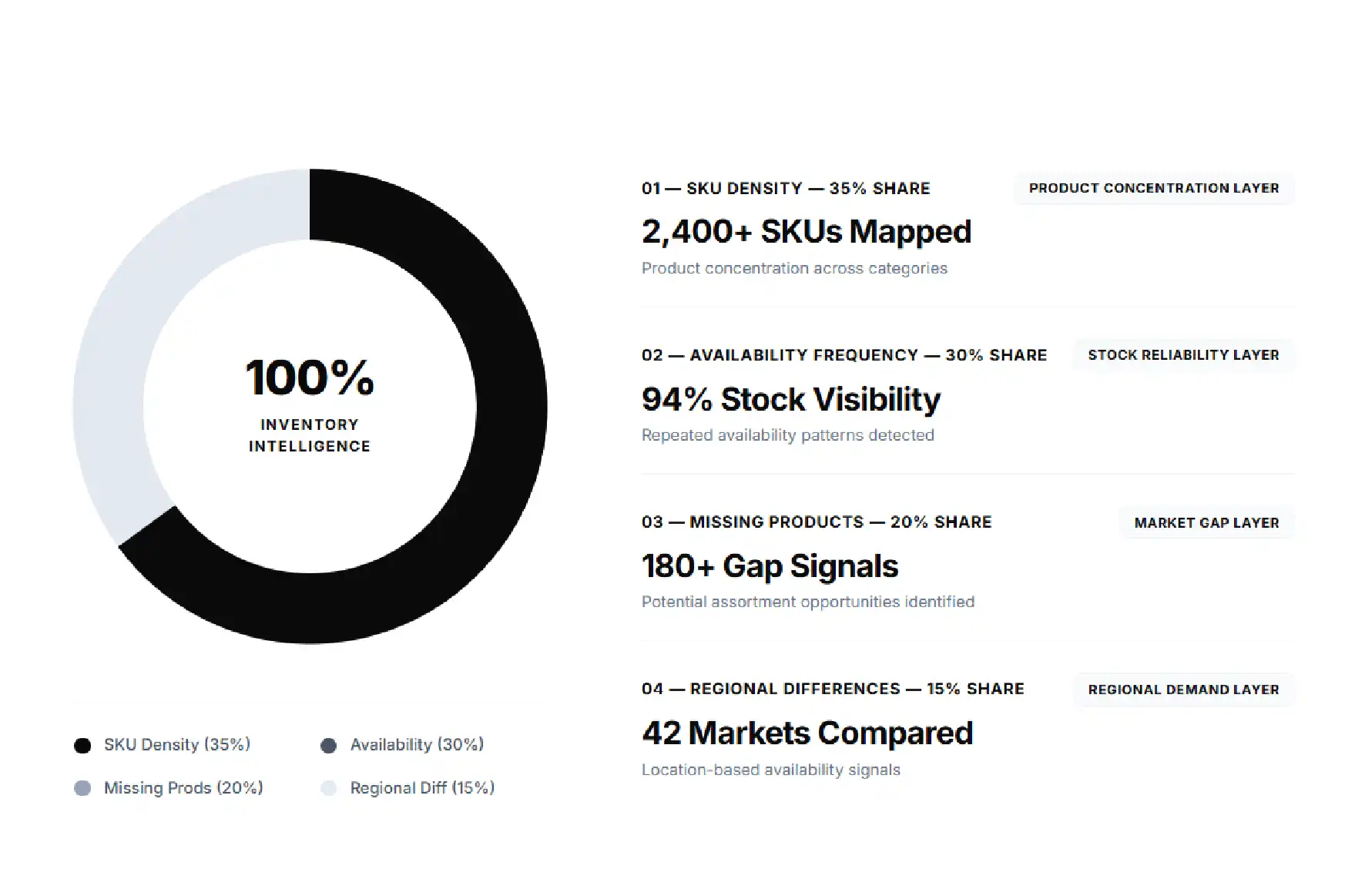
One of the strongest outcomes was identifying inventory density patterns across product categories.
The analysis measured how frequently products appeared, disappeared, and returned within marketplace listings.
| Measurement Area | Insight Generated |
|---|---|
| SKU Density | Product concentration across categories |
| Availability Frequency | Stock reliability measurement |
| Missing Products | Potential market gaps |
| Regional Differences | Location-based demand signals |
The system identified products with repeated stock shortages, helping brands evaluate supply chain improvements.
The analysis also highlighted opportunities where competitors had limited assortment coverage, allowing businesses to strengthen product presence.
By analyzing historical product records, the client developed stronger demand forecasting capabilities.
The system identified recurring patterns related to:
Machine learning models processed historical SKU activity to predict potential demand increases and inventory requirements.
This allowed businesses to improve planning accuracy and reduce missed opportunities caused by delayed market reactions.
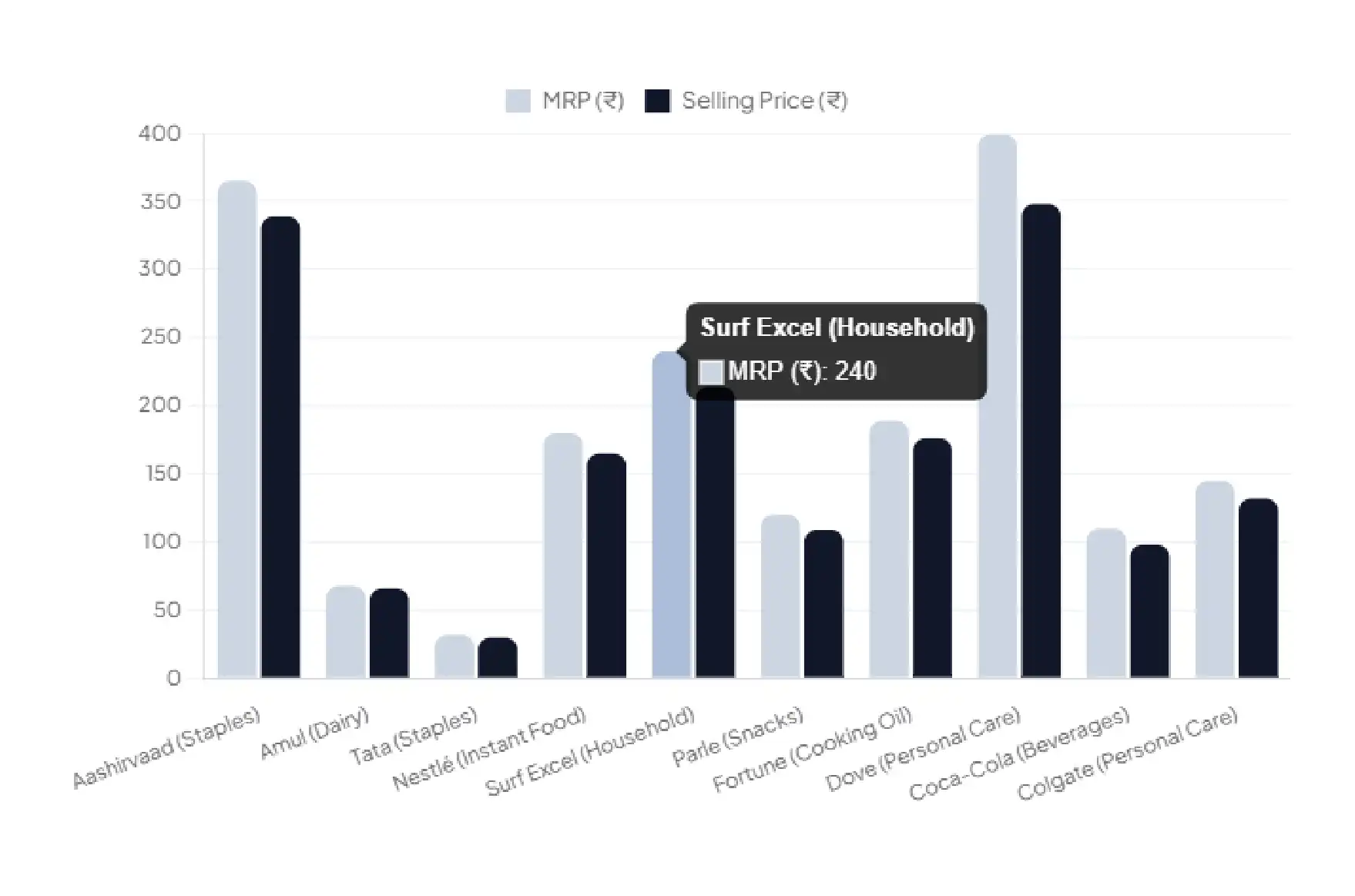
The automated intelligence pipeline captured structured SKU-level information across multiple grocery categories. Each record represented a snapshot of a product's pricing, inventory status, discount, and marketplace visibility at a specific point in time. This historical dataset enabled trend analysis, competitive benchmarking, and demand forecasting.
| SKU ID | Product Name | Category | Brand | MRP (₹) | Selling Price (₹) | Discount | Stock Status | Rating | Delivery Time | City | Last Updated |
|---|---|---|---|---|---|---|---|---|---|---|---|
| FM102341 | Aashirvaad Atta 5kg | Staples | Aashirvaad | 365 | 339 | 7% | In Stock | 4.6 | 14 mins | Bengaluru | 10:15 AM |
| FM102587 | Amul Gold Milk 1L | Dairy | Amul | 68 | 66 | 3% | In Stock | 4.8 | 12 mins | Mumbai | 10:18 AM |
| FM102744 | Tata Salt 1kg | Staples | Tata | 32 | 30 | 6% | Low Stock | 4.7 | 13 mins | Delhi | 10:20 AM |
| FM103128 | Maggi Noodles Pack of 12 | Instant Food | Nestlé | 180 | 165 | 8% | In Stock | 4.8 | 15 mins | Hyderabad | 10:22 AM |
| FM103566 | Surf Excel Easy Wash 1kg | Household | Surf Excel | 240 | 214 | 11% | Out of Stock | 4.7 | N/A | Chennai | 10:25 AM |
| FM103901 | Parle-G Biscuits 800g | Snacks | Parle | 120 | 109 | 9% | In Stock | 4.7 | 11 mins | Pune | 10:27 AM |
| FM104115 | Fortune Sunflower Oil 1L | Cooking Oil | Fortune | 189 | 176 | 7% | In Stock | 4.6 | 13 mins | Ahmedabad | 10:30 AM |
| FM104442 | Dove Shampoo 340ml | Personal Care | Dove | 399 | 348 | 13% | Low Stock | 4.5 | 16 mins | Kolkata | 10:32 AM |
| FM104773 | Coca-Cola 2.25L | Beverages | Coca-Cola | 110 | 98 | 11% | In Stock | 4.6 | 12 mins | Jaipur | 10:35 AM |
| FM105008 | Colgate Strong Teeth 200g | Personal Care | Colgate | 145 | 132 | 9% | In Stock | 4.8 | 14 mins | Lucknow | 10:38 AM |
After implementing automated Flipkart Minutes intelligence capabilities, the client achieved measurable improvements across retail analytics operations.
Our approach helps businesses convert complex digital marketplace activity into structured intelligence that supports faster and more accurate decision-making.
The solution provides continuous visibility into product availability, pricing movements, and category changes while eliminating manual monitoring limitations.
With scalable architecture, businesses can monitor increasing SKU volumes without losing accuracy or performance.
The system improves data quality through validation, cleaning, and structured processing methods, ensuring reliable information for analytics and forecasting.
By combining automation with advanced retail intelligence methods, organizations gain stronger competitive awareness and improved ability to respond to changing market conditions.
"We needed deeper visibility into quick-commerce marketplace activity, especially at the SKU level. The solution transformed fragmented product information into structured intelligence that helped us understand pricing movements, availability patterns, and category opportunities. The accuracy and speed of insights significantly improved our strategic planning process."
— Director of Retail Analytics
The final outcome was a scalable SKU intelligence system that transformed Flipkart Minutes marketplace data into actionable retail insights.
The client gained continuous visibility into product availability, pricing behavior, assortment changes, and demand patterns.
Implementation of advanced Web Scraping API Services enabled seamless data collection and processing across large product datasets.
The solution also improved forecasting capabilities by providing historical visibility into marketplace changes over time.
Deployment of automated Web Scraping Services created a strong foundation for future retail intelligence expansion.
Overall, the project delivered improved operational efficiency, stronger competitive positioning, and a data-driven approach to quick-commerce decision-making.
The system can collect SKU details, product names, categories, prices, discounts, availability status, ratings, and historical marketplace changes for detailed retail analysis.
SKU-level intelligence helps brands understand product performance, pricing movements, inventory gaps, and customer demand patterns for better decision-making.
Yes, automated pipelines continuously monitor availability changes and create historical records showing stock patterns and product movement.
Yes, the architecture is designed to process thousands of products and increasing marketplace data volumes efficiently.
Retailers, FMCG brands, grocery companies, e-commerce businesses, and market research organizations can use this intelligence for competitive analysis and planning.
Partner with iWeb Data Scraping to track real-time pricing, inventory, availability, and product trends from Flipkart Minutes with scalable, automated data intelligence solutions.
Start a projectFields marked * are required. Everything else just helps us scope faster — skip what you don't know yet.