How Can Food-Delivery Intelligence Help Businesses Optimize Menu, Pricing, and Market Strategies?
Introduction
The food delivery industry has transformed into a highly competitive digital ecosystem where restaurants, aggregators, brands, and market researchers need continuous visibility into menus, pricing strategies, customer preferences, and competitor activities. With thousands of restaurants operating across multiple delivery platforms, understanding market behavior manually has become extremely challenging. Food-delivery intelligence enables businesses to collect, organize, and analyze large volumes of restaurant and marketplace data to make informed decisions related to pricing, menu optimization, product positioning, and competitive strategy.
Modern food businesses no longer compete only on taste and service quality. They compete through digital visibility, promotional pricing, menu availability, customer ratings, delivery speed, and platform-specific positioning. By leveraging Food delivery menu, pricing, and item-matching intelligence, businesses can understand how their offerings compare across different platforms, regions, and competitors. This intelligence provides a structured view of restaurant performance by analyzing menu items, price variations, descriptions, categories, images, discounts, and availability.
The expansion of online food marketplaces has created the need for advanced Multi-Platform Food Delivery Analytics solutions that can track information from multiple sources, including restaurant websites, mobile applications, and food ordering platforms. These analytics solutions help restaurants, food chains, consulting firms, and technology companies identify pricing trends, customer demand patterns, and operational opportunities.
Understanding Food-Delivery Intelligence and Its Importance
Food-delivery intelligence refers to the process of collecting, processing, and analyzing digital food marketplace information to generate actionable business insights. It combines data extraction, machine learning, analytics, and competitive research to help businesses understand the rapidly changing food delivery environment.
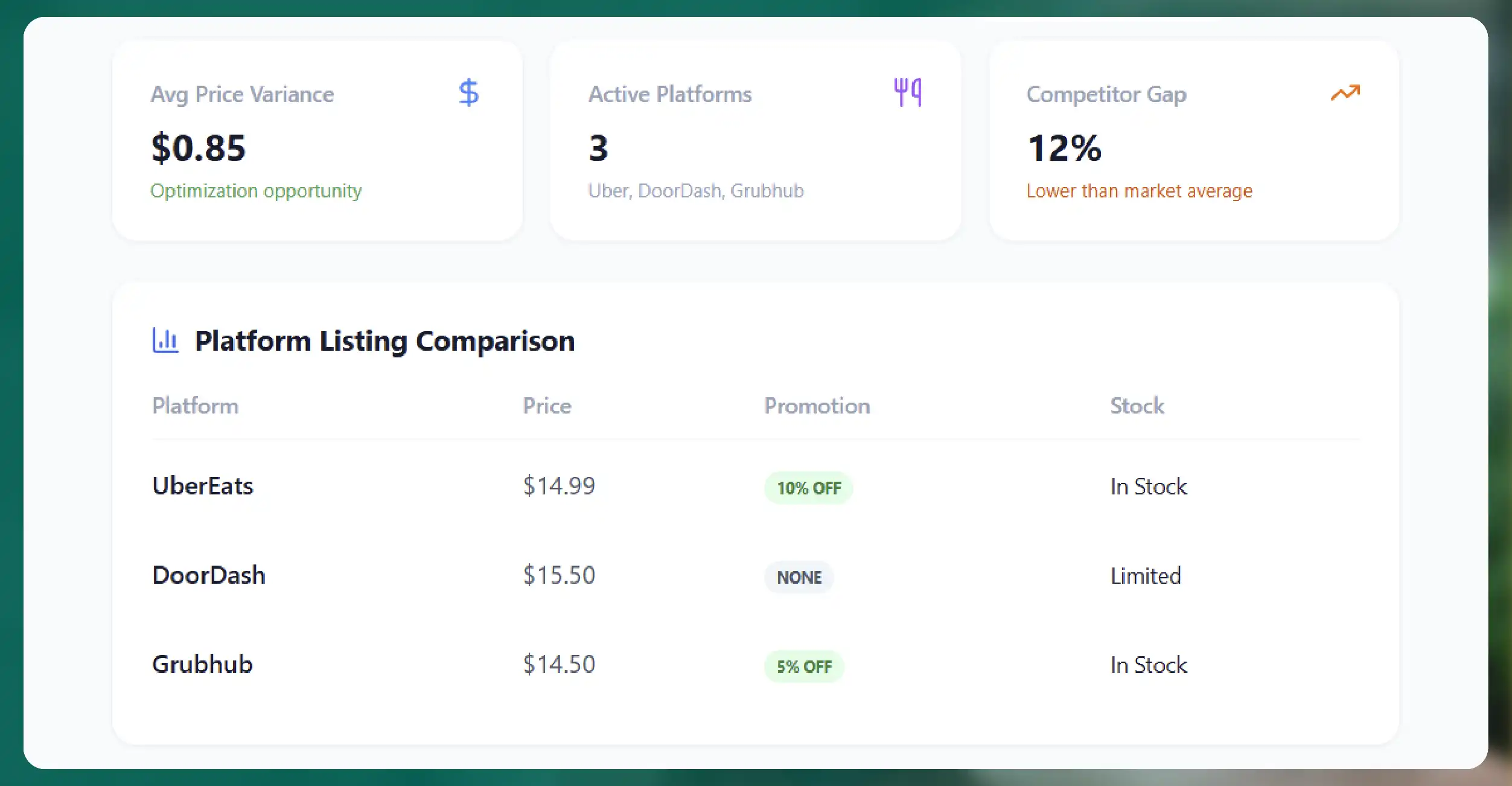
A restaurant listed on multiple delivery platforms may have different menu structures, pricing models, availability status, and promotional offers on each platform. For example, a burger listed on one platform may have a different name, description, or price compared with the same product available elsewhere. Without intelligent data processing, comparing these listings becomes complicated.
Food delivery intelligence solves this challenge by creating a unified view of restaurant offerings. Businesses can analyze:
- Menu item availability across platforms
- Price differences between delivery apps
- Discount and promotion strategies
- Restaurant ranking trends
- Category-wise performance
- Competitor menu expansion
- Regional pricing variations
- Customer demand indicators
This information helps companies improve menu planning, optimize pricing decisions, and maintain competitiveness in highly dynamic food markets.
Cross-Platform Menu Item Matching for Accurate Market Analysis
One of the biggest challenges in food marketplace analytics is identifying identical or similar menu items across different platforms. Restaurants frequently modify item names, descriptions, images, and categories depending on the platform they use.
For example, the same product may appear as “Classic Chicken Burger,” “Chicken Classic Burger,” or “Signature Chicken Burger” across different delivery applications. A simple keyword-based comparison may fail to identify that these products are essentially the same.
Cross-platform menu item matching uses advanced techniques such as natural language processing, image comparison, category mapping, and machine learning algorithms to identify equivalent products across different platforms.
Effective item matching helps businesses analyze:
- Price differences for identical products
- Menu size variations
- Competitor product positioning
- Regional menu customization
- New product launches
- Category growth trends
Accurate item matching is especially valuable for restaurant chains operating across multiple locations and delivery marketplaces. It allows brands to compare their own pricing consistency and evaluate competitor strategies with greater accuracy.
Food Delivery Price Monitoring and Competitive Pricing Insights
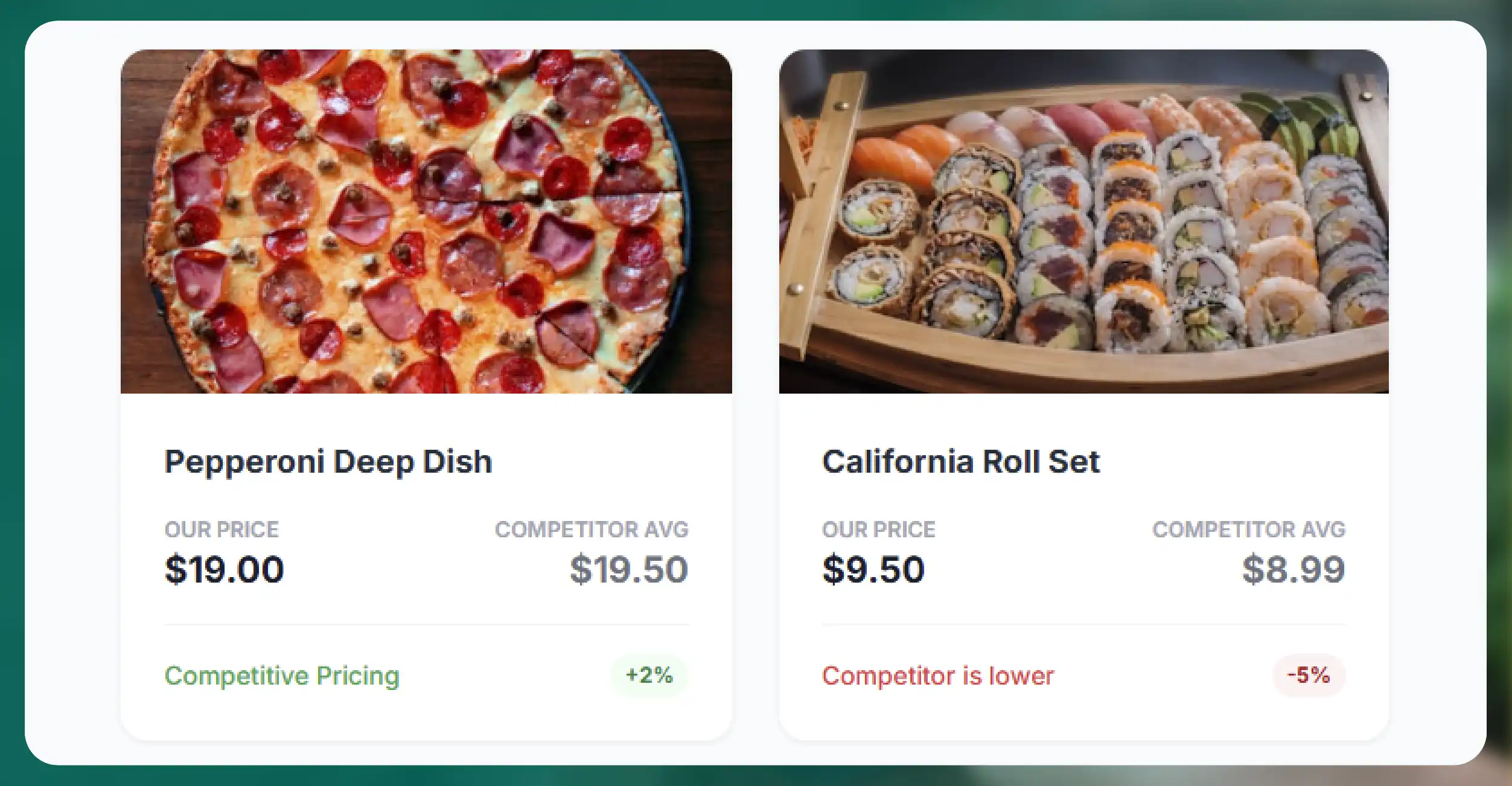
Pricing plays a critical role in customer purchasing decisions. Food delivery platforms frequently update prices based on demand, location, seasonality, promotions, and competitor activity. Businesses that monitor these changes can respond quickly and maintain stronger market positioning.
Food delivery price monitoring enables companies to track real-time and historical pricing information across multiple delivery platforms. This includes regular prices, discounted prices, promotional offers, delivery charges, and combo pricing.
Price intelligence helps businesses answer important questions:
- Are competitors offering lower prices for similar products?
- How frequently do restaurants change their pricing?
- Which menu categories experience the highest price fluctuations?
- Are discounts improving customer engagement?
- How does pricing differ between cities?
Restaurants can use this information to develop smarter pricing strategies. For example, if competitors consistently reduce prices during specific time periods, businesses can introduce targeted promotions rather than applying discounts across their entire menu.
Competitor Menu Data Collection and Market Research
Understanding competitor offerings is essential for restaurants, food brands, and marketplace operators. Manual research across hundreds of restaurants and locations requires significant time and resources. Automated data collection provides a scalable solution.
Competitor Food Delivery menu Data Scraping allows businesses to gather structured information from food delivery platforms, including restaurant details, menu items, pricing, ratings, reviews, categories, and availability.
Collected data can include:
- Data Attribute: Restaurant Name - Business Value: Identifying competitors and market presence
- Data Attribute: Menu Categories - Business Value: Understanding product segmentation
- Data Attribute: Item Names - Business Value: Comparing product offerings
- Data Attribute: Prices - Business Value: Monitoring pricing strategies
- Data Attribute: Discounts - Business Value: Evaluating promotional campaigns
- Data Attribute: Ratings - Business Value: Measuring customer satisfaction
- Data Attribute: Reviews - Business Value: Identifying customer preferences
- Data Attribute: Availability - Business Value: Tracking operational consistency
This competitive intelligence helps restaurants identify market gaps, discover trending products, and improve their own digital presence.
Building Comprehensive Restaurant Menu Datasets
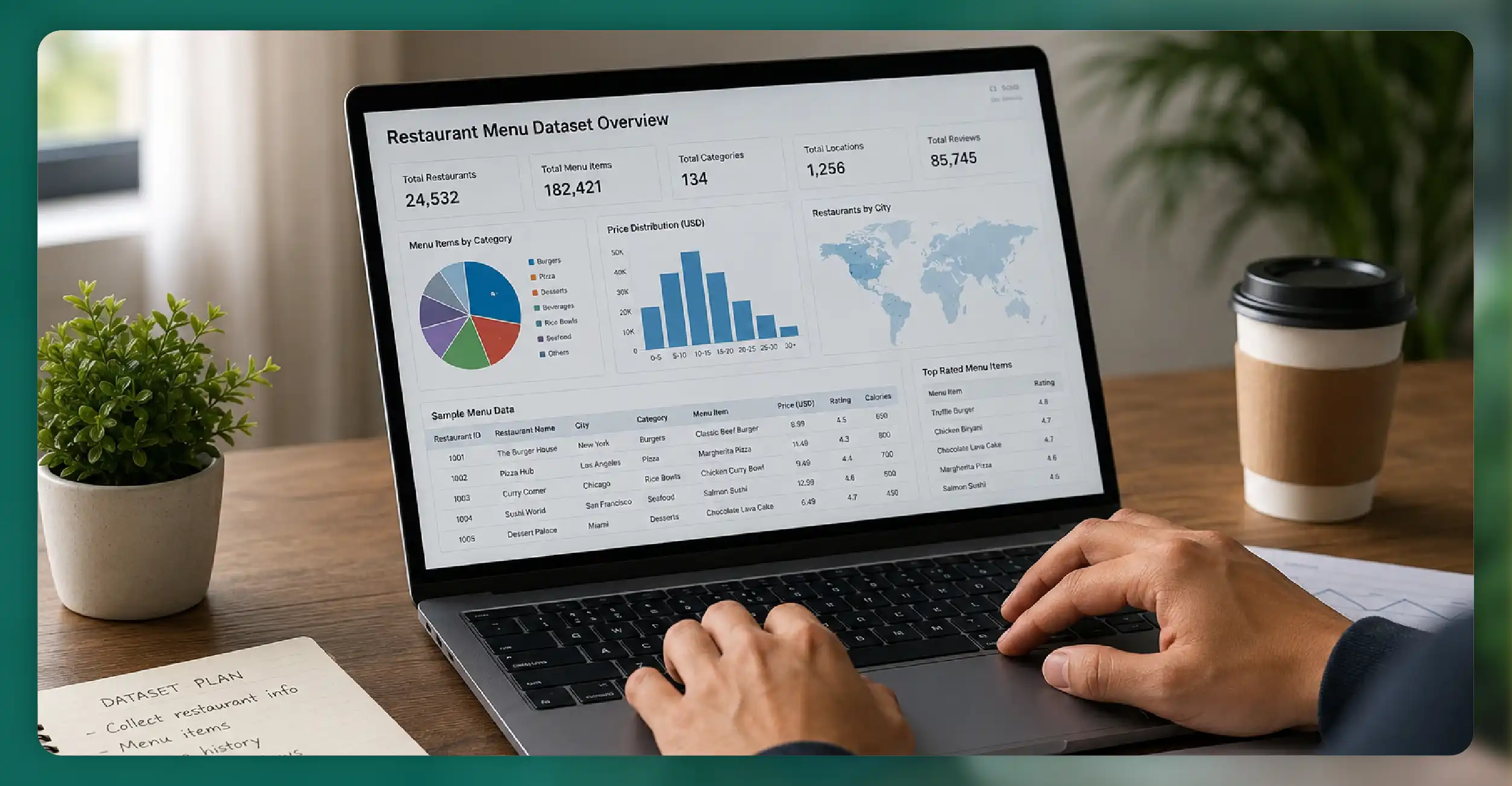
A structured dataset is the foundation of effective food delivery analytics. Businesses require clean, standardized, and regularly updated information to perform accurate analysis.
A Restaurant Menu Dataset can include thousands or millions of records containing restaurant information, menu items, pricing history, locations, categories, and customer engagement metrics.
Such datasets support multiple applications, including:
- Restaurant recommendation platforms
- Food market research
- Pricing intelligence systems
- Menu optimization tools
- Consumer behavior analysis
- Competitive benchmarking dashboards
A well-organized dataset allows companies to analyze food trends across regions and identify opportunities for expansion.
Extracting Food Delivery Data Through APIs and Automated Solutions
Modern businesses increasingly rely on automated data pipelines to access food marketplace information efficiently. APIs and scraping technologies allow organizations to collect large-scale food delivery data without manual tracking.
Businesses can use solutions to Extract Food delivery data API information containing restaurant listings, menu details, pricing information, availability updates, and location-based insights.
API-based data extraction provides benefits such as:
- Faster data collection
- Automated updates
- Structured data formats
- Easy integration with analytics platforms
- Improved decision-making speed
Organizations can integrate this information into dashboards, business intelligence systems, and pricing engines to monitor marketplace changes continuously.
Role of Mobile Application Data Extraction in Food Analytics
Most food ordering activity happens through mobile applications. These apps contain valuable information related to restaurant visibility, menu structures, customer interactions, and pricing patterns.
Professional Mobile App Data Scraping Services help businesses collect information from food delivery applications while maintaining accuracy and scalability. These services capture important details such as restaurant profiles, menu items, ratings, locations, offers, and delivery information.
Mobile app data extraction supports companies in:
- Tracking marketplace competition
- Monitoring regional differences
- Understanding customer demand
- Evaluating restaurant performance
- Identifying emerging food trends
With reliable mobile application intelligence, businesses can build stronger market strategies and improve customer experiences.
Unlock powerful food delivery insights with our data scraping solutions and gain a competitive edge through accurate menu, pricing, and marketplace intelligence.
Food Menu Data Extraction for Business Growth
Food brands require accurate and updated menu information to optimize operations and customer engagement. Automated extraction solutions help collect menu information from multiple sources and convert it into structured formats.
Using Food Menu Data Extraction Services, companies can analyze menu evolution, identify popular products, compare competitor offerings, and improve their own product strategies.
These insights are valuable for restaurant chains, food technology companies, delivery marketplaces, and investors analyzing food industry trends.
Future of Food Delivery Intelligence
The future of food delivery analytics will be driven by artificial intelligence, predictive analytics, and automated market intelligence platforms. Businesses will increasingly use advanced systems to forecast demand, personalize menus, optimize pricing, and identify customer preferences.
AI-powered solutions can analyze historical pricing patterns, seasonal demand, customer reviews, and competitor movements to recommend better business strategies.
As food delivery markets continue expanding globally, companies that use accurate data-driven insights will have a stronger advantage in improving profitability and customer satisfaction.
How iWeb Data Scraping Can Help You?
Multi-Platform Food Market Intelligence
Our data scraping services collect restaurant menus, pricing, availability, ratings, and promotions from multiple delivery platforms, helping businesses analyze market trends and make informed strategic decisions.
Accurate Competitor Price Monitoring
We help businesses track competitor food delivery prices, discounts, and offers across marketplaces, enabling smarter pricing strategies, improved competitiveness, and better understanding of changing customer purchasing patterns.
Advanced Menu Data Extraction
Our solutions extract detailed restaurant menu information, including categories, item names, descriptions, images, and prices, allowing brands to optimize offerings and identify new opportunities.
Cross-Platform Item Matching Analysis
We provide intelligent matching of similar food items across different delivery apps, helping businesses compare products, evaluate competitors, and analyze pricing differences with improved accuracy and consistency.
Custom Food Delivery Datasets
Our customized datasets deliver structured food marketplace insights in formats like CSV, JSON, and Excel, supporting analytics platforms, dashboards, research projects, and business intelligence applications.
Conclusion
Food delivery intelligence has become a critical requirement for businesses operating in the digital food marketplace. From monitoring competitor pricing to analyzing menu structures and matching products across platforms, data-driven solutions provide valuable visibility into market behavior.
Businesses can leverage Food Menu Data Extraction Services to collect reliable marketplace information and transform it into actionable insights. By analyzing the Food Delivery App Menu, organizations can understand customer preferences, optimize offerings, and improve competitive positioning.
Advanced Web Scraping API Services further enable automated access to structured food delivery information, helping companies build scalable analytics systems and make faster decisions in changing markets. With accurate data collection and intelligent analysis, food businesses can create smarter strategies, improve operations, and achieve sustainable growth.
Experience top-notch web scraping service and mobile app scraping solutions with iWeb Data Scraping. Our skilled team excels in extracting various data sets, including retail store locations and beyond. Connect with us today to learn how our customized services can address your unique project needs, delivering the highest efficiency and dependability for all your data requirements.