
52.8K+
TOTAL TENDER RECORDS PROCESSED

GeM Tender Data Scraping for Government Procurement Intelligence, Bid Monitoring, Supplier Analysis, and Strategic Business Opportunity Identification Across India.
This case study explores an enterprise procurement intelligence scenario where a data analytics organization implemented automated tender information collection to transform government procurement listings into structured, searchable, and actionable business intelligence. By implementing GeM tender data scraping, the organization established a centralized approach to monitoring government procurement opportunities, analyzing bidding activity, and identifying relevant business opportunities across different departments and geographical markets.
It is designed for:
The project also incorporated GeM portal data extraction to consolidate tender announcements, bid details, product categories, department information, submission deadlines, and award-related records into a unified intelligence environment.
The client's primary objective was to replace fragmented tender research activities with a scalable data collection and analytics framework. The organization wanted continuous access to procurement information, improved opportunity discovery, and better visibility into government purchasing activities without depending on time-consuming manual searches.
India's government procurement ecosystem generates substantial information through tender announcements, bidding activities, product requirements, service contracts, and procurement awards. Businesses participating in this ecosystem require accurate and timely information to identify opportunities, evaluate competition, and prepare commercially viable bids.
The client wanted to establish a centralized intelligence platform capable of monitoring government tender data India across multiple departments, procurement categories, and geographical locations. Its existing research process involved manually visiting procurement portals, downloading tender documents, checking deadlines, and organizing information through spreadsheets. This approach created operational delays and made large-scale opportunity tracking difficult.
The implementation introduced automated data collection pipelines that captured relevant tender information from the Government e-Marketplace, commonly known as GeM. The solution organized tender identifiers, buyer organizations, product categories, estimated values where available, publication dates, bid deadlines, and procurement status into standardized records.
The system also incorporated GeM awarded tenders data to help analysts understand completed procurement activities, successful suppliers, award values where disclosed, and historical purchasing patterns. Combining active tender information with historical award records provided a broader understanding of procurement demand and supplier participation.
To support continuous integration, the architecture was designed around a GeM bid data API approach, where authorized data interfaces and compatible extraction mechanisms could deliver structured records into internal databases and analytical applications.
The client operated in a competitive procurement intelligence environment where government tender information was continuously published, modified, extended, and updated. Its existing research infrastructure could not efficiently manage the growing volume of procurement records across departments and product categories.
Fragmented Tender Monitoring
Analysts manually visited procurement listings to identify new opportunities, review tender specifications, and monitor submission deadlines. This process consumed valuable working hours and increased the possibility of overlooking relevant opportunities.
Absence of Consolidated Public Procurement Data
Tender information, buyer details, product descriptions, award announcements, and historical records were distributed across different pages and document formats. This fragmentation made comparison and historical analysis difficult.
Lack of Real-Time Monitoring Capabilities
The client also experienced delays because its existing systems lacked real-time web scraping capabilities. New announcements, deadline extensions, amendments, and procurement status changes were not consistently captured within the required reporting cycles.
Operational Delays and Manual Workload
The client required a reliable data intelligence framework that could automate collection, improve information consistency, reduce research workloads, and provide structured procurement insights for business development and competitive analysis.
To overcome these challenges, the client needed an automated GeM procurement intelligence pipeline capable of continuous monitoring, structured data organization, and scalable analytics.
By implementing an automated GeM procurement intelligence pipeline, the client replaced fragmented research activities with a standardized data collection system. The solution continuously monitored relevant procurement listings, organized tender attributes, and prepared structured records for analytical applications.
The structured approach significantly improved the client's ability to organize procurement intelligence while creating a foundation for continuous market monitoring and future analytical expansion.
| Dimension | Manual Tender Tracking | Client Data Scraping System |
|---|---|---|
| Data Collection | Individual portal searches and manual downloads | Automated collection across selected procurement listings |
| Information Speed | Dependent on analyst availability | Scheduled and continuous extraction |
| Data Organization | Separate spreadsheets and documents | Centralized structured datasets |
| Deadline Monitoring | Manual calendar updates | Automated deadline identification and alerts |
| Tender Discovery | Keyword-based manual searches | Category, buyer, location, and keyword filtering |
| Historical Analysis | Limited spreadsheet records | Searchable historical procurement database |
| Award Intelligence | Separate award announcement searches | Consolidated available award information |
| Data Accuracy | Manual entry and verification | Automated validation and normalization |
| Scalability | Dependent on additional manpower | Expandable processing infrastructure |
| Reporting | Manually prepared reports | Automated dashboards and analytical outputs |
The centralized system provided a consistent analytical foundation for comparing procurement performance across departments while reducing repetitive operational work.
The brand in focus is an enterprise procurement intelligence and business analytics organization supporting companies that participate in India's government purchasing ecosystem. Its operations involve collecting procurement information, analyzing tender opportunities, monitoring departmental requirements, and developing structured datasets for commercial research.
The organization serves businesses interested in understanding government purchasing behavior across product procurement, professional services, infrastructure requirements, technology contracts, and other procurement categories.
As its coverage expanded, the organization experienced increasing difficulties in managing large volumes of tender announcements and supporting documents. Procurement information was frequently updated, and different departments published opportunities with varying descriptions, specifications, and submission schedules.
The organization needed more than a basic tender search solution. It required a centralized intelligence infrastructure capable of connecting active opportunities with historical procurement information and supplier activity.
Its objective was to provide users with an organized view of the procurement landscape, allowing them to identify relevant opportunities, compare historical activity, and understand category-level demand.
iWeb Data Intelligence delivered an end-to-end procurement intelligence solution designed to capture, process, validate, and organize relevant GeM tender information into a centralized analytical environment.
The implementation followed a modular architecture that supported collection, processing, enrichment, storage, and reporting.
Tender Discovery and Source Identification
The initial phase involved identifying relevant public procurement listings, tender search pages, category information, buyer details, and accessible award-related records. The extraction scope was aligned with the client's business requirements and the permitted access conditions of the source platform.
Automated Data Collection
We implemented automated extraction workflows to collect tender identifiers, titles, publishing departments, product categories, bid reference numbers, publication dates, closing dates, and available procurement details. Collection frequency was configured according to source accessibility and business requirements.
Document and Specification Processing
Tender documents frequently contain important information that may not appear in summary listings. The solution incorporated document processing to extract available specifications, eligibility requirements, technical descriptions, quantities, and commercial conditions.
Data Cleaning and Standardization
Collected records passed through validation and normalization workflows. Duplicate entries, inconsistent date formats, incomplete fields, and irrelevant information were identified and handled to maintain a consistent dataset.
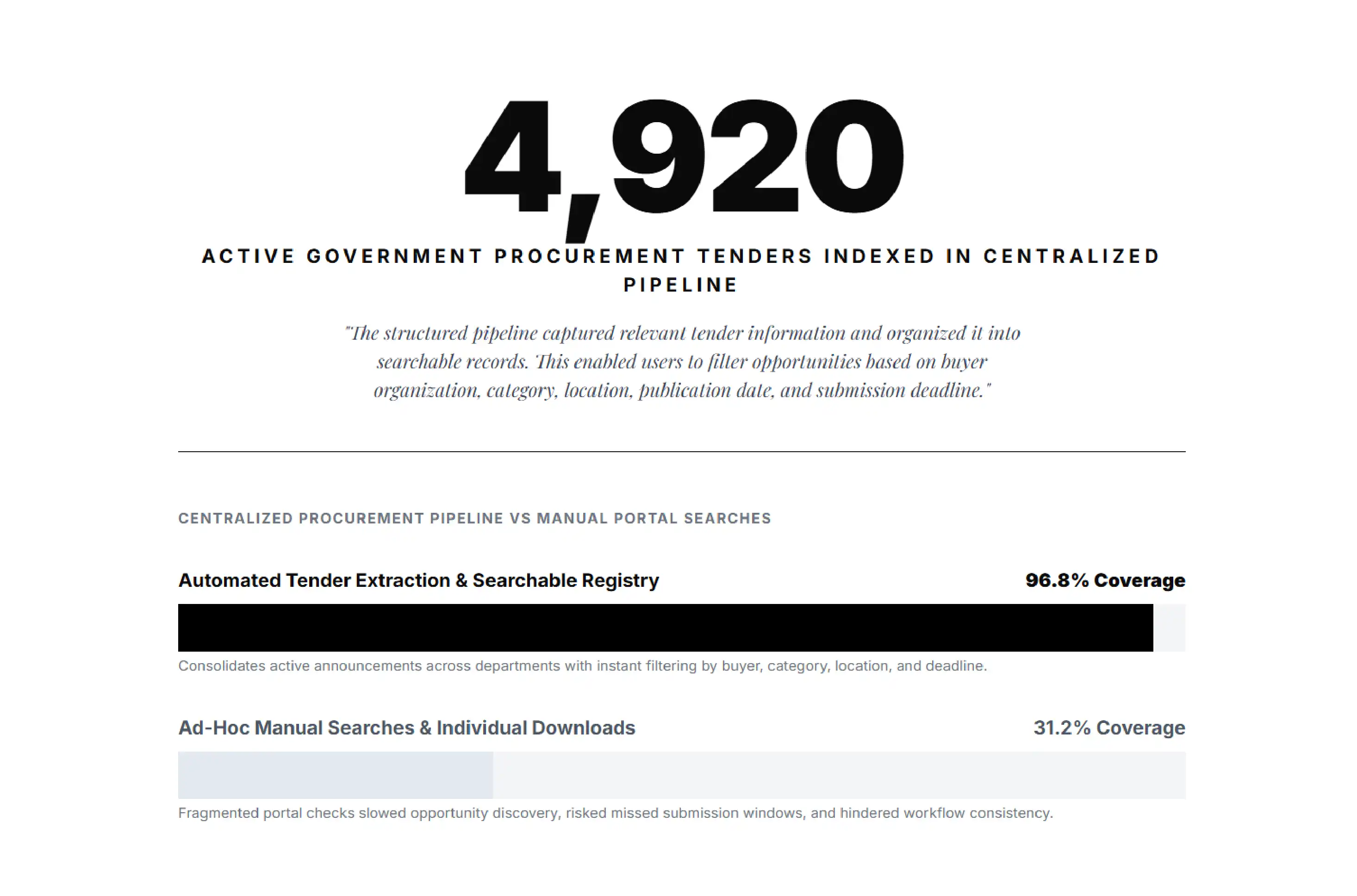
The automated extraction framework provided the client with centralized visibility into active tender announcements across selected procurement categories and departments. Previously, analysts depended on individual searches and manual downloads to identify new opportunities.
The structured pipeline captured relevant tender information and organized it into searchable records. This enabled users to filter opportunities based on buyer organization, category, location, publication date, and submission deadline.
The improved visibility reduced the time required to discover relevant procurement opportunities and strengthened the client's ability to maintain an organized tender monitoring workflow.
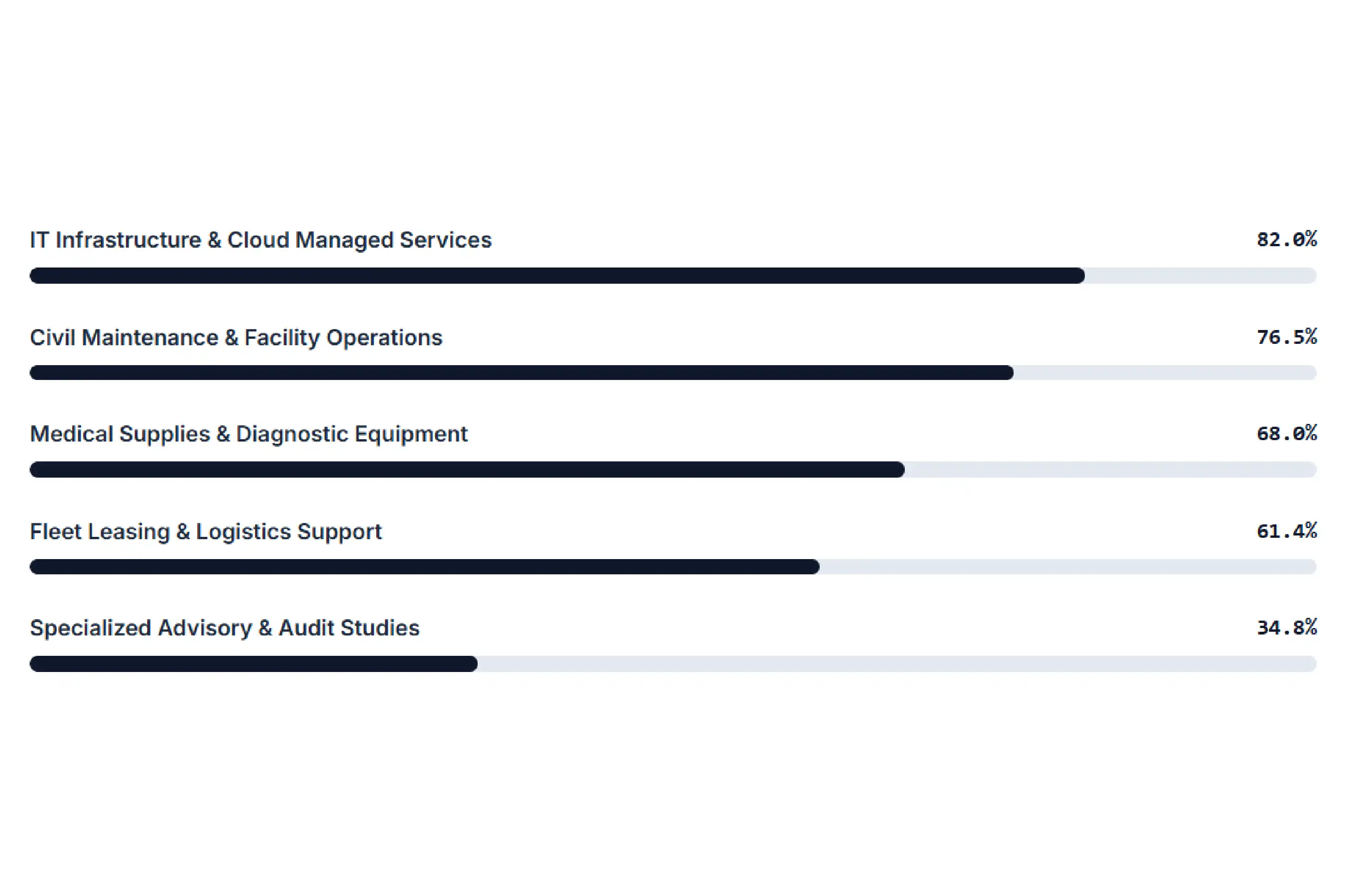
The integration of historical procurement information enabled the client to examine recurring purchasing requirements across government departments and public sector organizations.
Analysts could identify categories with repeated tender announcements, observe changes in procurement activity, and understand which departments frequently purchased particular products or services.
This information helped business development teams prioritize their research activities and identify potential buyers more systematically. Historical comparisons also provided a foundation for examining seasonal procurement activity, recurring contract requirements, and geographical differences in purchasing demand.
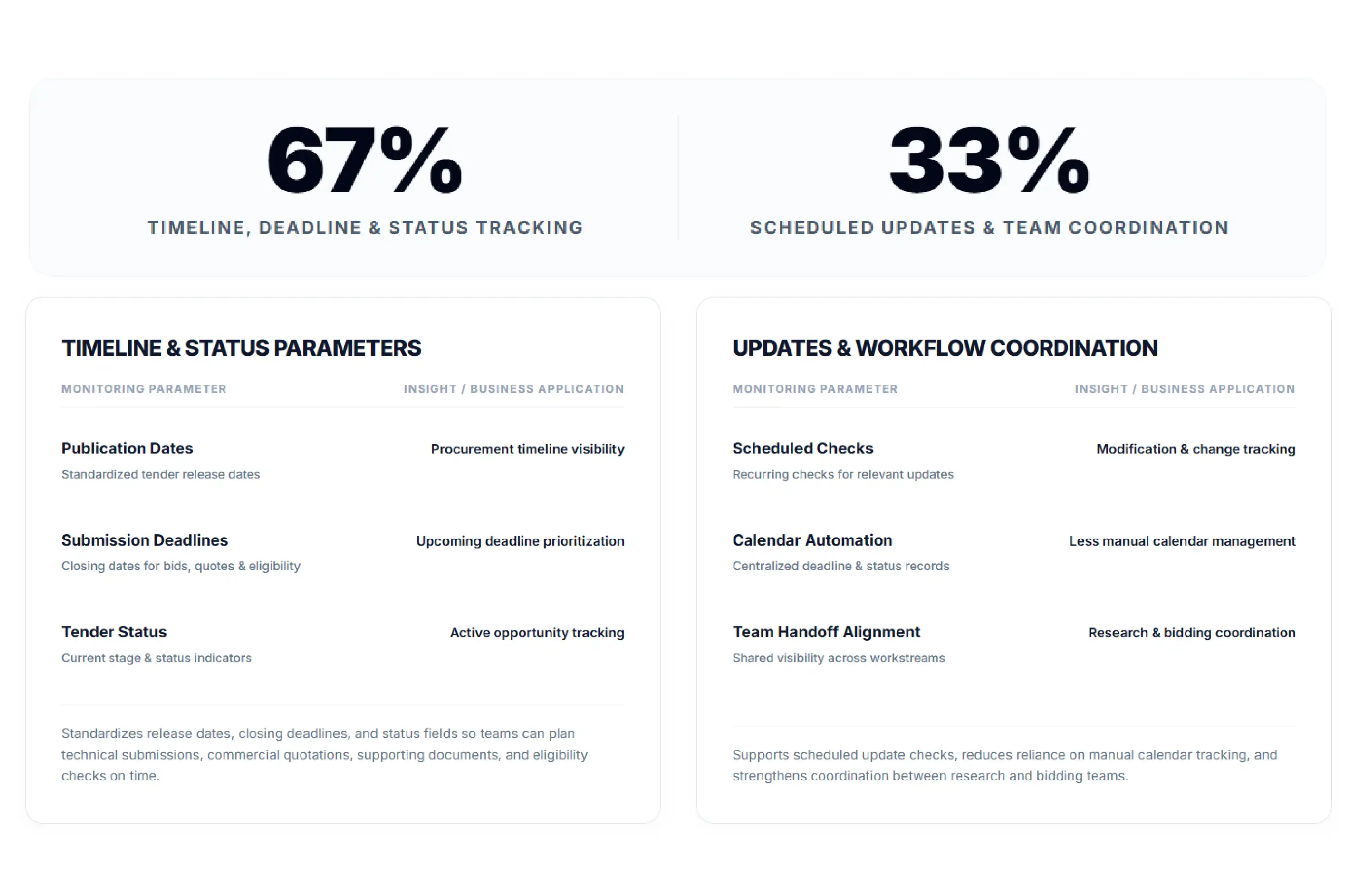
Tender deadlines are important operational variables because businesses must prepare technical submissions, commercial quotations, supporting documents, and eligibility information before the specified closing date.
The new system standardized available publication dates, submission deadlines, and tender status information. It also supported scheduled checks for relevant updates and changes.
This allowed analysts to identify upcoming submission deadlines, track modifications, and maintain better visibility into procurement timelines. The resulting workflow reduced dependence on manual calendar management and improved coordination between research and bidding teams.
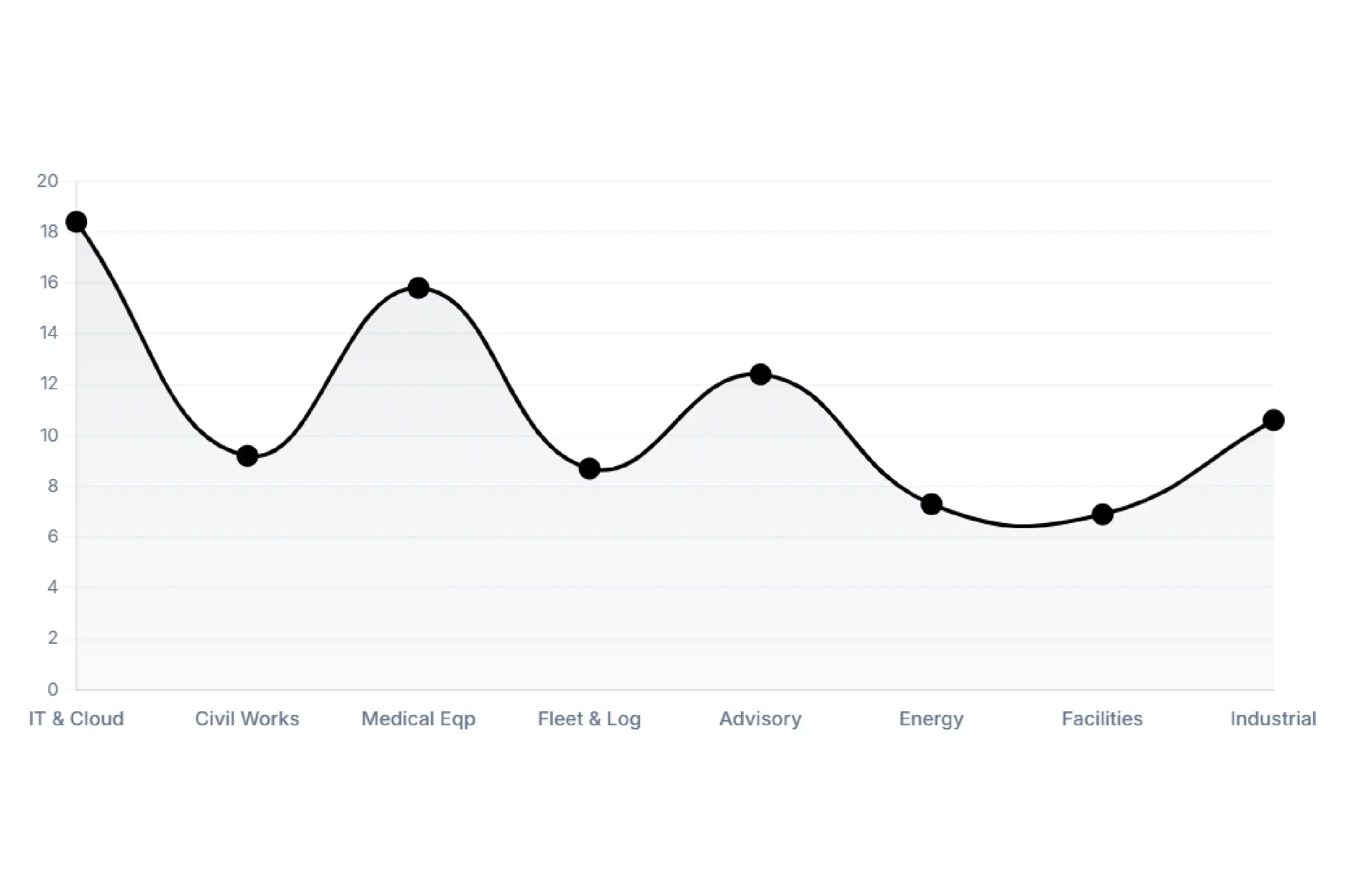
The availability of historical award information enabled the client to develop a more detailed understanding of procurement outcomes.
The system organized available supplier names, award references, contract information, procurement categories, and disclosed values into structured records.
This supported supplier-level research and helped analysts investigate historical participation across selected categories. The information also enabled comparative analysis of procurement outcomes, helping businesses understand existing market participants and identify areas requiring additional competitive research.
The following illustrative dataset demonstrates how extracted procurement information can be organized for analytical applications. The entries are sample records, not verified live GeM tender announcements.
It includes tender identifiers, buyer departments, categories, locations, estimated values, bid deadlines, and status information.
| Tender ID | Buyer Department | Category | Location | Estimated Value | Bid Deadline | Status |
|---|---|---|---|---|---|---|
| GEM/2026/001 | Education Department | Computer Systems | Delhi | ₹48,50,000 | 15-Nov-2026 | Active |
| GEM/2026/002 | Health Department | Medical Equipment | Maharashtra | ₹32,75,000 | 18-Nov-2026 | Active |
| GEM/2026/003 | Railway Department | Office Supplies | Uttar Pradesh | ₹12,40,000 | 20-Nov-2026 | Active |
| GEM/2026/004 | Public Works Department | Infrastructure Services | Bihar | ₹65,00,000 | 22-Nov-2026 | Active |
| GEM/2026/005 | Municipal Corporation | Cleaning Equipment | Karnataka | ₹18,90,000 | 25-Nov-2026 | Active |
| GEM/2026/006 | IT Department | Software Services | Telangana | ₹27,50,000 | 28-Nov-2026 | Under Review |
Note: Sample figures are illustrative and do not represent verified live GeM tender announcements or actual procurement values.
The structured dataset enables procurement analysts to compare tender categories, geographical distribution, estimated values, buyer organizations, and submission schedules.
Additional fields can include tender descriptions, product specifications, eligibility criteria, bid reference numbers, document links, contract periods, award status, supplier information, and available historical procurement details.
Following the implementation of automated tender data collection and structured analytics, the client experienced measurable improvements in information accessibility, procurement monitoring, and operational efficiency.
The following figures represent illustrative project outcomes for this enterprise case scenario:
iWeb Data Scraping helps businesses consolidate tender announcements, buyer information, product specifications, deadlines, and available award records into a unified database.
Centralized Procurement Intelligence
This reduces information fragmentation and creates a consistent foundation for procurement research, competitive analysis, and business development activities.
Automated Tender Monitoring
Automated collection workflows help organizations monitor relevant procurement listings according to selected categories, departments, and geographical requirements. Businesses can maintain better visibility into new opportunities and important updates without depending entirely on repetitive manual searches.
Reliable Data Processing
Advanced cleaning, validation, and normalization processes improve the consistency of collected procurement information. Duplicate identification and structured field mapping help transform fragmented source information into dependable datasets suitable for reporting, comparison, and analytical applications.
Scalable Analytics Infrastructure
iWeb solutions support expanding procurement intelligence requirements through configurable collection workflows and scalable processing architecture. Organizations can extend monitoring coverage across additional categories, departments, and geographical markets as their business intelligence requirements evolve.
Better Business Decision Support
Structured procurement information helps organizations evaluate purchasing patterns, understand supplier participation, identify relevant opportunities, and prioritize market research. By transforming raw tender records into meaningful intelligence, businesses can make more informed commercial and operational decisions.
"We are extremely satisfied with the procurement intelligence solution delivered by the iWeb team. Previously, our research process depended heavily on manual tender searches, spreadsheets, and repetitive information verification. The automated data collection framework has transformed how we access and organize government procurement information. The solution has improved our ability to monitor tender announcements, identify relevant opportunities, and analyze historical procurement activity. We particularly appreciate the structured datasets, reliable processing workflows, and analytical reporting capabilities. The project has reduced our manual research workload while improving the speed and consistency of our procurement intelligence operations. We now have better visibility into government purchasing requirements and can support our business development activities with more relevant information."
— Head of Procurement Intelligence
The project delivered a centralized and scalable government procurement intelligence system that transformed fragmented tender information into structured, searchable, and analytically useful datasets.
The client gained improved visibility into active procurement opportunities, historical tender announcements, buyer organizations, product categories, submission deadlines, and available award information. Automated processing reduced manual research activities and strengthened information consistency across its reporting infrastructure.
Implementation of a web scraping API enabled the integration of structured procurement records into internal databases, dashboards, and business intelligence applications. The architecture supported configurable extraction schedules, standardized data delivery, and integration with downstream analytical workflows.
The deployment of enterprise web crawling capabilities provided a scalable foundation for expanding procurement research across additional authorized public information sources. This allowed the organization to increase its monitoring coverage while maintaining consistent processing and validation standards.
GeM tender data scraping is the automated collection of accessible procurement information from the Government e-Marketplace. It helps businesses organize tender announcements, buyer details, product categories, deadlines, specifications, and available award information into structured datasets for research and analysis.
Depending on source accessibility and permissions, relevant information may include tender identification numbers, buyer organizations, product and service categories, bid publication dates, submission deadlines, descriptions, specifications, procurement status, and available award-related details.
Automated monitoring reduces repetitive manual searches and helps businesses identify relevant procurement opportunities more efficiently. It also improves visibility into tender updates, submission timelines, departmental purchasing requirements, and historical procurement patterns.
Yes. Structured procurement datasets can be integrated into business intelligence dashboards, databases, and analytical applications through suitable APIs and data delivery formats. This enables filtering, reporting, supplier analysis, category comparisons, and geographical procurement intelligence.
Yes. A scalable extraction architecture can support enterprise procurement research involving multiple categories, departments, and geographical markets. Collection frequency, processing capacity, validation requirements, and reporting formats can be configured according to business needs and permitted source access.
iWeb Data Scraping helps organizations automate procurement data collection, structure tender information, monitor relevant opportunities, and develop comprehensive procurement intelligence datasets. Our scalable data extraction solutions support faster research, better opportunity identification, and more informed business decisions across India's government procurement landscape.
Start a projectFields marked * are required. Everything else just helps us scope faster — skip what you don't know yet.