

Introduction
The food delivery industry has become increasingly data-driven, with restaurants, aggregators, brands, researchers, and technology companies relying on structured information to understand local markets and consumer behavior. GrabFood API scraping can help businesses collect restaurant, menu, pricing, availability, location, promotion, and delivery-related information at scale for analytical and competitive intelligence purposes.
Businesses can also implement GrabFood restaurant API scraping to gather restaurant names, cuisines, ratings, addresses, operating hours, delivery information, and other listing attributes. Similarly, GrabFood menu API extraction can provide structured menu-level information such as item names, descriptions, categories, prices, variants, add-ons, images, and availability.
Instead of manually checking thousands of restaurant pages, automated extraction can continuously collect relevant data and transform it into structured datasets. This makes GrabFood data useful for restaurant benchmarking, pricing intelligence, market research, menu analysis, and food delivery analytics.
What Is GrabFood API Scraping?
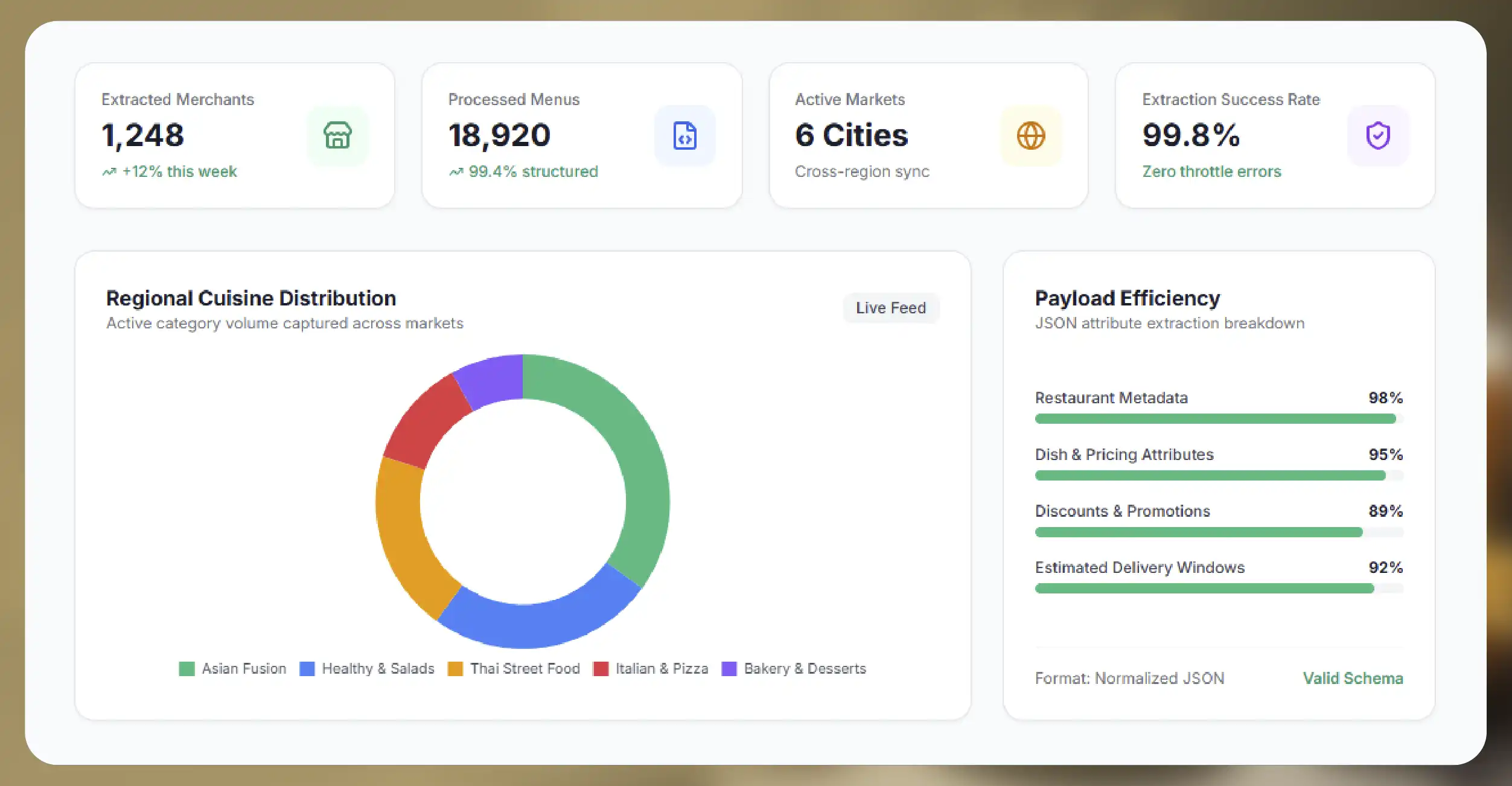
GrabFood API scraping refers to the automated collection of publicly accessible or authorized data associated with the GrabFood platform through available application interfaces, network responses, or web-based extraction methods. Depending on the implementation and access permissions, a data collection system can capture restaurant and food-related information in structured formats.
A typical extraction workflow identifies relevant data endpoints or page structures, sends permitted requests, processes returned responses, and converts information into standardized records. JSON-based responses can be particularly useful because they may already organize restaurant and menu attributes into machine-readable fields.
The extracted dataset can include restaurant identification, location, cuisine type, ratings, menu categories, individual dishes, prices, discounts, delivery charges, estimated delivery times, promotions, availability, and other attributes exposed through authorized access.
For businesses operating across multiple cities or countries, automated collection also makes it easier to compare restaurants and food offerings across geographic markets.
GrabFood Restaurant Data Extraction
Restaurant information is one of the most valuable datasets available for food delivery analytics. A structured restaurant dataset can help businesses understand how food establishments are distributed across locations and categories.
A comprehensive extraction process may capture restaurant name, restaurant ID, cuisine, address, latitude, longitude, rating, review count, operating hours, delivery fee, minimum order value, estimated delivery time, restaurant status, promotional information, and other available attributes.
This information can support competitive research by allowing analysts to compare restaurants within the same cuisine or geographic segment. For example, a company can evaluate how many restaurants offer similar cuisine, which restaurants have stronger ratings, how delivery fees vary, and how menu sizes differ across competitors.
Location-level restaurant data can also support mapping, territory planning, expansion analysis, and demand research.
GrabFood Menu and Product-Level Data
Menu information provides a deeper understanding of what restaurants actually sell. Automated extraction can organize menus into categories and individual food items, making the information easier to analyze.
A menu dataset may contain restaurant name, category name, item name, description, base price, discounted price, item availability, image URL, variant options, add-ons, serving information, and promotional labels.
GrabFood pricing data scraping API workflows can help businesses monitor price movements across restaurants and menu categories. Historical price records can reveal how restaurants change prices over time, whether discounts are temporary or recurring, and which categories experience stronger price fluctuations.
Menu-level datasets are also valuable for understanding consumer offerings. Analysts can compare pizza, burgers, Asian cuisine, desserts, beverages, vegetarian dishes, or other categories across different restaurants and locations.
Competitive Pricing Intelligence
Food delivery platforms frequently contain overlapping restaurant categories and competing menu offerings. Tracking this information systematically can provide useful competitive intelligence.
A pricing intelligence workflow can collect prices at scheduled intervals and store timestamped observations. Analysts can then compare current prices with historical values to identify increases, reductions, promotional periods, and unusual changes.
For example, a restaurant analytics company could compare the prices of comparable meals across multiple restaurants. It could also measure the difference between regular and discounted prices and determine how frequently restaurants use promotional pricing.
Price intelligence can support menu optimization, competitor benchmarking, revenue analysis, and strategic pricing decisions.
GrabFood API for Restaurant Analytics
GrabFood API for restaurant analytics can transform raw restaurant information into business intelligence. Once collected and standardized, data can be connected to dashboards, analytical databases, business intelligence platforms, or machine-learning pipelines.
Restaurant analytics can evaluate metrics such as average menu price, cuisine distribution, rating distribution, menu size, discount frequency, delivery fee, estimated delivery time, and restaurant density.
For restaurant chains, this can help compare their own locations against competitors. For food technology companies, it can provide market-level information for building recommendation engines, restaurant discovery applications, and pricing intelligence products.
Historical datasets can also reveal seasonal changes. Restaurants may adjust menus and prices during holidays, festivals, weekends, sporting events, or other periods of increased demand.
Building a GrabFood Menu Monitoring Platform
A GrabFood menu monitoring platform can automate the continuous collection and comparison of restaurant menu information. Such a platform can be designed around scheduled extraction, data validation, historical storage, change detection, and reporting.
The system can identify when a restaurant adds a new dish, removes an existing item, changes a price, modifies a description, or marks a product unavailable. These events can then be stored as historical observations.
For larger datasets, scalable infrastructure can process information from thousands of restaurants. Data can be stored in PostgreSQL, cloud databases, data warehouses, or object storage depending on the project's requirements.
Dashboards can display price movements, menu changes, restaurant availability, cuisine trends, and location-level comparisons.
GrabFood Menu & Pricing Data Scraping
GrabFood Menu & Pricing Data scraping can combine restaurant-level information with detailed menu observations to create a comprehensive food delivery dataset.
Instead of analyzing menu prices independently, businesses can connect every item with its restaurant, category, location, timestamp, promotional status, and availability. This relational structure makes advanced analysis easier.
For example, analysts can calculate average prices by cuisine, compare restaurant pricing within neighborhoods, identify popular menu categories, measure discount depth, and evaluate how prices change over time.
A historical database is particularly important because a single snapshot only shows the market at one moment. Repeated extraction creates a time series that supports trend analysis and forecasting.
Grab Food Data Extraction for Market Research
Grab Food Data Extraction can support food market research by providing a structured view of restaurant supply and consumer-facing offerings.
Researchers can use restaurant datasets to examine cuisine penetration, restaurant density, pricing ranges, menu variety, promotions, ratings, and delivery characteristics. Investors and market analysts can use these datasets to understand competitive landscapes before entering new markets.
Food brands can also study how their products are positioned against comparable offerings. A structured dataset may reveal whether competitors offer lower prices, larger menus, stronger promotions, or broader geographic coverage.
When datasets are collected repeatedly, analysts can also identify emerging trends rather than relying solely on static market information.
Food Delivery App Scraping
Food Delivery App Scraping enables businesses to collect structured information from digital food marketplaces for comparison and analytics. A multi-platform approach can potentially combine data from several food delivery services into a standardized dataset, subject to platform terms, technical restrictions, and applicable laws.
The main challenge is normalization. Different platforms may use different restaurant identifiers, category structures, price formats, location systems, and availability indicators.
A robust pipeline therefore needs entity matching and field standardization. Restaurant names can be normalized, cuisine categories mapped into common taxonomies, currencies standardized, and menu items associated with consistent identifiers.
This creates a unified dataset suitable for competitive benchmarking and food market intelligence.
Technical Architecture for GrabFood Data Scraping
A scalable system generally consists of several interconnected components. The collection layer retrieves permitted data, while the parsing layer extracts relevant fields from responses.
A validation layer checks missing values, duplicates, malformed records, and unexpected changes. A normalization layer standardizes prices, restaurant identifiers, categories, locations, and timestamps.
The storage layer maintains both current and historical observations. For high-volume projects, cloud infrastructure and distributed processing can support larger datasets.
Scheduling is another important component. Depending on business requirements, extraction can occur hourly, daily, weekly, or at another predefined interval.
Monitoring systems can detect failed requests, structural changes, missing records, and unusual data volumes so that pipelines remain reliable.
Business Applications of GrabFood Data
GrabFood datasets can support multiple business applications. Restaurant chains can monitor competitors and evaluate menu positioning. Food brands can track product categories and promotional activity. Market researchers can analyze restaurant supply and pricing trends.
Food technology companies can use structured data to develop dashboards, recommendation systems, market intelligence tools, and benchmarking products.
Investors can evaluate restaurant markets by analyzing density, pricing, cuisine distribution, and competitive intensity. Delivery businesses can also study delivery charges and estimated delivery times to understand service positioning.
The value of the dataset increases when current observations are combined with historical records, allowing businesses to identify trends instead of simply viewing isolated snapshots.
How iWeb Data Scraping Can Help You?
Customized Extraction
iWeb Data Scraping can build customized extraction pipelines capturing restaurant, menu, pricing, availability, location, promotion, and delivery attributes according to business requirements.
Structured Datasets
Collected information can be cleaned, standardized, deduplicated, and delivered through structured datasets suitable for analytics, dashboards, databases, and machine-learning workflows.
Historical Monitoring
Scheduled collection can maintain historical observations, helping businesses identify menu changes, pricing movements, promotional patterns, restaurant availability, and competitive market developments.
Scalable Processing
Scalable scraping infrastructure can process large restaurant and menu datasets while supporting multiple locations, categories, extraction frequencies, and customized data fields.
Business Intelligence
iWeb Data Scraping can transform extracted food delivery information into actionable datasets supporting competitor benchmarking, market research, pricing intelligence, restaurant analytics, and strategic planning.
Conclusion
GrabFood data can provide valuable insights into restaurant supply, menu composition, pricing, promotions, availability, and competitive positioning. Automated extraction makes it possible to transform large volumes of publicly accessible or authorized information into structured datasets for analysis.
Food Data Scraping can help businesses develop comprehensive restaurant intelligence by combining menu, pricing, location, availability, and competitive information in organized datasets.
Real-Time Food Delivery Data Scraping can further support businesses that require frequently refreshed information for dynamic pricing analysis, availability monitoring, market intelligence, and operational decision-making.
Web Scraping API Services can provide the scalable infrastructure required to collect, process, validate, and deliver food delivery datasets according to specific business requirements.
Ultimately, the effectiveness of a GrabFood data project depends on reliable extraction, consistent normalization, historical storage, responsible data practices, and clearly defined analytical objectives.
FAQs
Depending on authorized access and platform availability, datasets may include restaurant names, cuisines, locations, menus, item prices, discounts, ratings, availability, delivery information, and promotional details.
Yes. Scheduled data collection can create historical observations that allow businesses to compare menu prices, discounts, availability, and other changes over defined periods.
It can support restaurant analytics, competitive pricing intelligence, menu monitoring, market research, restaurant benchmarking, food delivery analysis, and structured dataset creation.
Yes. Depending on project requirements, extracted information can be organized into formats and storage systems such as JSON, CSV, Excel, databases, cloud storage, or API-based delivery.
Yes, provided the collection approach complies with applicable laws, platform terms, and access permissions. Scalable infrastructure can support large restaurant, menu, and pricing datasets across multiple locations.