
58.4M+
PRODUCT RECORDS PROCESSED

Product Data Extraction from Grainger Delivers Real-Time SKU Intelligence, Pricing Insights, Product Availability, and Procurement Analytics at Enterprise Scale.
This case study is based on a real-world enterprise implementation where an industrial procurement intelligence company transformed massive product catalogs into structured business intelligence through Product Data Extraction from Grainger. The objective was to create a centralized product intelligence platform capable of continuously monitoring industrial equipment, pricing movements, inventory changes, technical specifications, and supplier availability across thousands of product categories.
The organization implemented automated pipelines to scrape Grainger product catalog and pricing data across multiple product segments including industrial supplies, electrical equipment, HVAC systems, safety products, material handling equipment, tools, pumps, motors, and maintenance accessories. Instead of manually reviewing thousands of catalog pages every day, the enterprise established an automated intelligence framework capable of collecting structured information continuously while maintaining high accuracy and operational consistency.
The case study is designed for:
The client's biggest challenge was the inability to maintain visibility across an extremely dynamic industrial product ecosystem. Product specifications, pricing, stock levels, replacement models, certifications, and technical documentation changed frequently, while manual monitoring resulted in delayed purchasing decisions, inconsistent datasets, and missed cost-saving opportunities. They required a scalable intelligence platform capable of converting continuously changing catalog information into actionable procurement insights.
A leading procurement intelligence organization sought to modernize how industrial product information was collected, standardized, and analyzed across one of North America's largest industrial supply catalogs. Existing workflows depended heavily on manual catalog reviews and inconsistent supplier updates, creating significant delays in procurement planning and competitive benchmarking.
The implementation introduced automated Grainger SKU-level product data collection that continuously monitored product specifications, pricing, manufacturer information, compliance certifications, inventory levels, and category changes across hundreds of thousands of industrial SKUs. The platform standardized every incoming record before storing it within centralized analytical databases.
Continuous grainger price monitoring enabled procurement managers to identify pricing fluctuations, promotional campaigns, regional pricing differences, and cost variations affecting purchasing decisions. Instead of waiting for periodic catalog updates, pricing intelligence became available throughout the day, allowing buyers to respond rapidly to changing market conditions.
Advanced validation engines cleaned duplicate records, normalized technical specifications, mapped manufacturer part numbers, and standardized measurement units across millions of records. Machine learning models categorized products automatically while detecting anomalies requiring additional review.
Interactive dashboards provided procurement teams with real-time visibility into pricing trends, inventory movements, supplier performance, category growth, and purchasing opportunities. Decision-makers gained faster access to reliable industrial market intelligence, significantly improving sourcing efficiency, forecasting accuracy, and procurement planning.
Ultimately, the project transformed fragmented industrial catalog information into structured enterprise intelligence, enabling smarter procurement strategies, stronger competitive positioning, and scalable industrial data operations.
The client managed procurement intelligence across multiple industrial product categories where product catalogs evolved continuously with new SKUs, discontinued items, changing technical specifications, and fluctuating supplier inventories.
Although large amounts of product information were publicly available, maintaining accurate and timely datasets proved extremely difficult because updates occurred throughout the day.
The organization lacked automated grainger real-time data Scraping, forcing procurement analysts to spend significant time reviewing thousands of product pages manually before validating catalog changes.
Another major challenge involved inconsistent product specifications supplied by different manufacturers. Technical attributes frequently differed in naming conventions, making comparisons across competing brands extremely difficult.
The absence of Grainger product availability analytics prevented procurement managers from understanding inventory fluctuations across high-demand industrial components. Unexpected stock shortages frequently delayed purchasing decisions and increased sourcing costs.
Pricing intelligence remained fragmented across multiple departments.
Following implementation of an enterprise-grade extraction framework, the organization replaced manual catalog reviews with an automated intelligence ecosystem capable of continuously collecting, validating, and enriching industrial product information. By integrating the Grainger data extraction api, procurement teams established standardized datasets that supported pricing intelligence, catalog enrichment, inventory planning, and supplier performance analysis. Combined with Managed web scraping, the solution eliminated repetitive monitoring tasks while dramatically improving data freshness, consistency, and operational scalability.
| Dimension | Manual Catalog Monitoring | Automated Enterprise Intelligence Platform |
|---|---|---|
| Data Collection | Manual browsing of product pages | Continuous automated catalog extraction |
| Product Coverage | Limited SKUs monitored daily | Millions of products monitored simultaneously |
| Data Accuracy | Human errors and missed updates | Automated validation with high consistency |
| Product Specifications | Copied manually into spreadsheets | Structured technical attribute extraction |
| Price Updates | Periodic manual verification | Continuous automated monitoring |
| Inventory Monitoring | Checked only when required | Continuous availability intelligence |
| Category Classification | Manual categorization | AI-assisted standardized taxonomy |
| Historical Tracking | Limited archived information | Complete historical product database |
| Reporting Speed | Several days | Near real-time dashboards |
| Procurement Visibility | Fragmented information | Unified enterprise intelligence platform |
The organization featured in this case study is an enterprise procurement intelligence provider supporting manufacturers, distributors, maintenance contractors, industrial buyers, and supply chain organizations operating across multiple regions. Its core business depends upon collecting, organizing, validating, and analyzing massive industrial product catalogs to enable smarter purchasing decisions.
Before automation, analysts relied heavily on repetitive manual catalog reviews to identify pricing changes, newly introduced products, discontinued inventory, specification revisions, and supplier updates. As the industrial catalog expanded into millions of product records, maintaining consistent visibility became increasingly difficult.
The company also required continuous Stock-out and availability tracking across critical industrial components to minimize procurement delays and improve sourcing resilience. Unexpected inventory shortages frequently disrupted purchasing plans because visibility into changing stock conditions remained limited.
To overcome these operational constraints, the organization deployed enterprise-grade Real-time web scraping pipelines capable of monitoring industrial catalog activity around the clock. Every extracted product record underwent automated validation, normalization, specification mapping, duplicate removal, and enrichment before entering centralized analytical repositories.
The intelligence platform continuously tracked:
This transformation shifted procurement operations from reactive catalog management toward proactive industrial intelligence. Procurement managers gained immediate visibility into changing supplier conditions, sourcing opportunities, inventory risks, and catalog evolution, enabling faster purchasing decisions while reducing operational uncertainty across enterprise procurement workflows.
Our engagement began with a comprehensive assessment of the client's procurement workflows, catalog management process, and existing reporting infrastructure. The objective was not simply to collect product information but to establish an enterprise intelligence ecosystem capable of transforming rapidly changing industrial catalog data into structured, decision-ready business intelligence.
The solution architecture was designed around scalable extraction pipelines capable of monitoring millions of industrial products across numerous categories without disrupting downstream analytics. Using automated scheduling, intelligent parsers, metadata validation, and distributed cloud processing, the platform continuously captured catalog updates while maintaining high data quality.
Each extracted record passed through multiple validation stages where duplicate entries were removed, incomplete specifications were identified, measurement units were standardized, manufacturer references were normalized, and taxonomy mappings were applied consistently across every category.
The platform continuously collected:
The intelligence engine further enriched every record with historical tracking, enabling analysts to compare catalog evolution over time rather than relying solely on current snapshots.
To strengthen strategic planning, the platform incorporated Market trend and demand intelligence, enabling procurement leaders to identify emerging product categories, seasonal purchasing behavior, supplier performance trends, and changing industrial demand patterns across thousands of monitored products.
One of the most valuable outcomes of the implementation was continuous visibility into catalog evolution. Prior to automation, procurement teams relied on periodic manual reviews that frequently overlooked important product updates occurring between reporting cycles.
The automated intelligence platform continuously monitored every monitored category throughout the day, immediately identifying newly introduced products, discontinued SKUs, revised specifications, inventory adjustments, and pricing updates.
Instead of discovering catalog changes days later, procurement managers received structured intelligence almost immediately after modifications became available.
This significantly improved sourcing decisions because buyers could react before pricing fluctuations affected purchasing budgets or inventory shortages impacted production schedules.
The intelligence engine continuously tracked multiple catalog dimensions simultaneously, including:
| Monitoring Category | Intelligence Generated | Business Value |
|---|---|---|
| Product Launches | Newly introduced industrial products | Faster sourcing opportunities |
| SKU Modifications | Specification revisions | Improved catalog accuracy |
| Product Discontinuation | Removed inventory items | Better replacement planning |
| Price Changes | Daily pricing movement | Procurement optimization |
| Stock Availability | Inventory fluctuations | Reduced purchasing delays |
| Documentation Updates | Revised manuals and certifications | Compliance management |
| Category Expansion | New product assortment | Market intelligence |
| Brand Activity | Manufacturer portfolio changes | Competitive benchmarking |
Continuous monitoring eliminated blind spots that previously existed between scheduled catalog reviews.
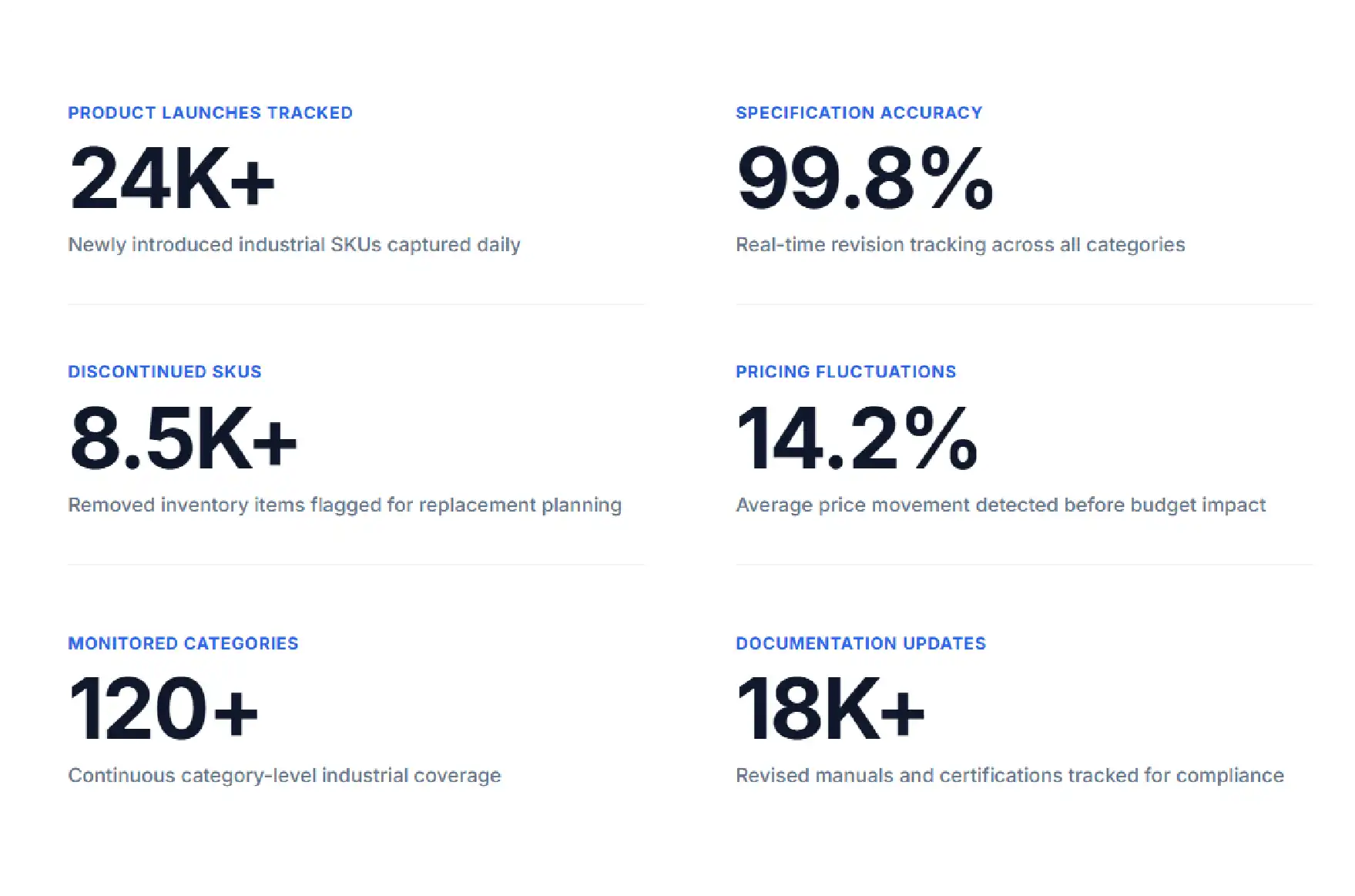
Industrial procurement decisions depend heavily on accurate pricing intelligence combined with inventory visibility. Before implementing the automated platform, purchasing teams often discovered pricing adjustments only after initiating procurement activities, reducing negotiation opportunities and increasing sourcing costs.
The new intelligence framework continuously evaluated pricing movements alongside inventory conditions, allowing procurement managers to understand not only what products cost but also whether inventory availability could influence purchasing strategy.
Historical pricing databases revealed recurring discount cycles, supplier pricing behavior, and category-specific fluctuations that previously remained hidden within fragmented datasets.
The platform correlated inventory changes with pricing movements, helping analysts identify situations where declining stock levels coincided with increasing prices or where inventory
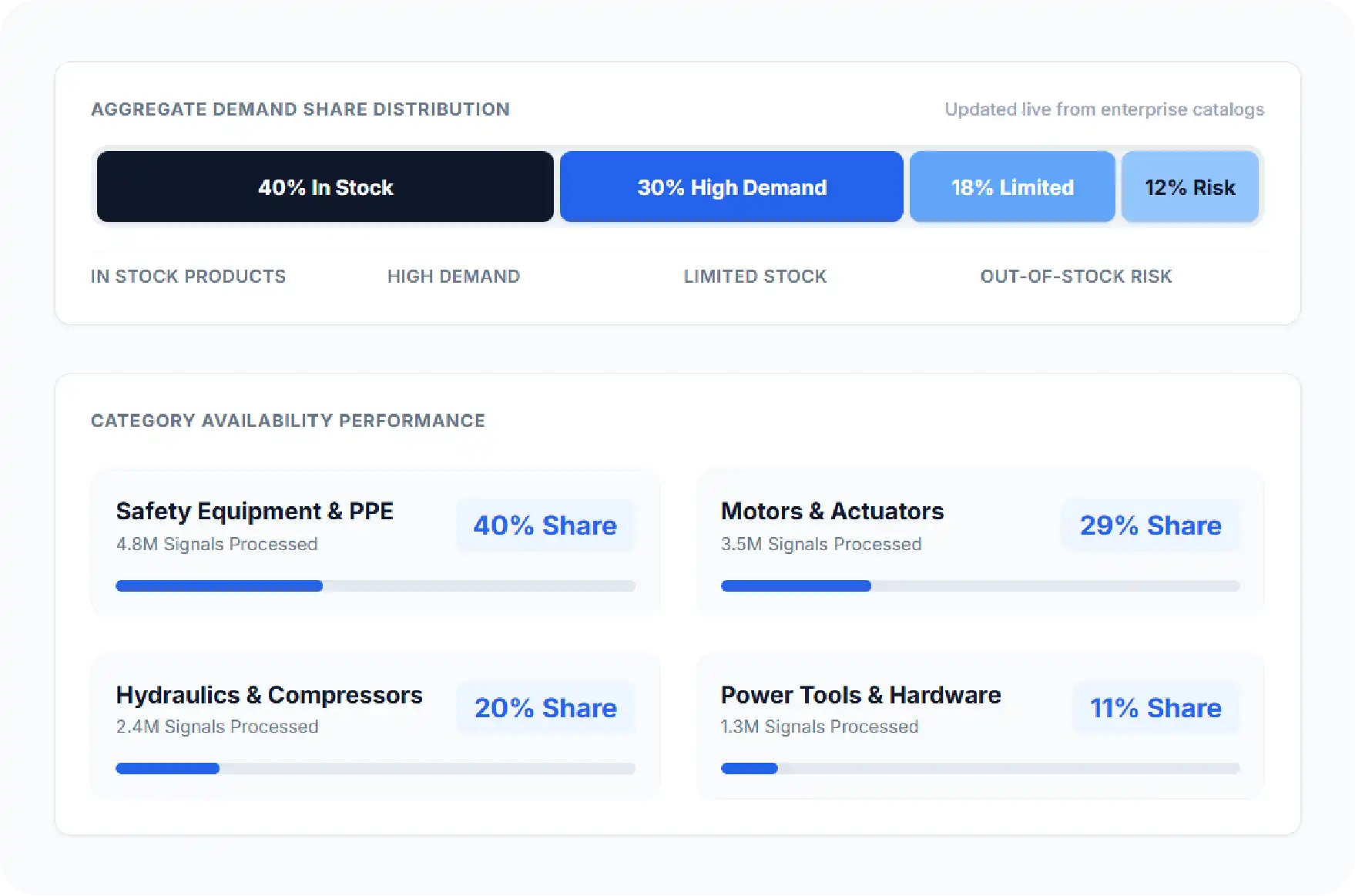
The following sample illustrates how structured industrial catalog information was standardized for enterprise analytics.
| SKU | Category | Brand | Current Price (USD) | Previous Price (USD) | Availability | Specification Records | Monthly Views | Price Change | Inventory Status |
|---|---|---|---|---|---|---|---|---|---|
| GR-481026 | Safety Gloves | Ansell | 24.85 | 26.10 | In Stock | 46 | 18,450 | -4.8% | Stable |
| GR-582941 | Electric Motor | ABB | 685.40 | 671.20 | Limited | 88 | 9,760 | +2.1% | Low Inventory |
| GR-814226 | Hydraulic Pump | Parker Hannifin | 1,482.90 | 1,465.70 | In Stock | 103 | 6,915 | +1.2% | Stable |
| GR-337154 | Air Compressor | Ingersoll Rand | 928.60 | 961.80 | In Stock | 71 | 7,428 | -3.5% | Stable |
| GR-924780 | Power Tool Kit | Milwaukee Tool | 316.45 | 328.10 | Backordered | 54 | 14,885 | -3.6% | Critical |
| GR-772611 | Industrial Fan | Dayton | 194.30 | 189.70 | In Stock | 39 | 11,502 | +2.4% | Stable |
| GR-556823 | Bearing Assembly | SKF | 88.55 | 92.30 | Limited | 44 | 13,210 | -4.1% | Low Inventory |
| GR-665914 | Welding Helmet | 3M Speedglas | 146.90 | 141.25 | In Stock | 51 | 15,044 | +4.0% | Stable |
These structured datasets enabled enterprise procurement systems to monitor pricing behavior, supplier competitiveness, inventory conditions, product assortment, and long-term catalog evolution from a centralized intelligence platform.
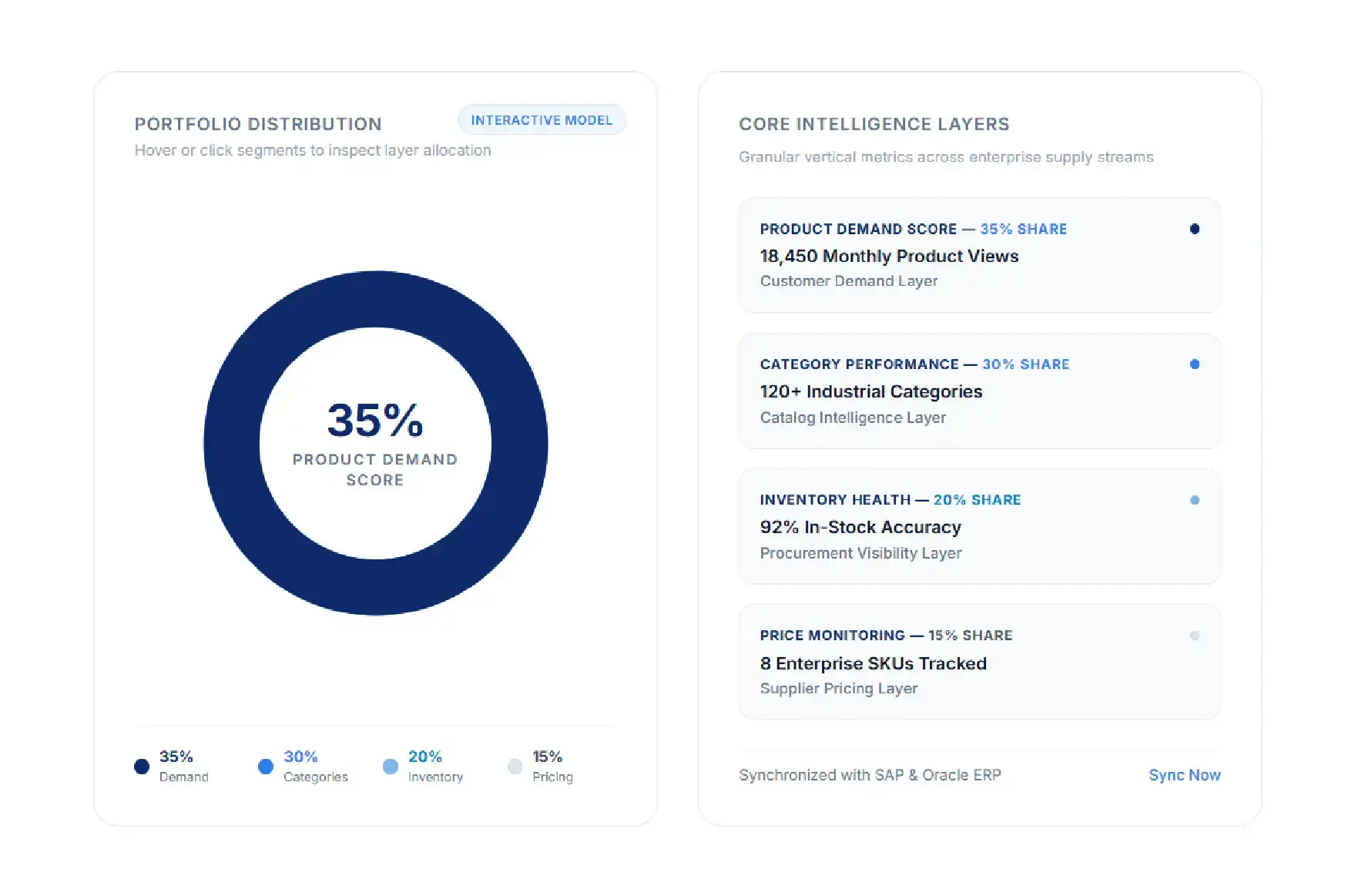
Following deployment of the enterprise intelligence platform, the client transitioned from periodic catalog reviews to a continuously updated procurement ecosystem where product, pricing, and inventory intelligence became immediately available to sourcing teams. Decision-makers no longer relied on fragmented spreadsheets or manual product verification. Instead, they accessed centralized dashboards containing validated industrial catalog intelligence that supported purchasing, supplier management, budgeting, and inventory optimization across every monitored business unit.
Continuous monitoring significantly shortened procurement response times because pricing movements, specification revisions, and inventory changes were identified as they occurred rather than during scheduled review cycles.
Historical intelligence also enabled procurement analysts to understand long-term supplier behavior, category growth, and pricing volatility, improving forecasting accuracy and reducing sourcing uncertainty.
The measurable business outcomes included:
Collectively, these improvements strengthened procurement agility while creating a scalable intelligence foundation capable of supporting future growth across increasingly complex industrial supply chains.
Industrial procurement requires much more than simple product extraction. Our enterprise methodology combines intelligent automation, scalable architecture, rigorous validation, and business-focused analytics to convert complex industrial catalogs into structured intelligence that directly supports procurement operations.
Our platform continuously monitors millions of industrial products while preserving historical records for every significant catalog event. Rather than replacing previous information, each update contributes to a growing intelligence repository that supports forecasting, supplier benchmarking, pricing analysis, and procurement optimization.
The solution emphasizes data quality at every processing stage. Automated validation routines detect inconsistencies, remove duplicate records, normalize technical specifications, standardize manufacturer identifiers, and enrich incomplete product information before datasets reach downstream analytical systems.
"The implementation completely transformed how our procurement organization manages industrial product intelligence. Previously, maintaining accurate visibility across millions of product records required substantial manual effort and still resulted in delayed decision-making.
Today, our sourcing teams work with continuously updated datasets that provide immediate access to pricing movements, inventory conditions, product specifications, and supplier changes. The quality of the structured data has significantly improved our procurement reporting while reducing operational overhead across multiple departments.
The automation has not only increased efficiency but has also strengthened our forecasting capabilities and purchasing confidence. We now make faster, more informed sourcing decisions supported by reliable industrial market intelligence."
— Director of Procurement Intelligence
The completed project delivered a fully automated industrial product intelligence platform capable of continuously collecting, validating, enriching, and analyzing millions of product records from large-scale industrial catalogs.
The organization established a centralized procurement intelligence environment where pricing, specifications, supplier information, inventory status, technical documentation, and historical product activity became available through a single structured analytical framework.
Automation eliminated repetitive catalog reviews while dramatically improving data freshness, reporting consistency, and procurement visibility.
Historical intelligence empowered decision-makers to evaluate supplier performance, analyze pricing trends, identify inventory risks, forecast purchasing demand, and optimize sourcing strategies using reliable enterprise datasets.
The scalable architecture continues to support expanding product coverage without compromising performance, allowing additional categories, manufacturers, and industrial markets to be incorporated seamlessly into existing analytical workflows.
Ultimately, the project delivered measurable operational improvements, reduced procurement complexity, enhanced forecasting accuracy, strengthened supplier intelligence, and established a future-ready foundation for enterprise-scale industrial commerce analytics.
It automatically collects product details such as SKUs, pricing, specifications, availability, and categories, converting them into structured datasets for procurement, analytics, and competitive intelligence.
The platform supports scheduled or near real-time updates, ensuring pricing, inventory, and product information remain current for business decisions.
It captures product names, SKUs, prices, specifications, stock status, manufacturer details, categories, images, and other publicly available product attributes.
It improves sourcing decisions, reduces manual work, enables faster supplier comparisons, supports inventory planning, and provides accurate pricing intelligence.
Yes. The platform is built to process millions of product records while maintaining high performance, accuracy, and reliable enterprise-scale data collection.
Fields marked * are required. Everything else just helps us scope faster — skip what you don't know yet.