
58.6K+
PROPERTY AUCTION RECORDS PROCESSED

Real Estate Auction Data Scraping for Tracking Property Listings, Monitoring Foreclosures, Analyzing Reserve Prices, and Identifying Investment Opportunities Across Greece.
This case study explains how an enterprise real estate intelligence organization leveraged real estate auction data scraping to transform fragmented property auction information into structured datasets, enabling investors, financial institutions, property consultants, and real estate businesses to identify opportunities, evaluate distressed assets, and understand auction market movements across Greece.
It is designed for:
The central challenge addressed in this case study was the difficulty of collecting and interpreting property auction information from multiple online sources. Important information, including property locations, reserve prices, auction dates, property classifications, and legal descriptions, was distributed across different listings and frequently updated.
A growing real estate investment intelligence organization wanted to improve its ability to identify property acquisition opportunities across Greece. The organization relied on multiple public auction information sources, including eAuction.gr data, to understand available properties, upcoming auction events, reserve prices, and changes in listing status.
However, collecting information manually created operational challenges. Auction announcements appeared across different property categories, geographic locations, and publication schedules. Important attributes were often presented in inconsistent formats, making comparisons difficult and limiting the organization's ability to identify attractive opportunities quickly.
To address these limitations, iWeb Data Intelligence implemented an automated property information extraction framework that captured foreclosure auction listings data from relevant publicly accessible sources.
The solution was designed to collect property descriptions, auction dates, reserve prices, locations, property types, listing references, and other available attributes. The extracted information was validated, normalized, and converted into structured records that could be integrated into the client's analytical environment.
An automated real estate auction feed was established to deliver updated information into centralized databases and reporting systems. The framework also supported historical record comparison, allowing analysts to understand changes in auction schedules, prices, availability, and property descriptions.
The client operated in a competitive real estate investment environment where auction opportunities could change rapidly. Identifying suitable properties required continuous monitoring of multiple websites, accurate extraction of listing information, and consistent evaluation of property characteristics.
One of the primary difficulties involved the fragmented nature of distressed property data Europe. Auction-related information was distributed across different digital platforms, making it challenging to establish a consolidated understanding of property availability, pricing, and regional auction activity.
Fragmented Property Information
Property details were published through different auction sources with inconsistent structures. Location descriptions, property categories, reserve prices, and auction dates were not presented uniformly. Analysts spent considerable time collecting and organizing information before beginning investment evaluations.
Limited Automated Data Collection
The absence of centralized real estate data scraping services restricted the client's ability to monitor a large number of property listings continuously. Manual browsing created delays, increased operational workloads, and made it difficult to identify newly published auction opportunities.
Inconsistent Listing Updates
Auction records frequently experienced changes involving scheduled dates, reserve prices, listing descriptions, and auction outcomes. Without automated comparison mechanisms, the client struggled to identify modifications and distinguish updated listings from previously collected records.
Geographic Data Standardization
Property addresses and location descriptions appeared in different formats and languages. Inconsistent geographic information made city-level, regional, and neighborhood-level analysis difficult. The client needed standardized location fields to support mapping, market comparisons, and investment screening.
Difficulty Managing Large-Scale Sources
Expanding the monitoring scope required a reliable enterprise web crawling framework capable of processing multiple publicly accessible sources while maintaining extraction consistency, validation accuracy, and operational stability.
To overcome these challenges, the client required an automated property auction extraction framework capable of continuous collection, standardization, and historical comparison.
By adopting an automated property auction extraction framework, the client replaced fragmented browsing and spreadsheet-based research with a centralized intelligence pipeline. The new approach continuously collected relevant listing information, standardized property attributes, and enabled systematic comparisons across auction sources.
| Dimension | Manual Auction Tracking | Client Data Scraping System |
|---|---|---|
| Data collection | Individual website browsing and manual downloads | Automated collection from multiple accessible auction sources |
| Listing coverage | Limited selection of properties | Expanded monitoring across property categories and regions |
| Price monitoring | Manual recording of reserve prices | Structured price extraction and historical comparison |
| Auction schedules | Periodic manual checking | Automated monitoring of published dates and changes |
| Property classification | Subjective manual categorization | Standardized residential, commercial, and land categories |
| Geographic information | Inconsistent address formats | Normalized city, region, and location fields |
| Duplicate management | Repeated records in spreadsheets | Automated record matching and deduplication |
| Historical analysis | Limited historical information | Centralized records supporting period-based comparisons |
| Reporting | Manual spreadsheet preparation | Structured dashboards and downloadable datasets |
| Scalability | Dependent on research personnel | Expandable automated processing infrastructure |
The comparison highlights how automated extraction can improve information consistency, reduce repetitive work, and create a stronger foundation for real estate market intelligence.
The brand in focus is a growing real estate investment and property intelligence organization operating within Greece's evolving digital auction ecosystem. It specializes in identifying potential property acquisition opportunities, evaluating distressed assets, and monitoring auction activity across residential, commercial, and land-based property categories.
Its business operations depend on accurate information about properties entering auction processes. These records provide valuable indicators of market supply, potential acquisition opportunities, regional property activity, and changes in auction-related pricing.
As the organization's research requirements expanded, its existing manual processes became increasingly difficult to maintain. Analysts needed to examine several digital sources, identify relevant property announcements, compare listing information, and update internal spreadsheets.
The growing volume of auction announcements also introduced data quality concerns. Similar properties could appear multiple times, auction schedules could change, and important information could be published in different formats.
To overcome these limitations, the organization decided to adopt an automated data intelligence framework.
iWeb Data Intelligence delivered an end-to-end property auction intelligence solution designed to collect, process, validate, and organize information from relevant publicly accessible Greek auction sources.
Source Assessment and Requirement Mapping
The implementation began with source assessment and data requirement mapping. Our team identified relevant listing pages, available property attributes, auction-related information, and the publication structures required for consistent extraction.
Automated Collection Framework
Automated crawlers were configured to capture property information while respecting applicable access restrictions, website terms, and technical limitations. The system was designed around permitted public information rather than restricted personal or confidential records. The extraction framework captured property titles, descriptions, property categories, locations, auction dates, reserve prices, listing references, and available status information.
Data Normalization and Validation
The next stage focused on data normalization. Different source formats were converted into standardized fields so that records could be compared consistently across multiple platforms. Our team implemented validation mechanisms to identify incomplete entries, inconsistent prices, duplicate listings, and incorrectly formatted dates. Where information was unavailable, the system retained appropriate null values instead of introducing unsupported assumptions.
Historical Record Comparison
We also introduced historical record comparison to identify meaningful changes in auction information. This enabled analysts to distinguish new listings from updated announcements and monitor changes in property availability.
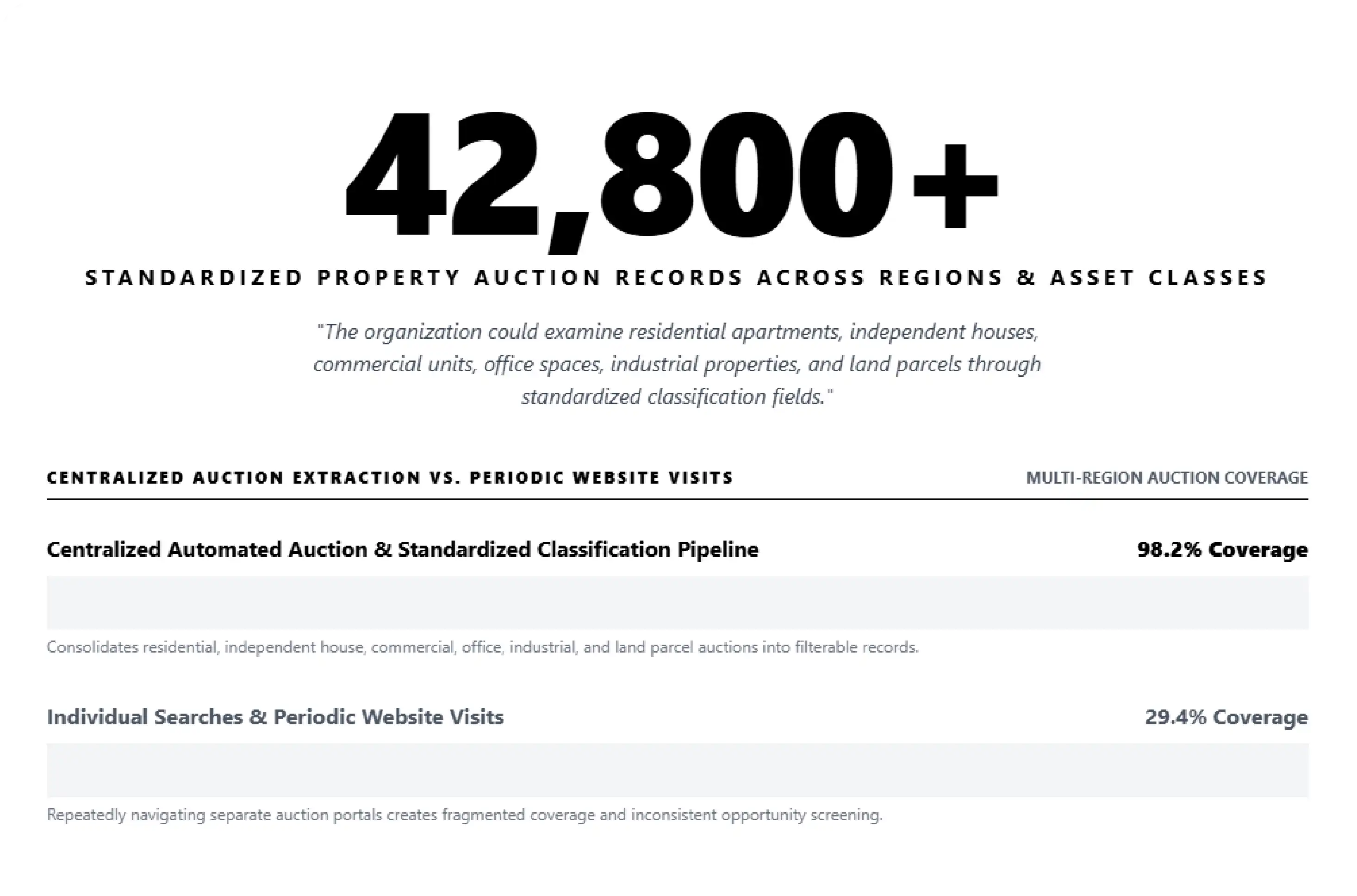
Automated extraction enabled the client to monitor a broader selection of property announcements across different regions and property categories.
Previously, analysts depended on individual searches and periodic website visits to identify available properties. The centralized system provided a more consistent view of published auction opportunities.
The organization could examine residential apartments, independent houses, commercial units, office spaces, industrial properties, and land parcels through standardized classification fields. This improved visibility helped analysts identify relevant opportunities according to property type, geographic preference, and available auction information. It also supported more consistent research workflows because property records could be filtered and compared without repeatedly navigating individual websites.
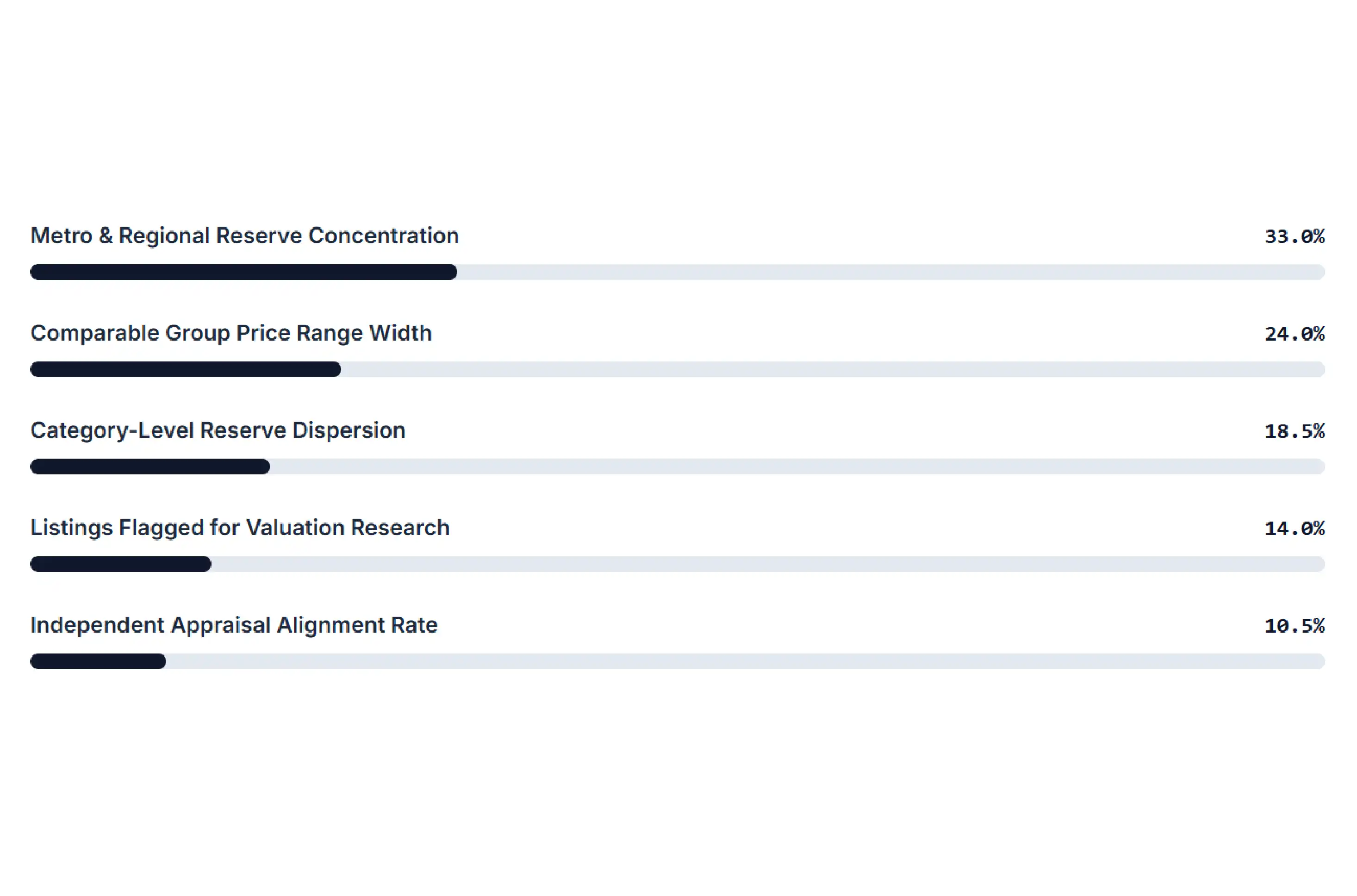
Reserve price information provided an important foundation for evaluating potential acquisition opportunities.
The structured dataset enabled analysts to compare property reserve prices across cities, regions, and property categories. It also supported the identification of price differences between comparable property groups.
By organizing prices into consistent numerical fields, the client could conduct descriptive analysis, calculate price ranges, and identify listings requiring additional valuation research. The system did not treat reserve prices as confirmed market valuations. Instead, these figures were used as auction-specific reference points that could be evaluated alongside independent property information. This distinction helped the client develop more realistic investment screening processes.
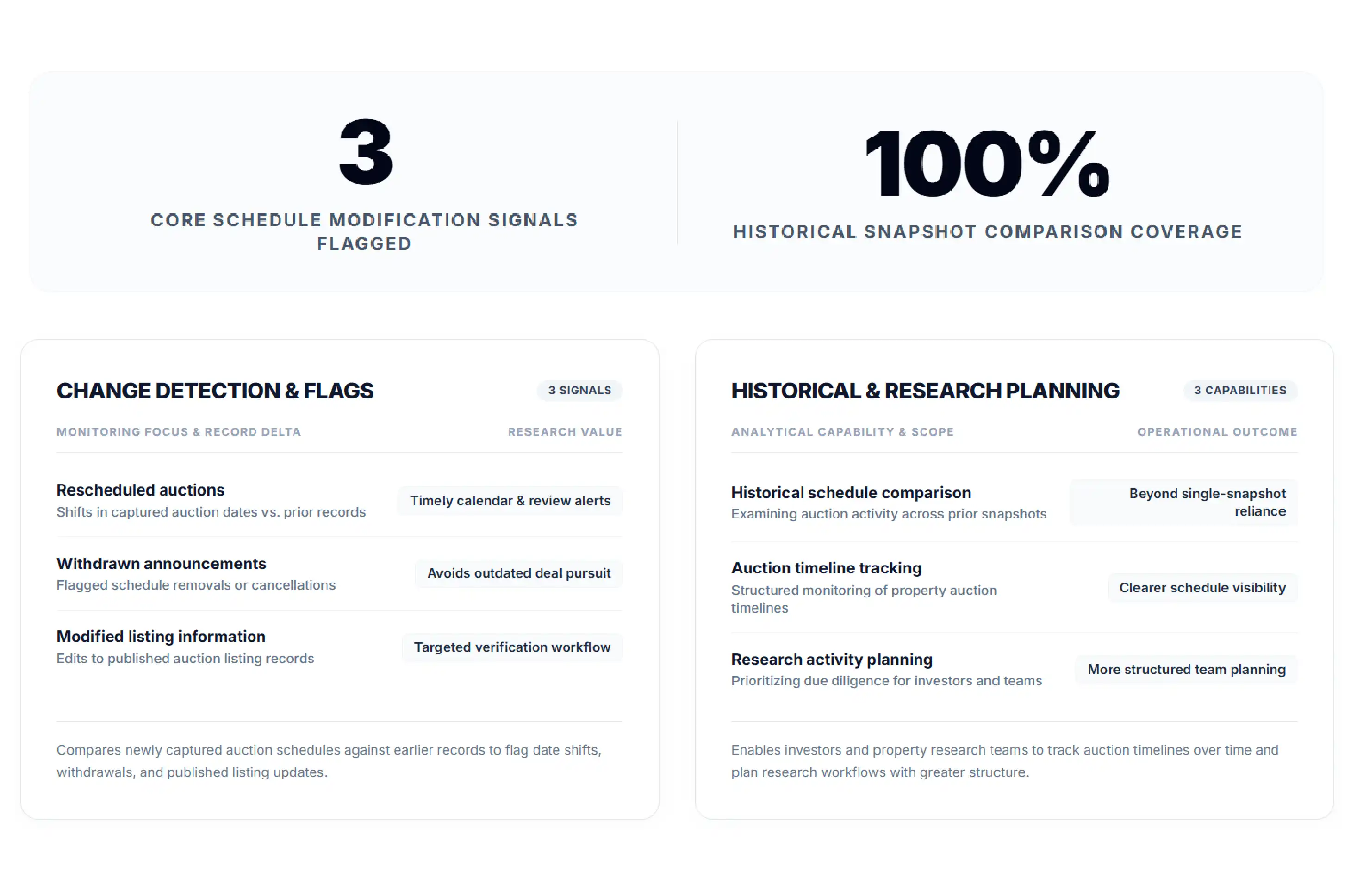
Auction schedules represent important operational information for investors and property research teams.
The implemented monitoring framework captured available auction dates and compared updated records with previously collected information.
When a listing changed, the system could flag the relevant modification for further review. This supported better awareness of rescheduled auctions, withdrawn announcements, and changes in published listing information. The historical comparison capability also allowed analysts to examine auction activity over time rather than relying exclusively on the latest available listing. Consequently, the organization gained a more structured approach to monitoring property auction timelines and planning research activities.
A structured dataset snapshot was generated to demonstrate how extracted auction information could be organized for analysis.
The following sample represents illustrative property records and is not a verified export from the eAuction.gr platform.
| Property ID | Property Type | Location | Reserve Price (€) | Auction Date | Status |
|---|---|---|---|---|---|
| GR001 | Apartment | Athens | 85,000 | 15-11-2026 | Scheduled |
| GR002 | Residential House | Thessaloniki | 142,000 | 19-11-2026 | Scheduled |
| GR003 | Commercial Unit | Patras | 110,000 | 22-11-2026 | Updated |
| GR004 | Land Parcel | Heraklion | 68,000 | 25-11-2026 | Scheduled |
| GR005 | Apartment | Piraeus | 96,000 | 28-11-2026 | Scheduled |
| GR006 | Office Space | Larissa | 125,000 | 02-12-2026 | Under Review |
| GR007 | Industrial Property | Volos | 215,000 | 05-12-2026 | Scheduled |
| GR008 | Residential House | Kalamata | 118,000 | 09-12-2026 | Updated |
| GR009 | Commercial Property | Rhodes | 175,000 | 12-12-2026 | Scheduled |
| GR010 | Land Parcel | Chania | 74,000 | 16-12-2026 | Scheduled |
Note: Sample figures are illustrative and do not represent verified live auction records from the eAuction.gr platform.
The structured dataset enables analysts to filter properties by type, location, reserve price, auction date, and status across monitored Greek regional markets.
Following the implementation of the automated property intelligence framework, the client achieved improvements across information collection, listing monitoring, and analytical efficiency.
The illustrative implementation reported the following operational outcomes:
iWeb Data Intelligence delivers scalable data extraction and processing solutions that help organizations transform fragmented digital information into structured, decision-ready datasets.
Our approach focuses on creating a unified data collection framework that supports multiple property sources, standardized records, and consistent analytical outputs.
Comprehensive Data Collection
Our extraction frameworks capture relevant publicly accessible property information across selected digital sources. This helps organizations consolidate fragmented listings and establish a broader view of auction market activity.
Advanced Data Cleaning
We implement validation, normalization, and deduplication processes to improve the consistency of extracted property information. This reduces data irregularities and supports more reliable research and reporting.
Scalable Infrastructure
Our automated systems are designed to accommodate expanding source coverage and growing data volumes. This allows businesses to extend their property intelligence operations without depending entirely on manual collection.
Flexible Data Delivery
Processed datasets can be delivered through structured CSV, Excel, JSON, database integrations, and API-based workflows, depending on business requirements and technical compatibility.
"The property auction data intelligence solution provided by the iWeb team significantly improved our ability to monitor and organize auction-related information. Previously, our analysts spent considerable time navigating multiple sources and manually compiling property details. The automated framework introduced a much more structured approach to information collection, validation, and reporting. We particularly appreciated the consistency of the extracted datasets and the ability to compare property information across different locations and categories. The historical monitoring capabilities also helped us understand listing changes and maintain better visibility into auction activity. The solution has strengthened our research operations, reduced repetitive work, and enabled our team to focus more effectively on evaluating property opportunities. We are pleased with the quality, flexibility, and scalability of the delivered intelligence framework."
— Head of Real Estate Research
The final outcome of the project was the development of a centralized and scalable property auction intelligence environment that transformed fragmented online auction announcements into organized, research-ready information.
Through the implementation of automated data collection, validation, classification, and historical monitoring, the client established a consistent foundation for understanding property auction activity across Greece.
The solution also enabled the organization to incorporate alternative data into its broader investment research framework. By combining auction announcements with other permitted property market information, analysts could develop a more comprehensive perspective on regional supply, distressed asset availability, and potential acquisition opportunities.
The centralized database supported the development of structured real estate property datasets containing property classifications, geographic information, reserve prices, auction schedules, listing references, and available status updates.
This improved the client's ability to conduct property comparisons, monitor auction announcements, evaluate regional opportunities, and maintain historical records for future analytical applications. The automated architecture also reduced dependency on repetitive manual collection activities while improving consistency across internal reporting workflows.
Real estate auction data scraping is the automated process of collecting publicly accessible property auction information from relevant online sources. It captures attributes such as property descriptions, locations, reserve prices, auction dates, listing references, and available status information. The extracted records are cleaned and organized into structured datasets for market research, property comparisons, and investment analysis.
Depending on the information publicly available on each source, extraction can include property identifiers, property categories, descriptions, geographic locations, reserve prices, scheduled auction dates, listing references, and published status updates. Additional fields may be included according to source availability and project requirements.
Yes. Relevant publicly accessible information can be monitored through an appropriately configured extraction framework, subject to the platform's terms, access restrictions, technical limitations, and applicable laws. Monitoring can capture available listing details and identify changes between collection periods.
Structured auction information helps investors identify relevant properties, compare reserve prices, evaluate geographic distribution, monitor auction schedules, and prioritize opportunities for further research. It also provides historical records that support market analysis and more systematic investment screening.
Yes. Structured datasets can be delivered in compatible formats such as CSV, Excel, JSON, or database integrations. Depending on the technical environment, these records can support dashboards displaying auction volumes, property categories, geographic distribution, reserve price ranges, and historical listing changes.
Partner with iWeb Data Intelligence to extract, monitor, and analyze real estate auction listings across Greece. Our customized data scraping solutions transform property announcements, reserve prices, auction schedules, and location details into structured intelligence for smarter investment decisions and stronger market visibility.
Start a projectFields marked * are required. Everything else just helps us scope faster — skip what you don't know yet.