

Introduction
The UK luxury retail market is highly competitive, with premium department stores, designer labels, and exclusive beauty brands continuously adjusting their product offerings, pricing strategies, and seasonal collections. Harrods, one of London's most recognised luxury department stores, offers an extensive assortment of fashion, accessories, beauty, fragrances, watches, jewellery, homeware, and lifestyle products. Monitoring this assortment provides valuable insights into luxury retail positioning and consumer preferences.
Harrods product data scraping enables retailers, luxury brands, market researchers, and e-commerce businesses to collect structured information about products, prices, categories, brands, and availability from Harrods' online storefront. Instead of manually reviewing thousands of product listings, businesses can organise relevant information into comprehensive datasets for competitive analysis.
Access to accurate Harrods product catalog data helps businesses understand how premium products are positioned across different categories, identify new launches, and evaluate assortment changes. Combining this information with UK luxury retail price data creates opportunities to benchmark premium pricing, analyse discount movements, and understand how luxury retailers respond to changing market conditions.
As luxury shopping increasingly integrates digital experiences with traditional retail, structured product intelligence has become essential for making informed commercial decisions.
Why Harrods Product Catalog Data Matters for Luxury Retailers?
Harrods maintains a diverse product assortment that reflects changing luxury consumer expectations. Its online catalogue provides a useful source of information for understanding premium product positioning across multiple retail categories.
For luxury brands and retailers, examining product listings can reveal how competitors present their collections, organise categories, and communicate product value.
Several business functions benefit from this intelligence:
- Competitive benchmarking: Compare product prices, brands, and available collections across luxury retailers.
- Assortment planning: Identify popular product categories, emerging brands, and seasonal assortment changes.
- Price positioning: Understand premium pricing differences between product categories and competing labels.
- Market research: Examine product descriptions, specifications, materials, and merchandising strategies.
- Inventory intelligence: Monitor listed availability and identify products that become unavailable or return to stock.
These insights help businesses evaluate their market position and identify opportunities to improve their luxury retail strategies.
What Data Can Be Extracted from Harrods?
A structured product catalogue dataset can capture multiple attributes associated with individual product listings. The exact fields depend on website accessibility, page structure, and the agreed extraction requirements.
Important data fields include:
| Data Category | Information Collected |
|---|---|
| Product Information | Product name, title, description, and SKU |
| Brand Details | Brand name, designer, and collection |
| Pricing | Original price, current price, and displayed discounts |
| Product Categories | Fashion, footwear, beauty, jewellery, and homeware |
| Product Variants | Sizes, colours, materials, and available options |
| Availability | Listed stock status and availability indicators |
| Product Images | Image URLs and gallery references |
| Product Specifications | Dimensions, ingredients, fabrics, and product features |
| Product URLs | Individual product page links |
| Customer Information | Displayed ratings and reviews, where available |
Collecting these attributes in a consistent format makes it easier to compare products, analyse category performance, and maintain organised competitive intelligence databases.
Tracking Luxury Retail Pricing Across Product Categories

Pricing is one of the most important factors influencing luxury retail positioning. Premium retailers often maintain different price structures depending on brand reputation, product exclusivity, materials, design, and seasonal demand.
Through luxury brand assortment tracking, businesses can examine how different labels position their products within the same category. For example, comparing handbags, designer footwear, watches, and fragrances can reveal differences in average selling prices and premium positioning.
A structured pricing dataset can support several analyses:
1. Original and Current Price Comparison
Track displayed original and current prices to identify markdowns, promotional activity, and price adjustments across selected products.
2. Discount Monitoring
Identify products with visible discounts and examine how promotional intensity varies across categories and brands.
3. Premium Price Benchmarking
Compare similar products from competing luxury retailers to understand price differences and brand positioning.
4. Seasonal Pricing Analysis
Monitor pricing changes during seasonal collections, festive periods, and major retail events.
5. Category-Level Price Segmentation
Group products into price ranges to understand the distribution of entry-level luxury, premium, and ultra-premium offerings.
These insights allow retailers to develop more informed pricing strategies without relying on occasional manual observations.
Understanding Harrods' Product Assortment and Brand Diversity
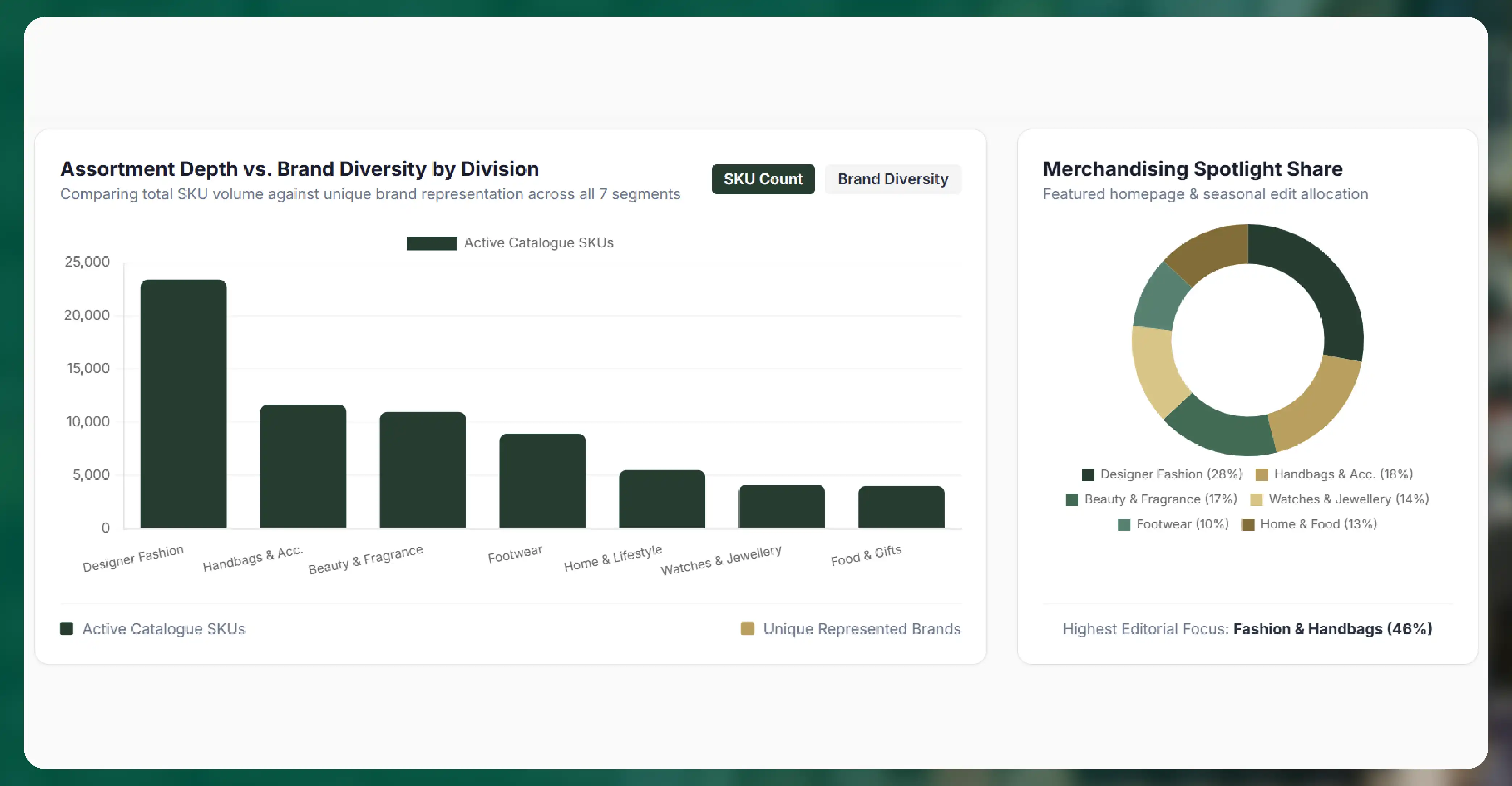
Product assortment intelligence extends beyond identifying individual products. It helps businesses understand the overall structure of a retailer's catalogue and how different brands contribute to its positioning.
Harrods' product categories offer opportunities to examine multiple luxury segments, including:
- Designer Fashion: Luxury clothing, dresses, outerwear, and designer collections.
- Handbags and Accessories: Premium handbags, wallets, belts, sunglasses, and fashion accessories.
- Footwear: Designer shoes, trainers, boots, heels, and seasonal footwear.
- Beauty and Fragrances: Skincare, makeup, perfumes, and premium beauty collections.
- Watches and Jewellery: Luxury timepieces, fine jewellery, and designer accessories.
- Home and Lifestyle: Furniture, decorative products, tableware, and luxury home accessories.
- Food and Gifts: Premium food products, confectionery, hampers, and gifting collections.
Analysing these categories helps businesses identify assortment concentration, understand brand representation, and discover product segments receiving greater merchandising attention.
It also enables luxury manufacturers to evaluate potential positioning opportunities and identify categories where their products could complement existing collections.
How to Scrape Luxury Ecommerce Sites for Competitive Intelligence?
Luxury retail websites contain extensive product information, but collecting it consistently requires a structured data extraction approach.
Businesses looking to scrape luxury ecommerce sites need a methodology that captures relevant product attributes while maintaining data accuracy and consistency.
A typical extraction process involves the following stages:
1. Website and Category Identification
Identify relevant Harrods product categories, brand pages, and individual product listings based on the business requirements.
2. Data Field Selection
Define the required attributes, including product names, SKUs, brands, prices, descriptions, images, and availability information.
3. Product Data Collection
Use suitable extraction techniques to gather accessible product information from relevant pages while respecting website terms, access restrictions, and applicable regulations.
4. Data Cleaning and Standardisation
Remove duplicate records, standardise product attributes, organise currencies, and structure category information into consistent fields.
5. Validation and Quality Checks
Review extracted records for missing values, inconsistent pricing formats, duplicate products, and incomplete product information.
6. Dataset Delivery
Export the processed information into CSV, Excel, JSON, or database-compatible formats according to business requirements.
This approach creates a reliable foundation for ongoing luxury retail analysis and competitive benchmarking.
Analysing UK Fashion Pricing and Apparel Trends
Fashion pricing changes according to brand positioning, product design, collection launches, materials, and consumer demand. Monitoring designer clothing and accessories provides valuable insights into how luxury brands compete within the UK market.
Businesses can use UK fashion pricing data to compare similar products across retailers and understand how premium fashion collections are priced.
For example, a retailer analysing designer coats could compare prices, materials, available sizes, colours, and brands. This information can reveal pricing gaps between competing labels and identify opportunities for differentiated product positioning.
Similarly, fashion and apparel data scraping can support detailed analysis of:
- Designer clothing prices across product categories.
- Seasonal collection launches and product availability.
- Size and colour variant distribution.
- Brand-level assortment expansion.
- Product descriptions, fabrics, and design specifications.
- Promotional pricing and markdown frequency.
Fashion manufacturers, online retailers, and market researchers can use these insights to understand category competition and develop more effective assortment strategies.
Benefits of Harrods Product Catalog Scraping for Different Businesses
Structured luxury product information serves multiple commercial purposes.
- Luxury Brands: Manufacturers can evaluate how their products and competing labels are positioned across premium retail environments.
- Online Retailers: E-commerce businesses can benchmark product pricing, identify assortment gaps, and improve their merchandising decisions.
- Market Research Companies: Analysts can study luxury retail trends, brand representation, and product category developments using structured datasets.
- Pricing Intelligence Providers: Data companies can develop comparative pricing solutions for premium retail clients.
- Distributors and Suppliers: Businesses can identify product categories and brands that offer potential distribution or partnership opportunities.
- Investment and Consulting Firms: Market analysts can use assortment and pricing information to understand competitive positioning and broader luxury retail developments.
The greatest value comes from transforming individual product listings into organised datasets that support repeatable analysis and business decision-making.
One-Time Product Catalog Snapshot vs Continuous Data Monitoring
Businesses do not always require continuous product extraction. Depending on their objectives, a one-time catalogue snapshot may provide sufficient information for a specific research or benchmarking project.
| Parameter | One-Time Snapshot | Continuous Monitoring |
|---|---|---|
| Data Collection | Collected during a defined period | Collected at scheduled intervals |
| Product Pricing | Captures displayed prices at extraction time | Identifies changes across collection periods |
| Availability | Records listed availability at extraction time | Tracks availability movements |
| Assortment | Provides a catalogue overview | Identifies additions and removals |
| Business Purpose | Market research and initial benchmarking | Ongoing competitive intelligence |
| Ideal Users | Consultants, researchers, and brands | Retailers, pricing teams, and analysts |
A one-time snapshot is particularly useful when businesses need a comprehensive view of Harrods' accessible product catalogue for a particular research period.
Continuous monitoring becomes more valuable when organisations need to understand price movements, product launches, and assortment changes over time.
The right approach depends on the frequency of analysis, business objectives, and available resources.
Challenges in Luxury Product Data Extraction
Collecting luxury retail information requires attention to website structure, product complexity, and data quality.
- Dynamic Website Elements: Some product information may load dynamically, requiring appropriate extraction methods to capture accessible content.
- Product Variations: A single product may have multiple sizes, colours, or configurations that need consistent identification.
- Pricing Differences: Original prices, promotional prices, and currency formats must be correctly distinguished.
- Duplicate Listings: Products appearing across multiple categories can create duplicate records if unique identifiers are not applied.
- Availability Changes: Product availability can change frequently, making the extraction timestamp important for accurate interpretation.
- Data Standardisation: Different brands use varying naming conventions, descriptions, and product specifications. Standardisation is necessary for meaningful comparisons.
Addressing these challenges through validation, structured extraction, and quality checks improves dataset usability.
Conclusion
Harrods product catalogue scraping offers businesses a practical way to understand the UK's luxury retail landscape through structured information about brands, products, pricing, and availability. A one-time catalogue snapshot can provide a valuable foundation for competitive benchmarking, assortment evaluation, and market research.
With reliable luxury assortment intelligence, businesses can identify category opportunities, compare premium brands, and understand how luxury retailers position their collections. Combining this information with beauty and cosmetics data scraping also enables a broader understanding of premium skincare, makeup, and fragrance markets.
For organisations seeking scalable market intelligence, ready-made ecommerce datasets can simplify access to structured product information and reduce the effort involved in building extraction workflows from scratch.
iWeb Data Scraping helps businesses transform accessible online retail information into organised, analysis-ready datasets. Whether the objective is a one-time Harrods catalogue snapshot or a broader luxury retail benchmarking project, structured data can support smarter pricing, assortment, and competitive decisions.
Frequently Asked Questions
Harrods product catalog scraping is the process of collecting accessible product information from Harrods' online store, including product names, brands, prices, descriptions, categories, images, and availability details.
Depending on website accessibility and project requirements, businesses can collect product titles, SKUs, brand names, original and current prices, descriptions, sizes, colours, product images, specifications, and availability indicators.
Yes. Structured product information can help businesses compare premium product prices, analyse displayed discounts, evaluate category-level pricing, and understand how different luxury brands position their collections.
Yes. A one-time extraction can capture an agreed selection of accessible product listings during a specific collection period. It is useful for market research, assortment analysis, and initial competitive benchmarking.
The extracted and processed data can be delivered in formats such as CSV, Excel, JSON, or database-compatible structures, depending on business requirements and the agreed project scope.